XRP ETF Hopes Take Big Hit Following Commissioner’s Vote

bitcoinistPublicado em 2025-08-08Última atualização em 2025-08-08

Resumo

Hopes for an XRP exchange-traded fund (ETF) took a sharp blow this week after U.S. Securities and Exchange Commission (SEC)...

Trusted Editorial content, reviewed by leading industry experts and seasoned editors. Ad Disclosure

Hopes for an XRP exchange-traded fund (ETF) took a sharp blow this week after U.S. Securities and Exchange Commission (SEC) Commissioner Caroline Crenshaw cast yet another dissenting vote against a crypto ETF proposal. The odds of XRP ETF approval, once riding high, have now fallen significantly as Crenshaw doubles down on her opposition and the entire crypto ETF market feels the pressure.

Crenshaw’s Vote Sends XRP ETF Hopes Crashing

The mood around the XRP ETF has shifted dramatically in recent days. After months of optimism, especially following the launch of the ProShares Ultra XRP ETF (UXRP) on NYSE Arca in July 2025, many believed this momentum would help Ripple secure approval for its own XRP ETF. 

However, Crenshaw’s vote quickly changed the tone. The commissioner has voted against every single crypto exchange-traded products proposal presented to the SEC so far, 13 in total. These proposals included not only XRP but also Bitcoin and Ethereum products, all of which passed by a 3-1 vote with Crenshaw as the only commissioner voting “no” each time.

XRP had met all the SEC’s updated listing requirements, including the key rule of maintaining at least six months of derivatives trading. However, Crenshaw’s continued opposition now raises fresh concerns about the future of crypto-related ETFs and whether her influence will slow down or even block future approvals. 

Polymarket data shows that approval odds for the XRP ETF dropped to 65% shortly after her vote, before climbing slightly to 71%. Just weeks ago, those odds were above 90%. 
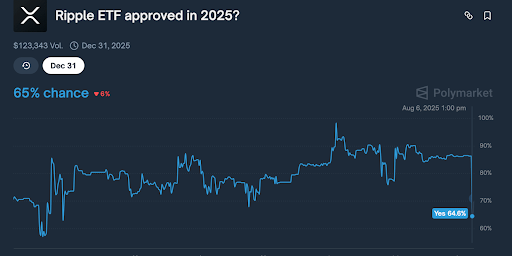
Ripple XRP ETF
Source: Polymarket

Crenshaw’s Criticism Extends Beyond Crypto ETFs

Crenshaw’s latest vote is part of a broader pattern that doesn’t stop at crypto ETFs, as she has also been highly critical of the SEC’s approach to other areas of crypto regulation, especially liquid staking and stablecoins.  According to her, the SEC’s advisory on liquid staking stacks too many assumptions and fails to provide clear direction for market participants.

The commissioners’ concerns about stablecoins are even sharper, strongly disagreeing with a recent SEC statement describing USD-pegged stablecoins as “digital dollars.” She warned that such marketing-style language could mislead investors about the actual risks. In her view, the SEC is failing to offer fact-based, legally sound rules for this fast-moving part of the market.

Her firm opposition has now become a roadblock for Ripple’s push to get an XRP ETF approved. While XRP may have checked all the technical boxes, Crenshaw’s vote shows that politics and personal viewpoints still play a significant role in the final decision. For now, Ripple and others in the crypto space await and watch, unsure how the SEC will move forward.

As the regulatory body continues to vote on new crypto products, Crenshaw’s stance adds uncertainty to XRP’s trajectory, as her vote as the only democrat currently serving on the SEC has become a key factor in shaping what comes next for crypto ETFs. 

XRP price chart from TradingView.com
Price surges after Ripple-SEC conclusion | Source: XRPUSDT on TradingView.com
Featured image from Unsplash, chart from TradingView.com
Editorial Process for bitcoinist is centered on delivering thoroughly researched, accurate, and unbiased content. We uphold strict sourcing standards, and each page undergoes diligent review by our team of top technology experts and seasoned editors. This process ensures the integrity, relevance, and value of our content for our readers.

My name is Sandra White. I am a graduate. I work for the news platforms NewsBTC and Bitcoinist, providing the latest updates on the world of cryptocurrencies. I love listening to music, learning new things, a family-oriented person, I dream of travelling around the world and getting a view of natures, the cultures, and how people live.

Leituras Relacionadas

The Most Secretive Winners of the AI Boom

"The Most Hidden AI Winners" An unlikely group of companies are emerging as major beneficiaries of the AI boom, not from designing chips, but from supplying critical materials and components essential for advanced semiconductor manufacturing. These 'hidden winners' are traditional manufacturers whose deep expertise in materials science has become indispensable. Japanese companies are leading this trend. Toto, globally known for bathroom fixtures, has seen its stock surge 145% over the past year, driven by its 40-year-old semiconductor ceramics business, which now contributes over half of its operating profit. Its electrostatic chucks are vital for advanced chip production and require years of expertise to manufacture. Similarly, Nittobo, a 128-year-old textile firm, controls 90% of the market for T-glass, a low-expansion glass fiber essential for AI chip substrates. Ajinomoto, the world's largest MSG producer, dominates the market (80-95% share) for ABF insulating film used in chip packaging. The core insight is that chasing "advanced" chips paradoxically increases reliance on traditional, high-precision material science where supply cannot be quickly replicated. These materials are now critical bottlenecks in the AI supply chain. This trend is mirrored in China's A股 market, framed by the theme of 'import substitution'. Companies like Zhongci Dianzi (electrostatic chucks) and Honghe Technology (ultra-thin electronic cloth) are making progress, but face the test of scaling production and matching Japanese rivals' quality. The key tension lies in the slow change of market perception. While profit structures rapidly shift towards high-margin tech components, these firms retain their traditional industry classifications, creating a valuation gap that is gradually closing as their roles in the AI ecosystem become undeniable.

链捕手Há 4m

The Most Secretive Winners of the AI Boom

链捕手Há 4m

DeFi Enters a Moment of Value Reassessment: Risks and Opportunities Behind the $70 Billion TVL

DeFi Enters a Moment of Value Reassessment: Peril and Opportunity Behind $70 Billion TVL On July 1st, the total value locked (TVL) across all DeFi protocols fell below $70 billion to approximately $69.358 billion, hitting its lowest point since February 2024. This decline signals a significant contraction in DeFi liquidity and marks a new adjustment phase for the industry, far from its 2021 peak of over $180 billion. The primary drivers of this TVL drop are a general decrease in crypto market risk appetite, which leads capital to exit volatile sectors like DeFi first, and the fading effectiveness of the high-yield liquidity incentive models that fueled the initial DeFi boom. Many protocols' high TVL figures were built on temporary subsidy-driven capital rather than genuine demand. Furthermore, capital is migrating to newer narratives like AI, RWA, and modular infrastructure. This cooldown exposes DeFi's growth bottlenecks: innovation has slowed with rampant protocol copycats, real yields have normalized to single digits, and poor user experience continues to hinder mass adoption beyond crypto-natives. However, the TVL decline does not spell the end for DeFi. The metric itself is limited, as it fluctuates with underlying asset prices. The industry is shifting from capital accumulation to efficiency competition, leveraging Layer 2 solutions and modular architecture to do more with less locked value. Crucially, DeFi is expanding into real-world financial use cases like the tokenization of real-world assets (RWA) and the growth of the stablecoin ecosystem, moving its value proposition from speculative token subsidies to real cash flows. In conclusion, while short-term pressures from liquidity contraction and user growth stagnation persist, the sector is undergoing a necessary value reassessment. DeFi is transitioning from a subsidy-driven, hype-based era toward a more mature, rational, and efficiency-focused phase, with long-term growth hinging on meeting real-world financial needs through RWA, stablecoins, and robust infrastructure.

marsbitHá 24m

DeFi Enters a Moment of Value Reassessment: Risks and Opportunities Behind the $70 Billion TVL

marsbitHá 24m

Trading

Spot
活动图片