Crypto Industry Split Between Congress’s Versions Of Market Structure Bill – Here’s Why

bitcoinistPublicado em 2025-08-08Última atualização em 2025-08-08

Resumo

As the US Congress continues to work on crypto-related legislation, some industry leaders disagree on which version of the market...

Trusted Editorial content, reviewed by leading industry experts and seasoned editors. Ad Disclosure

As the US Congress continues to work on crypto-related legislation, some industry leaders disagree on which version of the market structure bill will provide the much-needed clarity to the sector.

Paradigm Champions Senate’s Crypto Bill

On Thursday, several industry players discussed the differences between the US Congress’s versions of one of the landmark crypto bills. Following the passage of the GENIUS Act, the sector is now focused on the key market structure legislation, which is expected to offer the long-awaited clarity and protection for the industry.

Notably, the House of Representatives introduced and already passed the Digital Asset Market Clarity (CLARITY) Act of 2025, which seeks to establish a regulatory framework for crypto assets in the US, facilitate the growth of crypto projects, and protect customers.

In June, the US Senate started working on principles for its version of the market structure legislation, looking to draft a comprehensive set of rules. As reported by Bitcoinist, the Senate Banking Committee released a draft of its “framework of principles,” outlining six key principles for the upcoming crypto bill, which were allegedly “very well received” by the Decentralized Finance (DeFi) sector.

Today, Paradigm’s General Partner, Dan Robinson, shared the firm’s response to the Senate Banking Committee’s discussion draft on the bill, suggesting that this version is the best approach. Chainlink Labs, Galaxy Digital, Tribe Capital, Multicoin Capital, Electric Capital, and Ribbit Capital co-signed the letter.

Robinson argued that while both bills are an “improvement on the Howey-based regime (…), the Senate draft is significantly simpler, and avoids forcing decentralized tokens and protocols to fit themselves into an inflexible legislative framework.”

The lawyer explained that the Senate’s draft focuses on the concept of ancillary assets, which “distinguishes the typical crypto asset from securities due to its innate nature.” To the firms, this is the “cleanest test” that protects decentralized crypto assets while preventing traditional securities issuers from improperly exploiting this framework.

Paradigm’s VP of Regulatory Affairs added that if regulatory clarity involves replacing the current “inscrutable regime that no one can register under or operate in with another complex regime that requires a phalanx of lawyers & millions of dollars to comprehend, this exercise will have failed.”

Industry Players Divided Over Legislation

In an X post, journalist Eleanor Terret noted that most of the major crypto Venture Capital (VC) firms, except a16z crypto, “aligned on market structure and token classification for the first time.”

Nonetheless, a16z crypto’s Head of Policy and General Counsel, Miles Jennings, disagreed, stating “most major crypto hedge funds is more accurate. Most major crypto VCs supported CLARITY’s token maturity framework.”

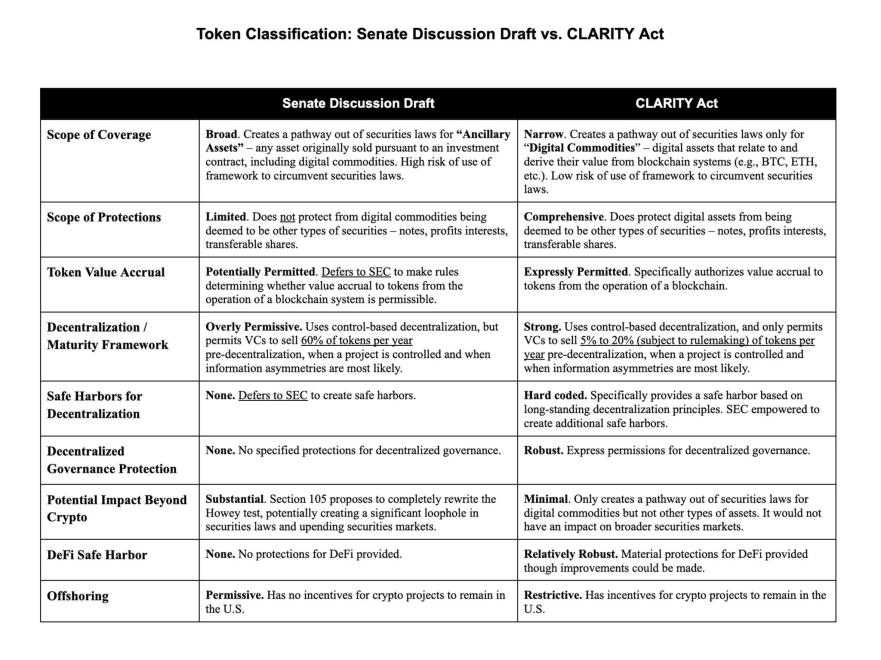
Jennings highlighted the Decentralization Research Center’s (DRC) summary chart comparing the Senate and House’s versions, arguing that “the undermining of CLARITY’s transfer restriction framework creates short-term incentives to circumvent decentralization and dump on retail. That’s not good for innovation.”
crypto

Difference between the Senate's discussion draft and the House's CLARITY Act. Source: The DRC on X

Earlier this week, the DCR also submitted its response to the Senate Banking Committee’s discussion draft, underscoring the importance of “building on the strong foundation established by the CLARITY Act.” The non-profit organization considers that while the Senate’s version is still evolving, the House’s “robust, control-based decentralization test” is the better approach.

Last month, the DCR and 50 other leading industry players sent a joint letter to Congress leaders supporting the CLARITY Act, the largest coalition of organizations in agreement on a particular test for decentralization, as the post noted.

Additionally, the non-profit affirmed that “sound market structure legislation must be grounded in control” and regulatory attention must focus on where it is warranted, while “preserving space for innovation and open systems.”

Similarly, attorney Gabriel Shapiro concurred that “the House approach is far superior.” To him, the Senate’s test is a “pure race to the bottom” with “stuff that makes no sense from a policy perspective.”

The fewer rights people have, the less regulated something is? it should be the opposite–if they have more rights, they are more protected under general contract law and there is less need for regulation. . . this is how you get pure memecoin mania forever, equity/token conflict of interest forever, etc. . .
crypto, Bitcoin, btc, btcusdt

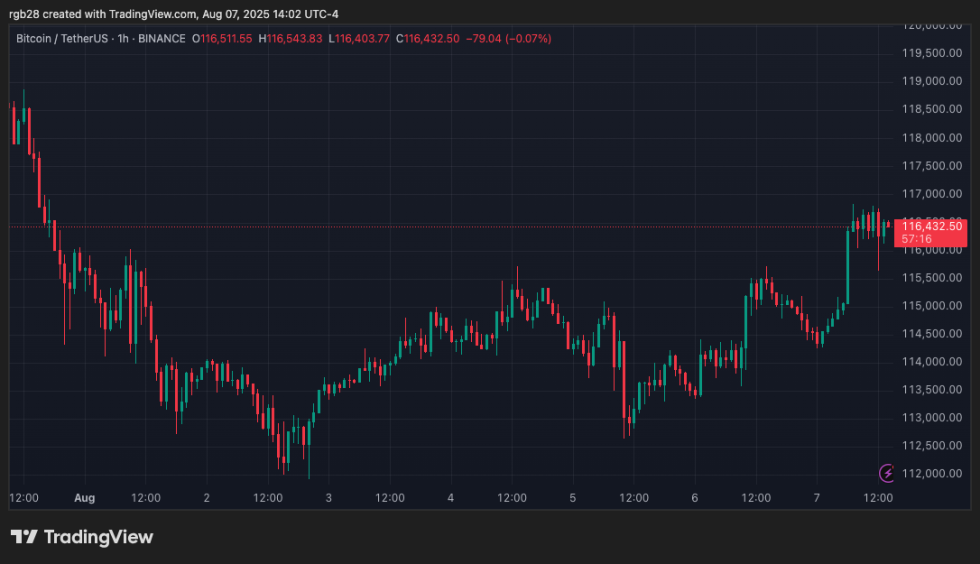
Bitcoin (BTC) traders at $116,432 in the one-week chart. Source: BTCUSDT on TradingView
Featured Image from Unsplash.com, Chart from TradingView.com
Editorial Process for bitcoinist is centered on delivering thoroughly researched, accurate, and unbiased content. We uphold strict sourcing standards, and each page undergoes diligent review by our team of top technology experts and seasoned editors. This process ensures the integrity, relevance, and value of our content for our readers.

Rubmar is a crypto enthusiast who likes learning and improving constantly. She enjoys reporting on the latest news and developments in the crypto industry. Rubmar also enjoys scrapbooking, crafting, simulation games, and watching football.

Leituras Relacionadas

Bitwise CIO: STRC Plunge is a Bottom Signal, Bull Market to Begin in Autumn

Matt Hougan, Chief Investment Officer at Bitwise, explains the recent Bitcoin price drop below $60,000 and its connection to the steep decline in MicroStrategy's STRC (Strategy's Perpetual Preferred Stock). STRC, designed as a high-yield, stable-price instrument, fell from its $100 target to $75 due to market fears over MicroStrategy's ability to sustain its dividend amid Bitcoin's price weakness. Hougan clarifies that while MicroStrategy's overall financial position remains strong, with significant Bitcoin holdings and cash, the core market anxiety centered on the optional nature of the dividend payments. In response, MicroStrategy announced a new operational framework: it will sell some Bitcoin as needed to fund dividends, will no longer actively defend the $100 share price through dividend hikes, and may repurchase STRC on the open market. This shift marks a change in MicroStrategy's role from a consistent, one-way buyer of Bitcoin to a more dynamic participant that may both buy and sell. According to Hougan, the STRC volatility is a classic late-cycle event, signaling the painful but necessary process of flushing out excessive leverage from the market. He draws parallels to the unwinding of the GBTC premium in the previous cycle. He identifies key potential bottoming signals: MSTR trading at a discount to its net asset value (NAV), extreme readings on the Crypto Fear & Greed Index, and persistently negative Bitcoin funding rates. Hougan concludes that while the exact timing of the market bottom is unpredictable, the current deleveraging phase suggests it is near. He expresses confidence that a new bull market will begin in the fall of this year, with the next major wave of buying expected to come from institutional investors like banks, asset managers, and pension funds.

Foresight NewsHá 17m

Bitwise CIO: STRC Plunge is a Bottom Signal, Bull Market to Begin in Autumn

Foresight NewsHá 17m

ENS Founder Seeks to 'Seize Power' from DAO

On June 29th, the ENS community entered the on-chain voting phase for a proposal to renew the ENS DAO Security Council's veto power for two more years. Shortly after voting began, ENS founder Nick Johnson used his substantial ENS holdings to cast over 3.55 million votes against the proposal, swinging the outcome despite initial strong support. The Security Council was established in July 2024 with a 4/8 multisig veto power to protect the DAO's treasury (valued over $350 million) from malicious proposals during a period of low voter participation. Its powers were limited to vetoing only harmful proposals, not normal ones. Nick Johnson's opposition stems from broader concerns about ENS DAO's governance. In late 2025, he and others expressed frustration that the DAO had become mired in political gamesmanship, with capable contributors leaving and leadership falling to less experienced or misaligned parties. This context set the stage for a major restructuring proposal by ENS COO Katherine Wu on June 19th, titled "Next Era of ENS DAO: Empowering the ENS Foundation." The controversial proposal aims to transfer daily operations, treasury management, and long-term strategy to a restructured ENS Foundation with a professional board, while the DAO would retain core protocol governance powers. Critics, including original ENS constitution author Brantly Millegan, argue this effectively transfers treasury control from token holders to ENS Labs (the core development team), undermining the DAO's original decentralized design. Nick's massive "no" vote on the Security Council renewal is seen as the first move in this power struggle. He explained his vote was due to concerns about insufficient checks on the Council's power and the potential for its veto to be used politically. In response, Katherine Wu submitted a revised proposal with higher execution thresholds (5/8 instead of 4/8) and stricter limits. The push for change comes as ENS's annual revenue has declined significantly, from over $10 million in 2023 to under $2 million in 2025, increasing pressure to manage the treasury more effectively. Nick Johnson now faces the challenge of proving that a more structured foundation can steer ENS better than the current DAO model.

Foresight NewsHá 47m

ENS Founder Seeks to 'Seize Power' from DAO

Foresight NewsHá 47m

Predicting World Cup Knockout Matches: Why Are Different AI Models So Far Apart?

AI performance in predicting the 2026 FIFA World Cup knockout matches varied significantly, according to an analysis of models including ChatGPT, Grok, DeepSeek, Gemini, and Claude. The standout predictions came from DeepSeek and Gemini for the Netherlands vs. Morocco match. Gemini precisely forecasted a 1-1 draw and a penalty shootout win for Morocco, while DeepSeek correctly identified the high probability of a draw and Morocco's potential to advance via a defensive and counter-attacking strategy. Grok and Tongyi Qianwen (千问) demonstrated strength in predicting accurate scores for matches with clearer favorites. They correctly called the narrow 1-0 win for Canada over South Africa and Brazil's 2-1 victory over Japan, as well as Norway's 2-1 win over Ivory Coast. ChatGPT and Claude excelled more in match process analysis than in predicting exact scores or upsets. They frequently identified potential challenges for favorites, such as Japan's pressing against Brazil or DR Congo's defensive tactics against England, even when predicting the favorite's ultimate victory. A notable failure was the unanimous misjudgment of Germany vs. Paraguay. All models incorrectly favored Germany, underestimating Paraguay's ability to force a penalty shootout and cause an upset. In summary, Gemini and DeepSeek showed the most insight for high-stakes, unpredictable matches. Grok and Qianwen were reliable "score predictors" for less volatile games. ChatGPT and Claude were strong "analytical models," adept at outlining match dynamics but often hesitant to predict upsets.

Odaily星球日报Há 1h

Predicting World Cup Knockout Matches: Why Are Different AI Models So Far Apart?

Odaily星球日报Há 1h

Trading

Spot
活动图片