Shiba Inu Open Interest Crashes From $328 Million July Peak To $190 Million, What’s Going On?

bitcoinistPublicado em 2025-08-05Última atualização em 2025-08-05

Resumo

Shiba Inu’s Open Interest (OI) has crashed from its July peak, sparking a bearish sentiment for the foremost meme coin....

Trusted Editorial content, reviewed by leading industry experts and seasoned editors. Ad Disclosure

Shiba Inu’s Open Interest (OI) has crashed from its July peak, sparking a bearish sentiment for the foremost meme coin. This development has coincided with the recent crypto market crash, as investors choose to wait on the sidelines amid market uncertainty. 

Shiba Inu’s Open Interest Crashes To $190 Million

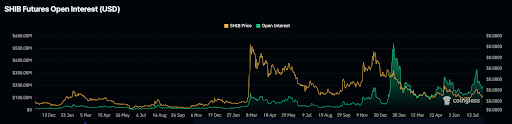
Coinglass data shows that Shiba Inu’s Open Interest is currently at $190 million, down significantly from its July peak of $328 million recorded on the 22nd of last month. Since then, the OI has declined daily, indicating a drop in interest in the meme coin among traders. Open Interest refers to the number of open positions on an asset at a particular time.

A plausible reason for the drop in Shiba Inu’s Open Interest is the crypto market correction, which has occurred over the last two weeks. SHIB has dropped from its local high of around $0.000016 as a result. Meanwhile, the meme coin is down over 8% in the last seven days. Notably, Shiba Inu had hit this local high on July 21, which highlights the correlation between price performance and this derivatives metric. 
Shiba Inu
Source: Chart from Coinglass

One reason for this market correction is the Trump tariffs, which are set to take effect from August 7. The U.S. president yesterday threatened to substantially raise tariffs on India from the current proposed 25%. This is a development that could further impact the markets, including crypto assets like Shiba Inu. The tariffs have a direct impact on the global economy and could negatively impact the flow of liquidity into these assets if they lead to inflation. 

Furthermore, the U.S. economy already looks to be in a fragile state, thanks to the July job report, which came in lower than expectations. A weak labor market could have several ripple effects, including a recession or stagflation, which is bearish for Shiba Inu and other assets. 

Some Positives For SHIB

The Shiba Inu long/short ratio is currently 1.09, which indicates that most traders are still bullish on the meme coin. This could help spark a market recovery, especially as the broader crypto market picks up. SHIB, alongside other crypto prices, has shown a resurgence on July 4, as the total crypto market surged as much as 2%. 

Thanks to this rebound, Shiba Inu’s derivatives trading volume surged as much as 20% to $161 million. Meanwhile, crypto analyst Javon Marks has again doubled down on his prediction that the foremost meme coin can record a 500% rally to reach $0.000081. This will bring SHIB close to its current all-time high (ATH) of $0.00008845. 

At the time of writing, the Shiba Inu price is trading at around $0.00001233, up in the last 24 hours, according to data from CoinMarketCap.

Shiba Inu
SHIB trading at $0.000012 on the 1D chart | Source: SHIBUSDT on Tradingview.com
Featured image from Getty Images, chart from Tradingview.com
Editorial Process for bitcoinist is centered on delivering thoroughly researched, accurate, and unbiased content. We uphold strict sourcing standards, and each page undergoes diligent review by our team of top technology experts and seasoned editors. This process ensures the integrity, relevance, and value of our content for our readers.

Scott Matherson is a leading crypto writer at Bitcoinist, who possesses a sharp analytical mind and a deep understanding of the digital currency landscape. Scott has earned a reputation for delivering thought-provoking and well-researched articles that resonate with both newcomers and seasoned crypto enthusiasts. Outside of his writing, Scott is passionate about promoting crypto literacy and often works to educate the public on the potential of blockchain.

Leituras Relacionadas

Zuckerberg Gave the AI Bull Market a Fright

Mark Zuckerberg and Meta inadvertently sent shockwaves through the AI stock market. News that Meta plans to sell its "excess" AI computing power to external clients triggered a trillion-dollar sell-off in AI infrastructure stocks like Nvidia and AMD, while Meta's stock rose. This seemingly simple business move—renting out idle resources—shook a core assumption underpinning the two-year AI bull market: the belief that computing power ("compute") would be perpetually scarce. This scarcity narrative had fueled valuations across the entire supply chain, from GPUs to power suppliers. Meta's motivations are layered: improving hardware utilization during non-peak R&D periods, executing a strategic pivot, and redefining AI infrastructure. Unlike rivals selling APIs, Meta's open-source approach with Llama appears aimed at building an ecosystem where it ultimately profits from the underlying compute, similar to how AWS transformed from Amazon's internal capacity. Meta is essentially offering an integrated "AI factory" service, not just raw GPU rental. The market's fear wasn't Meta selling a few chips, but the signal that GPU supply might become more shareable and efficient, transitioning the industry from a Capex-driven "hoarding" model to an Opex-driven "utilization" model. This could fundamentally reset valuation logic from scarcity to efficiency. While the sell-off reversed somewhat as investors realized this shift is long-term, the direction is set. The move marks a potential inflection point: the era of easy valuation gains from simply buying GPUs may be ending, giving way to an era where operational efficiency and return on AI assets take center stage.

marsbitHá 6m

Zuckerberg Gave the AI Bull Market a Fright

marsbitHá 6m

Arcus Chooses "Stepfather" Robinhood Chain, "Biological Father" dYdX Awkwardly Attempts to Salvage the Situation

Robinhood officially launched its own Layer 2 network, Robinhood Chain. In response, many major DeFi protocols like Uniswap and Chainlink announced integration. A key point of discussion was Arcus, a new decentralized exchange (DEX) developed by the dYdX team, which chose to launch on Robinhood Chain instead of the native dYdX Chain. Arcus offers 24/7, zero-fee trading of 95 tokenized stocks and perpetual contracts. This move sparked community concerns about dYdX Chain potentially being sidelined, causing DYDX token's price to drop over 12%. Critics questioned if dYdX Labs' focus is shifting to Arcus and how DYDX token holders would benefit from Arcus's future growth, especially as its founder mentioned a future Arcus token would allocate a portion to the dYdX community. dYdX founder Antonio Juliano clarified that dYdX Chain will continue operating, but acknowledged its deep decentralization involved trade-offs in performance and user experience. He stated Arcus is a separate product led by a new CEO, responding to market demands for faster, simpler platforms. The dYdX Foundation also confirmed DYDX's role remains unchanged for dYdX Chain governance and staking, with no plans for token migration. However, the core uncertainty remains: if Arcus succeeds, how will that value flow back to dYdX Chain and its DYDX token holders?

Odaily星球日报Há 1h

Arcus Chooses "Stepfather" Robinhood Chain, "Biological Father" dYdX Awkwardly Attempts to Salvage the Situation

Odaily星球日报Há 1h

Trading

Spot
活动图片