Основатель Grayscale Барри Силберт возвращается на должность председателя совета директоров

cryptonews.ruPublicado em 2025-08-14Última atualização em 2025-08-14

Grayscale Investments расширила свою руководящую команду и совет директоров в рамках своего «следующего этапа роста», назначив четырех ветеранов финансовой отрасли на ключевые руководящие должности и повторно назначив основателя Барри Силберта председателем совета директоров.

В расширенную команду руководителей вошли Диана Чжан на посту главного операционного директора, Рамона Бостон на посту директора по маркетингу, Андреа Уильямс на посту директора по коммуникациям и Максвелл Розенталь на посту директора по персоналу.

Недавно назначенные руководители пришли из традиционных финансовых компаний, таких как Bridgewater, Apollo, Goldman Sachs и Citadel.

Основатель Grayscale возвращается в качестве председателя совета директоров

Grayscale, основанная в 2013 году Барри Силбертом, является одной из старейших компаний, занимающихся инвестициями в криптовалюту. Она запустила первый публичный инвестиционный инструмент на основе биткоина в США — Grayscale Bitcoin Trust (GBTC), акции которого начали торговаться на внебиржевых рынках в 2015 году.

Компания управляет активами на сумму более 35 миллиардов долларов в четырех криптобиржевых фондах (ETF).

Возвращение Силберта на пост председателя совета директоров произошло в тот момент, когда Grayscale начала более агрессивно конкурировать с традиционными финансовыми гигантами в гонке криптовалютных ETF.

Хотя Grayscale запустила первый в США инструмент инвестирования в биткоины, сейчас она сталкивается с жесткой конкуренцией со стороны новых участников, таких как BlackRock и Fidelity, чьи спотовые биткоин-ETF с более низкими комиссиями быстро завоевали долю рынка.

«Когда я основал Grayscale в 2013 году, мы увидели огромную возможность стать пионером новой модели доступа к цифровым активам и инвестирования в них, — сказал Силберт. — Сегодня я по-прежнему глубоко убежден в долгосрочном позиционировании компании и в команде руководителей, ведущих ее вперед».

В настоящее время спотовый Bitcoin ETF Grayscale (GBTC) приносит больше дохода, чем любой другой Bitcoin ETF, зарабатывая $268,5 млн в год, в основном благодаря своей комиссии в размере 1,5%, что в шесть раз выше, чем у конкурентов, таких как IBIT BlackRock или FBTC Fidelity.
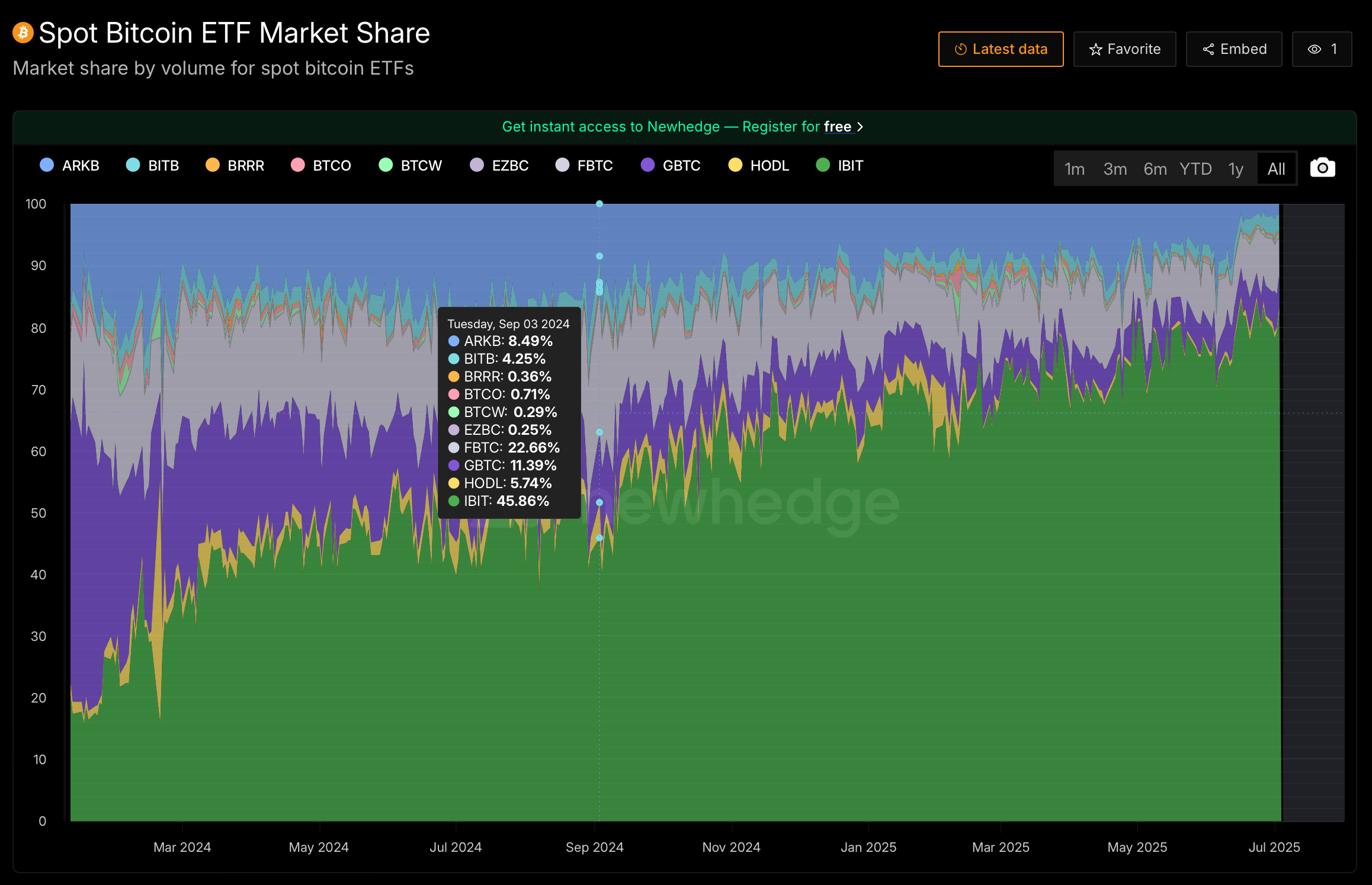
Источник: Newhedge.io.

Хотя его доля на рынке спотовых биткоин-ETF в США упала примерно до 5%, более высокие комиссии означают, что он по-прежнему опережает конкурентов по доходам, даже несмотря на отток средств в размере более 21 млрд долларов.

Криптовалютные компании обращаются к специалистам с Уолл-стрит

Несколько криптокомпаний привлекают ветеранов традиционной финансовой сферы в рамках подготовки к более широкому внедрению, чему способствует волна прокриптовалютного законодательства и растущая прозрачность регулирования в США.

В 2024 году Kraken укрепил свое руководство, наняв специалистов из традиционной финансовой сферы. Жиль БьянРоза, бывший директор по продуктам в необанке N26, стал директором по операциям и продуктам. Маркус Хьюз, имеющий опыт работы в Morgan Stanley и Coinbase, был назначен руководителем глобальной стратегии регулирования.

Galaxy Digital также привлекла специалистов из традиционной финансовой сферы для поддержки своего институционального расширения. В конце 2024 года компания наняла на должность финансового директора Тони Пакетта, бывшего финансового директора хедж-фонда Point72 и бывшего руководителя JPMorgan.

В начале 2025 года компания также получила лицензию на торговлю деривативами в Великобритании и расширила свое присутствие в Лондоне, что соответствует ее стратегии по обслуживанию глобальных институциональных клиентов.

Leituras Relacionadas

Claude's Watermark Has Been Cracked, Gaining 11k Stars, But Installation Is Refused

The article discusses the controversy surrounding Anthropic's implementation of a hidden watermark in all text generated by its AI, Claude. This policy, based on Google DeepMind's SynthID-Text technique, embeds a statistical signature by making inconsequential word choices. The watermark applies globally, even to human-written text lightly edited by Claude, sparking user backlash over issues of ownership and the creation of an "AI content second-class citizen" status. In response, an open-source tool called "watermarks-remover" (originally "remove-claude-marks") was released on GitHub, quickly gaining 11k stars. It works on three levels: removing invisible Unicode characters, using an agent to rewrite text and break statistical patterns, and stripping metadata from various file formats. Notably, Claude itself refused to install this removal tool as an Agent Skill, a task ultimately completed by another AI model, GLM 5.2. The article points out the irony that the removal code may have been written by Claude. The piece frames this as an ongoing battle between watermarking for traceability against misinformation and the desire for unmarked, owned content from paying users. It questions the practicality of mandatory technical markings when AI-generated text becomes indistinguishable from human writing, suggesting the open-source community's rapid development of countermeasures will continually outpace regulatory efforts.

marsbitHá 6m

Claude's Watermark Has Been Cracked, Gaining 11k Stars, But Installation Is Refused

marsbitHá 6m

SafePal Leaks Data of Nearly 40,000 Hardware Wallet Buyers: Private Keys Intact, Yet Danger Moves Closer to the Physical

Hardware wallet manufacturer SafePal has disclosed a data breach affecting approximately 39,798 customers who placed orders between March 2025 and April 2026. The leak exposed personal information including names, email addresses, phone numbers, physical delivery addresses, and purchase records. The company confirmed that private keys, recovery phrases, wallet passwords, and financial details were not compromised, as the cold storage systems operate in an isolated environment separate from the e-commerce servers. However, the breach poses significant risks beyond digital theft. Attackers now possess a high-value list of confirmed hardware wallet owners, effectively marking them as likely holders of substantial cryptocurrency. This enables highly targeted social engineering attacks, such as phishing emails referencing real order details, fake hardware deliveries, or phone scams impersonating SafePal support. The company has already identified and taken down over 30 related phishing sites. A critical aspect of the incident is the delayed disclosure timeline. SafePal acknowledged receiving initial user reports of phishing attempts in May but treated them as isolated. A full investigation began in July, with a public announcement not made until August, leaving users exposed for approximately three months. Furthermore, a configuration error prevented a data-purge routine from deleting old order information as intended, potentially increasing the scope of the leaked data. The incident highlights a structural paradox in the hardware wallet industry: while the devices are designed to secure private keys offline, the necessary e-commerce process collects sensitive personal data that, if leaked, makes the user a target. This mirrors a similar breach suffered by Ledger in 2020. Affected users are advised to be extremely vigilant. They should verify if they are impacted via SafePal's dedicated page, treat all unsolicited communications (emails, calls, physical mail) referencing SafePal as suspicious, and never share recovery phrases. Users who may have entered sensitive information on a phishing site must create a new wallet immediately. The breach underscores that in cryptocurrency security, the most vulnerable link is often the human user, not the cryptographic technology.

marsbitHá 27m

SafePal Leaks Data of Nearly 40,000 Hardware Wallet Buyers: Private Keys Intact, Yet Danger Moves Closer to the Physical

marsbitHá 27m

30 Years After Being Crushed by AI, People Have Fallen Back in Love with Chess

On May 11, 1997, IBM's "Deep Blue" defeated chess champion Garry Kasparov, marking the first time a machine triumphed in a top-level intellectual game. The narrative of human defeat by AI seemed cemented when AlphaGo beat Lee Sedol in Go in 2016, a game once considered AI's final frontier. Yet, nearly 30 years after AI's dominance began, chess is experiencing unprecedented popularity. Chess.com boasts over 250 million registered users and 10 million daily active players. Its CEO, Erik Allebest, attributes this resurgence to several waves: the pandemic, the Netflix series *The Queen's Gambit*, and viral AI chess bots like "Mittens" on social media. Crucially, each surge left a permanently higher user base. The key insight is that AI liberated the game. When machines unequivocally became the best, the pressure to "win" as the ultimate human was removed. Chess returned to its core: the intrinsic joy of play—the thrill of a tactical combo, the tension of a time scramble, the curiosity of post-game analysis. AI, now serving as an always-available coach and anti-cheat tool, became infrastructure that enhanced rather than killed the experience. In contrast, Go, deeply rooted in East Asian elite culture and often pursued for mastery and status, suffered a "collapse of meaning" at the professional level after AlphaGo. Players began mimicking AI moves, erasing distinctive styles and narrative. While some Go players gained fame as online personalities, it didn't translate to widespread engagement with the game itself. The divergence highlights a fundamental question in the age of AI: is the motivation for an activity about *winning* or *playing*? Activities where the process itself is the reward, like chess, can thrive when the pressure of being the best is gone. AI may rightly take over tasks done purely for outcome, but it cannot replace the human experience of simply enjoying the game.

marsbitHá 42m

30 Years After Being Crushed by AI, People Have Fallen Back in Love with Chess

marsbitHá 42m

Exiting Top Ten Shareholders of Kweichow Moutai, 'Long-term Capital' Portfolio Adjustments Revealed: National Social Security Fund Enters 12 New Stocks, Invests in Hard Tech Mthreads

With the ongoing release of semi-annual reports, the second-quarter investment moves of long-term institutional investors like the National Social Security Fund (NSSF) and insurance capital are becoming clear. Central Huijin Asset Management and China Securities Finance Corp., often referred to as the "national team," are no longer among the top ten shareholders of Kweichow Moutai. Data shows that as of August 14th, the NSSF held positions in 33 A-share companies, with a total portfolio value exceeding 11 billion yuan. It added 12 new stocks in Q2, spanning sectors like chemicals, food & beverage, and semiconductors. The NSSF maintains its stable investment style, favoring companies with solid performance and attractive valuations. Apart from exiting Moutai, Huijin and China Securities Finance also left the top ten shareholder lists of companies like Ping An Bank and Dahua Technology. Insurance capital heavily invested in 41 companies in Q2, with a total holding value over 26 billion yuan. They showed a continued preference for cyclical sectors like non-ferrous metals and chemicals, as well as high-dividend-yield stocks. Analysts note that these long-term funds act as market stabilizers and investment bellwethers. Their presence is reshaping the market ecology, steering focus towards fundamental corporate value and away from speculative trading. A notable move was the NSSF's new investment in Moore Threads, a loss-making but leading domestic GPU design company listed on the STAR Market, indicating interest in hard technology sectors. Looking ahead, analysts expect long-term capital to continue a dual-strategy: maintaining a foundation in high-dividend-value stocks while gradually increasing exposure to growth areas aligned with industrial upgrading, such as advanced manufacturing and tech self-sufficiency. The market's recovery is seen as gaining a firmer footing after recent adjustments.

marsbitHá 51m

Exiting Top Ten Shareholders of Kweichow Moutai, 'Long-term Capital' Portfolio Adjustments Revealed: National Social Security Fund Enters 12 New Stocks, Invests in Hard Tech Mthreads

marsbitHá 51m

Data of 54,000 wallet users leaked, Clarity odds just 10%: Hodler’s Digest, Aug. 16

Galaxy Digital has slashed the odds of the CLARITY Act passing in 2026 from 75% to just 10%, citing limited Senate session days. If it fails, the SEC and CFTC plan to issue their own crypto rules, though an SEC meeting was abruptly cancelled. High-profile meetings at the White House are planned to discuss the bill. Amid growing hack fears, crypto companies are urging AI labs to grant developers early access to advanced AI models for cybersecurity, following a $116M Coldcard wallet theft. Data breaches at Trezor and SafePal have exposed over 54,000 users' personal information. The CFTC is clashing with states over regulating prediction markets like Kalshi, ordering it to ignore a New York restraining order to maintain a national market, while a Washington state judge ruled against it. The Ethereum Foundation is revising its post-quantum plan, moving away from the Poseidon hash function, and scoping its next major upgrade, Hegotá, for next year. Tether received its first full clean audit opinion from KPMG, showing reserves exceeding liabilities by $6.814 billion. Marketwise, major cryptos saw weekly declines. Predictions include a possible Bitcoin bottom in October, while analysts dispute the feasibility of BTC reaching $1M by 2030. Glassnode notes Bitcoin is in its longest capitulation phase since FTX's collapse. Three men were charged for an alleged Bitcoin kidnapping plot in Missouri.

cointelegraphHá 1h

Data of 54,000 wallet users leaked, Clarity odds just 10%: Hodler’s Digest, Aug. 16

cointelegraphHá 1h

Trading

Spot
活动图片