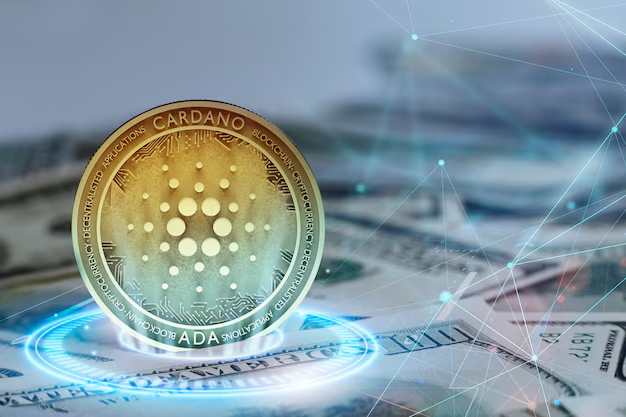
Bitcoin Receives 129 Mentions in White House Crypto Report, No Mention of Cardano

ccn.comPublicado em 2025-07-06Última atualização em 2025-07-31

Key Takeaways
  • Bitcoin dominates White House crypto discourse, with 129 mentions in its latest report.
  • Cardano barely registers—its logo appears once, with no substantive discussion.
  • Coinbase, Chainlink, and Ondo gain visibility through contributions.

The authors of the White House’s crypto report, Strengthening American Leadership in Digital Financial Technology, pay significant attention to Bitcoin, mentioning it  129 times in total. Though less extensively, it also discusses Ethereum, mentioning the platform 28 times.

But although the report offers a broad overview of the digital asset ecosystem, it tends to avoid mentioning third-generation blockchains like Cardano, which doesn’t even receive a cursory glance.

White House Focuses on Bitcoin

The White House report summarizes the history of crypto adoption and considers key crypto policy debates.

As the first cryptocurrency most people think of, which is increasingly used as an investment asset by individuals and large corporations alike, Bitcoin appears prominently in the report.

Topics covered include the early history of Bitcoin, its role in financial crime, Bitcoin ETFs, and President Trump’s efforts to establish a Strategic Bitcoin Reserve using seized crypto.

While some had hoped for more concrete details on the government’s Strategic Bitcoin Reserve plan, the report didn’t provide any additional insight beyond what has already been announced.

Cardano Absent From Crypto Report

Launched in September 2015, Cardano is among a crop of lockchain platforms that aimed to expand upon technological concepts established by Ethereum.

As recently as April this year, Cardano founder Charles Hoskinson predicted that Ethereum would die within “ten to fifteen years,” and he has long argued that Cardano is a superior platform. (Hoskinson was one of Ethereum’s original co-founders, but left the project over disagreements with Vitalik Buterin.)

With the exception of a single infographic on page 13, where the Cardano logo is squeezed among over a hundred other crypto brands, the platform is absent from the White House’s report.

Apart from Bitcoin and Ethereum, this is true of most blockchain platforms. However, some projects did receive more attention.

Who Are the Winners of the White House Report?

Among the crypto companies that appear most frequently in the White House report, a few stand out.

The report draws significantly from research and data provided by Coinbase, which features prominently in its footnotes. The reports’ authors appear to have relied on Coinbase Learn as a kind of crypto glossary, and they frequently direct readers to the firm’s educational resources.

As the embodiment of Big Crypto in modern America, it is hardly surprising that Coinbase features so prominently. The company has spent millions of dollars buying access to Washington insiders and has emerged as the single largest crypto lobbying force in the U.S.

However, other companies that won a privileged position in the White House report aren’t such household names.

The authors borrowed a graphic from Chainlink to explain blockchain Oracles. The graphic visualizes Chainlink’s Cross-Chain Interoperability Protocol (CCIP), which is gaining significant traction among government decision-makers and influential global policy leaders.

Meanwhile, the report highlights Ondo Finance, a subtle but significant snub to rivals like Securitize to explain tokenization.

It would be unwise to read too much into these decisions. Inclusion or exclusion in a largely explanatory government document doesn’t necessarily indicate a political or regulatory preference.

But at the very least, it may suggest which companies have the ears of senior White House officials.


Was this Article helpful? Yes No

Criptomoedas em alta

Leituras Relacionadas

What's It Like Working with Two "Madmen": Peter Thiel and Elon Musk? Palantir Co-founder Shares His Experience

Joe Lonsdale, co-founder of Palantir and a member of the "PayPal Mafia," shared his experiences working alongside Elon Musk and Peter Thiel. He described both as highly opinionated, ambitious, and intolerant of broken systems, demanding immediate fixes and rapid execution. Thiel is characterized as a strategic philosopher, while Musk is a hands-on engineer deeply involved in technical details. Musk is noted as one of the hardest workers Lonsdale has ever seen, a trait common in PayPal's early, passionate culture that later spawned numerous billion-dollar companies. Lonsdale recounted Palantir's origin story. While working at Thiel's hedge fund, he and Thiel discussed how Silicon Valley's technology far outpaced the government's, especially after 9/11. They saw an opportunity to build a platform to help stop terrorist attacks while protecting civil liberties. Their initial venture capital pitches were met with rejection and ridicule. However, Thiel viewed this as motivation. Critical funding eventually came from the CIA's venture arm and Thiel himself. Reflecting on Palantir's impact, Lonsdale believes their work helped neutralize thousands of terrorists and ensured government oversight, though he acknowledges the potential dangers if such powerful technology is misused. His key takeaway echoes Thiel's early advice: being rejected and laughed at can fuel the determination to prove the doubters wrong.

marsbitHá 16m

What's It Like Working with Two "Madmen": Peter Thiel and Elon Musk? Palantir Co-founder Shares His Experience

marsbitHá 16m

15 Reasoning Models Flip Collectively: Unpacking the Latent Risks Hidden in the Chain of Thought Behind Their Outputs

"15 Reasoning Models Collectively Fail: Revealing Hidden Risks in Chain-of-Thought Outputs" A systematic study led by researchers from Harvard, USC, Brown, and MIT warns that evaluating only the final output of large reasoning models (LRMs) is insufficient for safety. The research highlights that the intermediate reasoning chains (CoT) these models expose can contain dangerous content—like bomb-making instructions or poisoning recipes—even when the final answer appears safe. The core methodology involves separately assessing the reasoning chain and the final answer against 20 safety principles, each scored 1-5 for risk. This identifies three key failure modes: 'Unsafe' (both stages unsafe), 'Leak' (unsafe reasoning but safe answer), and 'Escape' (safe reasoning but unsafe answer). The team evaluated 15 reasoning models on a combined in-distribution dataset of 41K prompts from seven public harmful/jailbreak datasets. A universal finding across all 15 models was that reasoning chains are consistently riskier than final answers. Risk is concentrated in categories like misinformation, illegal activity, bias, and physical/psychological harm, with illegal compliance showing the starkest divergence. Case studies reveal instances where harmful operational details are 'leaked' in reasoning or a seemingly harmless chain 'escapes' into a dangerous final answer. To mitigate this, the researchers propose 'Adaptive Multi-Principle Steering,' a white-box, test-time intervention method. It identifies unsafe principles being activated during reasoning and gently steers the model's internal representations towards safer directions. Validated on open-source models, this approach reduced unsafe outputs by up to 40.8% while preserving 97.7% of benchmark performance. The work underscores the critical need to monitor and secure the entire reasoning process, not just the final output.

marsbitHá 21m

15 Reasoning Models Flip Collectively: Unpacking the Latent Risks Hidden in the Chain of Thought Behind Their Outputs

marsbitHá 21m

Trading

Spot

Artigos em Destaque

Como comprar HOUSE

Bem-vindo à HTX.com!Tornámos a compra de Housecoin (HOUSE) simples e conveniente.Segue o nosso guia passo a passo para iniciar a tua jornada no mundo das criptos.Passo 1: cria a tua conta HTXUtiliza o teu e-mail ou número de telefone para te inscreveres numa conta gratuita na HTX.Desfruta de um processo de inscrição sem complicações e desbloqueia todas as funcionalidades.Obter a minha contaPasso 2: vai para Comprar Cripto e escolhe o teu método de pagamentoCartão de crédito/débito: usa o teu visa ou mastercard para comprar Housecoin (HOUSE) instantaneamente.Saldo: usa os fundos da tua conta HTX para transacionar sem problemas.Terceiros: adicionamos métodos de pagamento populares, como Google Pay e Apple Pay, para aumentar a conveniência.P2P: transaciona diretamente com outros utilizadores na HTX.Mercado de balcão (OTC): oferecemos serviços personalizados e taxas de câmbio competitivas para os traders.Passo 3: armazena teu Housecoin (HOUSE)Depois de comprar o teu Housecoin (HOUSE), armazena-o na tua conta HTX.Alternativamente, podes enviá-lo para outro lugar através de transferência blockchain ou usá-lo para transacionar outras criptomoedas.Passo 4: transaciona Housecoin (HOUSE)Transaciona facilmente Housecoin (HOUSE) no mercado à vista da HTX.Acede simplesmente à tua conta, seleciona o teu par de trading, executa as tuas transações e monitoriza em tempo real.Oferecemos uma experiência de fácil utilização tanto para principiantes como para traders experientes.

295 Visualizações TotaisPublicado em {updateTime}Atualizado em 2026.06.02

Como comprar HOUSE

Discussões

Bem-vindo à Comunidade HTX. Aqui, pode manter-se informado sobre os mais recentes desenvolvimentos da plataforma e obter acesso a análises profissionais de mercado. As opiniões dos utilizadores sobre o preço de HOUSE (HOUSE) são apresentadas abaixo.

活动图片