半年战绩数亿:特朗普家族成“加密总统”最大赢家

比推Publicado em 2025-07-22Última atualização em 2025-07-22

自2025年1月20日唐纳德·特朗普(Donald Trump)二主白宫以来,曾以房地产和传统媒体巨头示人的川普家族,通过一系列大胆的数字资产投资,巧妙地将其政治品牌与新兴的加密经济深度融合,不仅刷新了自身的财富版图,也为政治人物如何利用数字资产积累财富和影响力提供了新的样本。

以下为这半年以来,特朗普与加密行业相关的关键事件梳理:
TRUMPH1.jpg

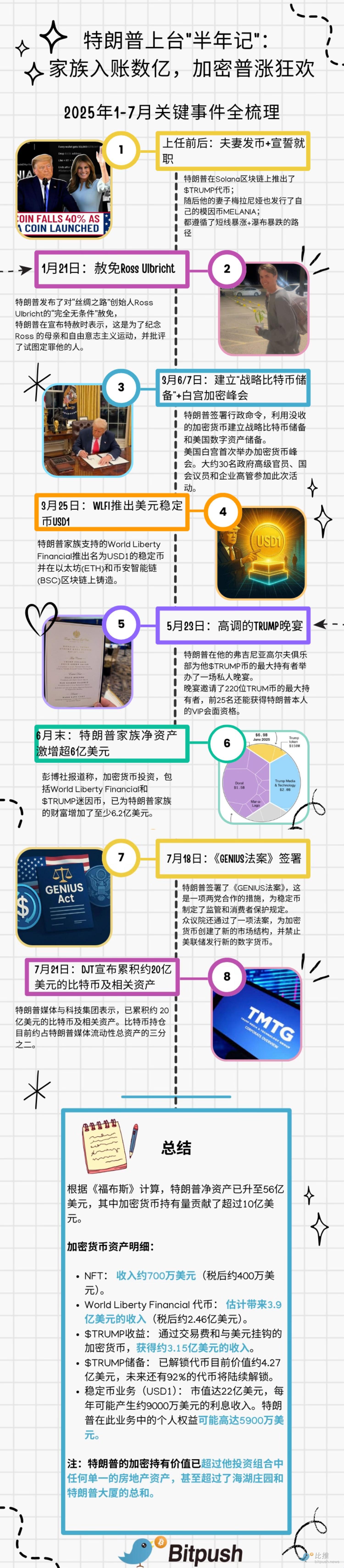
川普家族在加密领域的布局,自2025年1月上任后便呈现出清晰的时间线和多元化的投资组合:

  • 1月20日,就任前后meme币的诞生: 总统夫妇率先在Solana区块链上推出了TRUMP和MELANIA代币。这些代币不仅是政治支持的象征,更成为其家族数字资产布局的开端。

  • 1月21日,对Ross Ulbricht的赦免: 这一举动被视为川普政府向加密货币社群释放积极信号,尤其受到加密自由意志主义运动的欢迎。

  • 3月6日/7日,战略布局与行业对话: 川普政府通过行政命令设立国家战略比特币储备,并举办白宫加密峰会,邀请行业领袖和政策制定者共同探讨加密货币的未来,展现了其对数字资产的高度重视。

  • 3月25日,稳定币USD1的推出: 川普家族支持的World Liberty Financial(WLFI)推出美元稳定币USD1。该稳定币首先在以太坊和币安智能链上流通,并计划在未来应用于大规模的机构投资。

  • 5月29日,高调的TRUMP晚宴: 川普在纽约举办的TRUMP晚宴,进一步巩固了$TRUMP代币在其支持者中的地位,并为早期投资者提供了独特的回报。

  • 7月18日,《GENIUS法案》的签署: 川普签署了这项两党合作的法案,为稳定币制定了监管和消费者保护规定,旨在鼓励创新并为加密货币市场创建新的结构。这标志着加密货币在美国的监管框架正逐步完善。

  • 7月21日,DJT宣布累积巨额比特币: 川普媒体与科技集团宣布已累积约20亿美元的比特币及相关资产,其中比特币将占据川普媒体流动性总资产的三分之一,凸显了比特币在其战略投资中的核心地位。

根据《福布斯》的计算,唐纳德·川普的净资产已飙升至56亿美元,其中加密货币持有量贡献了超过10亿美元,成为其家族财富增长的关键驱动力。

具体来看,川普家族的加密货币资产组合收益包括:

  • NFTs: 川普早期的NFT交易卡销售带来了约700万美元的收入,税后净收益约为400万美元。

  • World Liberty Financial (WLFI) 代币: 估计为川普家族带来了约3.9亿美元的收益(税后约2.46亿美元)。WLFI推出的USD1稳定币市值已达22亿美元,预计每年可产生约1亿美元的利息收入,其中川普个人在此业务中的权益可能高达5900万美元。

  • $TRUMP迷因币收益: 通过交易费和与美元挂钩的加密货币,川普家族获得了约3.15亿美元的收入。此外,其持有的$TRUMP储备中,已解锁部分目前价值约4.27亿美元,未来还有92%的代币将陆续解锁,这预示着巨大的潜在收益。

过去六个月,美国政治与加密市场的边界正在被重新定义。白宫的新主人以令人惊讶的速度,完成了一场个人财富与行业发展的双重实验,不过,这种模式在带来巨大经济利益的同时,也引发了对政治人物利用影响力进行个人利益变现的深思。无论争议如何,川普无疑正在将加密货币推向主流,并在全球范围内重新定义政治与财富的关系。

作者:Mary Liu


Twitter:https://twitter.com/BitpushNewsCN

比推 TG 交流群:https://t.me/BitPushCommunity

比推 TG 订阅: https://t.me/bitpush

说明: 比推所有文章只代表作者观点,不构成投资建议

Leituras Relacionadas

Major Altcoin Market Players Did This During the Massive Rally!

As the cryptocurrency bull market intensifies, large-scale transactions by crypto 'whales' are drawing significant attention. Blockchain data reveals multi-million dollar positions opened and closed in Bitcoin ($BTC), Ethereum ($ETH), and Hyperliquid ($HYPE). A major investor, likely tied to Matrixport, closed a 40,000 $ETH long position worth ~$100.5M for a $9.9M profit. The investor still holds 80,000 $ETH (~$201M) and 500 $BTC (~$39M), with an unrealized profit of ~$22.9M. This turned their previous $92.5M total loss into an approximate $32.8M overall profit. On Hyperliquid, a trader known as loracle.hl reportedly lost over $70M trading $HYPE in the past three months. The investor currently holds ~$54.88M in $HYPE short positions, at risk of liquidation if $HYPE's price reaches $101.15. Notorious trader Machi Big Brother, who reportedly survived 500 liquidations, capitalized on the recent rally. He grew his portfolio from $152K to $12.72M in just three days, yielding over $12.5M in profit. While $HYPE hits a new all-time high, Multicoin Capital has deposited 427,422 $HYPE (~$31.74M) to Coinbase Prime over three days, raising speculation about a potential sale or portfolio rebalance. In Bitcoin markets, an anonymous whale stands out, selling ~2,700 $BTC (~$211.8M) in a recent transaction. Over three days, this whale sold a total of 7,700 $BTC, valued at approximately $576.6M.

cryptonews.ruHá 31m

Major Altcoin Market Players Did This During the Massive Rally!

cryptonews.ruHá 31m

Goldman Sachs' Summary After Silicon Valley Investigation: Agents Enter the Execution Era, AI Competition Shifts to Workflows, World Models Rise

Based on a recent field research in Silicon Valley, Goldman Sachs highlights a key shift in the AI industry: moving from systems that "answer questions" to autonomous AI agents that "execute tasks." Commercial models are transitioning from per-seat subscriptions to usage- and outcome-based pricing. The competition is shifting from raw model capability to mastery over specific business workflows, with value accruing to proprietary data, domain context, and operational expertise. A major hurdle for enterprise Agent deployment is not technical ability but "controllability"—issues of accountability, auditability, and error correction, especially in regulated fields. Workflows with clear rules, verifiable outcomes, and reversible actions (e.g., invoice processing) are being automated first. The model landscape is evolving toward a division of labor. Frontier models (like GPT-4) are expected to handle high-value, high-reliability core tasks, while improving open-source models will likely capture the majority (~90%) of inference tokens for standardized, high-volume tasks due to cost advantages. Finally, attention is moving from Large Language Models (LLMs) to "World Models," which understand physical environments, causality, and dynamic interactions. This shift elevates the importance of proprietary, real-world data (from industrial, scientific, and robotic systems) and could drive a second wave of compute demand. Goldman Sachs projects compute needs could grow ~24x over five years, benefiting cloud and infrastructure providers.

marsbitHá 1h

Goldman Sachs' Summary After Silicon Valley Investigation: Agents Enter the Execution Era, AI Competition Shifts to Workflows, World Models Rise

marsbitHá 1h

Fidelity Warns: The Boom in AI Agents May Not Be a Feast for Public Blockchains

Fidelity Digital Assets cautions that the anticipated boom in AI agents does not automatically guarantee a corresponding surge in public blockchain adoption or token value. While AI agents that can autonomously perform tasks like payments and data calls could theoretically utilize blockchain for settlement, a significant gap exists between "can use" and "must use." The analysis highlights six key risks. First, many AI agents, especially in corporate settings, may prefer closed, permissioned systems over public blockchains due to needs for speed, cost, compliance, and control. Second, increased on-chain transactions from AI-driven micropayments may not benefit native tokens if fees remain low or if value is captured by stablecoins and payment service providers instead. Third, while AI lowers development costs and increases the number of projects, more code does not equal more economic value and can lead to market oversaturation. Fourth, AI commoditizes coding, making pure technological advantage less of a sustainable moat; competition may shift to brand, liquidity, and user networks. Fifth, AI can also lower the cost of attacks by making vulnerability discovery easier, potentially outpacing security auditing and increasing ecosystem risk. Sixth, institutions may require "controlled blockchain" systems with robust identity, permissioning, and audit trails, conflicting with the permissionless nature of public chains. Ultimately, Fidelity argues against simply equating AI growth with blockchain prosperity. The narrative requires moving from speculation to a concrete analysis of which infrastructures can convert real AI agent needs into sustainable economic value, critically examining each step of the assumed value chain.

marsbitHá 1h

Fidelity Warns: The Boom in AI Agents May Not Be a Feast for Public Blockchains

marsbitHá 1h

Telegram Introduces WEB-Proxy Technology: Masks Traffic as Regular Website Visits

Telegram has introduced a new experimental WEB-Proxy technology designed to circumvent blocking by disguising messenger traffic as regular, secure website visits. Announced on August 21, 2026, the technology routes MTProxy data through an in-app WebView using HTTPS or WebSocket transport, making the data stream indistinguishable from legitimate web surfing. The core innovation is a multiplexed stream sent through a single WebView session. It uses special frame formats to pack multiple logical Telegram connections into one encrypted channel that externally resembles loading a web page. A server-side relay receives this stream, separates it into individual connections for the standard MTProxy, without decrypting content or knowing final destinations, thus preserving privacy. The WEB-Proxy operates on a standard HTTPS domain that also hosts a public website. The proxy bridge page is only activated by a specific URL parameter derived via HMAC-SHA256 from the proxy configuration; all other requests receive the normal site homepage. This provides reliable cover against automated detection systems. Currently a proof-of-concept, the system includes a desktop implementation, an experimental Android client, and plans for iOS support. The technology represents a shift towards more sophisticated integration with legitimate web infrastructure, complicating filtering systems that must choose between blocking HTTPS traffic entirely or allowing service access. Its long-term value will depend on resilience to adaptive traffic analysis and scalability without performance loss.

cryptonews.ruHá 1h

Telegram Introduces WEB-Proxy Technology: Masks Traffic as Regular Website Visits

cryptonews.ruHá 1h

Trading

Spot
活动图片