比特币最近的Op Return讨论和Bitcoin Core节点政策

金色财经Publicado em 2025-07-21Última atualização em 2025-07-21

最近比特币关于Op_Return输出讨论非常激烈,又激发了我的好奇心,我决定写一篇文章总结。其实这样的文章,主要是写给自己看,除非特别关心协议和技术,大家没必要浪费时间读。

甚至,现在AI这么强了,我觉得让chatgpt o3或者让gemini 2.5 pro deep research给各位写,要比我写的好太多。

在前几天,有一位朋友要做空Ordi,恰好是31 位 Core 贡献者联合发布《交易转发政策声明》的时间后。

我非常想告诉他这些关于Op_Return和往UTXO里塞数据的讨论,以及潜在的和铭文的关系。

但鉴于我对价格的预测真是烂到家了,我还是没说,不能影响别人发财啊。而且我真心觉得技术和价格现在是完全脱离了,没啥关系了。

一直以来,Core开发组,作为比特币的“官方”,对往比特币区块链上塞各种和比特币作为货币属性无关的数据,都是严防死守的。这个政策是从2014Op_return被引入Bitcoin开始,一直延续到最近的31Core贡献者联合声明之前,都是妥妥的严防死守。Core 一直对“非金融数据”抱持最小化立场:1)每笔交易最多 1  OP_RETURN2)单条数据不能超过 80 字节;3)允许节点用-datacarriersize 手动调大,b也就是这本质上不是共识规则。

一直以来,Core官方的态度和代码实践上都是严格限制“非金融”数据上链的。

但最近Bitcoin Core的代码仓库更新了对这些“非金融”数据的态度,一下子放开了对这些数据的限制,而且步子迈的特别大。

Core开发者 Peter Todd(这哥们现在到处称自己不是Core贡献者,只是研究者了,哈)在20254月份搞一个 PR #32359 “Remove arbitrary limits on OP_RETURN outputs”,提议:1

删除单条 80 字节和“单输出”检查;2)废弃 -datacarriersize 相关选项;3)其余 DoS 防护交由市场费用+带宽综合判断。

需要说明的是这个 PR 尚未合并进Bitcoin core主代码仓库,但 最近的31名开发者的联合声明等于给放宽政策背书,看起来要合并这个PR

另外,在20215BCH的升级是做了类似的规则更新,但这次BTC的规则更激进,BCH到现在为止在代码层次上还是限制单笔交易的op_return总字节尺寸不能超过223字节,在一笔bch交易里可以有多个op_return输出,但总字节数不能超过223字节。

BTC的这次PR是没有对Op_return在单笔交易的总字节量做出限制,但比特币的单笔交易有1M字节的限制,所以也可以认为单笔交易对Op_return的字节限制是1M

以上就是这一次Bitcoin Core节点软件在代码层面上对“非金融数据”上链的政策更改。

为什么会有这一更改?

从铭文在2022年火起来后,比特币区块链的总数据量(节点软件需要下载的文件总量)以及UTXO数量(节点软件里必须常驻内存的数据)都大规模膨胀。

下面是我使用chatgpt o3模型调研数据,并画出来的铭文火起来后比特币区块链数据膨胀的历史。
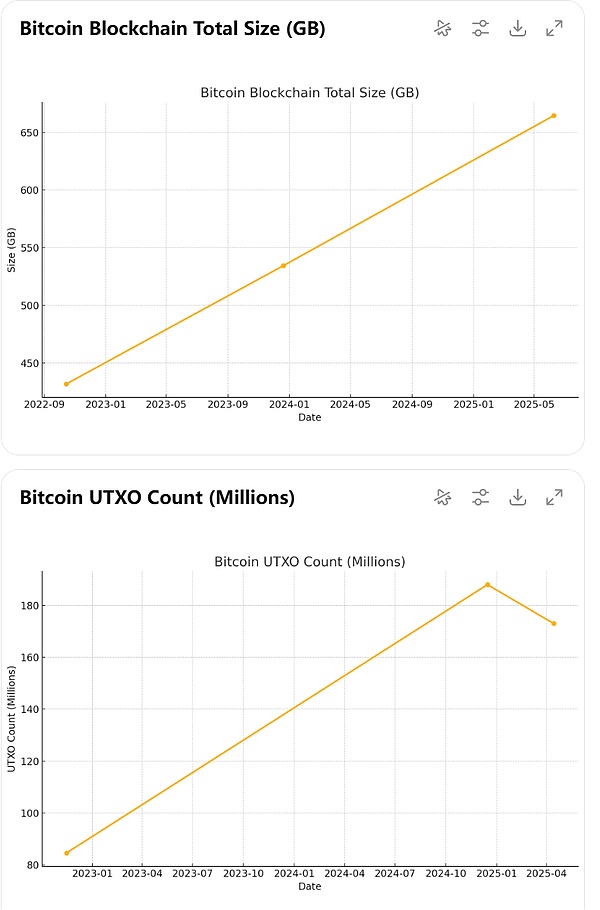
区块链总数据量从 ≈ 430 GB(2022-10)膨胀到 ≈ 665 GB(2025-06);

UTXO 集合一度冲到 1.88 亿条(2024-12),是 2022 年的两倍多;

(OP_RETURN 本身不进 UTXO,但碎片化 Taproot 输出会显著拉高。)

让比特币链上胖身材 + 多碎片同时出现,磁盘胀 60%UTXO  2 倍,这让很多开发者担心去中心化的成本了。

Core开发组从2022年以来,对铭文这些的应用就抱有非常大的敌意,强烈要求在规则层面进一步限制这些数据。Core开发者的主流观点是比特币区块链要去中心化,就要限制这些非金融数据,以让节点运行成本不会膨胀。

这里以Lukejr为代表,Lukejr自己开发的节点软件Knots就直接限制了对将数据塞进op_return的铭文类应用的交易的中继,就是Knote作为比特币的节点软件在收到铭文交易后是不转发的。

Op_return本身在比特币规则里是可以被节点软件裁剪的,也就是不具备区块链常见的数据永久保存的能力。

很多其他铭文类的应用,就担心自己的数据被比特币规则限制,使用了各种hack手段来设计协议,从利用Op_return,进化到了将数据塞进taproot脚本里,保存在交易的见证数据(witness)里。

在见证数据里,受益于segwit的手续费打折,以及见证数据区块的3M上限,让这些铭文类数据的矿工费又便宜,设计起来还比op_return还简单,并且受比特币协议保护,不会被裁剪。

这下就更惹火了Core开发组的很多开发者。

但除了少部分Core开发者,好像整个生态都挺欢迎这些铭文类应用的,包括矿工和交易所,都是明牌支持。

交易大量上架各种铭文类代币。

矿工甚至大量打包非标准脚本交易,以配合很多铭文类协议产生的更大更复杂的交易,这在实事上就突破了op_return数据的限制,因为本质上这种限制并不是共识层面的限制,只要有矿池打包了,其它矿池不会拒绝的。

上述两种情况,对比特币区块链数据的影响的区别是很大的。Op_return类数据和taproot脚本都会显著增加区块数据量,也会大量增加UTXO的数量。然而在完整节点运营视角来看,Op_return数据是可裁减的,但taproot脚本是不可裁减的。

这样的局势发展,大约是到了要倒逼协议做出变更了。

如果铭文类应用无法阻挡,那在协议层如果放开对Op_return数据的限制,给铭文类应用放开一个口子,引导它们使用Op_return,而不是taproot脚本,或许对比特币的节点运营来说是更友好的。

就让Core开发者产生了两派,少量的坚定认为应该在协议层堵死铭文类应用产生的“垃圾数据”,他们坚定认为铭文类应用就是对比特币发动的DDOS

而更多的开发者是觉得两权相害取其轻,引导数据往op_return发展,而不是可花费的脚本。

这就是,目前我看到的情况。

我觉得目前局势发展下去会产生什么结果呢?

Op_return数据的协议层更改,并不会产生比特币链的分裂,这是非共识层的。而且目前像Luke jr这样的强烈反对“非金融数据”上链的一方,采取的最极端的做法也仅仅是限制节点对铭文类交易的中继,而不是直接在协议里做设定其为非法。

所以这一次争议完全没有分裂的风险。

但我觉得Bitcoin core节点软件会朝着放宽Op_return数据限制方向发展。Luke jr这一派估计是要认了,按我读到的文章,Luke jr可是坚定的斗士,对自己的理念极其坚定,但这一次我觉得Luke jr要么做好长期战斗准备,要么认了。

铭文类,二层类应用,可能会迎来更友好的比特币底层协议开发环境。

但我对价格,是真不知道。

Criptomoedas em alta

Leituras Relacionadas

Farewell to Speculation: The Graham Moment of the Crypto Industry

"Farewell to Speculation: The Graham Moment for the Crypto Industry" The article draws a parallel between today's cryptocurrency market and the speculative, unregulated US stock market of the 1920s. That era lacked mandatory corporate disclosure, enabling rampant manipulation and turning stocks into gambling tools. The 1929 crash led to foundational reforms: the Securities Acts of 1933/34 mandated transparent, audited financial reporting, and Benjamin Graham's "Security Analysis" provided a framework for fundamental valuation. Together, they created modern investing, requiring both reliable data and a methodology to value assets. Similarly, the crypto market is currently driven by narratives and speculation. However, it possesses a key advantage: unlike 1920s corporations, blockchain protocols have inherently transparent, on-chain data for revenue, treasury, and activity. The core obstacle is not transparency, but the lack of legal claim to that value. Due to regulatory uncertainty (primarily the Howey Test), most tokens are deliberately stripped of economic rights like profit-sharing to avoid being classified as securities. This creates a paradox where protocols generate revenue, but token holders have no right to it. The turning point, argues the author, is imminent US legislation. The already-passed GENIUS Act provides a framework for stablecoins. The crucial CLARITY Act, currently in advanced legislative stages, aims to clearly categorize digital assets and define their regulatory treatment (SEC vs. CFTC). This would allow developers to legally design tokens with enforceable economic rights, such as profit distribution. If passed, this would enable a shift from speculation to fundamental investment. Analysis would focus on protocol revenue sustainability, network effects, valuation multiples, and the specific rights encoded in a token's contract—mirroring traditional equity analysis. The article notes significant legislative hurdles and timelines (1-3 years for rulemaking post-passage), but emphasizes the direction is set. A deeper challenge remains: building decentralized, legally enforceable governance and ownership structures to protect token holder rights, akin to corporate law. This will be a core development focus. The transformation applies mainly to revenue-generating protocol tokens, not to assets like Bitcoin (digital gold). The article concludes that the industry's question has evolved from "can tokens create value?" to "who gets to allocate that value?". Solving the latter, as in the 1920s, will mark crypto's transition to a legitimate asset class for fundamental investment.

Foresight NewsHá 4m

Farewell to Speculation: The Graham Moment of the Crypto Industry

Foresight NewsHá 4m

Quantum Computing "Manhattan Project" Unveiled: Is the Encryption Industry at a Critical Turning Point?

"Quantum Computing 'Manhattan Project' Launched: Is the Crypto Industry at a Critical Juncture?" On June 22, former U.S. President Donald Trump signed two executive orders. The first mandates all federal agencies upgrade their cryptographic systems to new, quantum-resistant standards by 2030. The second orders the Department of Energy to lead the development of a national quantum computer, signaling a shift from laboratory research to a state-enforced national agenda. This creates a hard deadline. A powerful quantum computer could break current encryption. The threat is compounded by "harvest now, decrypt later" attacks, where encrypted data is stored today for future decryption. Federal agencies must appoint migration officers and complete post-quantum cryptography (PQC) upgrades for key establishment by 2030 and digital signatures by 2031. Procurement rules will also be changed, forcing government contractors to comply. The crypto industry faces a direct threat. Bitcoin's ECDSA signatures are theoretically vulnerable. Research indicates millions of Bitcoin with exposed public keys are at risk if quantum computers advance. While projects like Bitcoin Quantum testnets and efforts by Ethereum, Solana, NEAR, and Zcash are exploring quantum-resistant solutions, achieving consensus in decentralized networks remains a major challenge. The centralized U.S. government has started a 5-year countdown. For decentralized crypto networks, the real test is whether they can complete this anti-quantum upgrade before the theoretical threat becomes a practical reality.

Foresight NewsHá 26m

Quantum Computing "Manhattan Project" Unveiled: Is the Encryption Industry at a Critical Turning Point?

Foresight NewsHá 26m

Coin Stock Barometer丨BitMine's Total Assets and Investment Reach $10.7 Billion, Exceeding ~$9.3 Billion Floating Loss; Strategy Buys Only 520 BTC, Strive Adds Positions Against the Trend (June 23)

This article provides a weekly market update on "coin-equity" trends, focusing on listed companies holding major cryptocurrencies. Key highlights include: **General Market Trends:** Global equities, particularly in the US, Japan, and South Korea, faced significant sell-offs, led by large tech and AI-related stocks. Analysts cite profit-taking and a shift from hype-driven to performance-driven valuation for AI companies. Market focus is on upcoming Micron Technology's earnings. **Cryptocurrency Treasury Updates:** * **Bitcoin (BTC):** Net weekly BTC purchases by listed companies (excluding miners) totaled approximately $86 million, down 13.97% from the prior week. Strategy (formerly MicroStrategy) purchased only 520 BTC for ~$34.9 million, while Strive Asset Management increased its holdings by 759 BTC for ~$50 million. Other notable actions include Mara Holdings adding 1,000 BTC and Capital B shareholders approving a massive financing plan (up to ~$1.2 trillion) to potentially expand its Bitcoin reserves. * **Ethereum (ETH):** BitMine emerged as the largest corporate ETH treasury, holding 5.67 million ETH (4.7% of supply). It purchased an additional 52,203 ETH ($92 million) in the past week. Sharplink completed a $75 million private placement to fund further ETH accumulation and stock buybacks. * **Solana (SOL):** The top five listed companies hold over 15.7 million SOL combined. However, Solmate Infrastructure, a SOL treasury firm, faces a lawsuit from its largest external shareholder alleging board misconduct and self-dealing. * **Other:** Updates include Canton Strategic's $50 million stock buyback plan and Lite Strategy's $1 million strategic investment in LitVM, a Layer-2 network for Litecoin. The article notes that while crypto treasury firms continue fundraising and accumulation, their stocks may struggle to rise against the broader market downturn until Q4.

marsbitHá 40m

Coin Stock Barometer丨BitMine's Total Assets and Investment Reach $10.7 Billion, Exceeding ~$9.3 Billion Floating Loss; Strategy Buys Only 520 BTC, Strive Adds Positions Against the Trend (June 23)

marsbitHá 40m

Trading

Spot
Futuros

Artigos em Destaque

Como comprar OP

Bem-vindo à HTX.com!Tornámos a compra de Optimism (OP) simples e conveniente.Segue o nosso guia passo a passo para iniciar a tua jornada no mundo das criptos.Passo 1: cria a tua conta HTXUtiliza o teu e-mail ou número de telefone para te inscreveres numa conta gratuita na HTX.Desfruta de um processo de inscrição sem complicações e desbloqueia todas as funcionalidades.Obter a minha contaPasso 2: vai para Comprar Cripto e escolhe o teu método de pagamentoCartão de crédito/débito: usa o teu visa ou mastercard para comprar Optimism (OP) instantaneamente.Saldo: usa os fundos da tua conta HTX para transacionar sem problemas.Terceiros: adicionamos métodos de pagamento populares, como Google Pay e Apple Pay, para aumentar a conveniência.P2P: transaciona diretamente com outros utilizadores na HTX.Mercado de balcão (OTC): oferecemos serviços personalizados e taxas de câmbio competitivas para os traders.Passo 3: armazena teu Optimism (OP)Depois de comprar o teu Optimism (OP), armazena-o na tua conta HTX.Alternativamente, podes enviá-lo para outro lugar através de transferência blockchain ou usá-lo para transacionar outras criptomoedas.Passo 4: transaciona Optimism (OP)Transaciona facilmente Optimism (OP) no mercado à vista da HTX.Acede simplesmente à tua conta, seleciona o teu par de trading, executa as tuas transações e monitoriza em tempo real.Oferecemos uma experiência de fácil utilização tanto para principiantes como para traders experientes.

422 Visualizações TotaisPublicado em {updateTime}Atualizado em 2026.06.02

Como comprar OP

Discussões

Bem-vindo à Comunidade HTX. Aqui, pode manter-se informado sobre os mais recentes desenvolvimentos da plataforma e obter acesso a análises profissionais de mercado. As opiniões dos utilizadores sobre o preço de OP (OP) são apresentadas abaixo.

活动图片