FOMO и слабые правила подпитывают суперцикл криптопреступности

cryptonews.ruPublicado em 2025-05-15Última atualização em 2025-07-15

По словам специалистов по кибербезопасности, медленное регулирование, страх упустить выгоду (FOMO) и растущее распространение криптовалют подпитывают «суперцикл» криптопреступности.

Потери от криптопреступлений достигли нового рекорда в первой половине 2025 года, побив предыдущий рекорд, установленный в 2022 году, и почти сравнявшись с общими потерями за весь 2024 год.
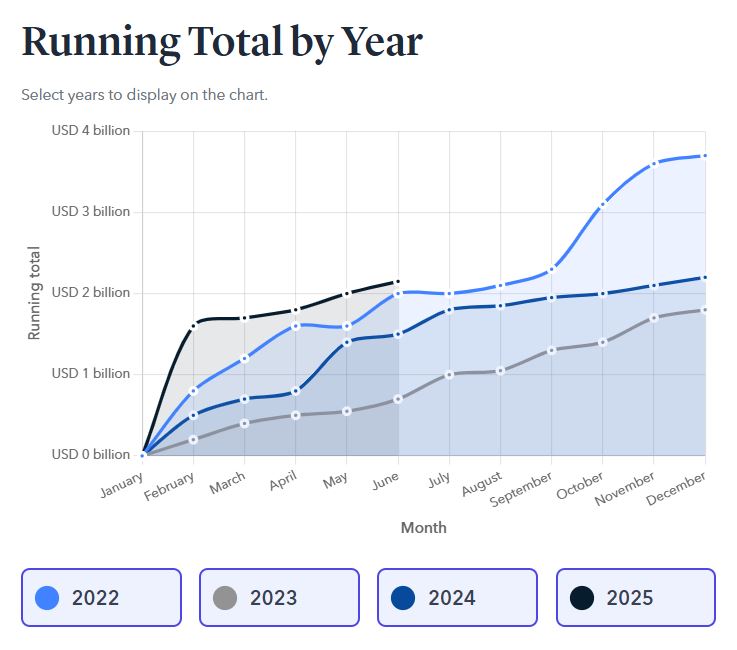
Убытки за первую половину 2025 года уже превысили убытки за весь 2024 год. Источник: TRM Labs.

Билл Каллахан, отставной агент Управления по борьбе с наркотиками и следователь по криптовалютам, заявил, что отсутствие регулирования в сочетании с шумихой и синдромом упущенной выгоды играет на руку преступникам, хотя он и не назвал бы это криминогенным суперциклом:

«Быстрое распространение новых криптоактивов, особенно мемкоинов, в сочетании с ростом числа розничных инвесторов и ограниченным надзором со стороны регулирующих органов создает возможности для преступной деятельности, включая кражи, фиктивные инвестиционные схемы, мошенничество и мошенничество».

Соотношение риска и вознаграждения благоприятствует криптопреступникам

Каллахан отметил, что мошенничество с криптовалютой, скорее всего, привлекает злоумышленников, учитывая анонимность и простоту организации мошеннических операций.

«Мы должны помнить, что у плохих парней есть время, деньги и ресурсы, чтобы усовершенствовать преступную деятельность, и им не нужно все делать правильно, чтобы продолжать получать солидную прибыль».

Компания CertiK, занимающаяся безопасностью блокчейнов, в своем отчете Hack3d за первое полугодие, опубликованном 1 июля, сообщила, что средний убыток от одного инцидента безопасности в 2025 году составил 4,3 млн долларов США, а медианный убыток — 103 996 долларов США.

Натали Ньюсон, старший исследователь блокчейнов, работающая в CertiK, рассказала, что «стечение обстоятельств» придало злоумышленникам смелости.

«Влиятельные лица и ключевые лидеры общественного мнения продолжают выпускать токены с сомнительными намерениями, получая прибыль с помощью таких тактик, как снайперские атаки, и оставляя розничных инвесторов беззащитными», — сказала Ньюсон.

Компания по мониторингу рынка Solidus Labs в своем майском отчете о результатах проверки сообщила, что 98,7% токенов на площадке запуска токенов Pump.fun демонстрируют характеристики схем «накачки и сброса».

В то же время Ньюсон заявила, что правоохранительные органы по всему миру сталкиваются с растущими проблемами — ограниченными ресурсами, межюрисдикционными сложностями и технической изощренностью киберпреступников.

В отчете аналитической компании Chainalysis, опубликованном в июле 2024 года, отмечено, что методы отмывания денег представляют особую проблему для правоохранительных органов и поставщиков криптоуслуг:

«В результате увеличивается разрыв между незаконной деятельностью и ответственностью, что создает все более враждебную среду для законных пользователей и разработчиков».

Ньюсон предполагает, что усиление безопасности смарт-контрактов и обучение пользователей могли бы переломить ситуацию, но признает, что остановить преступников невозможно.

Регуляторы недостаточно строги

Тем временем Хэнк Хуан, генеральный директор Kronos Research, утверждает, что регулирующие органы «перешли от чрезмерной реакции к недостаточной».

Он сказал, что, хотя первоначальное принуждение «часто было суровым», сейчас оно зашло слишком далеко в другую сторону, и мы «видим слишком мало ответственности»:

“Этот дисбаланс создаёт благодатную почву для того, что можно назвать суперциклом криптопреступности. Решение — не усиление репрессий, а разумное, целенаправленное регулирование и поиск баланса, чтобы и дальше стимулировать массовое внедрение”.

Нулевые потери — невыполнимая задача

В то же время правоохранительные органы по всему миру активизируют усилия по вытеснению недобросовестных игроков из криптопространства и устранению торговых площадок даркнета по всему миру.

Однако Хуан заявил, что, несмотря на усиление преследований, потери от криптовалютных преступлений никогда не достигнут нуля, поскольку децентрализованные рынки с анонимными участниками «всегда будут привлекать как хороших, так и плохих игроков».

По его словам, вместо того, чтобы пытаться исключить потери криптовалют, следует сосредоточиться на минимизации рисков для пользователей.

«Другие отрасли тоже страдают, но скорость и глобальный доступ к криптовалютам делают их особенно уязвимыми. Эти атаки направлены не столько на криптовалюты, сколько на проверку возможностей новых систем», — сказал Хуан.


Leituras Relacionadas

NVIDIA CPU Advances, China's RISC-V Responds: Semiconductor Deep Dive - Part Four

NVIDIA is set to launch its new Vera AI data center CPU in China as early as August, with high pricing. While this move offers a new option, it highlights China's continued dependence on foreign-controlled Arm architecture. In response, the Chinese semiconductor industry is increasingly turning to RISC-V as a strategic alternative for achieving high-performance computing autonomy. The article explores the concept of the "impossible triangle" in CPU development—balancing prosperity, control, and autonomy—and posits that RISC-V's open-source, modular nature offers a unique path to achieving all three. While RISC-V is already dominant in embedded systems, the focus is now shifting to data centers and AI workloads. China has become a global hotspot for RISC-V development, driven by AI-driven compute demand, supply chain concerns from export controls, cost benefits of open-source, and strong policy support. Multiple Chinese companies have reportedly crossed the key performance threshold of 15 SPECint per GHz, a benchmark for entering the high-performance CPU club. Progress extends beyond single-core benchmarks. Companies are developing complete computing subsystems, including commercial-grade coherent network-on-chip (NoC) technology and server processors with up to 40 cores that strictly adhere to the RVA23 standard to ensure software compatibility. Real-world applications are emerging in areas like video transcoding and edge AI. However, significant challenges remain. The RISC-V ecosystem faces fragmentation, immature toolchains and verification processes, and gaps in single-core performance and energy efficiency compared to mature x86 and Arm architectures. The formidable software moat, epitomized by NVIDIA's CUDA, is a long-term hurdle. In conclusion, while RISC-V cannot immediately replace offerings like NVIDIA's Vera, it represents a viable long-term path for China to develop a self-sufficient, high-performance CPU ecosystem. The journey is acknowledged to be long and arduous, requiring sustained effort to overcome technical and ecosystem challenges.

marsbitHá 2h

NVIDIA CPU Advances, China's RISC-V Responds: Semiconductor Deep Dive - Part Four

marsbitHá 2h

My Coding Betting Dashboard is Profiting, but Polymarket is Truly Not a Good Place for 'Arbitrage'

The author built a custom monitoring dashboard for Polymarket, a prediction market platform, and tested it with $1,600, achieving over 30% returns. However, the core argument is that Polymarket is not a good venue for traditional arbitrage. The dashboard has two main sections: a "Portfolio Dashboard" for tracking active positions with key metrics like total capital, P&L, and a risk-control module using a tier system (T1, T2, T3), and an "Opportunity Watchlist" for monitoring markets. The article details a critical structural trap in binary markets: a bet with a high perceived probability of success still carries a 100% loss risk if wrong. The author's T1/T2/T3 system is designed to manage this by limiting position sizes based on conviction and time horizon, emphasizing that high confidence should not equal high concentration. A key insight is the danger of "pseudo-diversification"—betting on different markets driven by the same underlying variable. The author concludes that Polymarket offers few true low-risk, arbitrage opportunities. It is instead a high-risk environment where wins can create a false sense of mastery, leading to large losses. The platform is better viewed as a training ground for honing judgment through disciplined, framework-driven betting rather than a reliable income source. The tools help transform intuition into structured, rule-based decisions to mitigate the risk of catastrophic errors.

marsbitHá 5h

My Coding Betting Dashboard is Profiting, but Polymarket is Truly Not a Good Place for 'Arbitrage'

marsbitHá 5h

WeChat AI Card Hands-On Guide: Has the AI Shopping Era Arrived?

**"WeChat AI Card" Practical Test Guide: Has the Era of AI Shopping Arrived?** WeChat has officially launched the "AI Exclusive Card," a feature integrated into its Workbuddy AI assistant. This card is designed to handle payments for AI-initiated purchases. Our hands-on test reveals it's not yet a tool for fully autonomous AI shopping, but rather a controlled payment layer for AI agents. The AI Card functions as an isolated sub-wallet within WeChat Pay. Users must bind the card and transfer funds into it from their main wallet. Crucially, every transaction requires explicit user confirmation via smartphone scan; AI cannot spend autonomously. Currently accessible through the Workbuddy agent, the card targets specific digital consumption scenarios: purchasing paid content (reports, data), calling paid APIs/tools, and subscribing to services. Its design prioritizes security and control by separating funds and mandating approval for each payment. We tested a real-world scenario: ordering bubble tea via Workbuddy using a "Meituan Life Assistant" skill. The process encountered multiple hurdles: high "skill" usage costs (exceeding daily free credits), and most importantly, while a payment was successfully initiated, the AI purchased an incorrect product (a mismatched group-buy coupon instead of the desired drink). This highlights the current limitation: the **AI Card only solves the payment step**. The broader challenge lies in the **AI agent's execution chain**—accurately understanding intent, navigating third-party platforms, selecting the right product, and ensuring proper fulfillment. The payment succeeded, but the purchase failed to meet the user's need. In conclusion, the WeChat AI Exclusive Card is a cautious, early-step experiment in AI commerce. It provides a secure, user-controlled payment method for agent interactions but is not yet capable of reliable, end-to-end complex purchases. For now, it's best used for low-value, low-risk digital services with careful user verification at each step. The vision of AI handling complete shopping tasks remains a work in progress.

marsbitHá 8h

WeChat AI Card Hands-On Guide: Has the AI Shopping Era Arrived?

marsbitHá 8h

Trading

Spot
Futuros
活动图片