Market Pulse: Week 29

insights.glassnodePublicado em 2025-07-13Última atualização em 2025-07-14

Beta release. Please submit your feedback here. Free for a limited period.

Overview

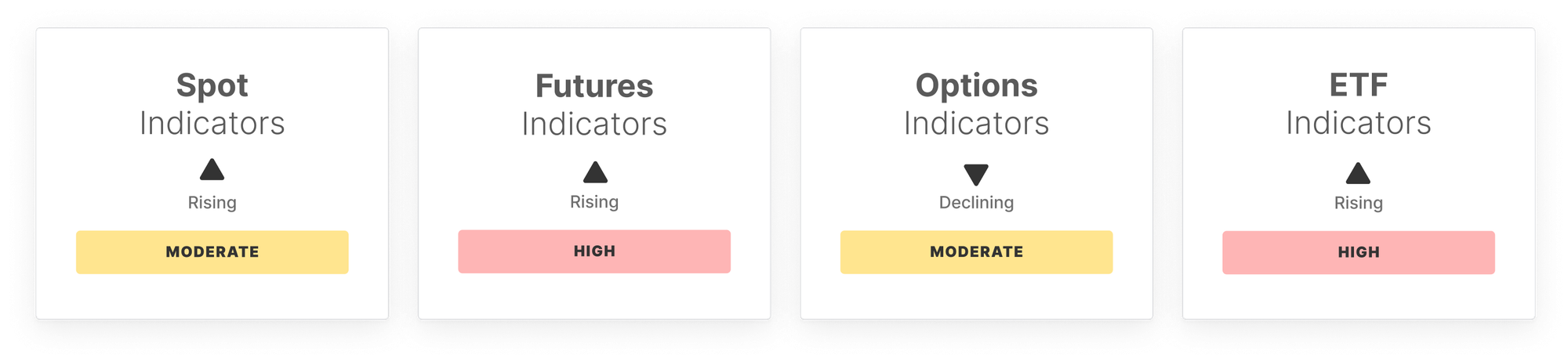
With Bitcoin breaking out of its recent choppy range to a new ATH, market sentiment has shifted decisively toward optimism. Price momentum accelerated alongside a 46.6% surge in spot volume and a reversal in CVD, indicating meaningful investor participation and a shift toward aggressive buying.

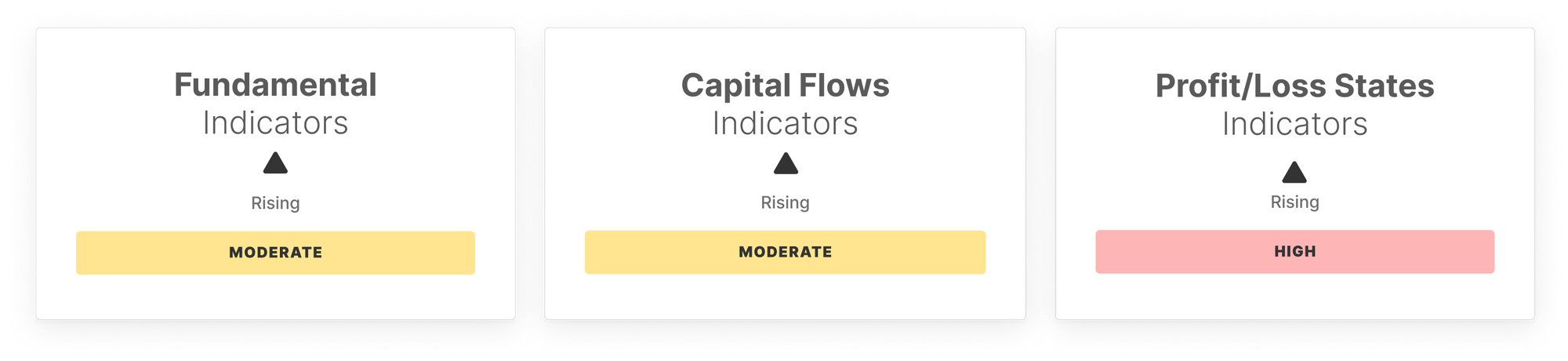
On-chain activity picked up, with transfer volume and ETF flows exceeding statistical highs, reflecting renewed interest from both retail and institutional segments.

The futures market echoed this enthusiasm, with open interest rising above its high band and funding rates spiking to $2.1M, signaling elevated long-side conviction.

Options market behavior showed a nuanced shift, with rising open interest and skew flipping negative, suggesting increasing demand for upside exposure. However, the narrowing volatility spread hints at a more tempered outlook, possibly reflecting expectations of reduced volatility after recent price moves.

Capital rotation metrics point to a slight increase in short-term holder activity, yet the dominance of long-term holders remains intact, supporting market stability. Meanwhile, profit/loss indicators signal caution, with realized profit-taking rising and nearly 99% of the supply in profit, suggesting elevated euphoria and potential risk of corrections.

In sum, the market is in a high-profit, high-conviction phase, supported by both derivatives and spot participation. While the breakout is backed by strong metrics, heightened profit margins and positioning imbalances call for increased vigilance going forward.

Off-Chain Indicators
On-Chain Indicators
Don't miss it!

Smart market intelligence, straight to your inbox.

Subscribe now

Disclaimer: This report does not provide any investment advice. All data is provided for information and educational purposes only. No investment decision shall be based on the information provided here and you are solely responsible for your own investment decisions.

Exchange balances presented are derived from Glassnode’s comprehensive database of address labels, which are amassed through both officially published exchange information and proprietary clustering algorithms. While we strive to ensure the utmost accuracy in representing exchange balances, it is important to note that these figures might not always encapsulate the entirety of an exchange’s reserves, particularly when exchanges refrain from disclosing their official addresses. We urge users to exercise caution and discretion when utilizing these metrics. Glassnode shall not be held responsible for any discrepancies or potential inaccuracies. 

Please read our Transparency Notice when using exchange data.

Leituras Relacionadas

A Decade of Change: The Demise of Crypto Startups

"The Decade-Long Transformation: The Demise of Crypto Startups" The article traces the dramatic evolution of the cryptocurrency industry from its anarchic beginnings to its current highly regulated and institutionalized state. In the early days (circa 2017), launching a crypto startup was remarkably simple: a whitepaper, a GitHub repository, and a Telegram group could attract thousands of retail investors via an Initial Coin Offering (ICO). Founders operated anonymously with near-zero regulatory and financial barriers, enabling rapid, global innovation but also widespread fraud. By 2026, the landscape is fundamentally different. To operate in major markets like the US, EU, and Asia, crypto businesses must now navigate a complex web of regulations akin to traditional finance. Compliance costs are prohibitive: estimates for a US multi-state operation range from $750,000 to $1.2 million in the first three years, with annual costs exceeding $2 million thereafter. Regulations like MiCA in the EU and New York's BitLicense have created high capital and operational hurdles that act as barriers to entry. Simultaneously, venture capital investment has shifted dramatically. Following the collapses of Terra and FTX, funding has concentrated in later-stage, established companies, creating a "barbell market." Early-stage and seed funding has shrunk significantly, while mega-funds like Andreessen Horowitz's $15 billion pool dominate. Most capital now flows to trading platforms, lending infrastructure, and B2B services. This environment favors mergers and acquisitions as the primary path for growth. Companies like Coinbase and Ripple are acquiring firms like Deribit and Hidden Road not for their technology, but for their licenses, banking relationships, and institutional trust—assets far more valuable than code. Distribution channels, compliance, and brand reputation have become the new moats, overshadowing pure technical innovation. The industry's maturation brings benefits: reduced scams, increased institutional participation, and clearer regulatory frameworks. However, it comes at a cost. The low-barrier, experimental ethos that defined crypto's first decade is fading. Entrepreneurs without substantial capital, pre-existing licenses, or institutional connections face immense challenges. Funding for exploratory fields like decentralized social media or novel governance models is drying up. Ultimately, the crypto industry is replicating the consolidation pattern seen in banking and tech after the 2008 financial crisis. While this brings stability and legitimacy, it raises a critical question: in this new, resource-intensive reality, is there still room for the disruptive, from-scratch innovation that gave birth to the sector?

Foresight NewsHá 20m

A Decade of Change: The Demise of Crypto Startups

Foresight NewsHá 20m

Trading

Spot
活动图片