US Bitcoin ETFs Record Consecutive Billion-Dollar Inflow Days As Price Nears $120K

bitcoinistPublicado em 2025-07-13Última atualização em 2025-07-13

Resumo

The US-based spot Bitcoin ETFs (exchange-traded funds) have continued their impressive form in the past few weeks, recording just one...

Trusted Editorial content, reviewed by leading industry experts and seasoned editors. Ad Disclosure

The US-based spot Bitcoin ETFs (exchange-traded funds) have continued their impressive form in the past few weeks, recording just one outflow day since June 9, 2025. As such, the crypto-linked investment products have witnessed a significant influx of capital in recent weeks.

The Bitcoin ETFs, however, witnessed the inflow of an unprecedented amount of capital to close the past week. This significant investor activity came as the price of the premier cryptocurrency forged multiple new all-time highs in the space of a few days. 

Bitcoin ETFs Record $2.72 Billion In Past Week: Report

According to the latest market data, the Bitcoin ETFs in the United States posted a total net inflow of $1.03 billion on Friday, July 11. This outstanding performance marked the second straight day of a 10-figure capital influx for the crypto-based investment vehicles.

Unsurprisingly, BlackRock’s iShares Bitcoin Trust (with the ticker IBIT) witnessed the largest net inflow, adding $953.52 million in value to close the week. This strong performance emphasizes the asset manager’s growing dominance in the crypto ETFs industry — as IBIT also recently became the fastest ETF to hit $80 billion in assets under management.

ARK 21Shares Bitcoin ETF (ARKB) came in second place, registering a net inflow of $23.51 million on Friday. Grayscale’s Bitcoin Mini Trust (BTC) and VanEck’s Bitcoin exchange-traded fund (HODL) also managed to post eight-figure inflows, with $20.93 million and $20.01 million, respectively.

Bitwise’s Bitcoin ETF (BITB) and Invesco’s fund (BTCO) were the only other funds to record positive inflows to close the week. BITB and BTCO posted $6.41 million and $5.3 million, respectively, on the day. It is worth noting that the other Bitcoin ETFs didn’t witness any net activity.
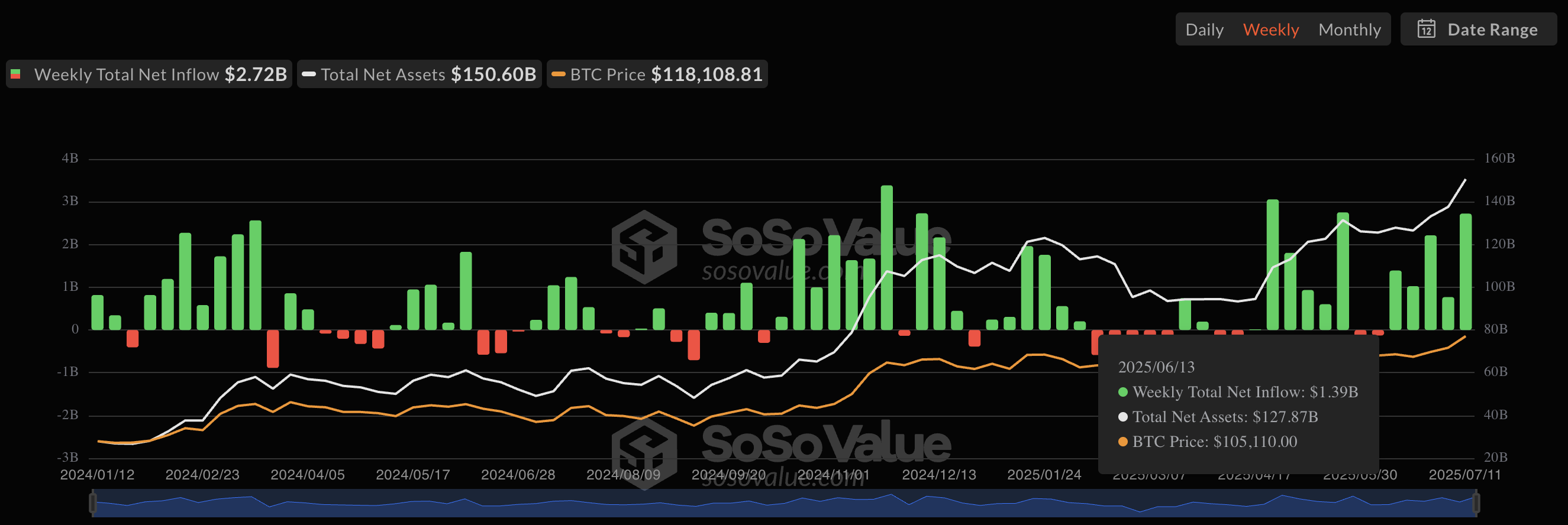
Bitcoin ETFs

Source: SoSoValue

As earlier mentioned, the US Bitcoin ETFs registered over a billion-dollar net inflow for the second consecutive day — for the first time since launching in January 2024. These performances in the past two days pushed the weekly record to around $2.72 billion, the fifth-largest weekly inflow.

Bitcoin Price Overview

The direct relationship between the Bitcoin price and the US Bitcoin ETFs’ inflows continued in the past week. On both days when the funds witnessed a billion-dollar capital influx, the price of BTC experienced a significant price surge, reaching a new all-time high of around $118,700.

As of this writing, the price of Bitcoin sits around $117,332, reflecting a 0.3% decline in the past 24 hours. Nevertheless, the value of the flagship cryptocurrency is still up by more than 8% in the past seven days.

Bitcoin ETFs

The price of BTC on the daily timeframe | Source: BTCUSDT chart on TradingView

Featured image created by DALL-E, chart from TradingView
Editorial Process for bitcoinist is centered on delivering thoroughly researched, accurate, and unbiased content. We uphold strict sourcing standards, and each page undergoes diligent review by our team of top technology experts and seasoned editors. This process ensures the integrity, relevance, and value of our content for our readers.

Opeyemi Sule is a passionate crypto enthusiast, a proficient content writer, and a journalist at Bitcoinist. Opeyemi creates unique pieces unraveling the complexities of blockchain technology and sharing insights on the latest trends in the world of cryptocurrencies. Opeyemi enjoys reading poetry, chatting about politics, and listening to music, in addition to his strong interest in cryptocurrency.

Leituras Relacionadas

A Decade of Change: The Demise of Crypto Startups

"The Decade-Long Transformation: The Demise of Crypto Startups" The article traces the dramatic evolution of the cryptocurrency industry from its anarchic beginnings to its current highly regulated and institutionalized state. In the early days (circa 2017), launching a crypto startup was remarkably simple: a whitepaper, a GitHub repository, and a Telegram group could attract thousands of retail investors via an Initial Coin Offering (ICO). Founders operated anonymously with near-zero regulatory and financial barriers, enabling rapid, global innovation but also widespread fraud. By 2026, the landscape is fundamentally different. To operate in major markets like the US, EU, and Asia, crypto businesses must now navigate a complex web of regulations akin to traditional finance. Compliance costs are prohibitive: estimates for a US multi-state operation range from $750,000 to $1.2 million in the first three years, with annual costs exceeding $2 million thereafter. Regulations like MiCA in the EU and New York's BitLicense have created high capital and operational hurdles that act as barriers to entry. Simultaneously, venture capital investment has shifted dramatically. Following the collapses of Terra and FTX, funding has concentrated in later-stage, established companies, creating a "barbell market." Early-stage and seed funding has shrunk significantly, while mega-funds like Andreessen Horowitz's $15 billion pool dominate. Most capital now flows to trading platforms, lending infrastructure, and B2B services. This environment favors mergers and acquisitions as the primary path for growth. Companies like Coinbase and Ripple are acquiring firms like Deribit and Hidden Road not for their technology, but for their licenses, banking relationships, and institutional trust—assets far more valuable than code. Distribution channels, compliance, and brand reputation have become the new moats, overshadowing pure technical innovation. The industry's maturation brings benefits: reduced scams, increased institutional participation, and clearer regulatory frameworks. However, it comes at a cost. The low-barrier, experimental ethos that defined crypto's first decade is fading. Entrepreneurs without substantial capital, pre-existing licenses, or institutional connections face immense challenges. Funding for exploratory fields like decentralized social media or novel governance models is drying up. Ultimately, the crypto industry is replicating the consolidation pattern seen in banking and tech after the 2008 financial crisis. While this brings stability and legitimacy, it raises a critical question: in this new, resource-intensive reality, is there still room for the disruptive, from-scratch innovation that gave birth to the sector?

Foresight NewsHá 36m

A Decade of Change: The Demise of Crypto Startups

Foresight NewsHá 36m

Trading

Spot
活动图片