How FUNToken Uses Revenue to Reduce Supply and Fund Growth

bitcoinistPublicado em 2025-07-12Última atualização em 2025-07-12

Resumo

Deflationary cryptocurrencies have always attracted interest from traders and long-term investors alike. The idea that an asset can become scarcer...

Trusted Editorial content, reviewed by leading industry experts and seasoned editors. Ad Disclosure

Deflationary cryptocurrencies have always attracted interest from traders and long-term investors alike. The idea that an asset can become scarcer over time, simply by design, is powerful. Yet in practice, very few projects have managed to create a system where deflation is both credible and sustainable.

FUNToken is one of the rare examples of a project that has implemented deflation not as a marketing tactic but as an integral part of its business model. By combining real product revenue, transparent burn events, and gamified adoption strategies, FUNToken has built an ecosystem where value creation and scarcity go hand in hand.

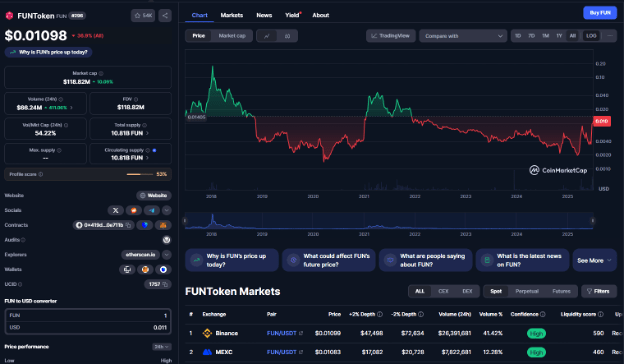
Today, FUNToken trades around $0.01098, with average daily trading volumes over $60 million and a market capitalization near $119 million.
In this article, let’s explore how FUNToken’s model works, why it is gaining traction, and what it signals for the future of deflationary token economies.

Revenue as the Engine of Scarcity

One of the central flaws in many deflationary projects is that their supply reduction mechanisms are detached from actual usage. A team may announce a burn, but if that burn relies on reserves rather than fresh revenue, it quickly loses credibility.

FUNToken has solved this problem by connecting supply reduction directly to the success of its platform. The most recent burn, completed on June 24, permanently removed 25 million FUN tokens from circulation. This burn was funded by revenue generated from platform activities, which is a core element of the project’s model.

Here is how it works in practice:

  • Each quarter, FUNToken calculates its total income from ecosystem services, which includes engagement within its Telegram AI bot and planned gaming products.
  • A part of that revenue is allocated to buybacks and burns.
  • Once purchased, tokens are sent to a designated burn address where they are irreversibly removed from circulation.

Why This Matters for Value

The significance of revenue-backed burns can be seen in market performance. After the June 24 burn, FUNToken’s price jumped from approximately $0.0045 to around $0.0064, a surge of over 41% within 24 hours.

This immediate reaction was driven by the clarity of the event. Investors could verify the burn transaction on-chain, see that it was funded by actual earnings, and understand that it permanently reduced available supply.

Unlike buybacks that get recycled back into treasury or staking pools, these burns are final. That finality is crucial because it aligns with investor expectations of deflationary economics.

A Roadmap That Converts Engagement into Growth

Sustainable deflation requires more than just supply cuts. It depends on a steady pipeline of engagement to drive revenue.

FUNToken’s roadmap is structured to maintain this engine. Throughout Q3 and Q4 of 2025, the project plans to roll out:

  • A dedicated mobile wallet that will support in-app token management, staking, and simplified swaps
  • A portfolio of 30 free-to-play games designed to encourage casual participation and daily transactions
  • Advanced integrations with the Telegram AI bot to further gamify the experience

Each of these roadmap items has a dual purpose. They attract new users by replicating familiar Web2 experiences, and they create revenue that sustains the burn model.

When the mobile wallet launches, users will be able to stake their tokens easily and track burn events in real time. This kind of visibility reinforces the perception of deflation as a transparent, ongoing process rather than an occasional headline.

The Role of the Telegram AI Bot in Driving Activity

No discussion of FUNToken’s deflationary model is complete without recognizing the impact of its Telegram $FUN AI bot.

This bot serves as an always-on engagement hub. Users can earn $FUN tokens by participating in simple activities like answering quiz questions, reacting to posts, or referring friends. With over 110,000 active users already participating, the bot is a major contributor to FUNToken’s recurring revenue.

This is how the model comes full circle:

  • Users complete tasks in the bot and generate transaction fees or monetized engagement.
  • That revenue becomes part of the quarterly pool used to fund burns.
  • As burns reduce supply, the tokens users have already earned become scarcer.
  • New users are attracted by transparent burn statistics and clear utility, expanding the cycle further.

This closed-loop structure is an important differentiator. In many projects, incentives are purely inflationary, diluting the rewards of early participants. FUNToken’s combination of activity-driven rewards and deflationary mechanics addresses this issue directly.

CertiK Audit and Skynet Monitoring

Another cornerstone of FUNToken’s credibility is its security posture. The project underwent a full CertiK audit, which verified that the smart contract is immutable and free of hidden minting functions.

CertiK’s findings mean that once tokens are burned, they cannot be reintroduced. This assurance is reinforced by CertiK Skynet, a continuous monitoring solution that scans the contract in real time for any anomalies.

For users who may be new to Web3 or concerned about token integrity, these measures provide reassurance. In effect, CertiK serves as the external validation that FUNToken’s deflationary claims are not just promises but verifiable facts.

What to Watch in the Months Ahead

Looking forward, there are several milestones that could further reinforce FUNToken’s model:

  • The release of the mobile wallet by the end of Q4 2025, providing a seamless home for staking and in-app transactions
  • Expansion of the free-to-play game library, which is expected to drive new engagement and revenue
  • Additional quarterly burns funded by rising platform income

If these milestones are met on schedule, FUNToken’s deflationary structure will only become more compelling to holders and new users.

Conclusion

FUNToken’s deflationary strategy is more than a set of tokenomics bullet points. It is a model that combines:

  • Revenue-backed burns that are fully transparent
  • User acquisition through accessible, gamified experiences
  • A clear roadmap that integrates mobile-first tools and casual gameplay
  • Independent verification by CertiK and real-time Skynet monitoring

As FUNToken continues to execute its roadmap and demonstrate quarterly burns, it is positioning itself as a prime example of how crypto projects can sustain both user adoption and long-term scarcity.

Note: The price mentioned was accurate at the time of writing (July 3, 2025) and may have changed since


Editorial Process for bitcoinist is centered on delivering thoroughly researched, accurate, and unbiased content. We uphold strict sourcing standards, and each page undergoes diligent review by our team of top technology experts and seasoned editors. This process ensures the integrity, relevance, and value of our content for our readers.

Bitcoinist is the ultimate news and review site for the crypto currency community!

Leituras Relacionadas

1600 Lines of Code Create an Underwater Manhattan, Fable 5 Leaves Karpathy Stunned

Title: Fable 5 Stuns Karpathy with 3D Worlds Built from 1600 Lines of Code An AI model, Fable 5, has demonstrated a remarkable leap in generating complex, interactive 3D worlds with minimal code. Showcased by Peter Gostev of Arena.ai, the model created 63 diverse 3D environments across themes like immersive cityscapes, explorable famous paintings, natural wonders, and cosmic phenomena. Many were generated in a single attempt. A standout creation is a detailed, submerged Manhattan built with only 1600 lines of Three.js code. Other highlights include traversable versions of Van Gogh's "Starry Night," a bear catching a salmon with realistic physics, and a split Red Sea. The model's ability to cohesively manage vast numbers of elements within a scene represents a significant technical advancement. Andrej Karpathy, who recently joined Anthropic's pre-training team, expressed amazement, particularly at how the model intuitively understood and rendered complex real-world interactions like a fish struggling when caught. He coined the term "fablemaxxing" to describe this qualitative leap. While Fable 5 excels at world-building, Gostev notes current limitations in creating engaging, long-form gameplay. The model also sometimes requires prompting to fully utilize its capabilities. Having topped the Agent Arena benchmark for real-world task completion, Fable 5 signals that the boundaries of AI-generated content are rapidly expanding, with its full potential yet to be discovered.

marsbitHá 5m

1600 Lines of Code Create an Underwater Manhattan, Fable 5 Leaves Karpathy Stunned

marsbitHá 5m

From ANSEM to CZ, The Celebrity Coin Relay Race Between Solana and BSC

The past week was a whirlwind of on-chain activity, sparked by the meteoric rise of $ANSEM, a Solana-based meme coin that surged 600x and hit a $100 million market cap in a single day. This rally began when crypto influencer Ansem announced his return to buying Solana meme coins and publicly advocated for an airdrop from the platform pump.fun. Ansem’s subsequent "soft claim" of the token—promising to airdrop creator revenue to followers—ignited a frenzy, drawing comparisons to past community-led token distributions. However, his dual role as a co-founder of the trading terminal Bullpen, which later hosted the $ANSEM airdrop, suggests a strategic promotional element. The narrative quickly shifted to "celebrity coins," where tokens named after influencers are sent to their public addresses in hopes of endorsement. While a similar coin, $TJR, briefly gained traction, it faltered after the influencer TJR urged focus back on $ANSEM. Attention then turned to projects Ansem endorsed and coins found in his wallet, like $manlet, but momentum on Solana began to stall. The action then migrated to BSC with the viral resurgence of a 2021 tweet from former Binance CEO CZ, referencing a "final form" bull. This sparked the explosive launch of $CZ, which briefly approached a $90 million market cap despite expectations that CZ wouldn't actively engage like Ansem. Another BSC token, $TCC, gained attention due to CZ's interactions with its promoter. The BSC ecosystem saw faster-paced, albeit volatile, "celebrity coin" plays, with tokens like $dingaling experiencing rapid pumps and dumps without official endorsements. Currently, BSC shows more momentum for new token launches than Solana, with the market awaiting a new narrative to succeed the fleeting "celebrity coin" trend.

marsbitHá 15m

From ANSEM to CZ, The Celebrity Coin Relay Race Between Solana and BSC

marsbitHá 15m

A Decade of Change: The Demise of Crypto Startups

"The Decade-Long Transformation: The Demise of Crypto Startups" The article traces the dramatic evolution of the cryptocurrency industry from its anarchic beginnings to its current highly regulated and institutionalized state. In the early days (circa 2017), launching a crypto startup was remarkably simple: a whitepaper, a GitHub repository, and a Telegram group could attract thousands of retail investors via an Initial Coin Offering (ICO). Founders operated anonymously with near-zero regulatory and financial barriers, enabling rapid, global innovation but also widespread fraud. By 2026, the landscape is fundamentally different. To operate in major markets like the US, EU, and Asia, crypto businesses must now navigate a complex web of regulations akin to traditional finance. Compliance costs are prohibitive: estimates for a US multi-state operation range from $750,000 to $1.2 million in the first three years, with annual costs exceeding $2 million thereafter. Regulations like MiCA in the EU and New York's BitLicense have created high capital and operational hurdles that act as barriers to entry. Simultaneously, venture capital investment has shifted dramatically. Following the collapses of Terra and FTX, funding has concentrated in later-stage, established companies, creating a "barbell market." Early-stage and seed funding has shrunk significantly, while mega-funds like Andreessen Horowitz's $15 billion pool dominate. Most capital now flows to trading platforms, lending infrastructure, and B2B services. This environment favors mergers and acquisitions as the primary path for growth. Companies like Coinbase and Ripple are acquiring firms like Deribit and Hidden Road not for their technology, but for their licenses, banking relationships, and institutional trust—assets far more valuable than code. Distribution channels, compliance, and brand reputation have become the new moats, overshadowing pure technical innovation. The industry's maturation brings benefits: reduced scams, increased institutional participation, and clearer regulatory frameworks. However, it comes at a cost. The low-barrier, experimental ethos that defined crypto's first decade is fading. Entrepreneurs without substantial capital, pre-existing licenses, or institutional connections face immense challenges. Funding for exploratory fields like decentralized social media or novel governance models is drying up. Ultimately, the crypto industry is replicating the consolidation pattern seen in banking and tech after the 2008 financial crisis. While this brings stability and legitimacy, it raises a critical question: in this new, resource-intensive reality, is there still room for the disruptive, from-scratch innovation that gave birth to the sector?

Foresight NewsHá 1h

A Decade of Change: The Demise of Crypto Startups

Foresight NewsHá 1h

Trading

Spot
活动图片