Deaton Fights For The XRP Army—Again: New Legal Battle Begins

bitcoinistPublicado em 2025-07-10Última atualização em 2025-07-10

Resumo

XRP investors are at the centre of a securities-fraud class action that accuses former Linqto chief executive William Sarris of...

Trusted Editorial content, reviewed by leading industry experts and seasoned editors. Ad Disclosure

XRP investors are at the centre of a securities-fraud class action that accuses former Linqto chief executive William Sarris of secretly imposing mark-ups of up to 60 percent on pre-IPO Ripple shares and other highly sought-after private-company equity like Uphold and Kraken sold through special-purpose vehicles on the fintech’s platform.

The 61-page complaint—Maxwell v. Sarris, filed on 9 July 2025 in the US District Court for the Southern District of New York—alleges that Sarris and unnamed accomplices acted as unregistered broker-dealers, used misleading offering exemptions and failed to deliver legal title to any of the underlying shares.

XRP Army’s Legal Champion Is Back

According to the filing, would-be purchasers were told the SPVs “held the same equity that insiders owned,” yet Linqto neither transferred the stock nor disclosed the hefty mark-ups baked into the purchase price—conduct the plaintiffs say violates Section 10(b) of the Securities Exchange Act and FINRA Rule 2040. Linqto’s own bankruptcy papers, lodged a day earlier in the Southern District of Texas, concede “historical failures to follow US laws governing the sale and marketing of private-company interests.”

Lead counsel John E. Deaton—best known for representing XRP holders in SEC v. Ripple—contends that Sarris “damaged the mission of democratising access to Silicon Valley” and misled ordinary investors: “People believed they were buying shares of Ripple, shares of SpaceX, but that’s not what they were buying.”

Because Sarris is sued in his personal capacity, Deaton argues the litigation is not stayed by Linqto’s Chapter 11 petition of 8 July 2025. The company, now led by chief executive Dan Siciliano, has secured up to $60 million in debtor-in-possession financing and says court oversight is “the only way forward” to emerge as “a profitable, law-abiding organisation” while it cooperates with SEC and FINRA investigations.

Investor outreach has proved challenging. Deaton scheduled an X Spaces session for 7:30 p.m. EST on 9 July, but abandoned the effort after repeated crashes, posting instead: “The spaces keeps crashing. We will set up a conference call early next week via phone line. I won’t do a Zoom link again because it got bombed last time.” He also reassured international users: “Anything I do includes ALL Linqto customers, regardless of where you live.”

Meanwhile, restructuring jockeying has begun. Shareholder Sapien Group says it has marshalled a majority bloc of equity and may seek to dismiss the Chapter 11 case, while Deaton has signalled plans to engage the creditors’ committee—a move endorsed by forensic accountant Rob Loh, who wrote that the panel “will have real power in the bankruptcy process.” Deaton confirmed: “Rob is correct. We will have a real say in what happens in the bankruptcy.”

Regulatory pressure is mounting on multiple fronts: Linqto disclosed parallel probes by the SEC and FINRA, and former chief revenue officer Gene Zawrotny is pursuing a wrongful-termination claim in California state court, alleging retaliation for flagging compliance failures. Deaton is now also turning up the pressure on behalf of the XRP community—particularly those who believed they were purchasing legitimate pre-IPO shares of Ripple.

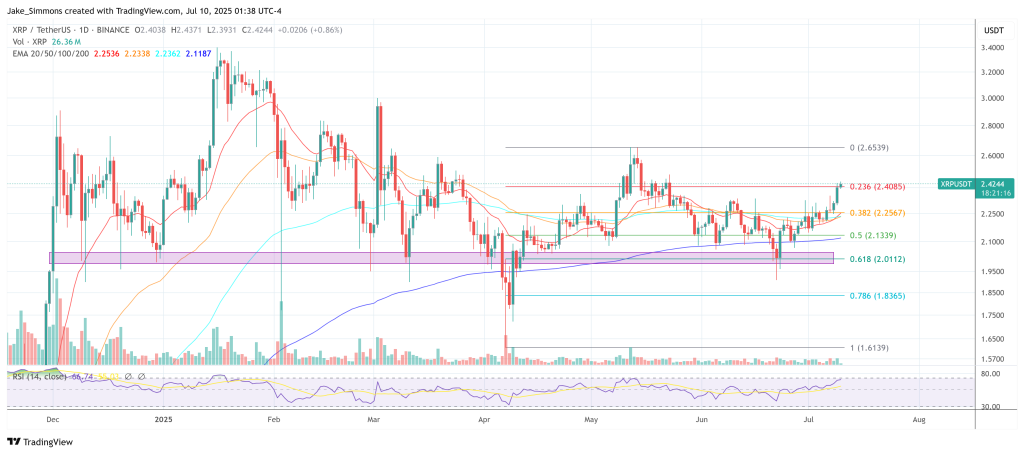
At press time, XRP traded at $2.42.
XRP price
XRP rises above the 0.236 Fib, 1-day chart | Source: XRPUSDT on TradingView.com
Featured image from YouTube, chart from TradingView.com
Editorial Process for bitcoinist is centered on delivering thoroughly researched, accurate, and unbiased content. We uphold strict sourcing standards, and each page undergoes diligent review by our team of top technology experts and seasoned editors. This process ensures the integrity, relevance, and value of our content for our readers.

Jake Simmons has been a Bitcoin enthusiast since 2016. Ever since he heard about Bitcoin, he has been studying the topic every day and trying to share his knowledge with others. His goal is to contribute to Bitcoin's financial revolution, which will replace the fiat money system. Besides BTC and crypto, Jake studied Business Informatics at a university. After graduation in 2017, he has been working in the blockchain and crypto sector. You can follow Jake on Twitter at @realJakeSimmons.

Leituras Relacionadas

Losing $55 Million to Sell Bitcoin, MicroStrategy's Faith Reaches Its Interest Payment Day

On July 6th, Michael Saylor's MicroStrategy announced the sale of 3,588 BTC for approximately $216 million, incurring a realized loss of around $55.45 million compared to its average cost basis. This move, contradicting Saylor's long-standing "never sell" Bitcoin philosophy, was executed to pay dividends on its digital credit securities. The article traces this shift from a small "desensitization test" sale of 32 BTC in late May to the board's authorization on June 30th to sell up to $1.25 billion in Bitcoin for corporate purposes like dividends and buybacks. Analysis reveals that MicroStrategy's previous growth "flywheel"—using stock premiums to fund more Bitcoin purchases—has stalled. With its stock trading near a critical threshold (1.22x its Bitcoin NAV), issuing new shares would dilute value. Simultaneously, its financing channels (preferred stock, common stock ATM, convertible notes) are constrained while facing rigid annual dividend/interest obligations of roughly $1.76 billion. Consequently, selling Bitcoin became the calculated "optimal solution" under its own financial model. This transforms MicroStrategy from crypto's most prominent steady buyer into a predictable seller, creating a potential overhead of ~2,400 BTC in monthly selling pressure if obligations are fully covered by sales. This shift challenges the valuation models of the entire Digital Asset Treasury (DAT) sector that emulated MicroStrategy. The company's path forward now hinges on Bitcoin's price recovery, which would allow its preferred stock to trade at par and reopen its financing flywheel, creating a cyclical dependency between the firm's financial model and the asset it holds.

链捕手Há 29m

Losing $55 Million to Sell Bitcoin, MicroStrategy's Faith Reaches Its Interest Payment Day

链捕手Há 29m

OUSD Fake Partnership Controversy? Stablecoins and the Credit Game of Giant Endorsements

Author: Chloe, ChainCatcher Last week, Open Standard launched the dollar stablecoin OpenUSD (OUSD) with a list of over 140 supposedly supporting companies, including major names like Visa, Mastercard, Stripe, American Express, BlackRock, BNY, Standard Chartered, Google, Shopify, Samsung, Coinbase, Solana, and Ripple. The announcement initially impacted Circle's stock price, but doubts about the list quickly emerged. Several Korean firms named, including Samsung Electronics, Shinhan Financial Group, Dunamu (Upbit's parent), and K Bank, clarified they had not formally agreed to join the alliance. Some stated they were only approached for potential interest or learned of their inclusion from news reports, expressing surprise. Similar concerns were raised by U.S. entities, suggesting the list may be misleading. OUSD, led by Zach Abrams of Bridge (acquired by Stripe in 2024), promotes zero-fee minting/redemption, no transaction limits, and sharing reserve asset yields with partners instead of keeping profits. However, this model makes listed partnership imply economic benefits, turning it into a serious credibility issue. This incident reflects a common crypto marketing tactic of leveraging big names. A Chainstory analysis found over 62% of crypto press releases in late 2025 were high-risk or scams. The situation recalls Facebook's Libra (later Diem), which collapsed in 2022 after initial heavyweight backers like Visa and PayPal withdrew under regulatory pressure. Circle CEO Jeremy Allaire welcomed the competition but highlighted the challenges. He argued stablecoin success relies on network effects and real usage, not just alliances. He criticized OUSD's "free" model and full revenue sharing as potentially starving infrastructure development. Noting the dominance of USDT (~$1.84T) and USDC (~$730B) in the ~$2.91T stablecoin market, he suggested many new entrants lack real utility despite inflated circulation from incentives. In conclusion, while OUSD has genuine backing and a distinct model, its future depends on actual adoption in B2B payments, settlements, and cross-border transactions, not just a prestigious partner list. The market will determine if it is a credible challenger or merely another marketing promise.

链捕手Há 31m

OUSD Fake Partnership Controversy? Stablecoins and the Credit Game of Giant Endorsements

链捕手Há 31m

Trading

Spot
活动图片