Deflation and No More Minting Gives Confidence That Can Reshape $FUN’s Future

bitcoinistPublicado em 2025-07-10Última atualização em 2025-07-10

Resumo

Cryptocurrencies often struggle to inspire trust over the long term. Traders and early adopters have grown weary of inflationary token...

Trusted Editorial content, reviewed by leading industry experts and seasoned editors. Ad Disclosure

Cryptocurrencies often struggle to inspire trust over the long term. Traders and early adopters have grown weary of inflationary token models, hidden supply expansions, and opaque treasury policies that quietly erode value. Against this backdrop, FUNToken has carved out a unique position as a deflationary token whose supply is permanently capped and whose burn mechanism is directly linked to measurable ecosystem growth.

This commitment to transparency and structural scarcity is not just rhetoric. It is backed by an audited smart contract, predictable quarterly burns, and a revenue-funded deflationary cycle. These elements together form a foundation of credibility that many projects in the gaming and community engagement space lack.

Today, FUNToken trades at approximately $0.011, with daily volumes exceeding $12 million.
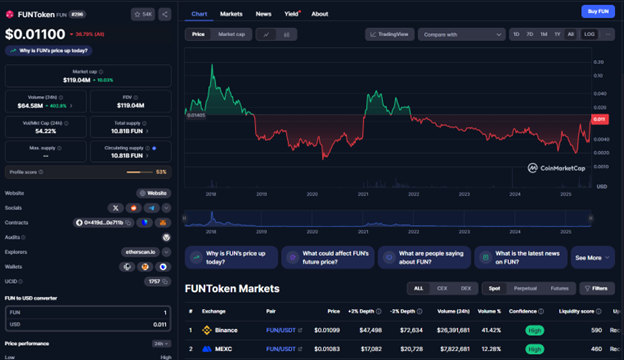
This pricing is a clear indicator of both the market’s appetite for deflationary assets and the growing adoption of FUNToken’s gaming and engagement platforms.

A Burn Model Built on Actual Revenue

The June 24 burn of 25 million FUN was the largest in the project’s history. Unlike projects that promise future burns from unallocated reserves, FUNToken executed this event with revenue generated from its ecosystem. This is a critical distinction. It means that the deflation is sustainable, repeatable, and tied to real economic activity rather than speculative treasury maneuvers.

The burn reduced total supply by about 0.23 percent, sending a clear signal to both holders and observers that FUNToken’s team intends to maintain a deflationary stance for the long term.

Key facts about the burn:

  • The tokens were sent to an irrevocable burn address, guaranteeing they are permanently removed.
  • The event was publicly verified on-chain, reinforcing transparency.
  • The burn was accompanied by clear communication about how future quarterly burns will also be funded through revenue rather than reserves.

CertiK-Audited Immutability: No Minting, No Surprises

Perhaps the most important assurance for any deflationary asset is that no new tokens can be created behind the scenes. In many projects, contracts contain hidden mint functions or privileges that allow the team to reintroduce supply, often without community consent.

FUNToken has addressed this concern head-on by undergoing a comprehensive CertiK audit. The audit concluded that:

  • The contract is immutable, meaning it cannot be changed to enable future minting.
  • There are no administrative functions that allow token supply increases.
  • All burn events are permanent and cannot be reversed or offset by fresh issuance.

CertiK Skynet monitoring adds another layer of transparency by continuously scanning the contract for irregularities or unauthorized transactions. For holders, this provides confidence that the value of their tokens will not be undercut by unseen inflation.

The Role of Deflation in Supporting Market Confidence

Many tokens attempt to create value by promising future utility or speculative demand. While those can be powerful catalysts, they often collapse when markets realize that circulating supply will grow faster than adoption.

FUNToken flips this model by demonstrating a commitment to sustained deflation. The burn completed in June was not a marketing event but a clear sign of how future burns will work. As the platform’s user base expands and revenue increases, larger quarterly burns can be expected.

This model creates predictable scarcity, which is especially important in volatile markets. Even as trading volumes fluctuate, the underlying supply curve is moving in one direction only: down.

Telegram AI Bot: The Engine Driving Adoption

A key part of FUNToken’s deflationary success is its ability to attract and retain users who generate revenue. The AI-powered $FUN Telegram bot is one of the most effective onboarding tools in the space.

The bot’s activity drives volume and generates platform fees that fund the quarterly burns. It also:

  • Lowers the barrier to entry by eliminating the need for complex wallet setups at the start.
  • Provides continuous incentives to stay active, including spins and bonus rewards.
  • Acts as a bridge to deeper participation in the ecosystem as the mobile wallet and gaming features roll out.

This blend of accessibility and economic impact reinforces the deflationary cycle by ensuring that the user base grows alongside token scarcity.

Roadmap Commitments Build Confidence

FUNToken’s deflationary model is credible in part because it is supported by an ambitious but transparent roadmap. The next phases of development are designed to increase both adoption and revenue, which in turn fund additional burns.

The roadmap includes:

  • Q3–Q4 2025: Launch of a mobile wallet with staking and token swaps. This feature will allow users to manage their holdings seamlessly without needing external apps.
  • Q4 2025: Deployment of free-to-play games integrated with FUNToken rewards. Each game will contribute to transaction volumes and platform revenue.
  • Q1 2026: Scaling efforts targeting over 1 million wallets and expanded engagement across the gaming ecosystem.

Why No Minting is So Important

In many tokens, even the promise of deflation can be undone by backdoor supply increases. Holders have seen countless examples of projects that minted new tokens to fund operations or reward insiders, only to watch their value erode over time.

FUNToken’s commitment to no minting is a direct response to this history. CertiK’s audit provides an independent, verifiable guarantee that:

  • There are no privileged functions that allow token creation.
  • The supply cap is enforced at the contract level, not by governance discretion.
  • All burns are permanent, reducing supply in a way that cannot be reversed or diluted.

This certainty is one of the reasons FUNToken is increasingly seen as a credible long-term holding. It allows users to plan with confidence, knowing that their tokens are not subject to hidden inflation risks.

Conclusion

FUNToken’s deflationary strategy represents a meaningful shift in how gaming and engagement tokens can create lasting value. By tying supply reductions directly to revenue, guaranteeing that no future minting can occur, and offering a transparent roadmap for growth, FUNToken provides the kind of structural credibility that many projects lack.

Note: The price mentioned was accurate at the time of writing (July 3, 2025) and may have changed since

Editorial Process for bitcoinist is centered on delivering thoroughly researched, accurate, and unbiased content. We uphold strict sourcing standards, and each page undergoes diligent review by our team of top technology experts and seasoned editors. This process ensures the integrity, relevance, and value of our content for our readers.

Bitcoinist is the ultimate news and review site for the crypto currency community!

Criptomoedas em alta

Leituras Relacionadas

Q-Day Countdown: Will Quantum Computing End Cryptocurrencies?

Quantum Computing's Threat to Cryptocurrency: A Countdown to Q-Day Quantum computing, specifically Shor's algorithm, poses a fundamental threat to the public-key cryptography (e.g., ECDSA, RSA) that secures blockchain networks like Bitcoin and Ethereum. This critical juncture, known as Q-Day, is estimated to occur potentially within the next 5-15 years. The core vulnerability stems from the public and immutable nature of blockchains. Assets in addresses where the public key is already exposed on-chain (e.g., spent outputs) are at direct risk, as a sufficiently powerful quantum computer could derive the private key. This threatens the very trust model of cryptocurrencies. The response lies in Post-Quantum Cryptography (PQC)—algorithms like lattice-based ML-DSA and hash-based SLH-DSA, which are resistant to quantum attacks. NIST has standardized key PQC algorithms (FIPS 203, 204, 205), providing a migration path. However, the primary challenge is not technical but socio-economic and involves complex governance: * **Bitcoin's** path is constrained by its conservative ethos. Migrating requires a soft-fork to new address types, facing hurdles like significantly larger signature sizes and, most critically, the divisive governance question of how to handle at-risk legacy UTXOs without violating core principles. * **Ethereum** is pursuing a "cryptographic agility" strategy, with a multi-layered roadmap. It leverages account abstraction for user accounts and is developing compressed hash-based signatures (e.g., leanXMSS) for its consensus layer, aiming for a full-stack upgrade over time. In conclusion, quantum computing does not spell an instant end for cryptocurrency but initiates a critical countdown. The industry has a limited "engineering comfort window" to orchestrate a coordinated, ecosystem-wide migration to PQC. The ultimate bottlenecks are the immense coordination efforts and governance decisions required for this foundational transition.

marsbitHá 16m

Q-Day Countdown: Will Quantum Computing End Cryptocurrencies?

marsbitHá 16m

Trump, the President Who Knows Best How to 'Trade Stocks'

Former US President Donald Trump reported a record-breaking $2.2 billion in personal income for 2025, the highest annual income ever disclosed by a sitting president. This figure, from a 927-page government ethics filing, represented a 3.5-fold increase from his $600 million income in 2024 and boosted his net worth to $6.5 billion. The primary drivers were cryptocurrency (64% of income, approximately $1.4 billion) and real estate (26%, approximately $575 million). His crypto earnings stemmed largely from the launch of his personal meme coin, $TRUMP, generating over $600 million in licensing fees, and substantial profits from the WLFI token and its parent company. Despite a sluggish property market, his Mar-a-Lago resort and associated golf clubs saw revenue surges of 50% and 27%, respectively, attributed to their use as venues for presidential events. Trump's financial disclosure also revealed an unprecedented level of stock market activity, with over 22,000 trades executed in 2025, averaging 87 trades per market day. Media analyses noted several instances where significant trading coincided with major policy announcements, such as proposed tariffs, raising questions about potential conflicts of interest. While the White House stated these trades were handled by a family-managed trust fund and not Trump directly, critics highlighted this as a departure from the blind trusts traditionally used by presidents post-Watergate. The report has intensified debate over the commercialization of the presidency. Supporters view it as a success story of a businessman-president, while critics argue it demonstrates an unprecedented conversion of public influence into private wealth, with policy decisions potentially linked to personal financial gains. The controversy centers on whether Trump's earnings represent innovative entrepreneurship or a fundamental conflict of interest, sparking renewed calls for stricter ethics reforms in US governance.

marsbitHá 25m

Trump, the President Who Knows Best How to 'Trade Stocks'

marsbitHá 25m

Countdown to Q-Day: Will Quantum Computing End Cryptocurrencies?

The article explores the existential threat quantum computing poses to cryptocurrencies and the urgent need for "post-quantum" migration. It outlines that quantum computers, through Shor's algorithm, could break the elliptic-curve cryptography (ECC) underlying blockchain security, potentially allowing private keys to be derived from public keys. The core challenge is not a lack of post-quantum cryptography (PQC) standards—like NIST's ML-KEM and ML-DSA—but the immense complexity of upgrading entire ecosystems before "Q-Day" (when quantum computers become capable of such attacks, estimated around 2035-2045). Key points include: * **Bitcoin's** risk is concentrated in legacy UTXOs with exposed public keys (e.g., early P2PK outputs). Migration faces massive hurdles: PQC signatures are much larger, increasing transaction size and cost, and the governance dilemma of handling un-migrated assets threatens its "code is law" ethos. * **Ethereum's** strategy focuses on "cryptographic agility," using Account Abstraction for user accounts and developing compressed hash-based signatures (like leanXMSS with SNARK aggregation) for consensus. Its migration is a complex, full-stack overhaul of execution, consensus, and data layers. * The "security debt" is enormous. The comfortable engineering window for a coordinated, ecosystem-wide upgrade is only 5-8 years. High-value infrastructure (exchanges, bridges) may face pressure before mainnet protocols. In conclusion, quantum computing is not an instant "doomsday" event but a forcing function for systemic change. Bitcoin's ultimate test is social consensus and property rights governance, while Ethereum's is technical complexity. Failure to migrate in time could lead to a fundamental re-pricing of crypto assets.

链捕手Há 29m

Countdown to Q-Day: Will Quantum Computing End Cryptocurrencies?

链捕手Há 29m

Losing $55 Million to Sell Bitcoin, MicroStrategy's Faith Reaches Its Interest Payment Day

On July 6th, Michael Saylor's MicroStrategy announced the sale of 3,588 BTC for approximately $216 million, incurring a realized loss of around $55.45 million compared to its average cost basis. This move, contradicting Saylor's long-standing "never sell" Bitcoin philosophy, was executed to pay dividends on its digital credit securities. The article traces this shift from a small "desensitization test" sale of 32 BTC in late May to the board's authorization on June 30th to sell up to $1.25 billion in Bitcoin for corporate purposes like dividends and buybacks. Analysis reveals that MicroStrategy's previous growth "flywheel"—using stock premiums to fund more Bitcoin purchases—has stalled. With its stock trading near a critical threshold (1.22x its Bitcoin NAV), issuing new shares would dilute value. Simultaneously, its financing channels (preferred stock, common stock ATM, convertible notes) are constrained while facing rigid annual dividend/interest obligations of roughly $1.76 billion. Consequently, selling Bitcoin became the calculated "optimal solution" under its own financial model. This transforms MicroStrategy from crypto's most prominent steady buyer into a predictable seller, creating a potential overhead of ~2,400 BTC in monthly selling pressure if obligations are fully covered by sales. This shift challenges the valuation models of the entire Digital Asset Treasury (DAT) sector that emulated MicroStrategy. The company's path forward now hinges on Bitcoin's price recovery, which would allow its preferred stock to trade at par and reopen its financing flywheel, creating a cyclical dependency between the firm's financial model and the asset it holds.

链捕手Há 57m

Losing $55 Million to Sell Bitcoin, MicroStrategy's Faith Reaches Its Interest Payment Day

链捕手Há 57m

Trading

Spot

Artigos em Destaque

Como comprar FUN

Bem-vindo à HTX.com!Tornámos a compra de FUNTOKEN (FUN) simples e conveniente.Segue o nosso guia passo a passo para iniciar a tua jornada no mundo das criptos.Passo 1: cria a tua conta HTXUtiliza o teu e-mail ou número de telefone para te inscreveres numa conta gratuita na HTX.Desfruta de um processo de inscrição sem complicações e desbloqueia todas as funcionalidades.Obter a minha contaPasso 2: vai para Comprar Cripto e escolhe o teu método de pagamentoCartão de crédito/débito: usa o teu visa ou mastercard para comprar FUNTOKEN (FUN) instantaneamente.Saldo: usa os fundos da tua conta HTX para transacionar sem problemas.Terceiros: adicionamos métodos de pagamento populares, como Google Pay e Apple Pay, para aumentar a conveniência.P2P: transaciona diretamente com outros utilizadores na HTX.Mercado de balcão (OTC): oferecemos serviços personalizados e taxas de câmbio competitivas para os traders.Passo 3: armazena teu FUNTOKEN (FUN)Depois de comprar o teu FUNTOKEN (FUN), armazena-o na tua conta HTX.Alternativamente, podes enviá-lo para outro lugar através de transferência blockchain ou usá-lo para transacionar outras criptomoedas.Passo 4: transaciona FUNTOKEN (FUN)Transaciona facilmente FUNTOKEN (FUN) no mercado à vista da HTX.Acede simplesmente à tua conta, seleciona o teu par de trading, executa as tuas transações e monitoriza em tempo real.Oferecemos uma experiência de fácil utilização tanto para principiantes como para traders experientes.

286 Visualizações TotaisPublicado em {updateTime}Atualizado em 2026.06.02

Como comprar FUN

Discussões

Bem-vindo à Comunidade HTX. Aqui, pode manter-se informado sobre os mais recentes desenvolvimentos da plataforma e obter acesso a análises profissionais de mercado. As opiniões dos utilizadores sobre o preço de FUN (FUN) são apresentadas abaixo.

活动图片