Биткоин ожидает нового максимума на фоне крайнего срока введения пошлин

cryptonews.ruPublicado em 2025-05-07Última atualização em 2025-07-07

Биткоин может обновить исторический максимум уже в ближайшие дни. Внимание рынка сосредоточено на двух ключевых событиях: завершении 90-дневного моратория на взаимные пошлины между США и ЕС в среду, а также на «Неделе криптовалют», которая пройдёт в столице страны.

«Биткоин, скорее всего, установит новый исторический максимум на этой или следующей неделе», — заявил в понедельник Маркус Тилен, руководитель исследований в 10x Research.

Он добавил, что сезонность после праздника Дня независимости 4 июля традиционно склоняется к росту, а рынки в значительной степени игнорируют риски, связанные с возможным введением тарифов.

Крайний срок истечения 90-дневного моратория — 9 июля. Именно тогда станет ясно, будут ли вводиться новые пошлины.

«Если США решат снова отложить их введение, это может быть воспринято рынками как сигнал нежелания вводить ограничения, что подстегнёт аппетит к риску», — сообщили аналитики UBS Global Wealth Management в заметке, цитируемой The Wall Street Journal.

«Биткоин, похоже, готовится к прорыву вверх», — согласился Джон Боллинджер, создатель технического индикатора Bollinger Bands, высказавшись об этом ещё в воскресенье.

Цена на биткоин в понедельник ненадолго превысила $109 500, находясь всего в 2% от своего исторического максимума, зафиксированного 22 мая.

Впереди волатильная неделя

«Вероятно, эта неделя будет неспокойной», — отметил главный инвестиционный директор Apollo Capital Хенрик Андерссон.

«Мы полагаем, что есть хорошие шансы на то, что США и ЕС подпишут рамочное соглашение на этой неделе», — добавил он.

Андерссон также упомянул, что Илон Маск снова упомянул биткоин в X (бывший Twitter), что, возможно, свидетельствует о его намерении вновь стимулировать интерес к активу.

«Любая коррекция вниз на этой неделе может стать хорошей возможностью для покупки перед следующей неделей, которая объявлена «криптовалютной неделей» в Вашингтоне», — заключил он.

Рынки уже растут

Ранее трейдеры опасались роста волатильности перед дедлайном по тарифам 9 июля, сообщил главный операционный директор биржи BTSE Джефф Мэй.

Однако, по его словам, «похоже, что рынки начали расти после того, как стало известно, что у сторон появилось больше времени для переговоров до вступления пошлин в силу в начале августа».

«Если во вторник мы увидим позитивные данные, рынки, вероятно, продолжат восходящее движение», — добавил он.

По данным CoinGecko, общая капитализация крипторынка выросла более чем на $50 млрд за последние 24 часа после относительно спокойных выходных.
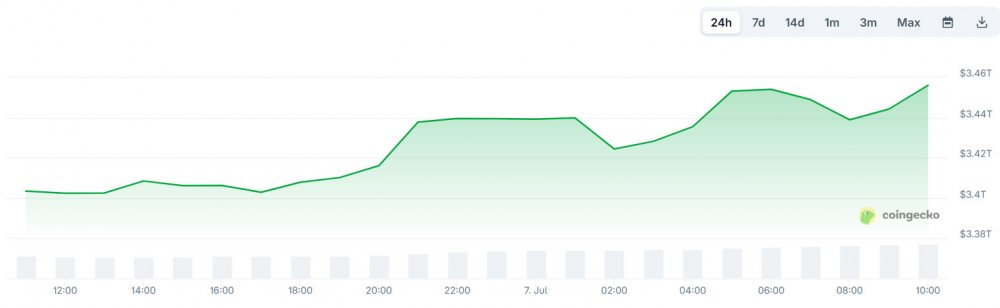

Общая рыночная капитализация за последние 24 часа. Источник: CoinGecko

Потенциал сезона альткоинов

Тем временем Ник Рак, директор LVRG Research, сказал, что трейдеры могут начать обращать внимание на альткоины в поисках потенциала роста. По его мнению, во второй половине года ожидается усиление волатильности и скачков цен на цифровые активы.

«Мы ожидаем, что биткоин войдёт в новую зону ценообразования, как только преодолеет свой исторический максимум», — добавил он.

Юджин Чунг, коммерческий директор платформы цифровых активов OSL, также уверен в позитивном развитии событий.

«Мы уверены, что всё больше инвесторов обратят внимание на биткоин и эфир как на инструменты защиты от макроэкономической неопределённости и возможного роста инфляции, особенно на фоне сигналов ФРС о потенциальном снижении процентных ставок в этом году», — поделился он оптимизмом.


Leituras Relacionadas

Alliance's Co-Founder's Letter to Entrepreneurs: Written on the Occasion of Cursor's $60 Billion Sale

In this letter to entrepreneurs, Alliance reflects on the success of Cursor's $60 billion sale to Elon Musk, using it as a case study to counter the misconception that opportunities in crowded fields like AI or crypto are exhausted. The piece argues that great companies like Cursor, Stripe, Figma, and Shopify are not built by geniuses with perfect ideas, but by founders who start with a non-consensus belief about the future and build for years before that future becomes obvious to everyone. They identify long-term shifts, find overlooked entry points, and execute relentlessly. The framework for success involves: 1. **Identifying your place in the technology cycle**: Early-stage opportunities focus on making new tech usable for power users (e.g., Coinbase, Cursor). Later-stage opportunities involve finding the "yin" to an existing "yang"—the blind spots of first-generation players (e.g., Stripe vs. PayPal, Figma vs. Adobe). 2. **Cultivating unique insights**: Immerse yourself deeply in the market. Use every product, talk to users, and build an audience. Insights will emerge naturally from deep engagement. 3. **Finding a "hair-on-fire" problem**: Look for a 10x improvement or a severe, urgent pain point. The strongest signal is people already building clumsy workarounds. 4. **Building a focused MVP**: Don't just add features because you can. Ask why users would abandon their current tool for yours. The best startups rarely force new behaviors; they improve familiar workflows with drastically lower friction. 5. **Winning a distribution channel**: Distribution is often the moat. Before product-market fit, achieve channel-market fit. Find where your customers are and build an engine to reach them, even through unscalable, manual efforts initially. 6. **Persistence**: The final, unteachable ingredient is resilience. Success stories like Cursor, Airbnb, and Nvidia involved years of grinding, rejection, and perseverance when the path forward seemed unclear. The conclusion is that there is no secret. Most people fail to consistently execute these steps over the long term. The few who do build the companies that define the next era. The world is yours to create.

链捕手Há 3m

Alliance's Co-Founder's Letter to Entrepreneurs: Written on the Occasion of Cursor's $60 Billion Sale

链捕手Há 3m

Crypto Miners' Big AI Gamble: Valuations Enter Differentiation Stage, Comeback Fight Proves Tough

Crypto Mining Firms' AI Bet: Valuation Divergence and a Challenging Transformation Facing declining profitability in crypto mining, mining companies are pivoting to AI infrastructure, capitalizing on their existing power resources, land, and data center expertise to offer GPU compute power. This transition narrative has boosted their stock prices significantly, with firms like Hut 8 and Bitfarms seeing gains over 100% year-to-date, far outpacing Bitcoin. This has led to a market valuation split, with pioneers like CoreWeave reaching a $62.8B market cap, while others remain below $5B. The market currently prioritizes growth potential over short-term profits, which remain under pressure due to heavy capital expenditures for AI build-outs and crypto asset volatility. However, the transformation is a high-stakes gamble. Bitcoin mining profitability is shrinking, with the average production cost around $63,707 and miner margins contracting. While AI offers a more lucrative long-term path, it requires massive investment—estimated at a $500B near-term funding gap. Success now hinges on execution: delivering on contracted power capacity, securing quality tenants like major cloud providers, and managing the immense financial burden. The valuation focus is shifting from mere power capacity to project delivery, future cash flows, and tenant quality, making this a difficult but critical turnaround attempt.

链捕手Há 12m

Crypto Miners' Big AI Gamble: Valuations Enter Differentiation Stage, Comeback Fight Proves Tough

链捕手Há 12m

Analysis of the Latest Portfolio Adjustment by the "Top Player" in the U.S. Stock Market: $9 Billion Short on NVIDIA, Shifting Focus to Power and Memory Sectors

AI investor Leopold Aschenbrenner has made a significant portfolio shift, taking a $9 billion nominal short position against top AI infrastructure stocks like NVIDIA, ASML, and Oracle. Simultaneously, he is redirecting capital towards what he sees as the next critical bottlenecks in the AI boom: power, memory, and data center networking, alongside private investments in AI model companies like Anthropic. This move is interpreted not as a call that the AI bubble has burst, but as a rotation within the infrastructure stack. The analysis highlights NVIDIA's recent $25 billion bond issuance as a potential signal, questioning why a cash-rich company would seek external debt despite high profits and increased dividends/buybacks. The core investment thesis is that the initial, crowded "picks and shovels" trade in semiconductors is maturing. The next wave of capital is expected to flow into the physical and logistical constraints of AI expansion: electricity supply, memory chip capacity, data center construction, and enabling technologies like optical networking (fiber) for high-bandwidth communication, where copper remains crucial for short distances. Aschenbrenner's substantial (approx. 20% of fund) private stake in Anthropic is noted as a key part of his strategy—investing directly in the "mine" (AI models) rather than just the "shovels." The discussion concludes that while certain segments may be overvalued, the overarching AI infrastructure demand driven by real product usage remains robust. The most promising long-term investments are seen in essential, non-sexy infrastructure—particularly energy and power companies—whose demand is viewed as a global constant irrespective of AI's cyclicality.

marsbitHá 33m

Analysis of the Latest Portfolio Adjustment by the "Top Player" in the U.S. Stock Market: $9 Billion Short on NVIDIA, Shifting Focus to Power and Memory Sectors

marsbitHá 33m

BIT Research: Liquidity is Disappearing, Will Bitcoin Replay the Bottoming Pattern of 2022?

The crypto market is currently in an adjustment phase driven by policy expectations and liquidity shifts. Despite a brief rebound fueled by geopolitical easing and SpaceX's strong IPO performance, unexpectedly hawkish signals from new Fed Chair Kevin Warsh have removed anticipated easing support. Concurrently, stablecoin liquidity is shrinking, with insufficient new capital inflows, pushing the market into a typically quiet summer period. Pricing lacks catalysts for a sustained rally. Daily trading volume has significantly contracted, stablecoin growth has slowed markedly, and the supportive effect of Strategy's (formerly MicroStrategy) STRC preferred stock-financed Bitcoin purchases is fading. Amid policy uncertainty, seasonal weakness, and liquidity contraction, Bitcoin faces near-term downward pressure. Warsh's hawkish pivot and refusal to provide a clear policy outlook have increased risk premiums, historically unfavorable for Bitcoin. Technically, the trend remains bearish below $73,700, with $62,446 as critical support. A break below could accelerate declines, though a prolonged consolidation phase, similar to 2022's bottoming process, is possible. Liquidity is a core constraint. Current daily volume is around $500 billion, roughly 25% of the peak during the July-Oct 2025 rally. The 12-month growth rates for USDT and USDC have fallen to ~20%, with 6-month growth near zero, indicating weak new inflows. Bitcoin ETF and Strategy-driven inflows have also weakened, with a 30-day rolling net outflow. With inflation at 4.2% above the Fed's target, combined hawkish policy, seasonal factors, and liquidity shortages challenge Bitcoin's ability to hold above $60,000. However, this adjustment phase may be forming a cyclical low this summer, potentially setting the stage for the next bull cycle.

marsbitHá 1h

BIT Research: Liquidity is Disappearing, Will Bitcoin Replay the Bottoming Pattern of 2022?

marsbitHá 1h

Trading

Spot
Futuros
活动图片