Robinhood发行“OpenAI代币”遭抵制,合成股权的法律边界在哪里?

marsbitPublicado em 2025-07-02Última atualização em 2025-07-03

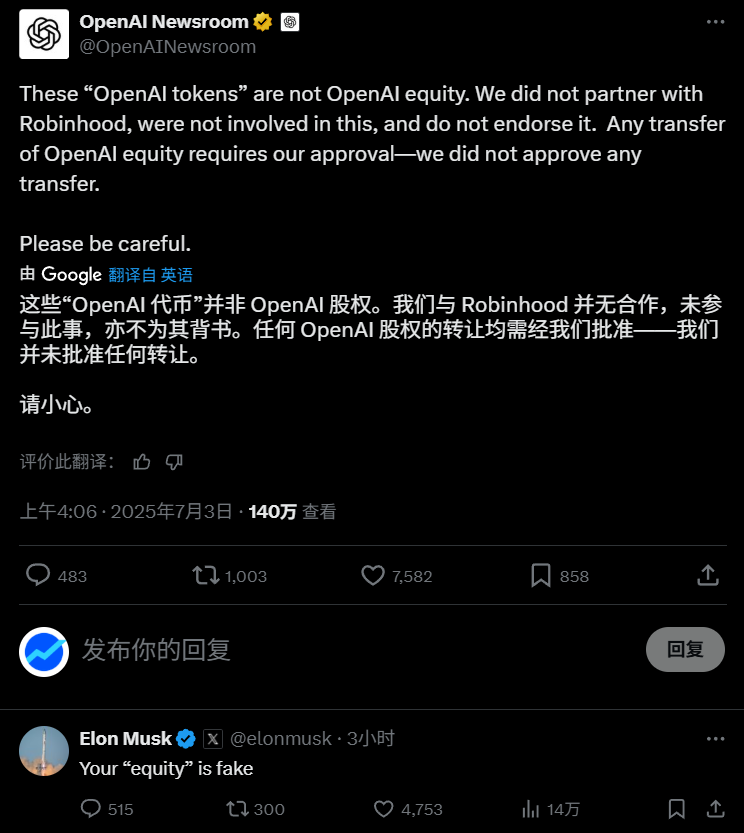
初夏的法国戛纳,本是电影与艺术的殿堂,却意外上演了一出金融科技领域的高风险戏剧。Robinhood的首席执行官Vlad Tenev在镁光灯下,意气风发地展示了一枚代表OpenAI头寸的“股票代币”,试图将其描绘为金融民主化革命的又一里程碑。然而,这场精心策划的表演,几乎在瞬间就遭到了来自大洋彼岸的精准狙击。人工智能巨头OpenAI发布了一份简短但措辞严厉的声明,字里行间透露出不容置喙的立场:“我们未与Robinhood合作,未参与,也不认可此行为。”
私募股权

这并非简单的公关口水战,而是一场深刻的、关乎金融世界底层逻辑的冲突。它标志着硅谷“快速行动,打破常规”的颠覆者精神,与私募股权市场“层层许可”的保守壁垒之间的一次正面碰撞。这起事件如同一枚探针,深入到金融创新的灰色地带,其核心并非技术本身,而是一场精心设计的、游走在法律边缘的实验。


剥开“代币”外衣:合成衍生品的内核

要洞悉这场争议的核心,我们必须穿透“代币”这一光鲜的技术概念,审视其真正的金融构造。Robinhood提供的“OpenAI代币”并非真正的股票。正如OpenAI在声明中精准指出的那样,“任何OpenAI股权的转让都需要我们的批准”。这句看似平淡的话,实则点明了私募市场的核心规则。与任何人都能在公开市场买卖苹果或特斯拉股票不同,非上市公司的股权转让受到严格的股东协议约束,任何交易都必须经过公司董事会的同意。这是一个封闭且高度管制的“许可制”世界,旨在保护公司免受不必要干扰,并确保股东结构的稳定可控。

那么,Robinhood是如何绕开这道壁垒的呢?他们采用了一种经典的金融工程工具——特殊目的实体(SPV)。其运作模式是:由一个SPV在法律上持有真实的OpenAI股份或其衍生品,然后Robinhood再发行代表对该SPV资产拥有债权的代币。因此,当一个欧洲用户购买这枚代币时,他得到的并非OpenAI的股东身份,而是对Robinhood所控制的那个SPV的一份债权。这是一种合成衍生品,其本质是追踪OpenAI的估值变化,为投资者提供“经济敞口”,而非真正的所有权。


挑战私募股权的护城河

这种结构与在欧洲广受欢迎的差价合约(CFD)惊人地相似。正如迪拜加密货币交易所Freedx首席商务官Anton Golub所言:“这只是一个包装……它不是真正的股权。”投资者购买的,实际上是一个追踪真实资产价格的衍生品合约。这正是本次事件法律风险的第一个关键点:Robinhood正在进行一场豪赌,赌的是在法律上,“提供经济敞口”不等于“转让股权”。如果这一逻辑成立,那么任何一家热门的私营公司,从SpaceX到Stripe,都可能在未经其许可的情况下,被动地拥有一个在全球范围内交易的“合成股票”。这无疑是所有私营公司创始人和投资者最不愿看到的局面,因为它从根本上挑战了他们对自己公司控制权和股东名册的掌控力。

OpenAI的激烈反应,正是源于对这种潜在失控的警惕。而当这场风波在社交媒体上发酵时,一位重量级人物的登场,则让剧情变得更加精彩。埃隆·马斯克,这位从不缺席任何热点的科技领主,在OpenAI的声明下留下了一句极具他个人风格的评论:“Your ‘equity’ is fake”(你的“股权”是假的)。

表面上看,这似乎只是对Robinhood的嘲讽,附和了OpenAI的说法。但马斯克的真正高明之处,在于他给“equity”(股权)这个词加上了意味深长的引号。这使得一条简单的评论,变成了一场“一石二鸟”的舆论战。考虑到他与OpenAI复杂的历史——作为联合创始人之一,他如今正在起诉OpenAI背离了最初的非营利使命——马斯克此举的矛头,显然也精准地对准了OpenAI本身。他仿佛在隔空喊话:“你们OpenAI有什么资格谈论真正的股权?你们自己如今的营利性架构,相对于创立时的初心,难道不也是一种‘假的’股权吗?” 这一手操作,既打击了Robinhood产品的合法性,又巧妙地攻击了宿敌OpenAI的道义基础,堪称企业公关战中的经典案例。


MiCA与MiFID II的监管

Robinhood选择在欧盟首发其产品,更是将这场法律博弈的复杂性提升到了一个新的维度。这是一次深思熟虑的司法管辖区套利。相较于美国严格的“合格投资者”制度(即只有高净值或高收入人群才能投资非上市公司股权),欧盟对散户投资者参与复杂金融产品交易的门槛相对更低,这为其提供了一个更为宽松的试验环境。

然而,宽松不代表没有规则。Robinhood此举,正把自己置于欧盟两大核心金融监管法规——《加密资产市场法规》(MiCA)与《金融工具市场指令II》(MiFID II)——的交叉路口,引发了一场关键的定性难题。MiCA是欧盟为加密资产量身打造的全新框架,而MiFID II则是监管传统金融工具(包括证券和衍生品)的成熟法规。问题的关键在于,MiCA明确规定,其不适用于已被MiFID II等现有金融法规涵盖的资产。

因此,欧洲的监管者面临一个棘手的选择:Robinhood的“OpenAI代币”究竟是一种应由MiCA管辖的新型“加密资产”,还是一种用新技术包装的、应遵循MiFID II的传统“金融工具”?如果被归类为MiCA下的加密资产,Robinhood或许能在一个相对更新、对加密更友好的框架下运营。但如果其衍生品属性被认定为主导,从而被划归为MiFID II下的金融工具,那么它将面临一套完全不同且通常更为严格的监管要求。这个单一产品的定性,将对整个行业的未来产生深远影响,它将为后续无数试图将传统资产代币化的项目划定清晰的法律边界。


小结

综上所述,OpenAI与Robinhood的风波,与其说是一场科技创新,不如说是一场高超的法律与金融工程实践。它暴露了当颠覆性技术试图渗透到壁垒森严的传统领域时,必然会引发的法律与文化冲突。Robinhood正行走在一根紧绷的法律钢丝上,一边是私募股权不可动摇的契约精神,另一边是欧洲监管体系尚在演进中的模糊地带。

无论这场实验最终走向何方,它都提出了一个无法回避的问题:在一个全球化、技术化的时代,当市场对优质资产的投资需求如此强烈时,传统的、基于地域和身份的准入壁垒还能维持多久?这起事件表明,如果传统的合规路径对普通投资者持续关闭,市场终将以自己的方式,无论是通过优雅的创新还是激进的冲撞,去寻找绕过障碍的途径。而法律和监管,也终将在一次次这样的碰撞中,被迫加速演化,以适应一个日益被代币化的未来。


Leituras Relacionadas

Super Spiral Mega-Boom, Micron's Earnings Report Rekindles the Semiconductor Bull Run

On June 25, 2026, Micron Technology released its blockbuster Q3 FY2026 results, significantly exceeding market expectations and reigniting confidence in the semiconductor bull market. Revenue soared to $41.456 billion (vs. ~$35.4B expected), up 346% year-over-year, while GAAP net profit surged nearly 15 times to $28.243 billion. Guidance for Q4 was even more striking, with projected revenue of approximately $50 billion, far surpassing prior estimates. The report highlighted that the AI boom is now fueling growth across Micron's entire product stack, not just HBM. Cloud memory, core data center, SSD, mobile, and automotive businesses all saw revenue growth exceeding 250-600%, with margins hovering around 80%. While HBM4 is already in volume shipment and 2026 capacity is sold out, AI-driven demand is also tightening supply for traditional DRAM and NAND, sustaining a strong pricing cycle. A pivotal development is Micron's shift toward a "demand-first" model. The company disclosed 16 long-term strategic customer agreements (SCAs), most spanning 5 years to 2030, covering about 20% of DRAM and one-third of NAND shipments. These are take-or-pay contracts, with 14 agreements already securing roughly $100 billion in guaranteed future revenue and $22 billion in customer performance assurances. To fulfill this locked-in demand, Micron plans substantial capacity expansion, with Q4 capital expenditure projected at ~$10 billion. This investment, backed by concrete long-term orders rather than cyclical speculation, marks a historic change for the memory industry. Following the earnings release, Micron's stock surged 16% after-hours, lifting the broader semiconductor sector globally. The report served as a powerful signal that AI infrastructure build-out is accelerating, with memory positioned as a central protagonist in the ongoing narrative.

Odaily星球日报Há 18m

Super Spiral Mega-Boom, Micron's Earnings Report Rekindles the Semiconductor Bull Run

Odaily星球日报Há 18m

Deciphering the Ethereum Foundation's New Structure: Reaffirming Self-Sovereignty Amid Institutionalization Trends

Summary: The Ethereum Foundation (EF) has announced a major restructuring, laying off 20% of its staff and introducing a new five-layer operational framework. This move aims to clarify the EF's mission and reaffirm Ethereum's core principle of self-sovereignty amidst growing institutionalization in the crypto space. The five layers are: 1. **Protocol Layer**: Focuses on maintaining Ethereum's foundational "CROPS" values—Censorship-resistant, Robust, Open, Private, and Secure. This involves core technical work like secure hard forks and mitigating toxic MEV. 2. **Access Layer**: Ensures users can practically exercise self-sovereignty through actions like reading the chain and making transactions. A key principle is the "zero option," meaning a trusted, non-intermediated path must always exist as an alternative to any centralized service. 3. **User Layer**: Bridges the protocol and access layers by grounding EF's work in the real needs of users and organizations. This is seen as crucial for moving beyond a purely research-driven approach and ensuring development effectively serves the ecosystem. 4. **Community Layer**: Responsible for building and maintaining consensus around Ethereum's core values both internally and externally. This involves guarding against centralization, upholding technological neutrality, and preventing short-term commercial interests from undermining CROPS principles. 5. **Institutional Layer**: Manages EF's engagement with institutions, but with the precondition of self-sovereignty. The goal is not to make it easier for institutions to control users, but to demonstrate how Ethereum's technology can enable better integrations. The article argues that while institutional adoption brings legitimacy, it also risks diluting crypto's foundational ethos of decentralization. The new structure represents EF's effort to navigate this tension, upholding its core mission while actively engaging with a broader, more complex ecosystem.

marsbitHá 36m

Deciphering the Ethereum Foundation's New Structure: Reaffirming Self-Sovereignty Amid Institutionalization Trends

marsbitHá 36m

OpenRouter: How Did This 'AI Model Relay Station' Achieve a $10 Billion Valuation?

OpenRouter: The Model Router Building a $10B+ Company This article explores OpenRouter, a platform that aggregates access to over 400 AI models from 70+ providers (like OpenAI, Claude, Gemini) through a single API. It has grown into a unicorn with a $1.3B valuation by 2026, processing massive scale—reaching 100 trillion tokens monthly. Its core value isn't just being a "model supermarket." For developers building real-world AI applications, managing multiple models for different tasks (e.g., cheap models for titles, powerful ones for long articles) is complex. OpenRouter acts as a critical "model scheduling layer," handling routing, failover between providers, cost optimization, and enterprise features like zero-data-retention policies and budget controls. OpenRouter's business model is a "toll fee": it charges a small platform fee (5.5%) on purchased credits while passing model costs directly to users. Its revenue scales with the tokens flowing through its system, which saw explosive growth as AI apps evolved. Key growth drivers include: 1) The explosion of specialized models, increasing choice complexity; 2) AI apps shifting focus from performance to cost optimization; 3) The rise of AI agents that require more reliable, multi-step model calls. However, risks remain. Large enterprises or cloud providers (AWS, Google Cloud) could build similar internal gateways. Its position between model suppliers and developers could also create future tension over pricing and data control. To stay ahead, OpenRouter must deepen its enterprise features and prove it's more than just a request forwarder.

marsbitHá 56m

OpenRouter: How Did This 'AI Model Relay Station' Achieve a $10 Billion Valuation?

marsbitHá 56m

Bitcoin Falls Below $60,000 Again; After 20 Months, We've Reached a New Low

Bitcoin Drops Below $60,000, Hitting a 20-Month Low Bitcoin fell below the key $60,000 psychological level again, reaching a low of $59,023—its lowest point in approximately 20 months, dating back to October 2024. While it later recovered slightly to around $60,600, this marks its third significant breach of $60,000 this year. The downturn is attributed to two primary factors. First, U.S. spot Bitcoin ETFs are experiencing their longest streak of net outflows since launch, with nearly $5.94 billion withdrawn over 30 days. This creates sustained selling pressure as Authorized Participants sell Bitcoin to meet redemptions. Second, shifting macroeconomic expectations are adding pressure. Strong U.S. job data and hawkish remarks from Fed officials have increased market pricing for potential rate hikes, reversing the earlier liquidity-driven bullish sentiment and prompting a shift away from risk assets like Bitcoin. Analyst views are mixed. 21Shares maintains a bullish long-term outlook, expecting prices to recover towards $100,000, citing historical post-halving cycles and substantial ETF holdings as a base. In contrast, Arthur Hayes predicts a potential bottom around $40,000 within six months due to persistent Fed hawkishness. CryptoQuant suggests, based on on-chain data, that the market may not find a bottom until prices fall below the average investor cost basis around $53,000, potentially extending the bearish phase into late 2026 or early 2027. The immediate focus is on upcoming U.S. inflation data and Fed signals. Lower-than-expected CPI could offer relief, but confirmation of sticky inflation or continued ETF outflows may lead to further downside pressure. Bitcoin's ability to hold above $60,000 remains a critical test for the near-term market direction.

Odaily星球日报Há 1h

Bitcoin Falls Below $60,000 Again; After 20 Months, We've Reached a New Low

Odaily星球日报Há 1h

Trading

Spot
Futuros
活动图片