解码底部信号:加密市场的崩盘与反弹剧本

深潮Publicado em 2025-06-23Última atualização em 2025-06-23

需要理解风险背后的心理机制,并借此优势来识别潜在的市场底部。

作者:Doc

编译:Tim,PANews

这篇撰文的目的是让你了解我如何识别市场中的关键信号。我们需要理解风险背后的心理机制,并借此优势来识别潜在的市场底部。

1.共识越低的项目越先崩盘

当不确定性袭来,卖家会抛售他们最不看好的资产。例如,共识低的币将率先崩盘,更早失血。

从逻辑上想想:如果你急需用钱,不会去卖你的贵重物品,而是卖掉那些平时用不着、不值钱的东西。

同样地,当交易员不确定市场走势或希望降低风险时,往往会变卖自己情感依赖最低的资产来套现。

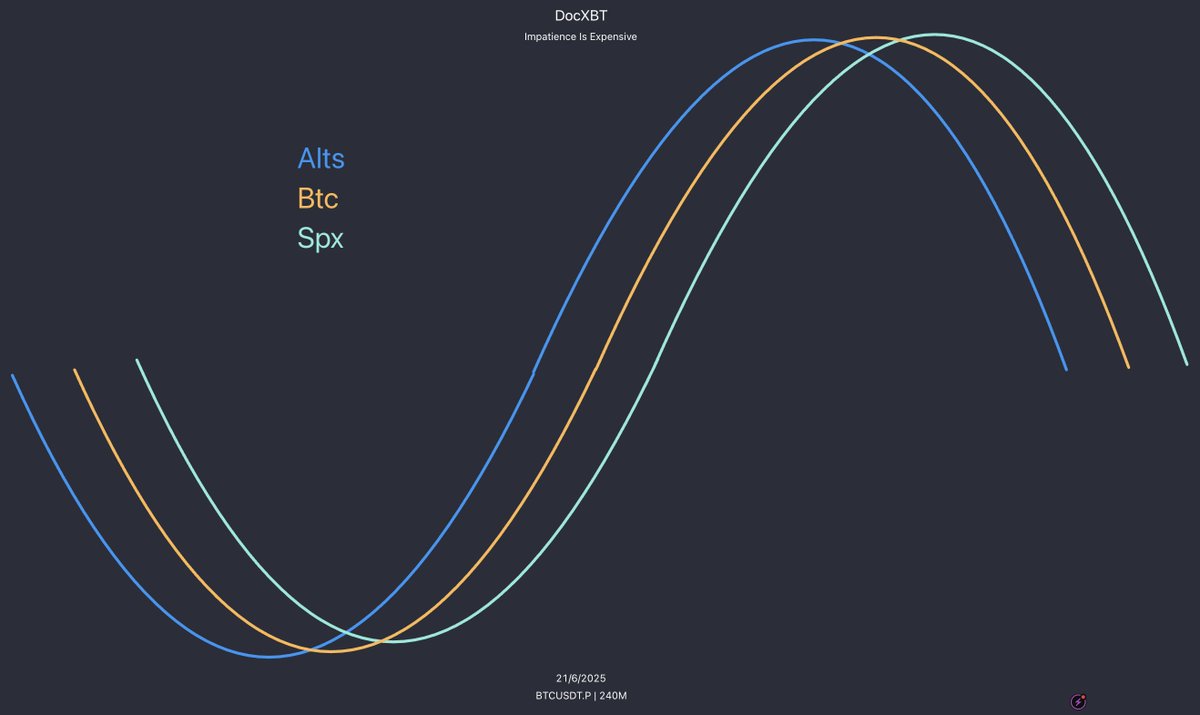
这种现象在比特币每次冲顶时都会发生,绝非巧合。山寨币并非在比特币登顶后上涨,而是伴随比特币登顶同步上涨。它们更早在比特币面前显露出一丝疲态,数周前就已率先见顶。

这是一个早期预警信号。聪明的交易者会在其他人还未察觉要发生什么事之前就先行降低风险。

2.风险VS蓝筹币

让我们回到之前的那个逻辑:人们会尽可能长久地保留自己珍视的高品质财物,只有在走投无路时才会忍痛割爱。

那些最受追捧的币种,通常都会尽可能地守住已有的涨幅。这就是为什么比特币总是一副坚挺的样子,而每次市场崩盘前几周,网上总会充斥着“大家慌什么,比特币明明稳得很”之类的推文。

抛售顺序:

a)先是垃圾币

b)然后是蓝筹币

c)最后所有币都被抛售

3.反身性效应出现

疲软会导致更多的疲软。

当巨鲸开始在枯竭需求中抛售时,就会诱发市场疲软。这是典型的筹码派发阶段特征:接盘乏力、需求枯竭、趋势走远等现象。

风险资产的特征转变,将使经验丰富的交易员中核心决策层重新评估策略。

"我没能在顶部卖出,但行情性质已变。是时候降低敞口或平仓了。"

"要是这种跌幅都算核爆级崩盘,我账户里还藏着什么雷?"

突然间:仓位调整引发更大的抛售,这就是反身性,风险偏好消退的正反馈循环。

4.波动性:最后一舞

​​当比特币大跌将至,市场常现诡静:波动骤降、行情窄幅震荡、自满心态登顶。​​

然后,砰~,就崩盘了。

​​现在,让我们聚焦平衡与失衡的市场本质。​​

平衡在市场参与者对何为昂贵、何为便宜逐渐达成共识时达成。这是一场​​共舞​​。这就是​​均衡​​。

均衡则意味着平静。​​ 已知信息已被消化、投机活动减弱、波动性收窄​​。

这场​​共舞​​会持续下去,直到一方感到厌倦、疲惫,或者想去酒吧再喝一杯。即,买方或卖方筋疲力竭;或者供给、需求发生改变。

均衡遭到破坏​​。一旦它被打破:便出现​​失衡​​。

价格剧烈偏离原位。​​ 价值变得模糊不清;​​波动性暴增​​。市场渴望平衡并会​​主动寻求​​ 。

价格常常会​​回归到最近形成过平衡的区域​:如高成交量点、订单块、综合价值区域等。

正是在这些区域,你会看到最​​猛烈的反弹​​。

“​​初测即最佳时机​​”。后续测试的反应会逐渐减弱。情况趋于结构化。价格在新点位企稳。波动性收缩。平衡重现于市。

5.抛售进程及底部识别

投降抛售并非终局的开始,而是中局的终结。

a)山寨VS比特币

本轮周期中,山寨币往往在比特币崩盘前完成主要抛售。

最近案例:Fartcoin在二月底比特币崩盘前,已从高点回落88%。既然该规律成立,我们便可在寻找市场衰竭信号(触底迹象)时将其作为交易信号。

当比特币仍在剧烈波动、寻得新平衡时,最强的山寨币会率先显现相对强势的枯竭迹象。

简单来说,当比特币进入失衡后期阶段时,应该寻找优质替代币来建立平衡仓位。

作为参与者,我们的目标是捕捉这些背离现象。

"市场动能是否转变?"

"波动性是否在收窄?"

"抛售速度是否正在放缓?"

"当比特币创新低时,它是否仍能稳住?"

第二季度见底信号:

  1. 动量减弱 (比如Fartcoin)

  2. SFP、偏离度 (比如Hype、Sui公链)

  3. 更高的低点VS比特币更低的点(比如Pepe币)

山寨币通常先跌为敬,待比特币触底后其跌势反而放缓。

​​甄别优质山寨币的诀窍在此。​​

弱者恒弱。

强者悄然布局,抢在市场行情启动之前。

b)比特币VS标普500

现在给大家安排一个小练习吧。

整合本文的所有概念,或许以下现象就变得合理了:

  • 23年夏季:比特币先于标普500见顶,更早完成筑底

  • 24年夏季:比特币先于标普500见顶,并在区间低位消化了标普因宏观因素引发的暴跌

  • 25年迄今:比特币先于标普500见顶,并在区间低位承受了标普20%的暴跌

​​核心结论​​

市场筑底是过程而非瞬间完成:山寨币先行 → 比特币接力 → 标普殿后

​​操作要义​​:重点观察市场结构演变,而非单纯跟踪情绪波动

Leituras Relacionadas

Stablecoins Becoming the Next Policy Challenge for the Fed's Walsh Version

Fed Governor Christopher Waller's speech at the June 22 conference on the U.S. dollar's international role signifies a notable policy shift: stablecoins like USDT and USDC are now being formally considered as potential channels for transmitting U.S. dollar liquidity globally. With their combined market cap surpassing $250 billion and high transaction volumes, these digital assets are moving from the periphery of crypto policy to the core of monetary system research. The key concern for policymakers is how stablecoin flows interact with traditional dollar infrastructure. Their growth could affect bank deposits, demand for short-term Treasury securities (like T-bills), and global access to dollars, depending on whether demand originates overseas or substitutes for domestic bank balances. Issuers' reserve management—holding assets in banks, money market funds, or Treasuries—links stablecoin activity directly to these core markets. The Fed's research agenda now examines whether stablecoins, by combining payment and balance-holding functions on digital rails, could complicate monetary policy implementation or transmit liquidity stress to banks. While current Treasury holdings by issuers are under 1% of the total market, their concentrated demand could marginally impact yields, especially during periods of stress. Consequently, stablecoins are evolving from mere crypto trading tools into a private-layer dollar transmission system with public policy implications, prompting closer regulatory scrutiny of their reserve robustness, redemption mechanisms, and systemic integration.

marsbitHá 2m

Stablecoins Becoming the Next Policy Challenge for the Fed's Walsh Version

marsbitHá 2m

A 380% Soar, Shenzhen’s 100-Billion-Yuan IPO Rings the Bell

HKC Holdings, a major Chinese display panel manufacturer, has successfully listed on the Shenzhen Stock Exchange's main board. The company's shares surged over 380% on its debut, pushing its market capitalization to around 350 billion yuan (formerly reaching 500 billion yuan). Founded by Wang Zhiyong in Shenzhen's Huaqiangbei electronics market nearly three decades ago, HKC evolved from assembling monitors to becoming a global top-tier supplier of semiconductor display panels for TVs, monitors, and smartphones. The IPO marks a significant milestone for HKC and its backers. The company's growth into the capital-intensive panel manufacturing sector was supported through partnerships with state-owned capital from regions like Chongqing, Mianyang, and Chuzhou. Its shareholder list also includes BOE Technology's investment arm. In recent years, HKC reported strong financials, with core panel business contributing over 70% of revenue and clients including Samsung, TCL, and Xiaomi. This listing is seen as part of a broader trend in Shenzhen's evolving tech landscape. Beyond established giants, the city is nurturing clusters of leading companies in specialized sectors like robotics—exemplified by the "Shenzhen Robot Valley"—and storage chips, where a group of firms dubbed the "Storage Five Tigers" has achieved a combined trillion-yuan market valuation. Shenzhen's strategic focus on emerging industries such as AI terminals, low-altitude economy, and humanoid robotics aims to build new industrial depth and foster the next generation of tech champions.

marsbitHá 14m

A 380% Soar, Shenzhen’s 100-Billion-Yuan IPO Rings the Bell

marsbitHá 14m

Domestic First Explosion-Proof Certification, World's First Fueling Brain Solution: How Did They Secure Two 'Firsts'?

China's embodied AI sector is booming, with over ¥37 billion in funding this year. The focus has shifted decisively to real-world application, particularly in hazardous, repetitive tasks humans should avoid. A key, often prohibitive, barrier to entry for robots in environments like gas stations and oil fields is obtaining explosion-proof certification, requiring meticulous hardware and circuit design from the ground up. The article explores three main application areas. At gas stations, the challenge lies in executing a long, precise sequence of actions (opening caps, handling the fuel nozzle) with millimeter accuracy across diverse car models. For facility inspections, robots need sustained autonomous patrols combined with real-time anomaly detection and response. Port scenarios introduce the complexity of multi-robot coordination. Addressing the core challenge of long-horizon tasks, the piece highlights a technical breakthrough: a "world model"-driven approach. This enables predictive planning, allowing the AI to visualize the desired end-state (e.g., nozzle returned, cap closed) and work backward to synthesize intermediate visual frames. This "imagination" of the task trajectory, as implemented in the H-GAR architecture, guides action generation, significantly reducing cumulative error in multi-step operations. The three-step H-GAR process involves generating a coarse action draft, synthesizing target-conditioned observation frames, and then refining actions based on visual context and a memory of past successful motions. The conclusion emphasizes that success in specialized, safety-critical fields requires long-term commitment and deep integration of the "embodied brain" (AI) with a purpose-built, certified physical "body." Mastering this brain-body-data闭环 (closed-loop) is positioned as a crucial competitive advantage for commercialization.

marsbitHá 1h

Domestic First Explosion-Proof Certification, World's First Fueling Brain Solution: How Did They Secure Two 'Firsts'?

marsbitHá 1h

Trading

Spot
Futuros
活动图片