Three Key Bitcoin On-Chain Metrics to Watch Now

tokeninsight_enPublicado em 2025-06-08Última atualização em 2025-06-11

Introduction

Understanding Bitcoin’s market goes beyond just watching price movements. On-chain metrics provide deeper insights into investor behavior and market cycles by analyzing blockchain data directly. This article explores three key on-chain indicators – MVRV (Market Value to Realized Value), Bitcoin balance on exchanges, and the 1+ year HODL wave – and how they help paint a data-driven picture of Bitcoin’s market health.

MVRV Z-Score (Market Value to Realized Value)

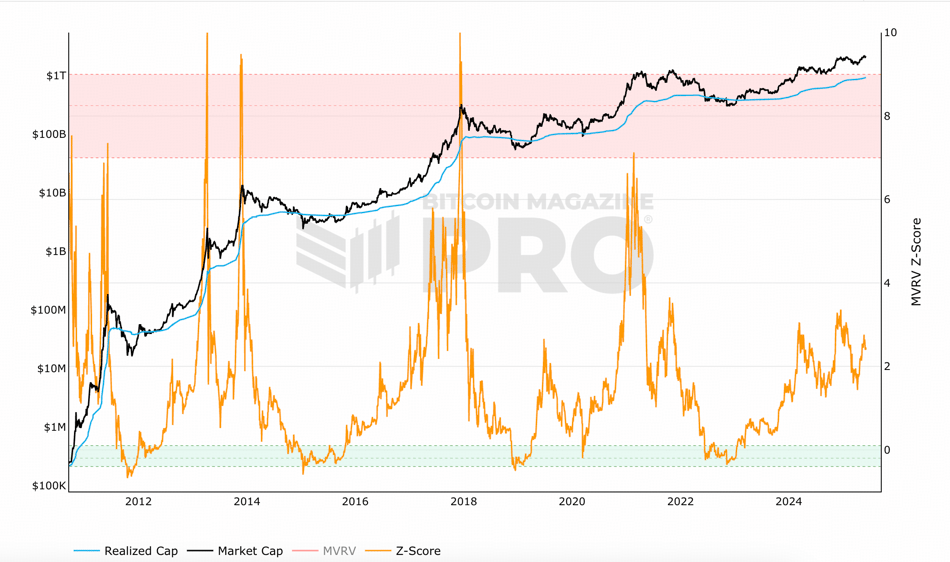
Bitcoin’s MVRV Z-Score chart, showing that current levels remain well below historical peaks. Higher MVRV Z-Score values (red areas) signaled past cycle tops, while low values (green) coincided with bear market lows.
Source: https://www.bitcoinmagazinepro.com/charts/mvrv-zscore/

What is MVRV?

MVRV stands for Market Value to Realized Value. In simple terms, it’s the ratio of Bitcoin’s total market capitalization to its realized capitalization. The market cap is just the current price times the circulating supply. The realized cap, in contrast, values each coin at the price when it last moved on-chain (essentially an aggregate “cost basis” for all BTC). By comparing these, MVRV shows the gap between current price and the average price at which coins were acquired. If the ratio is high, the average holder is in profit – on average, coins are worth much more now than what their owners paid. If MVRV is low or below 1.0, it means many holders would be sitting on losses if they sold at current prices.

Why is MVRV important?

This metric is a barometer of market sentiment and valuation extremes. A high MVRV indicates the market value is far above the aggregated cost basis, suggesting potential overvaluation – in such periods investors have large unrealized profits, so there may be greater temptation to sell (historically, MVRV spikes have aligned with major price tops). Conversely, a very low MVRV (especially below 1) means the market is trading near or even under the average on-chain cost basis, indicating possible undervaluation or capitulation – past bear market bottoms saw MVRV in this low range when most investors were underwater on their positions. In practice, analysts consider MVRV as a gauge of fair value vs. hype: it helps identify when Bitcoin is extremely overvalued or undervalued relative to what holders actually paid.

MVRV Z-Score

The MVRV Z-Score is a statistical refinement of the basic MVRV ratio. It compares Bitcoin’s market value to its realized value and then normalizes the difference using the historical standard deviation of that difference.

While MVRV gives a simple ratio, the Z-Score adds statistical depth, identifying extremes more precisely. Historically:

  • A Z-Score above 7–8 has aligned with market tops (euphoria, overvaluation).
  • A Z-Score near or below 0 has marked bottoms (despair, capitulation).

Unlike raw MVRV, which can drift over time due to structural shifts in realized cap, the Z-Score accounts for historical volatility, making it more robust for cycle analysis.

Potential Problem

The fundamental problem with the MVRV-Z Score lies in the fact that it is constructed entirely from on-chain data. Today, a substantial majority of Bitcoin trading occurs off-chain — particularly on centralized exchanges, ETFs as well as in the derivatives markets.

For example, if a large investor accumulates Bitcoin on Coinbase but leaves it in the exchange wallet without withdrawing to self-custody, there will be no on-chain movement. As a result, the realized value component of MVRV-Z does not update. Yet the market is clearly absorbing a large buy-side volume, a signal that MVRV-Z fails to capture.

MVRV-Z Score remains a powerful tool for identifying long-term valuation extremes based on historical price behavior and UTXO flows, it is fundamentally constrained by its on-chain-only perspective.

Bitcoin Balance on Exchanges

Total BTC held on exchanges over time (orange) versus Bitcoin’s price (black). Exchange balances grew steadily until 2020, peaking around 3.4 million BTC, then began declining. By 2025, exchange reserves have fallen near multi-year lows (signaling more coins in self-custody).

What is the “balance on exchanges” ?

This simply measures how much Bitcoin is held in wallets belonging to centralized exchanges. On-chain analytics can identify known exchange addresses and sum up all BTC in those wallets. The result is an estimate of the total supply sitting on exchanges available for trading.

Why is this important?

Exchange balance is often interpreted as an indicator of selling pressure and investor sentiment. The logic goes: when lots of BTC are parked on exchanges, those coins are just one quick sell order away from hitting the market – indicating potential supply overhang. Conversely, when the exchange balance drops, it means investors are pulling coins into cold storage, making them less immediately available for sale – a sign of accumulation and confidence (investors are comfortable holding, not looking to liquidate).

Historical trends support this view: rising exchange reserves have tended to coincide with bear markets or price declines (investors send BTC to exchanges, presumably to sell), whereas sustained declines in exchange-held BTC have often accompanied bull markets (coins moving off exchanges as people HODL for the long term).

Potential Problem

The landscape of custody is evolving. In late 2024–2025, a significant new factor was the rise of Bitcoin ETFs and institutional custodians. These products led to coins moving out of retail exchanges into custodial cold storage for ETFs. The exchange balance metric saw a drop (because those coins left exchanges), but this wasn’t due to individual hodlers—it was a shift in where coins are held.

According to Glassnode's analysis, when you combine exchange holdings with ETF custodial wallets, the total has remained relatively stable around ~3 million BTC, meaning the apparent outflows were largely a transfer from one type of custodian to another rather than a true supply squeeze.

Declining Exchange Balances Are Enhancing the Accuracy of MVRV Z-Score

One of the most frequently cited limitations of the MVRV Z-Score lies in its exclusive reliance on on-chain data. As a metric that compares Bitcoin’s market capitalization to its realized capitalization (where realized cap tracks the aggregated cost basis of all coins based on their last on-chain movement), the MVRV Z-Score fails to capture any activity that occurs off-chain.

In such a context, if large volumes of Bitcoin are bought and held within exchange wallets without being withdrawn to self-custody, those transactions remain invisible to the realized cap component. The result is a potential distortion: the metric may suggest under- or overvaluation based on incomplete data about actual cost basis and market sentiment.

However, this core limitation may be becoming less severe in the current market environment. A significant structural shift has occurred in Bitcoin custody patterns since 2020, as evidenced by the sharp and sustained decline in the total BTC balance held on centralized exchanges.

This mass withdrawal behavior has important implications for the MVRV Z-Score. As more BTC leaves exchanges, those movements typically generate on-chain activity. These withdrawals register new timestamps and prices for the UTXOs involved, thereby updating the realized cap. As a result, a growing portion of market activity that was previously invisible to MVRV is now being incorporated into its dataset. The consequence is that the MVRV Z-Score may now more accurately reflect market sentiment and aggregated cost basis than it did during earlier periods of heavy exchange dominance.

However, the rise of ETFs and institutional custodianship introduces new layers of abstraction: while coins may leave retail exchanges, they often move into large custodial aggregators whose on-chain patterns may be difficult to interpret, limiting the granularity of insight available from realized cap updates.

Most U.S.-based spot Bitcoin ETFs were launched in early 2024, during the early phase of a bull market. Since their inception, these ETFs have primarily been in an accumulation phase, buying large quantities of BTC from exchanges and transferring them into institutional-grade custodial wallets. These are first-time acquisitions, meaning they involve on-chain settlement: coins are purchased (often OTC or via prime brokers), then withdrawn from exchange wallets and deposited into ETF custodians’ wallets—triggering UTXO updates in the process.

Because these transactions involve actual on-chain movements—either withdrawals from exchange hot wallets or direct transfers into segregated custody—they are captured in the realized cap calculation. Thus, the MVRV Z-Score does reflect the cost basis of these ETF-acquired coins, even though those coins now sit in wallets that may appear relatively static afterward.

1+ Year HODL Wave (Long-Term Holder Supply)

Bitcoin “1+ Year HODL Wave” – percentage of supply untouched for at least one year. In prior cycle peaks (2017, 2021), this percentage dropped significantly as long-term holders sold off, whereas currently it remains elevated, indicating many are still holding their coins.

Source: https://www.bitcoinmagazinepro.com/charts/1-year-hodl-wave/

What is the 1+ Year HODL Wave?

The term HODL waves refers to a visualization of Bitcoin’s supply divided by the last time each coin moved (its “age”). The 1+ year HODL wave specifically measures the proportion of Bitcoin that hasn’t been moved from one address to another in at least one year. In plain language, it’s the share of BTC being held by long-term holders (LTHs) – people who haven’t touched their coins for a year or more.

Why is it important?

The HODL wave is a window into holder behavior and market cycles. Generally, long-term holders set the floor and ceiling of cycles: they accumulate during bear markets (increasing the 1y+ wave as coins age without moving), and they distribute during bull markets (spending some of those old coins, which shrinks the 1y+ percentage).

A rising 1+ year HODL wave indicates coins aging and staying put – a sign of accumulation and strong conviction. This often happens in bear phases when prices are low and patient investors or “smart money” keep buying or holding. Conversely, when the 1+ year band starts to decline, it means previously dormant coins are on the move – typically indicating profit-taking by long-term holders as the market heats up.

In bull markets, long-term holders gradually sell or redistribute coins to newer buyers, which shows up as a drop in the percentage of 1y+ old coins. Thus, this metric provides insight into where we are in the cycle: if the long-term HODLer cohort is at all-time highs, it suggests we’re still in a strong-hands, accumulation-heavy phase; if that cohort rapidly shrinks, it can signal a distribution phase associated with market tops.

Potential Problem

On its own, the HODL wave doesn’t tell you if those long-term holders will continue to hold or are about to sell en masse. It’s a bit like looking at a reservoir of water without knowing when the dam will open. You know a lot of water (supply) is stored up, but timing the release requires other data. The metric is most powerful when combined with others – for example, pairing a decline in HODL wave with a spike in exchange inflows and a high MVRV would strongly indicate a top forming. But the HODL wave by itself is more informative about the past and present state of holdings than the immediate future.

Combining Metrics for Deeper Insights

No single metric can capture the full complexity of Bitcoin’s market. Each of the three indicators above – MVRV, exchange balances, and the HODL wave – shines light on one dimension of market behavior. MVRV is about investors’ profitability (and thus greed/fear), exchange balance is about traders’ positioning (liquid vs. cold storage), and HODL wave is about long-term holder conviction. Taken together, they give a holistic view of the market’s state.

At major cycle tops, you tend to see confluence in these metrics: MVRV will be very high (signaling overvaluation and big unrealized profits), HODL wave will start dropping (long-term holders finally spending coins), and exchange balances may tick up (coins flowing to exchanges to be sold). No single metric is a perfect sell signal, but together these paint a powerful warning.

Current data (mid-2025) from these metrics collectively points to a robust market: valuations aren’t at extreme danger levels, supply on exchanges is constrained, and hodlers remain historically resolute.


Criptomoedas em alta

Leituras Relacionadas

From Auto Finance to Bitcoin to AI Engines: An Analysis of Cango's 'What Not to Do' Strategy

From Auto Finance to Bitcoin and Now AI: Cango's "What Not to Do" Strategy Cango, a Chinese auto finance platform that went public on the NYSE in 2018, is undergoing its third major transformation. After selling its entire auto business in 2024, it pivoted to become a large-scale Bitcoin miner, acquiring 50 exahash of mining rigs from Bitmain. However, its true goal was never Bitcoin, but owning and controlling energy infrastructure. Now, Cango is pivoting again. While most listed Bitcoin miners are leasing power to giant hyperscalers for AI training clusters, Cango is taking the opposite path. It has launched an AI inference subsidiary called EcoHash, focusing not on training but on distributed inference. The company's strategy hinges on the insight that over 70% of mining industry power is controlled by small, independent sites (10-50 MW), which are too small for hyperscalers but ideal for low-latency AI inference. Cango aims to partner with these small operators, providing the AI technology, customers, and financing through its EcoLink software layer, which can distribute workloads across sites for reliability. Cango maintains a hybrid model, running roughly 31.7 EH/s of Bitcoin mining for cash flow while aggressively cleaning its balance sheet—slashing long-term debt by 94.5% to $30.6 million and raising $75 million for its AI venture. Its first AI deployment will be at a 50 MW site in Georgia. The strategy faces skepticism, given the high costs of converting mining sites and the potential for an AI bubble. However, Cango's leadership believes discipline around "what not to do"—avoiding direct competition with hyperscalers in training—positions it to capture the long-tail demand for distributed AI inference power.

Foresight NewsHá 12m

From Auto Finance to Bitcoin to AI Engines: An Analysis of Cango's 'What Not to Do' Strategy

Foresight NewsHá 12m

Strategy's Bitcoin Sales Cap Far Exceeds $1.25 Billion: A Detail the Market Overlooked

The article discusses how MicroStrategy's potential Bitcoin sales go far beyond the announced $1.25 billion "reserve-building capacity." It clarifies a key distinction in the company's "BTC Monetization Program": selling Bitcoin to *build* a new dollar reserve (the $1.25B cap) versus selling to *replenish* the existing USD Reserve after it's used for expenses like preferred share dividends. The recent $216M BTC sale for dividend payments was a "replenishment," leaving the headline $1.25B building quota untouched. The plan actually outlines three potential funding pools from BTC sales: 1) Building the reserve ($1.25B cap), 2) Covering preferred share/ debt costs (no specified cap), and 3) Funding buyback programs (up to $20B). This means the structured sales potential exceeds $30 billion, not including uncapped replenishment sales. The piece argues this marks MicroStrategy's shift from a passive "buy-and-hold" Bitcoin proxy to an actively managed entity using BTC as a balance-sheet tool to manage its complex capital structure (common stock, preferred shares, debt, reserve). This creates new dynamics and potential conflicts, as actions benefiting one part (e.g., selling BTC to pay dividends) may pressure another (e.g., undermining the "never sell" narrative). Investors must now parse the company's specific terminology ("build" vs. "replenish") to understand the true scope of future BTC sales, which is significantly larger than the market initially perceived.

marsbitHá 18m

Strategy's Bitcoin Sales Cap Far Exceeds $1.25 Billion: A Detail the Market Overlooked

marsbitHá 18m

Goldman Sachs Report Deconstructs the Competitive Landscape of China's AI Large Models: Who Will Be the Long-Term Winner?

Goldman Sachs analyzes China's AI large language model (LLM) landscape, identifying key players and a strategic shift towards efficiency and global expansion. The report highlights that Chinese open-source/open-weight models are closing the performance gap with top global proprietary models at significantly lower cost, driven by architectural innovations like MoE. This enables a "two-tier" market: a high-end segment (e.g., GLM5.2, Qwen3.7 Max) with pricing at ~$1 per million tokens, and a low-end, price-sensitive global segment. Open-source strategies aid adoption but limit monetization, as deployments via third-party platforms (e.g., AWS Bedrock, Alibaba Cloud) may not generate direct revenue for model creators. The industry is thus moving towards "open-weight + community license" models with revenue-sharing to improve unit economics. Internationally, the focus is shifting from "token maximization" to ROI-driven enterprise adoption, particularly in non-U.S. markets. Major cloud platforms are integrating Chinese models (e.g., DeepSeek, MiniMax). Using a competitive framework based on pricing power, cost advantage, and financial strength, Goldman Sachs identifies **Zhipu AI** and **DeepSeek** as leaders in foundational text models, and **ByteDance** (with Seedance) leading in multimodal/video generation. **MiniMax** and **Kuaishou** are also rated favorably. The firm forecasts China's AI model API/subscription revenue growing from ~RMB 35bn (2026E) to RMB 879bn by 2030.

marsbitHá 18m

Goldman Sachs Report Deconstructs the Competitive Landscape of China's AI Large Models: Who Will Be the Long-Term Winner?

marsbitHá 18m

Trading

Spot

Artigos em Destaque

O que é BITCOIN

Compreender o HarryPotterObamaSonic10Inu (ERC-20) e a Sua Posição no Espaço Cripto Nos últimos anos, o mercado de criptomoedas assistiu a um aumento na popularidade das moedas meme, cativando não apenas os traders, mas também aqueles que procuram envolvimento comunitário e valor de entretenimento. Entre estes tokens únicos está o HarryPotterObamaSonic10Inu (ERC-20), um projeto intrigante que mistura referências culturais no tecido das criptomoedas. Este artigo explora os principais aspetos do HarryPotterObamaSonic10Inu, examinando os seus mecanismos, a sua ética orientada pela comunidade e o seu envolvimento com o vasto panorama cripto. O que é o HarryPotterObamaSonic10Inu (ERC-20)? Como o nome sugere, o HarryPotterObamaSonic10Inu é uma moeda meme construída na blockchain Ethereum, classificada sob o padrão ERC-20. Ao contrário das criptomoedas tradicionais, que podem enfatizar a utilidade prática ou o potencial de investimento, este token prospera no valor de entretenimento e na força da sua comunidade. O projeto visa promover um ambiente onde utilizadores envolvidos possam reunir-se, partilhar ideias e participar em atividades inspiradas por diversos fenómenos culturais. Uma característica notável do HarryPotterObamaSonic10Inu é a zero taxa sobre transações. Este elemento atraente visa encorajar a negociação e o envolvimento da comunidade, isento de encargos adicionais que podem desencorajar os traders de pequena escala. A oferta total da moeda está fixada em mil milhões de tokens, uma cifra que marca a sua intenção de manter uma circulação substancial dentro da comunidade. Criador do HarryPotterObamaSonic10Inu (ERC-20) As origens do HarryPotterObamaSonic10Inu estão um pouco envoltas em mistério; os detalhes sobre o criador permanecem desconhecidos. O desenvolvimento deste token carece de uma equipa identificável ou de um plano explícito, o que não é raro no setor das moedas meme. Em vez disso, o projeto surgiu de forma orgânica, com o seu progresso a depender fortemente do entusiasmo e da participação da sua comunidade. Investidores do HarryPotterObamaSonic10Inu (ERC-20) No que diz respeito a investimentos externos e apoios, o HarryPotterObamaSonic10Inu também permanece ambíguo. O token não lista quaisquer fundações de investimento conhecidas ou apoio organizacional significativo. Em vez disso, o “sangue vital” do projeto é a sua comunidade de base, que informa o seu crescimento e sustentabilidade através da ação coletiva e do envolvimento no espaço cripto. Como Funciona o HarryPotterObamaSonic10Inu (ERC-20)? Como uma moeda meme, o HarryPotterObamaSonic10Inu opera principalmente fora dos quadros tradicionais que muitas vezes governam o valor dos ativos. Existem vários aspetos distintivos que definem como o projeto funciona: Transações Sem Taxas: Sem taxas sobre transações, os utilizadores podem comprar e vender o token livremente, sem a preocupação de custos ocultos. Envolvimento da Comunidade: O projeto prospera na interação da comunidade, aproveitando plataformas de redes sociais para criar entusiasmo e facilitar a participação. Discussões, partilha de conteúdo e envolvimento são elementos cruciais que ajudam a expandir o seu alcance e a fomentar a lealdade entre os apoiantes. Sem Utilidade Prática: Deve ser notado que o HarryPotterObamaSonic10Inu não oferece utilidade concreta dentro do ecossistema financeiro. Em vez disso, é classificado como um token principalmente para entretenimento e atividades comunitárias. Referência Cultural: O token incorpora de forma inteligente elementos da cultura popular para atrair interesse, conectando-se tanto com entusiastas de memes como com seguidores de criptomoedas. HarryPotterObamaSonic10Inu exemplifica como as moedas meme operam de forma diferente de projetos de criptomoedas mais tradicionais, entrando no mercado como construções sociais inovadoras em vez de ativos utilitários. Linha do Tempo do HarryPotterObamaSonic10Inu (ERC-20) A história do HarryPotterObamaSonic10Inu é marcada por vários marcos notáveis: Criação: O token surgiu de um meme viral, capturando a imaginação de muitos entusiastas de criptomoedas. Datas específicas de criação não estão disponíveis, sublinhando a sua ascensão orgânica. Listagem em Exchanges: O HarryPotterObamaSonic10Inu conseguiu entrar em várias exchanges, permitindo um acesso e negociação mais fáceis pela comunidade. Iniciativas de Envolvimento da Comunidade: Atividades contínuas direcionadas a melhorar a interação comunitária, incluindo concursos, campanhas em redes sociais e geração de conteúdo por fãs e defensores. Planos de Expansão Futura: O roteiro do projeto inclui o lançamento de uma coleção de NFTs, mercadorias e um site de eCommerce relacionado aos seus temas culturais, envolvendo ainda mais a comunidade e tentando adicionar mais dimensões ao seu ecossistema. Pontos-Chave sobre o HarryPotterObamaSonic10Inu (ERC-20) Natureza Orientada pela Comunidade: O projeto prioriza a contribuição coletiva e a criatividade, assegurando que o envolvimento dos utilizadores está na vanguarda do seu desenvolvimento. Classificação como Moeda Meme: Representa o epítome da criptomoeda baseada em entretenimento, destacando-se dos veículos de investimento tradicionais. Sem Afiliação Direta com o Bitcoin: Apesar da semelhança no nome do ticker, o HarryPotterObamaSonic10Inu é distinto e não tem qualquer relação com o Bitcoin ou outras criptomoedas estabelecidas. Foco na Colaboração: O HarryPotterObamaSonic10Inu é projetado para criar um espaço de colaboração e partilha de histórias entre os seus detentores, proporcionando uma via para a criatividade e o fortalecimento da comunidade. Perspectivas Futuras: A ambição de expandir além da sua premissa inicial para NFTs e mercadorias delineia um caminho para o projeto potencialmente entrar em avenidas mais mainstream dentro da cultura digital. À medida que as moedas meme continuam a capturar a imaginação da comunidade cripto, HarryPotterObamaSonic10Inu (ERC-20) destaca-se devido aos seus laços culturais e abordagem centrada na comunidade. Embora possa não se encaixar no molde típico de um token orientado para utilidade, a sua essência reside na alegria e camaradagem fomentadas entre os seus apoiantes, destacando a natureza em evolução das criptomoedas em uma era cada vez mais digital. À medida que o projeto continua a desenvolver-se, será importante observar como as dinâmicas comunitárias influenciam a sua trajetória no panorama em constante mudança da tecnologia blockchain.

1.7k Visualizações TotaisPublicado em {updateTime}Atualizado em 2024.12.03

O que é BITCOIN

Como comprar BTC

Bem-vindo à HTX.com!Tornámos a compra de Bitcoin (BTC) simples e conveniente.Segue o nosso guia passo a passo para iniciar a tua jornada no mundo das criptos.Passo 1: cria a tua conta HTXUtiliza o teu e-mail ou número de telefone para te inscreveres numa conta gratuita na HTX.Desfruta de um processo de inscrição sem complicações e desbloqueia todas as funcionalidades.Obter a minha contaPasso 2: vai para Comprar Cripto e escolhe o teu método de pagamentoCartão de crédito/débito: usa o teu visa ou mastercard para comprar Bitcoin (BTC) instantaneamente.Saldo: usa os fundos da tua conta HTX para transacionar sem problemas.Terceiros: adicionamos métodos de pagamento populares, como Google Pay e Apple Pay, para aumentar a conveniência.P2P: transaciona diretamente com outros utilizadores na HTX.Mercado de balcão (OTC): oferecemos serviços personalizados e taxas de câmbio competitivas para os traders.Passo 3: armazena teu Bitcoin (BTC)Depois de comprar o teu Bitcoin (BTC), armazena-o na tua conta HTX.Alternativamente, podes enviá-lo para outro lugar através de transferência blockchain ou usá-lo para transacionar outras criptomoedas.Passo 4: transaciona Bitcoin (BTC)Transaciona facilmente Bitcoin (BTC) no mercado à vista da HTX.Acede simplesmente à tua conta, seleciona o teu par de trading, executa as tuas transações e monitoriza em tempo real.Oferecemos uma experiência de fácil utilização tanto para principiantes como para traders experientes.

4.2k Visualizações TotaisPublicado em {updateTime}Atualizado em 2026.06.02

Como comprar BTC

O que é $BITCOIN

OURO DIGITAL ($BITCOIN): Uma Análise Abrangente Introdução ao OURO DIGITAL ($BITCOIN) OURO DIGITAL ($BITCOIN) é um projeto baseado em blockchain que opera na rede Solana, com o objetivo de combinar as características dos metais preciosos tradicionais com a inovação das tecnologias descentralizadas. Embora partilhe um nome com o Bitcoin, frequentemente referido como “ouro digital” devido à sua percepção como uma reserva de valor, o OURO DIGITAL é um token separado projetado para criar um ecossistema único dentro da paisagem Web3. O seu objetivo é posicionar-se como um ativo digital alternativo viável, embora os detalhes sobre as suas aplicações e funcionalidades ainda estejam em desenvolvimento. O que é o OURO DIGITAL ($BITCOIN)? OURO DIGITAL ($BITCOIN) é um token de criptomoeda explicitamente projetado para uso na blockchain Solana. Em contraste com o Bitcoin, que fornece um papel amplamente reconhecido como armazenamento de valor, este token parece focar em aplicações e características mais amplas. Aspectos notáveis incluem: Infraestrutura Blockchain: O token é construído na blockchain Solana, conhecida pela sua capacidade de lidar com transações de alta velocidade e baixo custo. Dinâmicas de Oferta: O OURO DIGITAL tem um fornecimento máximo limitado a 100 quatrilhões de tokens (100P $BITCOIN), embora os detalhes sobre o seu fornecimento circulante ainda não tenham sido divulgados. Utilidade: Embora as funcionalidades precisas não estejam explicitamente delineadas, existem indicações de que o token poderia ser utilizado para várias aplicações, potencialmente envolvendo aplicações descentralizadas (dApps) ou estratégias de tokenização de ativos. Quem é o Criador do OURO DIGITAL ($BITCOIN)? Neste momento, a identidade dos criadores e da equipa de desenvolvimento por trás do OURO DIGITAL ($BITCOIN) permanece desconhecida. Esta situação é típica entre muitos projetos inovadores no espaço da blockchain, particularmente aqueles alinhados com finanças descentralizadas e fenómenos de moedas meme. Embora tal anonimato possa fomentar uma cultura orientada pela comunidade, intensifica as preocupações sobre governança e responsabilidade. Quem são os Investidores do OURO DIGITAL ($BITCOIN)? As informações disponíveis indicam que o OURO DIGITAL ($BITCOIN) não tem apoiantes institucionais conhecidos ou investimentos proeminentes de capital de risco. O projeto parece operar num modelo peer-to-peer focado no apoio e adoção da comunidade, em vez de rotas de financiamento tradicionais. A sua atividade e liquidez estão principalmente situadas em exchanges descentralizadas (DEXs), como a PumpSwap, em vez de plataformas de negociação centralizadas estabelecidas, destacando ainda mais a sua abordagem de base. Como Funciona o OURO DIGITAL ($BITCOIN) A mecânica operacional do OURO DIGITAL ($BITCOIN) pode ser elaborada com base no seu design de blockchain e nas características da rede: Mecanismo de Consenso: Ao aproveitar o exclusivo proof-of-history (PoH) da Solana combinado com um modelo de proof-of-stake (PoS), o projeto assegura uma validação eficiente das transações, contribuindo para o alto desempenho da rede. Tokenomics: Embora mecanismos deflacionários específicos não tenham sido extensivamente detalhados, o vasto fornecimento máximo de tokens implica que pode atender a microtransações ou casos de uso de nicho que ainda estão por definir. Interoperabilidade: Existe o potencial para integração com o ecossistema mais amplo da Solana, incluindo várias plataformas de finanças descentralizadas (DeFi). No entanto, os detalhes sobre integrações específicas permanecem não especificados. Cronologia de Eventos Chave Aqui está uma cronologia que destaca marcos significativos relacionados ao OURO DIGITAL ($BITCOIN): 2023: O lançamento inicial do token ocorre na blockchain Solana, marcado pelo seu endereço de contrato. 2024: O OURO DIGITAL ganha visibilidade ao tornar-se disponível para negociação em exchanges descentralizadas como a PumpSwap, permitindo que os utilizadores o negociem contra SOL. 2025: O projeto testemunha atividade de negociação esporádica e potencial interesse em envolvimentos liderados pela comunidade, embora não tenham sido documentadas parcerias ou avanços técnicos notáveis até ao momento. Análise Crítica Forças Escalabilidade: A infraestrutura subjacente da Solana suporta altos volumes de transações, o que pode aumentar a utilidade do $BITCOIN em vários cenários de transação. Acessibilidade: O potencial preço de negociação baixo por token pode atrair investidores de retalho, facilitando uma participação mais ampla devido a oportunidades de propriedade fracionada. Riscos Falta de Transparência: A ausência de apoiantes, desenvolvedores ou um processo de auditoria publicamente conhecidos pode gerar ceticismo em relação à sustentabilidade e confiabilidade do projeto. Volatilidade do Mercado: A atividade de negociação depende fortemente do comportamento especulativo, o que pode resultar em volatilidade significativa dos preços e incerteza para os investidores. Conclusão O OURO DIGITAL ($BITCOIN) surge como um projeto intrigante, mas ambíguo, dentro do ecossistema em rápida evolução da Solana. Embora tente aproveitar a narrativa do “ouro digital”, a sua divergência do papel estabelecido do Bitcoin como reserva de valor sublinha a necessidade de uma diferenciação mais clara da sua utilidade pretendida e estrutura de governança. A aceitação e adoção futuras dependerão provavelmente da abordagem da atual opacidade e da definição mais explícita das suas estratégias operacionais e económicas. Nota: Este relatório abrange informações sintetizadas disponíveis até outubro de 2023, e desenvolvimentos podem ter ocorrido além do período de pesquisa.

127 Visualizações TotaisPublicado em {updateTime}Atualizado em 2025.05.13

O que é $BITCOIN

Discussões

Bem-vindo à Comunidade HTX. Aqui, pode manter-se informado sobre os mais recentes desenvolvimentos da plataforma e obter acesso a análises profissionais de mercado. As opiniões dos utilizadores sobre o preço de BTC (BTC) são apresentadas abaixo.

活动图片