Cycle Performances Say Dogecoin Price Will Rally Above $2.28

bitcoinistPublicado em 2025-06-11Última atualização em 2025-06-11

Resumo

Dogecoin’s current trading range between $0.18 and $0.24 has largely mimicked the steady accumulation phases seen in past bull cycles....

Trusted Editorial content, reviewed by leading industry experts and seasoned editors. Ad Disclosure

Dogecoin’s current trading range between $0.18 and $0.24 has largely mimicked the steady accumulation phases seen in past bull cycles. Although its price action appears muted on shorter timeframes, a technical analysis of broader market cycles shows that the meme coin may be nearing the end of its consolidation phase and entering the early stages of a breakout trajectory.

Fibonacci Pattern Points To Bullish Continuation

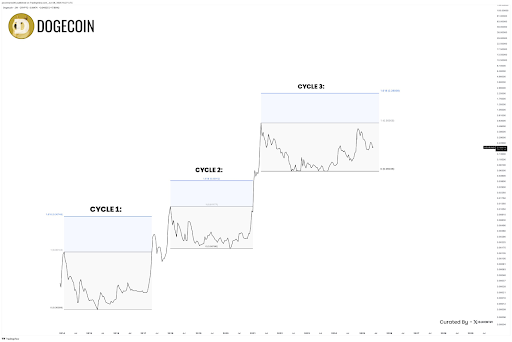
According to a recent post by crypto analyst Javon Marks on the social media platform X, Dogecoin’s price movements over the years reveal a highly consistent relationship with Fibonacci extension levels, especially the 1.618 level. Marks highlighted that in the two previous primary cycles, 2014 to 2017 (Cycle 1) and 2017 to 2021 (Cycle 2), Dogecoin exceeded the 1.618 Fibonacci extension measured from its respective accumulation bases in their bear market lows. 

In Cycle 1, DOGE went from a 0 Fibonacci level in the 2015 bear market low to a peak above the 1.618 Fibonacci level in 2018. This translated to a move from $0.00009 to $0.00748, representing an increase of more than 8,200% from its cycle low.
Dogecoin
Source: Javon Marks on X

Cycle 2 followed a similar structure, where the pattern of surpassing the 1.618 Fib level held true. DOGE initially consolidated around its 0 Fib baseline near $0.00168 throughout most of 2020 during a prolonged bear market. Then, in early 2021, the meme coin began to surge aggressively, first reclaiming the 1.0 extension level around $0.11773 and eventually moving beyond the 1.618 extension of $0.39921. This breakout culminated in Dogecoin reaching its current all-time high of approximately $0.7326 in May 2021, a 43,000% increase from its cycle low.

Dogecoin’s Next Price Target

As illustrated in the accompanying chart, the Fibonacci projection for the current Dogecoin cycle begins at the 2022 bear market low of $0.06036. This price point forms the zero baseline for what is now being tracked as Cycle 3.

Keeping in mind Dogecoin’s cyclical behavior, this places the current 1.618 Fibonacci extension target at $2.28008 for the ongoing cycle. Notably, the 1.0 Fib extension level was already confirmed at $0.56953 following Dogecoin’s earlier all-time high. Reaching this price target would translate to a 3670% increase from the current price level, but Dogecoin could repeat what happened in Cycle 2 and even exceed the 1.618 Fib level.

Notably, each breakout not only exceeded the Fibonacci level but also reset the base for the next macro cycle. Therefore, a successful move above $2.28 would complete the third full cycle and lay the groundwork for DOGE’s long-term valuation above the $1 threshold even in the next bear market. At the time of writing, Dogecoin is trading at $0.1912, up by 5.5% in the past 24 hours.

Dogecoin
DOGE trading at $0.19 on the 1D chart | Source: DOGEUSDT on Tradingview.com
Featured image from Getty Images, chart from Tradingview.com
Editorial Process for bitcoinist is centered on delivering thoroughly researched, accurate, and unbiased content. We uphold strict sourcing standards, and each page undergoes diligent review by our team of top technology experts and seasoned editors. This process ensures the integrity, relevance, and value of our content for our readers.

Scott Matherson is a leading crypto writer at Bitcoinist, who possesses a sharp analytical mind and a deep understanding of the digital currency landscape. Scott has earned a reputation for delivering thought-provoking and well-researched articles that resonate with both newcomers and seasoned crypto enthusiasts. Outside of his writing, Scott is passionate about promoting crypto literacy and often works to educate the public on the potential of blockchain.

Leituras Relacionadas

Tiger Research: Zuckerberg Begins Betting on Prediction Markets, While Asian Nations Still View Them as Gambling

This article examines the rise of prediction markets, contrasting their growing institutional acceptance in the West with their restrictive regulation in Asia. It details how prediction markets, which originated from informal political betting and academic experiments like the Iowa Electronic Market, aggregate crowd wisdom into probabilistic prices through binary contracts. Their growth accelerated around 2020, reaching over $14 billion in monthly volume. A key driver is the "skin in the game" principle, where users risk their own capital, leading to high accuracy in predicting events like Fed rate decisions and elections, as demonstrated by platforms like Polymarket. Meta's entry, with Mark Zuckerberg reportedly leading the development of the Arena app, signals the market's maturation. In the U.S., court rulings have distinguished prediction markets from gambling, facilitating entry by traditional financial institutions. However, most Asian jurisdictions still classify them as gambling, focusing on social control rather than financial innovation. The article argues this stance creates three problems for Asia: 1) regulatory arbitrage pushes users to riskier offshore platforms, 2) loss of sovereign information infrastructure as valuable social sentiment data accumulates abroad, and 3) abandonment of user protection. It concludes that Asia needs a policy shift from prohibition to constructive regulation, integrating these markets into the formal system to harness their data as a national asset, as initiatives like Limitless Research are beginning to do.

marsbitHá 1h

Tiger Research: Zuckerberg Begins Betting on Prediction Markets, While Asian Nations Still View Them as Gambling

marsbitHá 1h

Ethereum's Next Decade in the Eyes of Vitalik

"Lean Ethereum" Long-Term Roadmap Unveiled by Vitalik Buterin On July 5, 2026, Vitalik Buterin published the "Lean Ethereum" roadmap, positioning it as Ethereum's third major evolution following the Merge. This multi-year, multi-phase upgrade aims to fundamentally transform Ethereum's core protocol through staged network upgrades extending to 2029. Key goals include achieving 1 gigagas per second L1 throughput (a massive increase from the current ~32 TPS), near-instant finality, and quantum-resistant cryptography. The plan involves transitioning Ethereum's security model from full transaction re-execution by all nodes to native verification via recursive STARK proofs. A major proposed change is replacing the EVM with a proof-friendly architecture like RISC-V or leanISA, though this remains a point of contention, especially with L2s like Arbitrum favoring alternatives like WASM. Other planned upgrades include a restructured state model with a large, cheap "warehouse" storage layer to drastically reduce fees for migrated applications, multi-dimensional gas pricing, and a new focus on making privacy a first-class, native protocol feature. While the roadmap significantly raises Ethereum's long-term technical ceiling, analysts note it does not directly address ETH's mid-term token economics or value capture. The plan's multi-year timeline means near-term price impact will likely depend on observable progress milestones, such as the successful deployment of the upcoming Glamsterdam gas limit increase, growth in L2 activity and blob usage, and trends in L1 fee revenue and ETH burn.

链捕手Há 3h

Ethereum's Next Decade in the Eyes of Vitalik

链捕手Há 3h

In Just 11 Days, Claude Rewrote Millions of Lines of Code, an Epic AI Engineering Feat Sparks Fury

In just 11 days, Bun's founder Jarred Sumner used Anthropic's Claude AI models to rewrite its million lines of code from Zig to Rust. This move sparked significant controversy, particularly from Zig's creator, Andrew Kelley, who publicly criticized Sumner's engineering practices and the decision to use AI for such a massive rewrite. Bun, a high-performance JavaScript/TypeScript runtime and rival to Node.js, was originally written in Zig. After Anthropic acquired Bun, the team encountered persistent stability and memory safety bugs in the Zig codebase. These issues, combined with Zig's strict policy against LLM-generated code, led to the decision to rewrite in Rust. The rewrite was executed using Claude AI tools at an estimated API cost of $165,000, dramatically reducing the expected time and financial cost. Andrew Kelley's response was scathing. He blamed the original bugs on poor engineering habits, calling Bun's Zig code a collection of "hacks on top of hacks." He expressed relief that Bun was no longer associated with Zig, fearing it would misrepresent the language and attract low-quality, AI-generated contributions. The tech community is divided; some view Kelley's critique as unprofessional, while others see it as a defense of engineering integrity. A major concern about the AI-driven rewrite is the resulting code quality. The translation from Zig left approximately 27,000 lines of unsafe Rust code, raising fears about long-term maintainability and technical debt. The debate centers on whether this project is a milestone in AI-assisted development or a future maintenance nightmare.

marsbitHá 4h

In Just 11 Days, Claude Rewrote Millions of Lines of Code, an Epic AI Engineering Feat Sparks Fury

marsbitHá 4h

Trading

Spot
活动图片