XRP Price At $27: Guardian Arch Formation Predictions 1,000% Move

bitcoinistPublicado em 2025-06-10Última atualização em 2025-06-11

Resumo

The XRP price action is making headlines again as a rare technical pattern known as the Guardian Arch formation points...

Trusted Editorial content, reviewed by leading industry experts and seasoned editors. Ad Disclosure

The XRP price action is making headlines again as a rare technical pattern known as the Guardian Arch formation points to a potential 1,000% surge. If this prediction plays out, XRP, which is currently sitting at $2.28, could soar to $27, marking one of the most explosive bull runs in crypto history. 

Guardian Arch Fuel $27 XRP Price Explosion 

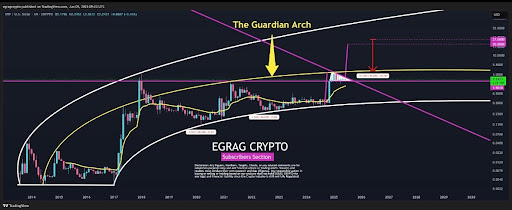
On June 6, prominent crypto analyst Egrag Crypto captured the attention of the broader crypto community by identifying a distinct pattern, the Guardian Arch, on the XRP price chart. With the emergence of this key chart formation, the analyst forecasts a parabolic move that could see XRP potentially reaching between $20 and $27 this cycle.

According to Egrag Crypto’s analysis, XRP appears to be following a measured move trajectory that historically results in a significant upward price surge. The Guardian Arch formation, highlighted by the yellow line on the XRP chart, is seen as a critical threshold that, once breached, could mark the altcoin’s entry into a sustained double-digit territory

Notably, Egrag Crypto forecasts that the measured move points to an initial conservative target of $20 for XRP. However, with the bullish momentum from the Guardian Arch formation, the analyst believes that the XRP price could skyrocket even higher, potentially surging by 1,000% to reach historical all-time highs of $27. 
XRP
Source: Egrag Crypto on X

In response to Egrag Crypto’s $27 price forecast for XRP, a community member questioned what level of market dominance would support this bullish thesis. The analyst replied that XRP’s dominance will need to climb to around 15%, indicating that it must capture a significantly larger portion of the total cryptocurrency market cap

This is a rather ambitious scenario, considering XRP’s current dominance typically hovers between 2% and 4%. Moreover, achieving a 15% market dominance would require a substantial inflow of capital into the cryptocurrency and a major shift in market dynamics favoring the asset. 

Post-Peak Caution And Bear Market Forecast

While the XRP price outlook, based on Egrag Crypto’s analysis, looks extremely bullish in the short to mid-term, the analyst also issues a sobering warning about the possibility of a harsh reversal. Drawing parallels with the 2021 market cycle, where XRP experienced a steep decline following its peak, the analysis outlines a potential 86% drop that could follow the projected market top of around $27. 

In this bearish scenario, Egrag Crypto predicts that XRP could fall back to a price level near $3, which he considers a possible bear market bottom. The analyst has also indicated that the Guardian Arch formation on the XRP price chart may have a dual-purpose framework. This chart pattern encapsulates the potential for a massive upward move while simultaneously functioning as a gateway into a post-peak downtrend. 

Notably, Egrag Crypto has emphasized the importance of strategic planning in trading, advising traders to avoid depending on a single exit point for profit taking. Instead, he recommends setting rational, tiered profit targets as the market unfolds while planning and following a clear and flexible exit strategy. 

XRP
XRP trading at $2.29 on the 1D chart | Source: XRPUSDT on Tradingview.com
Featured image from iStock, chart from Tradingview.com
Editorial Process for bitcoinist is centered on delivering thoroughly researched, accurate, and unbiased content. We uphold strict sourcing standards, and each page undergoes diligent review by our team of top technology experts and seasoned editors. This process ensures the integrity, relevance, and value of our content for our readers.

Scott Matherson is a leading crypto writer at Bitcoinist, who possesses a sharp analytical mind and a deep understanding of the digital currency landscape. Scott has earned a reputation for delivering thought-provoking and well-researched articles that resonate with both newcomers and seasoned crypto enthusiasts. Outside of his writing, Scott is passionate about promoting crypto literacy and often works to educate the public on the potential of blockchain.

Criptomoedas em alta

Leituras Relacionadas

Tiger Research: Zuckerberg Begins Betting on Prediction Markets, While Asian Nations Still View Them as Gambling

This article examines the rise of prediction markets, contrasting their growing institutional acceptance in the West with their restrictive regulation in Asia. It details how prediction markets, which originated from informal political betting and academic experiments like the Iowa Electronic Market, aggregate crowd wisdom into probabilistic prices through binary contracts. Their growth accelerated around 2020, reaching over $14 billion in monthly volume. A key driver is the "skin in the game" principle, where users risk their own capital, leading to high accuracy in predicting events like Fed rate decisions and elections, as demonstrated by platforms like Polymarket. Meta's entry, with Mark Zuckerberg reportedly leading the development of the Arena app, signals the market's maturation. In the U.S., court rulings have distinguished prediction markets from gambling, facilitating entry by traditional financial institutions. However, most Asian jurisdictions still classify them as gambling, focusing on social control rather than financial innovation. The article argues this stance creates three problems for Asia: 1) regulatory arbitrage pushes users to riskier offshore platforms, 2) loss of sovereign information infrastructure as valuable social sentiment data accumulates abroad, and 3) abandonment of user protection. It concludes that Asia needs a policy shift from prohibition to constructive regulation, integrating these markets into the formal system to harness their data as a national asset, as initiatives like Limitless Research are beginning to do.

marsbitHá 1h

Tiger Research: Zuckerberg Begins Betting on Prediction Markets, While Asian Nations Still View Them as Gambling

marsbitHá 1h

Ethereum's Next Decade in the Eyes of Vitalik

"Lean Ethereum" Long-Term Roadmap Unveiled by Vitalik Buterin On July 5, 2026, Vitalik Buterin published the "Lean Ethereum" roadmap, positioning it as Ethereum's third major evolution following the Merge. This multi-year, multi-phase upgrade aims to fundamentally transform Ethereum's core protocol through staged network upgrades extending to 2029. Key goals include achieving 1 gigagas per second L1 throughput (a massive increase from the current ~32 TPS), near-instant finality, and quantum-resistant cryptography. The plan involves transitioning Ethereum's security model from full transaction re-execution by all nodes to native verification via recursive STARK proofs. A major proposed change is replacing the EVM with a proof-friendly architecture like RISC-V or leanISA, though this remains a point of contention, especially with L2s like Arbitrum favoring alternatives like WASM. Other planned upgrades include a restructured state model with a large, cheap "warehouse" storage layer to drastically reduce fees for migrated applications, multi-dimensional gas pricing, and a new focus on making privacy a first-class, native protocol feature. While the roadmap significantly raises Ethereum's long-term technical ceiling, analysts note it does not directly address ETH's mid-term token economics or value capture. The plan's multi-year timeline means near-term price impact will likely depend on observable progress milestones, such as the successful deployment of the upcoming Glamsterdam gas limit increase, growth in L2 activity and blob usage, and trends in L1 fee revenue and ETH burn.

链捕手Há 3h

Ethereum's Next Decade in the Eyes of Vitalik

链捕手Há 3h

In Just 11 Days, Claude Rewrote Millions of Lines of Code, an Epic AI Engineering Feat Sparks Fury

In just 11 days, Bun's founder Jarred Sumner used Anthropic's Claude AI models to rewrite its million lines of code from Zig to Rust. This move sparked significant controversy, particularly from Zig's creator, Andrew Kelley, who publicly criticized Sumner's engineering practices and the decision to use AI for such a massive rewrite. Bun, a high-performance JavaScript/TypeScript runtime and rival to Node.js, was originally written in Zig. After Anthropic acquired Bun, the team encountered persistent stability and memory safety bugs in the Zig codebase. These issues, combined with Zig's strict policy against LLM-generated code, led to the decision to rewrite in Rust. The rewrite was executed using Claude AI tools at an estimated API cost of $165,000, dramatically reducing the expected time and financial cost. Andrew Kelley's response was scathing. He blamed the original bugs on poor engineering habits, calling Bun's Zig code a collection of "hacks on top of hacks." He expressed relief that Bun was no longer associated with Zig, fearing it would misrepresent the language and attract low-quality, AI-generated contributions. The tech community is divided; some view Kelley's critique as unprofessional, while others see it as a defense of engineering integrity. A major concern about the AI-driven rewrite is the resulting code quality. The translation from Zig left approximately 27,000 lines of unsafe Rust code, raising fears about long-term maintainability and technical debt. The debate centers on whether this project is a milestone in AI-assisted development or a future maintenance nightmare.

marsbitHá 4h

In Just 11 Days, Claude Rewrote Millions of Lines of Code, an Epic AI Engineering Feat Sparks Fury

marsbitHá 4h

Trading

Spot

Artigos em Destaque

Como comprar MOVE

Bem-vindo à HTX.com!Tornámos a compra de Movement (MOVE) simples e conveniente.Segue o nosso guia passo a passo para iniciar a tua jornada no mundo das criptos.Passo 1: cria a tua conta HTXUtiliza o teu e-mail ou número de telefone para te inscreveres numa conta gratuita na HTX.Desfruta de um processo de inscrição sem complicações e desbloqueia todas as funcionalidades.Obter a minha contaPasso 2: vai para Comprar Cripto e escolhe o teu método de pagamentoCartão de crédito/débito: usa o teu visa ou mastercard para comprar Movement (MOVE) instantaneamente.Saldo: usa os fundos da tua conta HTX para transacionar sem problemas.Terceiros: adicionamos métodos de pagamento populares, como Google Pay e Apple Pay, para aumentar a conveniência.P2P: transaciona diretamente com outros utilizadores na HTX.Mercado de balcão (OTC): oferecemos serviços personalizados e taxas de câmbio competitivas para os traders.Passo 3: armazena teu Movement (MOVE)Depois de comprar o teu Movement (MOVE), armazena-o na tua conta HTX.Alternativamente, podes enviá-lo para outro lugar através de transferência blockchain ou usá-lo para transacionar outras criptomoedas.Passo 4: transaciona Movement (MOVE)Transaciona facilmente Movement (MOVE) no mercado à vista da HTX.Acede simplesmente à tua conta, seleciona o teu par de trading, executa as tuas transações e monitoriza em tempo real.Oferecemos uma experiência de fácil utilização tanto para principiantes como para traders experientes.

328 Visualizações TotaisPublicado em {updateTime}Atualizado em 2026.06.02

Como comprar MOVE

Discussões

Bem-vindo à Comunidade HTX. Aqui, pode manter-se informado sobre os mais recentes desenvolvimentos da plataforma e obter acesso a análises profissionais de mercado. As opiniões dos utilizadores sobre o preço de MOVE (MOVE) são apresentadas abaixo.

活动图片