$100 Trillion Crypto Boom? Macro Experts Say It’s Closer Than You Think

bitcoinistPublicado em 2025-06-10Última atualização em 2025-06-10

Resumo

Global Macro Investor’s head of research Julien Bittel used a marathon X thread on 9 June to stitch together what...

Trusted Editorial content, reviewed by leading industry experts and seasoned editors. Ad Disclosure

Global Macro Investor’s head of research Julien Bittel used a marathon X thread on 9 June to stitch together what he calls “The Everything Code”―a demographic-debt-liquidity feedback loop that he believes will catapult the digital-asset complex from today’s roughly $3.5 trillion capitalization to $100 trillion within a decade.

Speaking against the backdrop of a crypto market that has already doubled since the start of 2024, Bittel lays the groundwork with a blunt diagnosis of the developed world’s labour market. “The labor force participation rate isn’t going to rise anytime soon – it’s set to keep declining over time. This is a structural problem,” he writes, adding that “humans are already being replaced by AI and robots at a staggering pace, and that shift is only just beginning. This is deflationary.” In his view, shrinking workforces meet unyielding entitlement promises in a cocktail that “reinforces the need for ongoing stimulus to keep the system afloat. Fewer workers. More tech. Same debts.”

Bittel’s next step is the fiscal arithmetic. With public and private liabilities already hovering near 120% of global GDP, “the only answer is more debt… That’s how the system survives,” he warns. Should growth sputter, “Debt-to-GDP is going to keep rising over time,” a trend he expects policymakers to absorb through monetary debasement rather than austerity.

Debasement, he reminds readers, is the hidden eight-percent annual loss of purchasing power that piles on top of headline inflation. “Cash has quietly become one of the riskiest assets out there,” Bittel argues, forcing savers to seek double-digit nominal returns simply to stand still.

The $100 Trillion Crypto Supercycle

From there the thread pivots to liquidity, the variable Bittel and GMI founder Raoul Pal have elevated to first-principles status. When GMI combines central-bank balance-sheet expansion with commercial-bank credit creation across major economies, the resulting “Total Liquidity” gauge explains about 90% of Bitcoin’s moves and 95% of the Nasdaq-100’s, he writes. “Fewer workers. More tech. Same debts,” means liquidity must keep rising to prevent a credit contraction, and that liquidity, in Bittel’s models, “is the tide that lifts scarce, risk-sensitive assets.”

Scarcity is the bridge to Bitcoin. “Bitcoin has been compounding purchasing power faster than any asset in human history—annualizing nearly 150 percent in excess of the debasement rate since 2010,” Bittel notes, while even the Nasdaq’s stellar 13 percent real return “is down 99.94 percent versus Bitcoin since the start of 2012. Shocking…” The superlatives serve a purpose: they frame Bitcoin as the only macro-scale antidote to the policy cocktail of demographic drag, rising leverage and forced liquidity.

All of that funnels into his headline projection. “We’re still in the early stages of a global race—a scramble by institutions, sovereigns, and individuals—to accumulate as much Bitcoin as possible,” Bittel writes. That scramble, he believes, will propel the crypto universe “from a $3 trillion asset class today to $100 trillion over the next seven to ten years.”
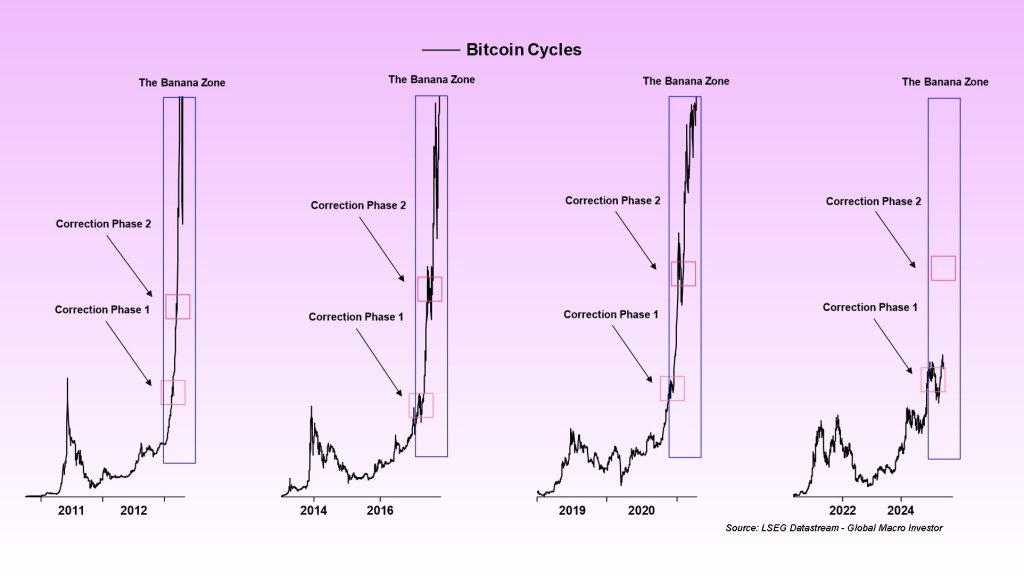
Bitcoin cycles
“The Banana Zone” | Source: X @BittelJulien

Doing the math, a jump from the current $3.55 trillion market capitalisation implies a 40% compound annual growth rate over a decade, or roughly 61% if the window compresses to seven years—both aggressive, but neither without precedent in earlier crypto cycles.

Bittel concedes the path will be “both incredibly challenging and unimaginably rewarding—the worst of times and the best of times,” but he insists Bitcoin is “part of the solution.” He and Pal have called the coming chase for scarce assets “the single greatest wealth-creation opportunity of our lifetimes,” and Bittel closes the thread by declaring that if GMI’s call plays out, it will be “remembered as the greatest macro trade of all time. This is The Everything Code.”

Pal, whose own presentation at Real Vision’s Sui Basecamp in May framed crypto as “a supermassive black hole that outperforms and sucks in every other asset,” reaches similar conclusions. He places Bitcoin in what he calls the “banana zone,” a reflexive phase in which expanding liquidity and herd behaviour interact to drive parabolic gains, with a cycle target of roughly $450,000 per coin. Pal’s estimates implies a Bitcoin capitalization only well above $40 trillion even without altcoins—complementing Bittel’s upper-bound scenario.

At press time, the total crypto market cap stood at $3.37 trillion.
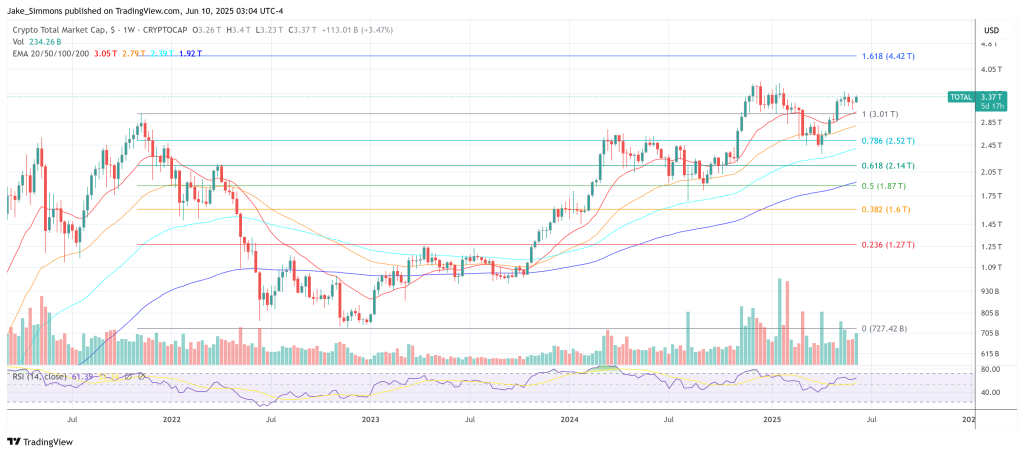
Crypto market cap
Total crypto market cap, 1-week chart | Source: TOTAL on TradingView.com
Featured image created with DALL.E, chart from TradingView.com
Editorial Process for bitcoinist is centered on delivering thoroughly researched, accurate, and unbiased content. We uphold strict sourcing standards, and each page undergoes diligent review by our team of top technology experts and seasoned editors. This process ensures the integrity, relevance, and value of our content for our readers.

Jake Simmons has been a Bitcoin enthusiast since 2016. Ever since he heard about Bitcoin, he has been studying the topic every day and trying to share his knowledge with others. His goal is to contribute to Bitcoin's financial revolution, which will replace the fiat money system. Besides BTC and crypto, Jake studied Business Informatics at a university. After graduation in 2017, he has been working in the blockchain and crypto sector. You can follow Jake on Twitter at @realJakeSimmons.

Leituras Relacionadas

Tiger Research: Zuckerberg Begins Betting on Prediction Markets, While Asian Nations Still View Them as Gambling

This article examines the rise of prediction markets, contrasting their growing institutional acceptance in the West with their restrictive regulation in Asia. It details how prediction markets, which originated from informal political betting and academic experiments like the Iowa Electronic Market, aggregate crowd wisdom into probabilistic prices through binary contracts. Their growth accelerated around 2020, reaching over $14 billion in monthly volume. A key driver is the "skin in the game" principle, where users risk their own capital, leading to high accuracy in predicting events like Fed rate decisions and elections, as demonstrated by platforms like Polymarket. Meta's entry, with Mark Zuckerberg reportedly leading the development of the Arena app, signals the market's maturation. In the U.S., court rulings have distinguished prediction markets from gambling, facilitating entry by traditional financial institutions. However, most Asian jurisdictions still classify them as gambling, focusing on social control rather than financial innovation. The article argues this stance creates three problems for Asia: 1) regulatory arbitrage pushes users to riskier offshore platforms, 2) loss of sovereign information infrastructure as valuable social sentiment data accumulates abroad, and 3) abandonment of user protection. It concludes that Asia needs a policy shift from prohibition to constructive regulation, integrating these markets into the formal system to harness their data as a national asset, as initiatives like Limitless Research are beginning to do.

marsbitHá 1h

Tiger Research: Zuckerberg Begins Betting on Prediction Markets, While Asian Nations Still View Them as Gambling

marsbitHá 1h

Ethereum's Next Decade in the Eyes of Vitalik

"Lean Ethereum" Long-Term Roadmap Unveiled by Vitalik Buterin On July 5, 2026, Vitalik Buterin published the "Lean Ethereum" roadmap, positioning it as Ethereum's third major evolution following the Merge. This multi-year, multi-phase upgrade aims to fundamentally transform Ethereum's core protocol through staged network upgrades extending to 2029. Key goals include achieving 1 gigagas per second L1 throughput (a massive increase from the current ~32 TPS), near-instant finality, and quantum-resistant cryptography. The plan involves transitioning Ethereum's security model from full transaction re-execution by all nodes to native verification via recursive STARK proofs. A major proposed change is replacing the EVM with a proof-friendly architecture like RISC-V or leanISA, though this remains a point of contention, especially with L2s like Arbitrum favoring alternatives like WASM. Other planned upgrades include a restructured state model with a large, cheap "warehouse" storage layer to drastically reduce fees for migrated applications, multi-dimensional gas pricing, and a new focus on making privacy a first-class, native protocol feature. While the roadmap significantly raises Ethereum's long-term technical ceiling, analysts note it does not directly address ETH's mid-term token economics or value capture. The plan's multi-year timeline means near-term price impact will likely depend on observable progress milestones, such as the successful deployment of the upcoming Glamsterdam gas limit increase, growth in L2 activity and blob usage, and trends in L1 fee revenue and ETH burn.

链捕手Há 3h

Ethereum's Next Decade in the Eyes of Vitalik

链捕手Há 3h

In Just 11 Days, Claude Rewrote Millions of Lines of Code, an Epic AI Engineering Feat Sparks Fury

In just 11 days, Bun's founder Jarred Sumner used Anthropic's Claude AI models to rewrite its million lines of code from Zig to Rust. This move sparked significant controversy, particularly from Zig's creator, Andrew Kelley, who publicly criticized Sumner's engineering practices and the decision to use AI for such a massive rewrite. Bun, a high-performance JavaScript/TypeScript runtime and rival to Node.js, was originally written in Zig. After Anthropic acquired Bun, the team encountered persistent stability and memory safety bugs in the Zig codebase. These issues, combined with Zig's strict policy against LLM-generated code, led to the decision to rewrite in Rust. The rewrite was executed using Claude AI tools at an estimated API cost of $165,000, dramatically reducing the expected time and financial cost. Andrew Kelley's response was scathing. He blamed the original bugs on poor engineering habits, calling Bun's Zig code a collection of "hacks on top of hacks." He expressed relief that Bun was no longer associated with Zig, fearing it would misrepresent the language and attract low-quality, AI-generated contributions. The tech community is divided; some view Kelley's critique as unprofessional, while others see it as a defense of engineering integrity. A major concern about the AI-driven rewrite is the resulting code quality. The translation from Zig left approximately 27,000 lines of unsafe Rust code, raising fears about long-term maintainability and technical debt. The debate centers on whether this project is a milestone in AI-assisted development or a future maintenance nightmare.

marsbitHá 4h

In Just 11 Days, Claude Rewrote Millions of Lines of Code, an Epic AI Engineering Feat Sparks Fury

marsbitHá 4h

Trading

Spot
活动图片