Cardano Releases First-Ever Bitcoin DeFi Protocol: Why It Matters

bitcoinistPublicado em 2025-06-10Última atualização em 2025-06-10

Resumo

Cardano’s research and engineering arm, Input Output Global (IOG), has unveiled “Cardinal,” the first protocol that allows native Bitcoin unspent...

Trusted Editorial content, reviewed by leading industry experts and seasoned editors. Ad Disclosure

Cardano’s research and engineering arm, Input Output Global (IOG), has unveiled “Cardinal,” the first protocol that allows native Bitcoin unspent transaction outputs (UTXOs) — including Ordinals — to circulate inside Cardano-based decentralized-finance markets without custodians or federations.

The disclosure came late Monday when IOG chief technology officer Romain Pellerin published a nine-part thread on X describing Cardinal as “a new primitive for Bitcoin,” adding that his team has “made history with the first cross-chain Ordinal wrap.” He summarized the design in a single sentence: “Bitcoin stays locked under MuSig2; the wrapped UTXO is minted cross-chain; it is redeemable at any time via fraud-proofed peg-out — no rehypothecation, no compromise.”

How The Cardano Bridge Works

Cardinal keeps the original satoshis on the Bitcoin base layer, secured by a MuSig2 aggregated multi-signature controlled by a rotating operator set. A hashed-timelock contract (HTLC) defines the conditions under which the funds may be reclaimed; on the Cardano side, an extended-UTXO (eUTXO) smart contract mints a 1:1-pegged non-fungible token that represents the locked UTXO. Off-chain verification is supplied by BitVMX, a verifiable-execution framework that publishes fraud proofs to Bitcoin if an operator cheats. Pellerin noted that the “1-of-n honest” assumption keeps the bridge closer to Bitcoin’s own security model than today’s federated walk-arounds such as wBTC.

Because every wrapped output is itself an NFT, Ordinals retain their on-chain provenance when they cross the bridge. Once resident on Cardano, the wrapped satoshis or Ordinals become fully programmable assets that can be deposited on automated-market-maker pools, lent out for yield, or used as collateral without relinquishing ownership of the underlying inscription. “Ordinals can now be used in DeFi, serve as collateral, be auctioned across chains, borrow / lend value without losing provenance,” Pellerin wrote.

Custodial and federated bridges such as BitGo’s wrapped-Bitcoin contracts on Ethereum have dominated the $8.7 billion BTC-on-DeFi market but have also introduced single-point-of-failure and rehypothecation risks. The bridging sector has lost more than $2.5 billion to exploits since 2021, according to public incident trackers. Cardinal’s one-of-n MuSig2 model aims to shrink the trust surface while retaining capital efficiency: redeeming the NFT triggers a burn on Cardano and an unlock on Bitcoin, with BitVMX proofs published if an operator withholds the release.

Cardano’s eUTXO accounting mirrors Bitcoin’s own UTXO structure, simplifying the mathematical equivalence proofs required for a symmetric peg. Low fee volatility, native tokenization (no ERC-721 wrapper layer) and deterministic, script-level transaction costs further influenced the choice, Pellerin said. Nevertheless, the specification released on GitHub is chain-agnostic; extensions for Ethereum, Solana and Avalanche are already sketched in the repository.

Cardano founder Charles Hoskinson amplified the announcement to his 1.5 million followers, writing: “Welcome to the first Bitcoin DeFi protocol developed for Cardano.”

Cardinal is not yet a turnkey consumer product. Pellerin stressed that the release is “infrastructure” and called for external contributors to improve SNARK-based burn-proof generation, recursive state proofs and wallet UX. Independent auditors will also need to scrutinize the MuSig2 implementation and operator rotation logic, both frequent failure points in prior bridge exploits.

At press time, ADA traded at $0.6984.
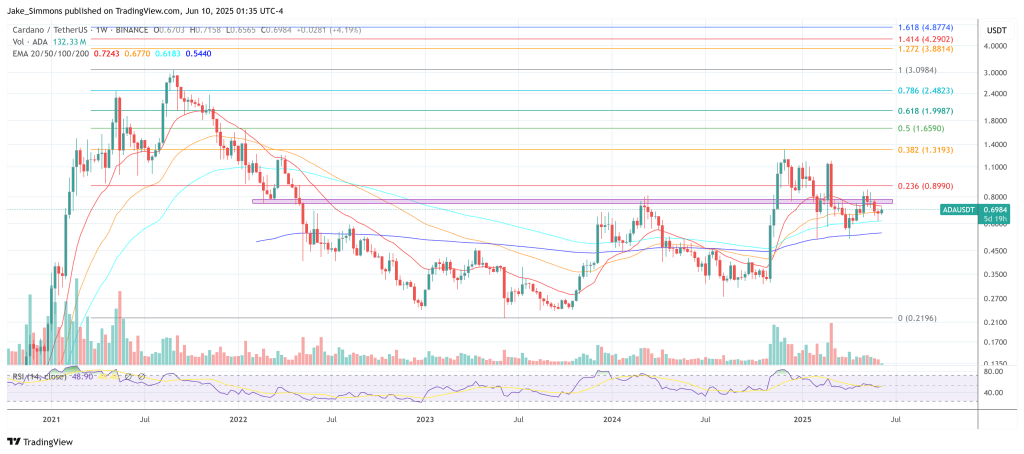
Cardano price
ADA remains below key resistance, 1-week chart | Source: ADAUSDT on TradingView.com
Featured image created with DALL.E, chart from TradingView.com
Editorial Process for bitcoinist is centered on delivering thoroughly researched, accurate, and unbiased content. We uphold strict sourcing standards, and each page undergoes diligent review by our team of top technology experts and seasoned editors. This process ensures the integrity, relevance, and value of our content for our readers.

Jake Simmons has been a Bitcoin enthusiast since 2016. Ever since he heard about Bitcoin, he has been studying the topic every day and trying to share his knowledge with others. His goal is to contribute to Bitcoin's financial revolution, which will replace the fiat money system. Besides BTC and crypto, Jake studied Business Informatics at a university. After graduation in 2017, he has been working in the blockchain and crypto sector. You can follow Jake on Twitter at @realJakeSimmons.

Criptomoedas em alta

Leituras Relacionadas

Tiger Research: Zuckerberg Begins Betting on Prediction Markets, While Asian Nations Still View Them as Gambling

This article examines the rise of prediction markets, contrasting their growing institutional acceptance in the West with their restrictive regulation in Asia. It details how prediction markets, which originated from informal political betting and academic experiments like the Iowa Electronic Market, aggregate crowd wisdom into probabilistic prices through binary contracts. Their growth accelerated around 2020, reaching over $14 billion in monthly volume. A key driver is the "skin in the game" principle, where users risk their own capital, leading to high accuracy in predicting events like Fed rate decisions and elections, as demonstrated by platforms like Polymarket. Meta's entry, with Mark Zuckerberg reportedly leading the development of the Arena app, signals the market's maturation. In the U.S., court rulings have distinguished prediction markets from gambling, facilitating entry by traditional financial institutions. However, most Asian jurisdictions still classify them as gambling, focusing on social control rather than financial innovation. The article argues this stance creates three problems for Asia: 1) regulatory arbitrage pushes users to riskier offshore platforms, 2) loss of sovereign information infrastructure as valuable social sentiment data accumulates abroad, and 3) abandonment of user protection. It concludes that Asia needs a policy shift from prohibition to constructive regulation, integrating these markets into the formal system to harness their data as a national asset, as initiatives like Limitless Research are beginning to do.

marsbitHá 40m

Tiger Research: Zuckerberg Begins Betting on Prediction Markets, While Asian Nations Still View Them as Gambling

marsbitHá 40m

Ethereum's Next Decade in the Eyes of Vitalik

"Lean Ethereum" Long-Term Roadmap Unveiled by Vitalik Buterin On July 5, 2026, Vitalik Buterin published the "Lean Ethereum" roadmap, positioning it as Ethereum's third major evolution following the Merge. This multi-year, multi-phase upgrade aims to fundamentally transform Ethereum's core protocol through staged network upgrades extending to 2029. Key goals include achieving 1 gigagas per second L1 throughput (a massive increase from the current ~32 TPS), near-instant finality, and quantum-resistant cryptography. The plan involves transitioning Ethereum's security model from full transaction re-execution by all nodes to native verification via recursive STARK proofs. A major proposed change is replacing the EVM with a proof-friendly architecture like RISC-V or leanISA, though this remains a point of contention, especially with L2s like Arbitrum favoring alternatives like WASM. Other planned upgrades include a restructured state model with a large, cheap "warehouse" storage layer to drastically reduce fees for migrated applications, multi-dimensional gas pricing, and a new focus on making privacy a first-class, native protocol feature. While the roadmap significantly raises Ethereum's long-term technical ceiling, analysts note it does not directly address ETH's mid-term token economics or value capture. The plan's multi-year timeline means near-term price impact will likely depend on observable progress milestones, such as the successful deployment of the upcoming Glamsterdam gas limit increase, growth in L2 activity and blob usage, and trends in L1 fee revenue and ETH burn.

链捕手Há 2h

Ethereum's Next Decade in the Eyes of Vitalik

链捕手Há 2h

In Just 11 Days, Claude Rewrote Millions of Lines of Code, an Epic AI Engineering Feat Sparks Fury

In just 11 days, Bun's founder Jarred Sumner used Anthropic's Claude AI models to rewrite its million lines of code from Zig to Rust. This move sparked significant controversy, particularly from Zig's creator, Andrew Kelley, who publicly criticized Sumner's engineering practices and the decision to use AI for such a massive rewrite. Bun, a high-performance JavaScript/TypeScript runtime and rival to Node.js, was originally written in Zig. After Anthropic acquired Bun, the team encountered persistent stability and memory safety bugs in the Zig codebase. These issues, combined with Zig's strict policy against LLM-generated code, led to the decision to rewrite in Rust. The rewrite was executed using Claude AI tools at an estimated API cost of $165,000, dramatically reducing the expected time and financial cost. Andrew Kelley's response was scathing. He blamed the original bugs on poor engineering habits, calling Bun's Zig code a collection of "hacks on top of hacks." He expressed relief that Bun was no longer associated with Zig, fearing it would misrepresent the language and attract low-quality, AI-generated contributions. The tech community is divided; some view Kelley's critique as unprofessional, while others see it as a defense of engineering integrity. A major concern about the AI-driven rewrite is the resulting code quality. The translation from Zig left approximately 27,000 lines of unsafe Rust code, raising fears about long-term maintainability and technical debt. The debate centers on whether this project is a milestone in AI-assisted development or a future maintenance nightmare.

marsbitHá 3h

In Just 11 Days, Claude Rewrote Millions of Lines of Code, an Epic AI Engineering Feat Sparks Fury

marsbitHá 3h

From Auto Finance to Bitcoin to AI Engines: An Analysis of Cango's 'What Not to Do' Strategy

From Auto Finance to Bitcoin and Now AI: Cango's "What Not to Do" Strategy Cango, a Chinese auto finance platform that went public on the NYSE in 2018, is undergoing its third major transformation. After selling its entire auto business in 2024, it pivoted to become a large-scale Bitcoin miner, acquiring 50 exahash of mining rigs from Bitmain. However, its true goal was never Bitcoin, but owning and controlling energy infrastructure. Now, Cango is pivoting again. While most listed Bitcoin miners are leasing power to giant hyperscalers for AI training clusters, Cango is taking the opposite path. It has launched an AI inference subsidiary called EcoHash, focusing not on training but on distributed inference. The company's strategy hinges on the insight that over 70% of mining industry power is controlled by small, independent sites (10-50 MW), which are too small for hyperscalers but ideal for low-latency AI inference. Cango aims to partner with these small operators, providing the AI technology, customers, and financing through its EcoLink software layer, which can distribute workloads across sites for reliability. Cango maintains a hybrid model, running roughly 31.7 EH/s of Bitcoin mining for cash flow while aggressively cleaning its balance sheet—slashing long-term debt by 94.5% to $30.6 million and raising $75 million for its AI venture. Its first AI deployment will be at a 50 MW site in Georgia. The strategy faces skepticism, given the high costs of converting mining sites and the potential for an AI bubble. However, Cango's leadership believes discipline around "what not to do"—avoiding direct competition with hyperscalers in training—positions it to capture the long-tail demand for distributed AI inference power.

Foresight NewsHá 3h

From Auto Finance to Bitcoin to AI Engines: An Analysis of Cango's 'What Not to Do' Strategy

Foresight NewsHá 3h

Trading

Spot

Artigos em Destaque

Como comprar ADA

Bem-vindo à HTX.com!Tornámos a compra de Cardano (ADA) simples e conveniente.Segue o nosso guia passo a passo para iniciar a tua jornada no mundo das criptos.Passo 1: cria a tua conta HTXUtiliza o teu e-mail ou número de telefone para te inscreveres numa conta gratuita na HTX.Desfruta de um processo de inscrição sem complicações e desbloqueia todas as funcionalidades.Obter a minha contaPasso 2: vai para Comprar Cripto e escolhe o teu método de pagamentoCartão de crédito/débito: usa o teu visa ou mastercard para comprar Cardano (ADA) instantaneamente.Saldo: usa os fundos da tua conta HTX para transacionar sem problemas.Terceiros: adicionamos métodos de pagamento populares, como Google Pay e Apple Pay, para aumentar a conveniência.P2P: transaciona diretamente com outros utilizadores na HTX.Mercado de balcão (OTC): oferecemos serviços personalizados e taxas de câmbio competitivas para os traders.Passo 3: armazena teu Cardano (ADA)Depois de comprar o teu Cardano (ADA), armazena-o na tua conta HTX.Alternativamente, podes enviá-lo para outro lugar através de transferência blockchain ou usá-lo para transacionar outras criptomoedas.Passo 4: transaciona Cardano (ADA)Transaciona facilmente Cardano (ADA) no mercado à vista da HTX.Acede simplesmente à tua conta, seleciona o teu par de trading, executa as tuas transações e monitoriza em tempo real.Oferecemos uma experiência de fácil utilização tanto para principiantes como para traders experientes.

1.3k Visualizações TotaisPublicado em {updateTime}Atualizado em 2026.06.02

Como comprar ADA

Discussões

Bem-vindo à Comunidade HTX. Aqui, pode manter-se informado sobre os mais recentes desenvolvimentos da plataforma e obter acesso a análises profissionais de mercado. As opiniões dos utilizadores sobre o preço de ADA (ADA) são apresentadas abaixo.

活动图片