Dogecoin Price Crash To Continue? Analyst Shows Fair And Optimistic EOY Targets

bitcoinistPublicado em 2025-06-05Última atualização em 2025-06-05

Resumo

The Dogecoin price is facing significant bearish pressure, declining by over 12% this past week, as it struggles to find...

Trusted Editorial content, reviewed by leading industry experts and seasoned editors. Ad Disclosure

The Dogecoin price is facing significant bearish pressure, declining by over 12% this past week, as it struggles to find strong support. The recent market turbulence has left analysts questioning whether this downtrend will continue. Notably, a crypto market expert has weighed in on both fair and optimistic End-of-the-Year (EOY) targets for Dogecoin, offering insights into where the leading meme coin might be headed in this bull cycle.

Dogecoin Price End Of The Year Targets

Dogecoin has sparked concern amongst the broader crypto market following its recent pullback from previous highs. Despite sitting at a low of $0.19, a new technical analysis by pseudonymous TradingView crypto expert TradingShot has forecasted a bullish fair value and optimistic end-of-year target for Dogecoin. 

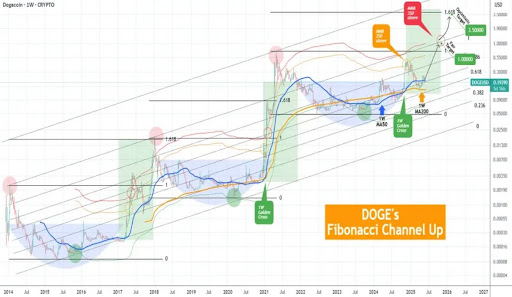
The analyst offers a different perspective on Dogecoin’s ongoing downtrend—-one that suggests that the price dip could mark the beginning of a final bullish leg of the current cycle. According to the corresponding chart, Dogecoin has respected a long-standing Fibonacci Channel Up structure, bouncing precisely from its 1W MA200, which acted as the cycle bottom in early April. Notably, the price has since rebounded and is now consolidating around the 1W MA50, signaling a potential run to new highs

Dogecoin
Source: TradingShot on Tradingview

TradingShot notes that Dogecoin’s current price behavior remains consistent with past market cycles, where, after testing the MA200, the meme coin began a sustained rally. The Channel Up structure has also historically guided the altcoin’s price movements, with major cycle tops coinciding with Fibonacci Extension levels. 

Based on the TradingView expert’s chart, the 2021 bull run broke above the 1.5 Fibonacci level, showing an uncommon deviation from the channel. For the current cycle, the chart highlights two key end-of-the-year targets. The fair value is set at $1.00, aligning with the 1.0 Fibonacci Extension and the MMB 3SD above. The analyst has also forecasted an optimistic target at $3.50, coinciding with the horizontal 1.618 Fibonacci level, which was previously reached during the January 2018 cycle top and exceeded during the May 2021 peak. 

Golden Cross And MMB Trends Support DOGE EOY Forecast

TradingShot’s end-of-year bull case for Dogecoin is further reinforced by the formation of a 1W Golden Cross on its price chart. Historically, this technical pattern has marked the beginning of explosive price increases in not just DOGE but other cryptocurrencies in the market. 

Now incorporating the Mayer Multiple Bands (MMB), the TradingView analyst points out that in the final year of each bull cycle, after the formation of the 1W Golden Cross, the DOGE price has consistently reached the MMB 2SD above first and then climbed to the MMB 3SD above. Currently, Dogecoin has already touched the MMB 2SD but has yet to test the 3SD, indicating untapped upside potential.

Dogecoin
DOGE trading at $0.19 on the 1D chart | Source: DOGEUSDT on Tradingview.com
Featured image from Getty Images, chart from Tradingview.com
Editorial Process for bitcoinist is centered on delivering thoroughly researched, accurate, and unbiased content. We uphold strict sourcing standards, and each page undergoes diligent review by our team of top technology experts and seasoned editors. This process ensures the integrity, relevance, and value of our content for our readers.

Scott Matherson is a leading crypto writer at Bitcoinist, who possesses a sharp analytical mind and a deep understanding of the digital currency landscape. Scott has earned a reputation for delivering thought-provoking and well-researched articles that resonate with both newcomers and seasoned crypto enthusiasts. Outside of his writing, Scott is passionate about promoting crypto literacy and often works to educate the public on the potential of blockchain.

Leituras Relacionadas

From Transaction Fees to Stablecoins: The Revenue Drivers and Economic Moats Behind Web3 Business Models

"From Transaction Fees to Stablecoins: Revenue Drivers and Moats in Verified Web3 Business Models" This analysis explores five established Web3 revenue models, examining their drivers and long-term sustainability. 1. **Transaction Fees**: This model is highly cyclical, with income tied to market activity and user risk appetite (formula: volume × fee rate). Growth depends on expanding the market, gaining market share, and maintaining stable fees amid intense competition. 2. **Stablecoin Reserve Yield**: Revenue stems from the scale of issued stablecoins and the interest earned on their underlying reserves (like US Treasuries). While predictable with strong moats (high user migration costs), growth is tied to adoption as on-chain dollar infrastructure and is sensitive to interest rate cycles. 3. **Funding Rate Arbitrage & Lending Spreads**: Protocols like Aave and Ethena profit from capital supply-demand imbalances. Similar to transaction fees, this model is cyclical and driven by user leverage demand during bullish market phases. 4. **Block Space Sales**: Chains sell computational resources (formula: demand × gas price). A key challenge is the ongoing decline in gas fees due to technological advances and competition among L1s and L2s. Future viability hinges on whether demand growth can offset falling unit prices. 5. **Protocol-Level Service Fees**: Similar to SaaS, this model involves charging other protocols for essential services (e.g., oracles like Chainlink). Revenue scales with ecosystem adoption. The primary moat is high switching costs once integrated, making market leadership crucial. In summary: Transaction fees and funding spreads are highly cyclical. Stablecoin yields and protocol services build strong, durable moats. Block space sales face the structural challenge of perpetually declining unit revenue despite growing demand.

marsbitHá 1h

From Transaction Fees to Stablecoins: The Revenue Drivers and Economic Moats Behind Web3 Business Models

marsbitHá 1h

Trading

Spot
活动图片