Cardano Developer IOG Flags Unconstitutional Behavior: Here’s Why

bitcoinistPublicado em 2025-06-04Última atualização em 2025-06-04

Resumo

In a late-night post on June 3, Input Output Global (IOG) announced that it had finished reviewing two high-profile governance...

Trusted Editorial content, reviewed by leading industry experts and seasoned editors. Ad Disclosure

In a late-night post on June 3, Input Output Global (IOG) announced that it had finished reviewing two high-profile governance actions now before Cardano’s Voltaire-era electorate. “Input | Output has completed its assessment of the Amaru and DeFi Liquidity budget Info Actions. We find the DeFi Liquidity action unconstitutional … We find the Amaru action constitutional,” the company wrote on X.

That single sentence set off a new round of debate about the procedural safeguards embedded in the Cardano Constitution—a document adopted in February to give legal weight to on-chain decision-making.

Cardano Proposals Under Scrutiny

IOG’s “No” vote on the liquidity proposal rests on a technical but foundational rule in Article III, Section 5 of the Constitution. The article requires every governance action to publish a URL for its off-chain documentation and to record, on-chain, the cryptographic hash of that file. The hash is supposed to guarantee that no one can quietly swap the PDF or JSON once voting begins.

In the liquidity proposal the two values diverged. Input Output Global’s engineers downloaded the file and calculated a Blake2b-256 digest. The hash embedded in the transaction, however, was different. That mismatch “renders the proposal unconstitutional in its current form,” IOG argued, because voters cannot be sure what they are really approving.

The practical upshot is that, unless the authors resubmit with matching metadata, the Stablecoin Liquidity budget—originally pitched as a ₳50 million, 12-month programme to seed liquidity across Cardano DEXs—cannot move forward. Cardano’s Delegated Representatives (DReps) may still cast ballots, but the Constitutional Committee is now obliged to disregard the result.

By contrast, the “Cardano Blockchain Ecosystem Budget: Amaru 2025” sailed through IOG’s review. The project seeks ₳1.5 million to finance an alternative Cardano node implementation written in Rust. Governance Space records show the action is already pulling in more than 90 percent “Yes” support from voting stake—well above the 50 percent threshold that treasury-related actions must clear.

IOG’s rationale highlights several constitutional touch-points: the proposal’s purpose aligns with decentralisation goals in the Preamble and Article I; it follows the standard metadata format demanded by Article III, Section 5; it provides an explicit fund-administration framework that satisfies Article IV, Section 2; and it confirms that the requested sum will not breach the Net-Change Limit in Article IV, Section 3.

The only caveat IOG raised concerns the line-item for “Ad-hoc mercenaries” to cover audits—an ambiguous phrase that the company says should be clarified before disbursement.

What Happens Next

Under Cardano’s CIP-1694 governance flow, DReps have until epoch 563 (June 8) to vote. If the DeFi Liquidity action retains its flawed metadata, it will almost certainly be tossed regardless of the tally. The Amaru budget, on the other hand, is on track for approval; once ratified, its maintainers will be able to draw down funds in tranches, subject to on-chain spending scripts and oversight from PRAGMA’s legal wrapper.

The episode underscores why the Constitution’s seemingly dry formatting rules matter. Without an anchor-hash match, the “single source of truth” principle that keeps Cardano proposals immutable collapses, opening the door to bait-and-switch edits that no chain audit could detect. As IOG’s post put it, the mismatch “undermines the constitutional requirement for a clear, verifiable, and identical link between the on-chain governance action and its off-chain specification.”

At press time, ADA traded at $0.69.
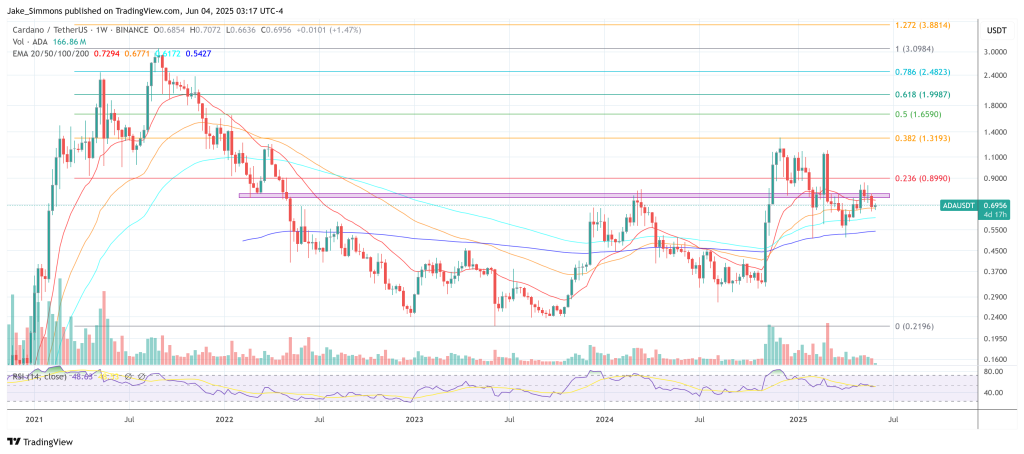
Cardano price
ADA hovers below key resistance again, 1-week chart | Source: ADAUSDT on TradingView.com
Featured image created with DALL.E, chart from TradingView.com
Editorial Process for bitcoinist is centered on delivering thoroughly researched, accurate, and unbiased content. We uphold strict sourcing standards, and each page undergoes diligent review by our team of top technology experts and seasoned editors. This process ensures the integrity, relevance, and value of our content for our readers.

Jake Simmons has been a Bitcoin enthusiast since 2016. Ever since he heard about Bitcoin, he has been studying the topic every day and trying to share his knowledge with others. His goal is to contribute to Bitcoin's financial revolution, which will replace the fiat money system. Besides BTC and crypto, Jake studied Business Informatics at a university. After graduation in 2017, he has been working in the blockchain and crypto sector. You can follow Jake on Twitter at @realJakeSimmons.

Criptomoedas em alta

Leituras Relacionadas

From Transaction Fees to Stablecoins: The Revenue Drivers and Economic Moats Behind Web3 Business Models

"From Transaction Fees to Stablecoins: Revenue Drivers and Moats in Verified Web3 Business Models" This analysis explores five established Web3 revenue models, examining their drivers and long-term sustainability. 1. **Transaction Fees**: This model is highly cyclical, with income tied to market activity and user risk appetite (formula: volume × fee rate). Growth depends on expanding the market, gaining market share, and maintaining stable fees amid intense competition. 2. **Stablecoin Reserve Yield**: Revenue stems from the scale of issued stablecoins and the interest earned on their underlying reserves (like US Treasuries). While predictable with strong moats (high user migration costs), growth is tied to adoption as on-chain dollar infrastructure and is sensitive to interest rate cycles. 3. **Funding Rate Arbitrage & Lending Spreads**: Protocols like Aave and Ethena profit from capital supply-demand imbalances. Similar to transaction fees, this model is cyclical and driven by user leverage demand during bullish market phases. 4. **Block Space Sales**: Chains sell computational resources (formula: demand × gas price). A key challenge is the ongoing decline in gas fees due to technological advances and competition among L1s and L2s. Future viability hinges on whether demand growth can offset falling unit prices. 5. **Protocol-Level Service Fees**: Similar to SaaS, this model involves charging other protocols for essential services (e.g., oracles like Chainlink). Revenue scales with ecosystem adoption. The primary moat is high switching costs once integrated, making market leadership crucial. In summary: Transaction fees and funding spreads are highly cyclical. Stablecoin yields and protocol services build strong, durable moats. Block space sales face the structural challenge of perpetually declining unit revenue despite growing demand.

marsbitHá 1h

From Transaction Fees to Stablecoins: The Revenue Drivers and Economic Moats Behind Web3 Business Models

marsbitHá 1h

Trading

Spot

Artigos em Destaque

Como comprar ADA

Bem-vindo à HTX.com!Tornámos a compra de Cardano (ADA) simples e conveniente.Segue o nosso guia passo a passo para iniciar a tua jornada no mundo das criptos.Passo 1: cria a tua conta HTXUtiliza o teu e-mail ou número de telefone para te inscreveres numa conta gratuita na HTX.Desfruta de um processo de inscrição sem complicações e desbloqueia todas as funcionalidades.Obter a minha contaPasso 2: vai para Comprar Cripto e escolhe o teu método de pagamentoCartão de crédito/débito: usa o teu visa ou mastercard para comprar Cardano (ADA) instantaneamente.Saldo: usa os fundos da tua conta HTX para transacionar sem problemas.Terceiros: adicionamos métodos de pagamento populares, como Google Pay e Apple Pay, para aumentar a conveniência.P2P: transaciona diretamente com outros utilizadores na HTX.Mercado de balcão (OTC): oferecemos serviços personalizados e taxas de câmbio competitivas para os traders.Passo 3: armazena teu Cardano (ADA)Depois de comprar o teu Cardano (ADA), armazena-o na tua conta HTX.Alternativamente, podes enviá-lo para outro lugar através de transferência blockchain ou usá-lo para transacionar outras criptomoedas.Passo 4: transaciona Cardano (ADA)Transaciona facilmente Cardano (ADA) no mercado à vista da HTX.Acede simplesmente à tua conta, seleciona o teu par de trading, executa as tuas transações e monitoriza em tempo real.Oferecemos uma experiência de fácil utilização tanto para principiantes como para traders experientes.

1.3k Visualizações TotaisPublicado em {updateTime}Atualizado em 2026.06.02

Como comprar ADA

Discussões

Bem-vindo à Comunidade HTX. Aqui, pode manter-se informado sobre os mais recentes desenvolvimentos da plataforma e obter acesso a análises profissionais de mercado. As opiniões dos utilizadores sobre o preço de ADA (ADA) são apresentadas abaixo.

活动图片