29 Million Impressions, Only $71 Earned: How to Make Money from Traffic on X Platform?

marsbitPublicado em 2025-12-26Última atualização em 2025-12-26

Resumo

An experiment on X platform revealed that chasing high exposure metrics does not translate to meaningful revenue. After generating 28.9 million impressions and gaining 37.5k followers through aggressive tactics like spamming comments and piggybacking on popular accounts, the author earned only $71.49. The key insight is that exposure is a vanity metric—it doesn’t drive earnings. What matters is engagement from paid verified users. Comments and reposts from premium users carry the most weight, while likes and free user interactions contribute little. The platform’s algorithm filters out bot-driven activity, making inflated exposure worthless. The author also experienced negative side effects: bot followers diluted audience quality, reduced trust with the algorithm, and increased the risk of being flagged as spam. The recommended strategy shifts focus to quality over quantity: aim for 3-5% engagement rates, prioritize comments from verified users (45-50% of total followers), and create original content. Sustainable monetization comes from building a genuine community, not chasing empty metrics.

Written by: MAD Vincent

Compiled by: Chopper, Foresight News

I did exactly what they said: frantically spammed comments, closely followed top accounts to ride on their traffic, and jumped on every trending topic, chasing impressions like chips in a bull market.

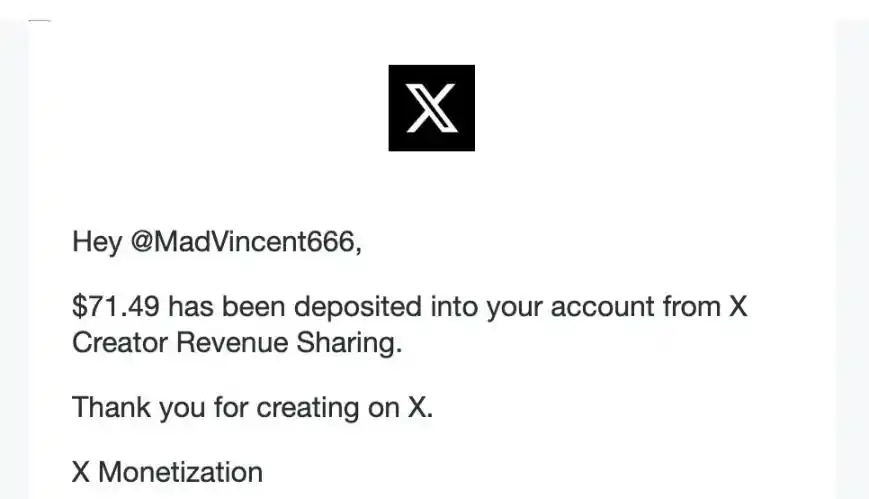
After 29 million impressions, the X platform paid me $71.49.

This is a warning. As of 2025, those still chasing impressions on the X platform are neither seizing the initiative nor working hard—they are merely the exit liquidity for bot traffic.
The Lie Everyone Believes

At some point, the crypto community (CT) reached a consensus: "The higher the impressions, the more money you make." This was half-true in the past. But by 2025, it has become a complete fallacy.

Today, impressions are nothing but a vanity metric: they look glamorous and addictive but are utterly useless for actual earnings. They can make your data panel as beautiful as a bull market chart, but the corresponding bank deposit is pitifully small, akin to a forgotten small wallet.

I learned this lesson the hard way.
My Personal Experiment (A.K.A. How I Got Rugged)

In mid-December 2025, I launched this aggressive traffic experiment: posting over 200 comments daily, specifically targeting top accounts' posts to蹭热度 (ride on their popularity), without limiting myself to any vertical, aiming for an all-out "indiscriminate bombardment."

Movies, gaming, politics, cryptocurrency, memes, sports... as long as it was a hot topic, I jumped in to comment.

Soon, my actions echoed across the platform: "Bro, I see you everywhere," "The algorithm must love you," "This data is explosive growth."

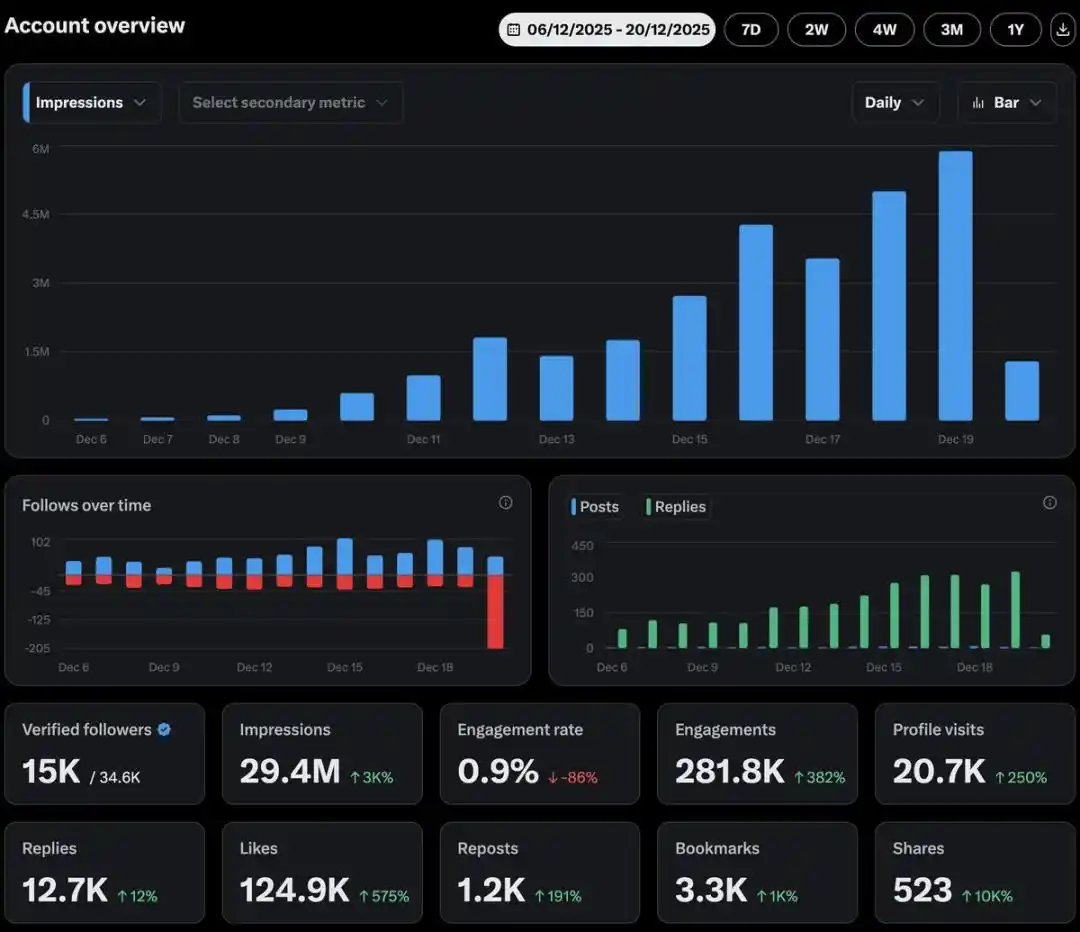
Now, let's look at the specific results: 28.9 million impressions, 267.7k engagements, 119.5k likes, 11.8k comments, 3.1k bookmarks, 20k profile visits, 37.5k followers, with verified users accounting for about 41%.

On average, I only posted 4 original pieces of content per day, with the rest of the traffic全靠 "comment section蹭热度 (riding on popularity)." Looking solely at the data panel, it was a crushing advantage. But when payday came, the deposit was only $71.49.

It was then that I fully understood: impressions don't make money; high-quality interactions from paying users are what matter.

The monetization logic of the X platform has long changed. It no longer rewards exposure but rather who interacts with you.

If your engagement data doesn't come from paying verified users, it's no different from having no engagement at all.

The Real Rules of X Platform Monetization in 2025

There's no mystery behind this; it's just that many are unwilling to accept reality. The real monetization rules are as follows.

Only engagement types from paying verified users count towards monetization: comments, reposts, bookmarks, likes, and the engagement must occur within monetizable reply posts.

Some engagement types are无效 for monetization: free user engagement, bot traffic, skyrocketing impressions without paying user participation, "fake viral" posts without paying user engagement.

One comment from a paying verified user might be worth far more than 100 bot likes.

Additionally, engagement has varying weights; not all are equal. Comments and reposts carry the highest weight, followed by bookmarks, with likes being the lowest.

So, if your engagement data shows the following characteristics: many likes, few comments, low verified user ratio—then your account may look popular but has no monetization value.

The Unmentioned Bot Traffic Trap

Riding on the popularity of top accounts' comment sections seems like a shortcut to gaining followers, but it's actually a distribution engine for bot traffic.

Here's what really happens: your comment gets pushed to a bot network → impressions skyrocket → engagement data appears healthy → at settlement, the platform filters out all invalid traffic.

This is why the absurd result of "29 million impressions, only $71 earned" occurs. This isn't a system glitch; it's the precise execution of platform rules.

This Playstyle Is Ruining Your Account

This is not only an extremely low ROI practice but also causes irreversible damage to your account.

Bot Follower Pollution

In just a few days, my account gained over 2500 bot followers. These bots lower:

  • The account's verified user ratio

  • The platform's trust rating for you

  • Future settlement amounts

Audience Dilution

Your followers are no longer a targeted audience but have become worthless "noise." The platform understands this, advertisers understand this, and ultimately, your earnings will reflect this directly.

Algorithmic Downgrade Penalty

Posting 200+ comments daily →极易触发限流 (easily triggers rate-limiting). Content lacks vertical focus →无法向算法传递清晰的账号标签 (unable to convey clear account labels to the algorithm). Ultimately, your account will be flagged by the algorithm as a "suspected spam account."

Creator Burnout

You think you're dominating the platform's hot list, but then the bank deposit notification hits you like a ton of bricks. Most creators give up at this very moment.

What I Did

I completely overturned my previous strategy: cleaned up 2500 bot followers, removed 5000 zombie followers, stopped the comment-section popularity riding, and focused on building a genuine follower community.

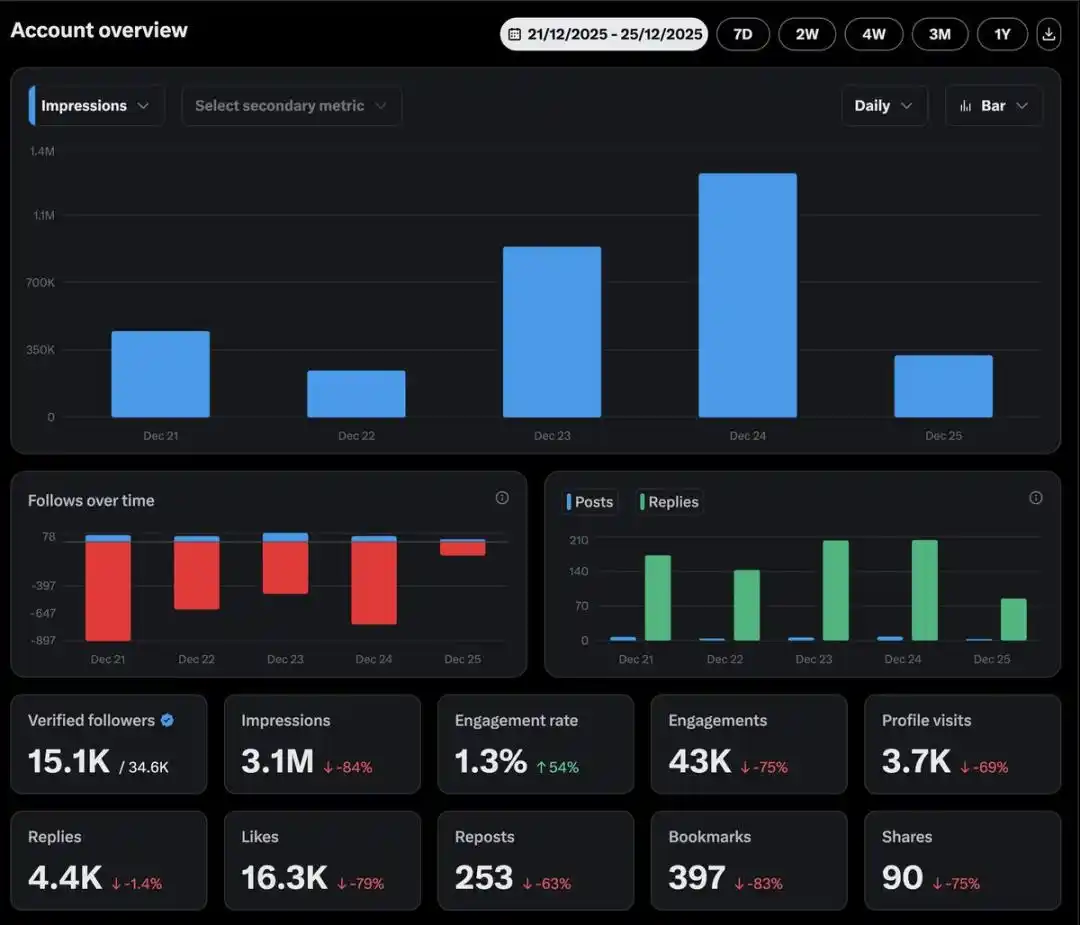
In the short term, account metrics确实下滑了 (did decline), but the long-term health of the account is recovering.

In the next settlement cycle, my account data showed new characteristics: lower impressions, higher quality engagement (check the engagement rate percentage), more precise follower growth, and significantly reduced creative pressure.
The Core Metrics Actually Worth Focusing On

If you want to make money on the X platform, aim for the following goals:

  • 3%-5% engagement rate

  • High-engagement posts dominated by comments

  • 45%-50% verified user ratio

  • Consistent output of original content

Having fewer impressions is okay; having high-quality user interaction is key. Achieve these, and you'll go from "Why are my earnings so terrible?" to "So this is how you achieve stable monetization."

The Final Truth

Impressions are like the siren's song: they make you think you've seized the initiative, make you feel like you're the platform's focus, and give you an illusion of "importance."

But they don't bring a single cent of profit. What monetizes is high-quality interaction from paying users. In 2025, the X platform will not reward "traffic speculators"; it will only reward "content builders."


Perguntas relacionadas

QWhat was the author's total earnings from 29 million impressions on X platform?

AThe author earned only $71.49 from 29 million impressions on the X platform.

QAccording to the article, what is the key factor for actual monetization on X platform in 2025?

AHigh-quality interactions from paid verified users, not just high impression counts, are the key to actual monetization.

QWhat negative consequences did the author experience from chasing impressions via comment spamming?

AThe author gained over 2500 bot followers, diluted their audience, risked algorithm downgrades, and experienced psychological burnout.

QWhat types of user interactions are considered most valuable for monetization on X platform?

AComments and reposts from paid verified users carry the highest weight for monetization, followed by bookmarks, with likes being the least valuable.

QWhat core metrics should creators focus on to achieve stable earnings on X platform according to the article?

ACreators should aim for a 3%-5% engagement rate, high-quality interactions like comments, 45%-50% verified user ratio, and consistent original content output.

Leituras Relacionadas

From Gold to Bitcoin: Fixed Supply + Institutional Frenzy, Might It Repeat the 'Explosive' Price Trend?

"From Gold to Bitcoin: Fixed Supply and Institutional Frenzy May Lead to 'Explosive' Price Rally Analysts suggest Bitcoin's price action could mirror gold's over the past two decades, following the launch of spot Bitcoin ETFs. Gold ETFs, introduced in 2004, drove gold's price surge to a current market cap near $28 trillion. Both gold and Bitcoin are non-yielding stores of value, with prices driven purely by investor sentiment rather than cash flows or credit. Gold ETFs experienced dramatic cycles: explosive growth, painful drawdowns, and slow recoveries, with each cycle reaching higher peaks. Bitcoin ETFs, approved in early 2024, saw rapid institutional adoption but are now facing similar volatility. Recent warnings highlight the risk of significant ETF outflows disrupting the current rebound. BlackRock's IBIT, a leading Bitcoin ETF, has sold nearly 100,000 BTC to meet redemptions while still holding over 733,000. The core parallel is fixed supply: when demand surges, prices explode, but demand is often volatile and wave-like, not steady. Institutional interest, through ETFs and corporate adoption, remains a key support pillar, helping to cushion sell-offs. If Bitcoin captures even a fraction of gold's role as a store of value, its upside potential is immense, though the path will be marked by high volatility. For investors, focusing on long-term trends and managing risk is crucial as this 'price explosion' narrative unfolds."

Foresight NewsHá 23m

From Gold to Bitcoin: Fixed Supply + Institutional Frenzy, Might It Repeat the 'Explosive' Price Trend?

Foresight NewsHá 23m

Why Is AI Agent Shopping Hard to Popularize?

The article argues that the popular narrative of "AI agent shopping" – equipping AI with a wallet to autonomously handle purchases – is fundamentally flawed and oversimplifies the complexity of shopping. It deconstructs shopping into two core actions: **information retrieval** (standardized, easily automated) and **value judgment** (deeply subjective and human-centric). The narrative mistakenly assumes AI can fully handle both. Value judgment itself has two layers: **evaluation** (assessing options against criteria) and **demand definition** (setting the criteria, weights, and values). The latter is inherently human and dynamic, as preferences are not fixed but constructed during the decision-making process ("constructive preferences"). The real dividing line for automation is not product standardization, but whether the **act of choosing** itself holds experiential value. For mundane purchases (e.g., printer paper), full AI delegation works. For experiential goods (e.g., wine, furniture), the joy of selection is core to consumption, so AI should act as an assistant that narrows options, leaving the final choice to humans. The "AI wallet" concept confuses three separate elements: decision-making, execution, and fund custody. Current payment industry solutions (e.g., from Stripe, Mastercard, Google, Visa) show that limited, scoped payment authorization tokens are sufficient for most consumer scenarios, not full fund custody. The true use case for autonomous AI wallets is in **B2B procurement** and **machine-to-machine (M2M) settlements** for standardized, high-frequency, low-value transactions. The real bottlenecks for AI shopping are not payment technology, but **1) the lack of trusted data sources** (e.g., fake reviews, counterfeit goods) and **2) the impossibility of automating human demand definition**. The conclusion is that the focus should be on safely automating the assessment and filtering process while reserving for humans the rights to define their criteria and enjoy the final act of choice. For experiential goods, the platform's competitive advantage shifts to providing a superior selection experience.

Foresight NewsHá 1h

Why Is AI Agent Shopping Hard to Popularize?

Foresight NewsHá 1h

After Nine Months of Shorting, a Full Turn to Long: Renowned Trader Opens Bitcoin Positions Around 64K, Crypto Market Long-Short Divergence Intensifies

After nine months of being short, prominent crypto trader Doctor Profit has closed all his bearish positions and started buying Bitcoin near $64,000, signaling a complete bullish reversal. He argues that structural market changes—such as impending U.S. regulation (CLARITY Act) and institutional adoption via securities tokenization—are rewriting the traditional four-year cycle script, potentially bringing the market bottom forward from the widely expected September/October timeframe. This view finds some technical support from on-chain analyst gumsays, who notes a bullish divergence on Bitcoin's weekly chart has persisted for 147 days, nearing the 161-day duration seen before the 2022 cycle low. However, cycle researcher Jake Pahor presents a counter-argument based on historical data. Analyzing patterns since 2014, he identifies three common features of past bear market bottoms: a ~12-month duration from peak to trough, a sustained period of extreme fear (with a proprietary risk score below 20), and the price falling below Bitcoin's realized price (~$53,000 currently). The current cycle, only nine months from its October 2025 peak, meets none of these conditions. The debate highlights a market torn between "front-running" a potential early bottom driven by new fundamentals and waiting for confirmation through traditional on-chain and sentiment metrics. While Doctor Profit opts for aggressive buying, Pahor maintains a disciplined, tiered accumulation strategy, continuing weekly buys at current risk levels but reserving larger orders for if more extreme fear emerges.

marsbitHá 1h

After Nine Months of Shorting, a Full Turn to Long: Renowned Trader Opens Bitcoin Positions Around 64K, Crypto Market Long-Short Divergence Intensifies

marsbitHá 1h

Trading

Spot
活动图片