29 Million Impressions, Only $71 Earned: How to Make Money from Traffic on X Platform?

marsbitPublicado em 2025-12-26Última atualização em 2025-12-26

Resumo

An experiment on X platform revealed that chasing high exposure metrics does not translate to meaningful revenue. After generating 28.9 million impressions and gaining 37.5k followers through aggressive tactics like spamming comments and piggybacking on popular accounts, the author earned only $71.49. The key insight is that exposure is a vanity metric—it doesn’t drive earnings. What matters is engagement from paid verified users. Comments and reposts from premium users carry the most weight, while likes and free user interactions contribute little. The platform’s algorithm filters out bot-driven activity, making inflated exposure worthless. The author also experienced negative side effects: bot followers diluted audience quality, reduced trust with the algorithm, and increased the risk of being flagged as spam. The recommended strategy shifts focus to quality over quantity: aim for 3-5% engagement rates, prioritize comments from verified users (45-50% of total followers), and create original content. Sustainable monetization comes from building a genuine community, not chasing empty metrics.

Written by: MAD Vincent

Compiled by: Chopper, Foresight News

I did exactly what they said: frantically spammed comments, closely followed top accounts to ride on their traffic, and jumped on every trending topic, chasing impressions like chips in a bull market.

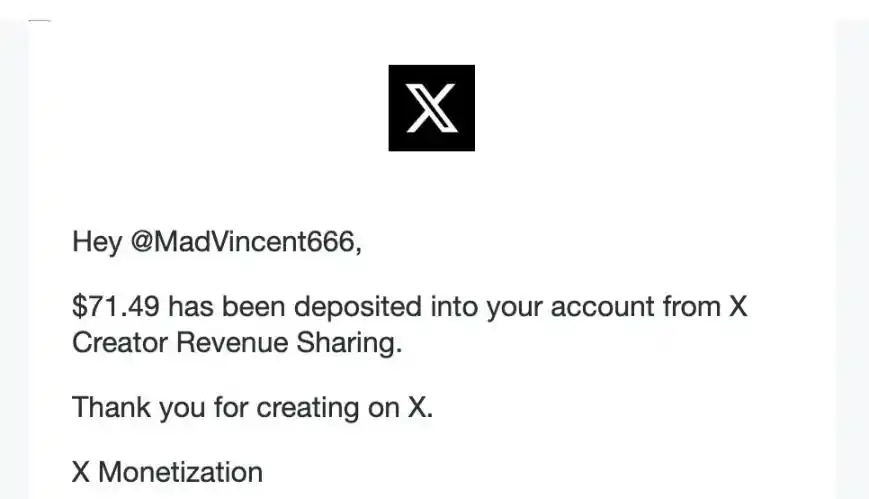
After 29 million impressions, the X platform paid me $71.49.

This is a warning. As of 2025, those still chasing impressions on the X platform are neither seizing the initiative nor working hard—they are merely the exit liquidity for bot traffic.
The Lie Everyone Believes

At some point, the crypto community (CT) reached a consensus: "The higher the impressions, the more money you make." This was half-true in the past. But by 2025, it has become a complete fallacy.

Today, impressions are nothing but a vanity metric: they look glamorous and addictive but are utterly useless for actual earnings. They can make your data panel as beautiful as a bull market chart, but the corresponding bank deposit is pitifully small, akin to a forgotten small wallet.

I learned this lesson the hard way.
My Personal Experiment (A.K.A. How I Got Rugged)

In mid-December 2025, I launched this aggressive traffic experiment: posting over 200 comments daily, specifically targeting top accounts' posts to蹭热度 (ride on their popularity), without limiting myself to any vertical, aiming for an all-out "indiscriminate bombardment."

Movies, gaming, politics, cryptocurrency, memes, sports... as long as it was a hot topic, I jumped in to comment.

Soon, my actions echoed across the platform: "Bro, I see you everywhere," "The algorithm must love you," "This data is explosive growth."

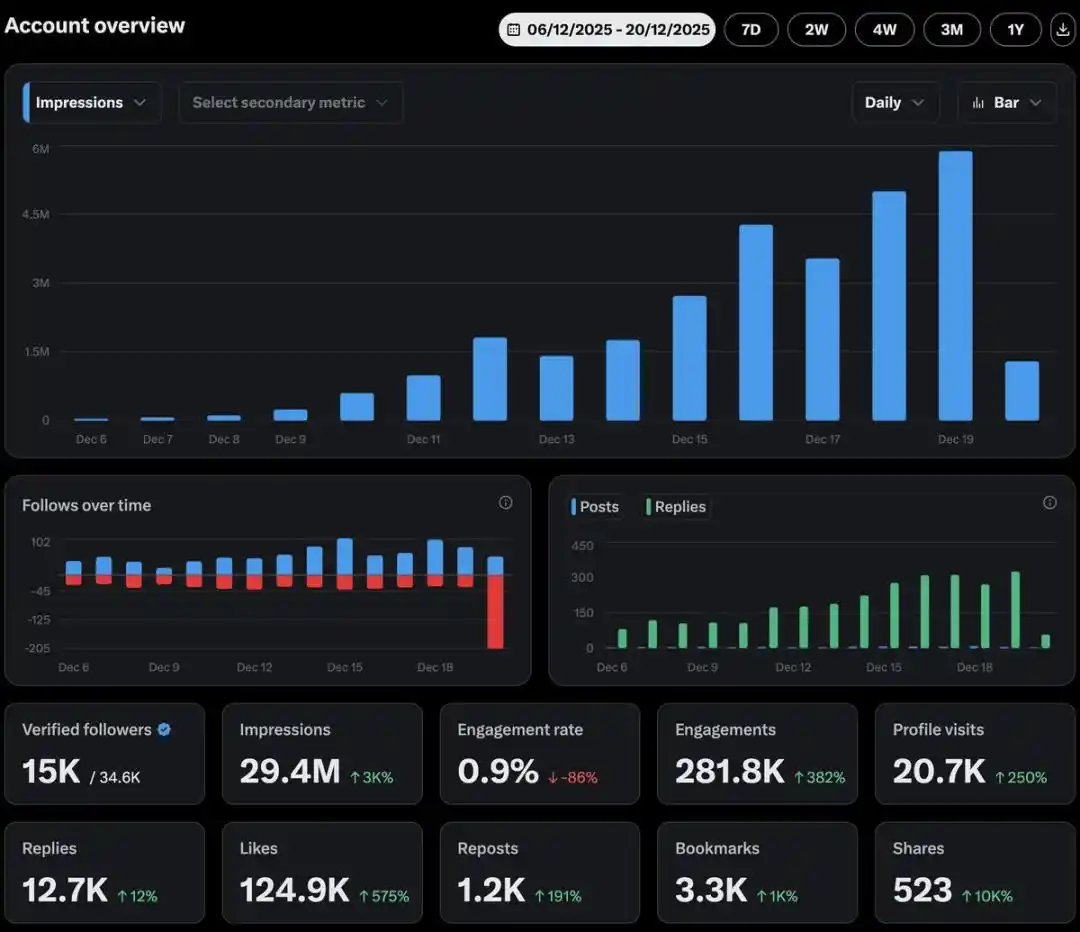
Now, let's look at the specific results: 28.9 million impressions, 267.7k engagements, 119.5k likes, 11.8k comments, 3.1k bookmarks, 20k profile visits, 37.5k followers, with verified users accounting for about 41%.

On average, I only posted 4 original pieces of content per day, with the rest of the traffic全靠 "comment section蹭热度 (riding on popularity)." Looking solely at the data panel, it was a crushing advantage. But when payday came, the deposit was only $71.49.

It was then that I fully understood: impressions don't make money; high-quality interactions from paying users are what matter.

The monetization logic of the X platform has long changed. It no longer rewards exposure but rather who interacts with you.

If your engagement data doesn't come from paying verified users, it's no different from having no engagement at all.

The Real Rules of X Platform Monetization in 2025

There's no mystery behind this; it's just that many are unwilling to accept reality. The real monetization rules are as follows.

Only engagement types from paying verified users count towards monetization: comments, reposts, bookmarks, likes, and the engagement must occur within monetizable reply posts.

Some engagement types are无效 for monetization: free user engagement, bot traffic, skyrocketing impressions without paying user participation, "fake viral" posts without paying user engagement.

One comment from a paying verified user might be worth far more than 100 bot likes.

Additionally, engagement has varying weights; not all are equal. Comments and reposts carry the highest weight, followed by bookmarks, with likes being the lowest.

So, if your engagement data shows the following characteristics: many likes, few comments, low verified user ratio—then your account may look popular but has no monetization value.

The Unmentioned Bot Traffic Trap

Riding on the popularity of top accounts' comment sections seems like a shortcut to gaining followers, but it's actually a distribution engine for bot traffic.

Here's what really happens: your comment gets pushed to a bot network → impressions skyrocket → engagement data appears healthy → at settlement, the platform filters out all invalid traffic.

This is why the absurd result of "29 million impressions, only $71 earned" occurs. This isn't a system glitch; it's the precise execution of platform rules.

This Playstyle Is Ruining Your Account

This is not only an extremely low ROI practice but also causes irreversible damage to your account.

Bot Follower Pollution

In just a few days, my account gained over 2500 bot followers. These bots lower:

  • The account's verified user ratio

  • The platform's trust rating for you

  • Future settlement amounts

Audience Dilution

Your followers are no longer a targeted audience but have become worthless "noise." The platform understands this, advertisers understand this, and ultimately, your earnings will reflect this directly.

Algorithmic Downgrade Penalty

Posting 200+ comments daily →极易触发限流 (easily triggers rate-limiting). Content lacks vertical focus →无法向算法传递清晰的账号标签 (unable to convey clear account labels to the algorithm). Ultimately, your account will be flagged by the algorithm as a "suspected spam account."

Creator Burnout

You think you're dominating the platform's hot list, but then the bank deposit notification hits you like a ton of bricks. Most creators give up at this very moment.

What I Did

I completely overturned my previous strategy: cleaned up 2500 bot followers, removed 5000 zombie followers, stopped the comment-section popularity riding, and focused on building a genuine follower community.

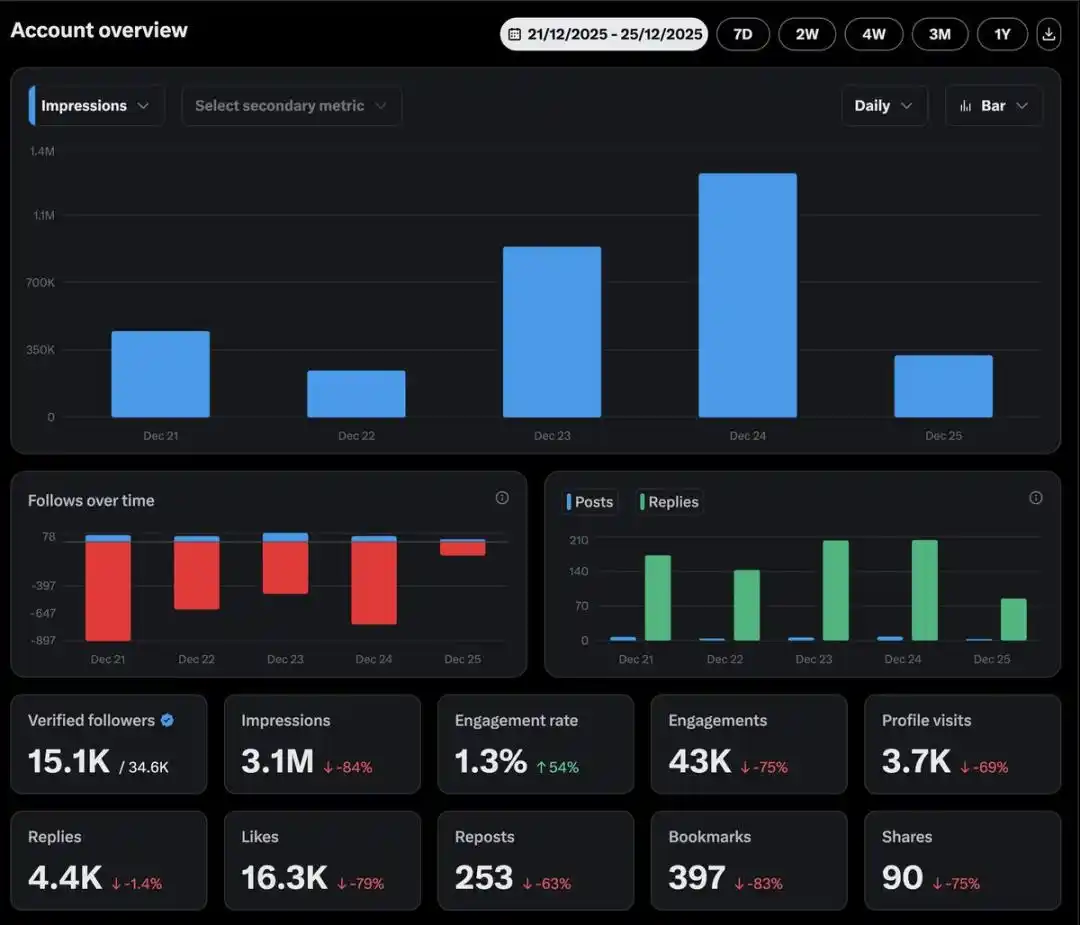
In the short term, account metrics确实下滑了 (did decline), but the long-term health of the account is recovering.

In the next settlement cycle, my account data showed new characteristics: lower impressions, higher quality engagement (check the engagement rate percentage), more precise follower growth, and significantly reduced creative pressure.
The Core Metrics Actually Worth Focusing On

If you want to make money on the X platform, aim for the following goals:

  • 3%-5% engagement rate

  • High-engagement posts dominated by comments

  • 45%-50% verified user ratio

  • Consistent output of original content

Having fewer impressions is okay; having high-quality user interaction is key. Achieve these, and you'll go from "Why are my earnings so terrible?" to "So this is how you achieve stable monetization."

The Final Truth

Impressions are like the siren's song: they make you think you've seized the initiative, make you feel like you're the platform's focus, and give you an illusion of "importance."

But they don't bring a single cent of profit. What monetizes is high-quality interaction from paying users. In 2025, the X platform will not reward "traffic speculators"; it will only reward "content builders."


Perguntas relacionadas

QWhat was the author's total earnings from 29 million impressions on X platform?

AThe author earned only $71.49 from 29 million impressions on the X platform.

QAccording to the article, what is the key factor for actual monetization on X platform in 2025?

AHigh-quality interactions from paid verified users, not just high impression counts, are the key to actual monetization.

QWhat negative consequences did the author experience from chasing impressions via comment spamming?

AThe author gained over 2500 bot followers, diluted their audience, risked algorithm downgrades, and experienced psychological burnout.

QWhat types of user interactions are considered most valuable for monetization on X platform?

AComments and reposts from paid verified users carry the highest weight for monetization, followed by bookmarks, with likes being the least valuable.

QWhat core metrics should creators focus on to achieve stable earnings on X platform according to the article?

ACreators should aim for a 3%-5% engagement rate, high-quality interactions like comments, 45%-50% verified user ratio, and consistent original content output.

Leituras Relacionadas

Who Funds the Agents?

**Summary: Who Funds AI Agents?** OpenAI recently shut down a feature allowing AI agents to shop for users, highlighting the challenge of creating a secure and regulated environment for agent-driven transactions. While payment infrastructure exists, a crucial governance layer—defining spending limits, fraud detection, tax handling, and return policies—is largely missing. The potential is enormous: AI agents already processed $73M across 176M transactions last year, with McKinsey forecasting this could grow to $3-5T in global consumer commerce by 2030. The core competition isn't just about processing payments, which can be very cheap (especially with crypto-based settlement), but about controlling the rules that govern agent spending. Key players like Stripe and Coinbase are racing to dominate this governance layer. Stripe's acquisition of wallet provider Privy allows it to set spending policies, identity checks, and human-in-the-loop approvals directly at the wallet level. Similarly, Coinbase's stack, including its x402 protocol and AgentKit, embeds governance rules. This vertical integration across settlement, wallet, and governance layers is becoming the dominant strategy. Control over the governance layer is where significant future value lies. If agents handle trillions in transactions, even a small fee for managing compliance, fraud prevention, and policy enforcement could generate billions in annual revenue. The companies that successfully integrate across the payment stack will capture value from idle agent balances, transaction fees, and governance services, positioning themselves as the foundational banks of the AI agent economy.

marsbitHá 1m

Who Funds the Agents?

marsbitHá 1m

A Nation Blocks Chips, a Giant Buys a Nuclear Power Plant: Why It's Time to Seriously Consider DeAI

**Title: Great Powers Blockade Chips, Giants Buy Nuclear Plants: Why It's Time to Seriously Consider DeAI** In May 2026, the US closed loopholes for Chinese firms to acquire advanced NVIDIA chips via overseas subsidiaries. That same month, Kenya halted a $1B geothermal data center project involving Microsoft, fearing its immense energy consumption. Meanwhile, Huawei announced mass production of its Ascend AI chip. These disparate events underscore a new reality: the competition for computing power ("compute") has escalated beyond the tech industry, becoming a geopolitical and infrastructural battleground. A new era of oligopoly is forming, with control over the AI stack—from GPU chips (NVIDIA) and cloud platforms (AWS, Azure, Google Cloud) to foundational models (OpenAI, Anthropic)—concentrating in a few Western "AI Octopus" corporations. This centralization creates systemic risks: pricing power and platform lock-in for users, infrastructure fragility, and a widening "compute divide" that threatens to marginalize nations without independent AI capacity. An "AI Iron Curtain" is deepening through export controls. In response, some nations like Saudi Arabia and the UAE are investing heavily to buy compute power, aiming to transition from oil to AI economies. The EU seeks to triple its compute capacity by 2030 to reduce dependency. However, the spending gap is vast, with four US tech giants alone planning ~$750B in AI capex for 2026. The race is increasingly constrained by energy, with AI tasks consuming up to 1000x more power than web searches, pushing firms to even acquire nuclear plants. This landscape is fueling interest in Decentralized AI (DeAI). It proposes a third way: using open protocols to coordinate a global network of idle GPUs, independent developers, and data centers, creating an AI infrastructure without a single controlling entity. Leveraging blockchain and cryptographic verification, DeAI aims to break market concentration, disperse energy demands, reduce geopolitical dependencies, and enhance transparency. While still nascent in performance and stability, DeAI's core promise is not immediate superiority but providing a crucial alternative architecture to resist monopoly, censorship, and centralized power. As specialized AI hardware costs fall and open-source models flourish, the window to build this foundation is open. The very existence of such competition serves as a vital check against the inevitable abuse of concentrated power.

marsbitHá 55m

A Nation Blocks Chips, a Giant Buys a Nuclear Power Plant: Why It's Time to Seriously Consider DeAI

marsbitHá 55m

Outpoll Review: A Prediction Market Platform Built for Active Traders

Outpoll Review: A Prediction Market Platform Built for Active Traders In recent years, prediction markets have grown from a niche sector to a mainstream arena, attracting billions in trading volume and institutional capital. However, the user experience and tools for traders have not kept pace. Outpoll, a new global prediction market platform, aims to fill this gap by providing enhanced trading infrastructure for active and professional traders. Built on standard prediction market principles, Outpoll allows users to trade on the outcome of specific events. It uses fully collateralized contracts with USDC settlement, charges a competitive 0.1% fee per trade, and provides clear settlement rules upfront to minimize disputes. A key focus for Outpoll is its professional-grade trading tools. The platform supports limit and market orders, as well as take-profit and stop-loss orders for open positions—features uncommon in prediction markets. For automated trading, Outpoll offers comprehensive REST and WebSocket APIs, enabling portfolio management, price arbitrage, and integration with existing tools. The platform also features a creator-led market model, where approved experts and community leaders can create and manage markets for niche topics under platform supervision. Its integrated interface combines news feeds directly with trading functions, allowing users to monitor events and manage positions seamlessly. Outpoll launched with a native Android app (available on Google Play) and plans an iOS version later this year. In summary, Outpoll distinguishes itself with trader-focused tools, practical APIs, transparent and collateralized markets, integrated news, and an expanding creator program. For active traders, its advanced order types and API access alone make it a platform worth watching. Outpoll is now globally accessible via outpoll.com and Google Play.

marsbitHá 1h

Outpoll Review: A Prediction Market Platform Built for Active Traders

marsbitHá 1h

Trading

Spot
Futuros
活动图片