Solaxy Presale Heats Up as Traders Hunt the Next Hyperliquid

bitcoinistPublicado em 2025-05-25Última atualização em 2025-05-25

Resumo

Crypto X is buzzing. Headlines are flying. Everyone’s talking about Hyperliquid and its so-called ‘Solana moment.’ It’s the kind of...

Trusted Editorial content, reviewed by leading industry experts and seasoned editors. Ad Disclosure

Crypto X is buzzing. Headlines are flying. Everyone’s talking about Hyperliquid and its so-called ‘Solana moment.’

It’s the kind of narrative that kicks off altcoin season fever – memories of 2021-style rallies, where coins you’d never heard of turned into overnight giants.

This type of hype isn’t just noise. It moves markets. And right now, traders are scrambling to spot the next low-cap rocket before it takes off.

That’s where Solaxy ($SOLX) comes in. It’s a wild, meme-fueled new crypto project with a clever twist – and it’s starting to show the same early signs of explosive potential.

The crypto presale is live, the buzz is building, and the clock is ticking. With 22 days left, Solaxy might just be the next unexpected hero of this cycle.

The Hype Machine Is Back On

So why is everyone suddenly talking about ‘Solana moments’ again.

Hyperliquid ($HYPE) surged as much as 240% in recent weeks before settling at a 95% gain over the past 30 days, climbing to $36.61 and grabbing serious attention across X and crypto Telegram groups.

$HYPE surge over the last 30 days on CoinMarketCap.
Source: CoinMarketCap.

But it’s not just about one coin mooning – it’s about the return of narrative-driven trading. People aren’t just scanning charts anymore. They’re chasing stories. They’re hunting for the next Solana or Pepe.

Back in 2021, coins didn’t pump because of utility – they pumped because of memes, momentum, and madness. Solana had the ‘Ethereum killer’ badge.
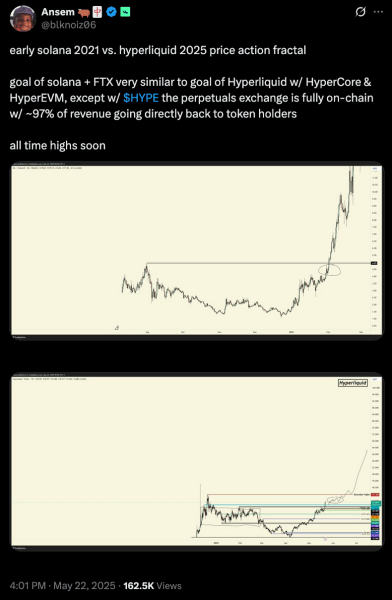
early solana 2021 vs. hyperliquid 2025 price action fractal post on X.

Dogecoin rode Elon’s posts like a SpaceX shuttle. Shiba Inu sold the dream of a decentralized meme empire.
These coins had a vibe, a cult following, and a sense of being in on something big before the rest of the world caught on.

Now, that same playbook is working again. Hyperliquid’s rally showed that you don’t need a blue-chip label to skyrocket. You just need attention, the right narrative, and perfect timing.

And that’s exactly the wave Solaxy is ready to ride.

What Is Solaxy ($SOLX) and Why Is Everyone Talking About It?

Solaxy ($SOLX) isn’t just another meme coin – it’s a full-blown blockchain revolution dressed up in memes and chaos.

It’s the first-ever Layer 2 built on Solana, and it’s here to do what Solana alone couldn’t: fix its traffic jams, smooth out its failed transactions, and push the speed to new levels.
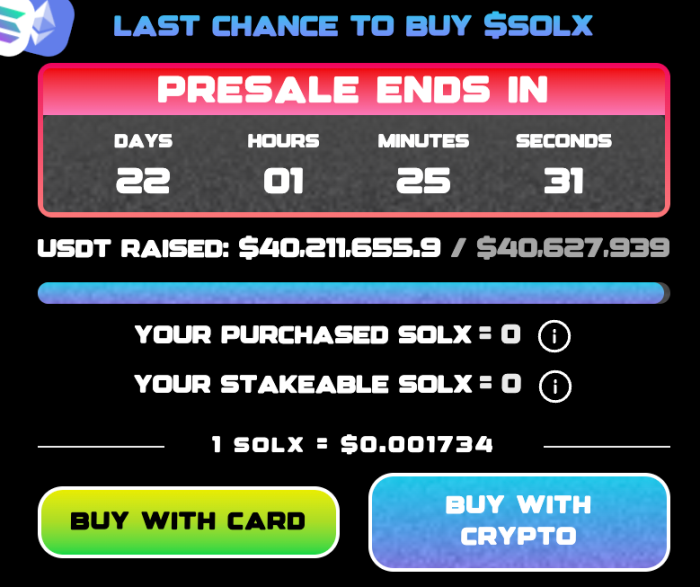
How to buy $SOLX presale.

Solaxy unlocks Solana’s full potential by adding scalability, reliability, and an Ethereum-sized opportunity.
That’s right – $SOLX is a multichain token, native to Solaxy (the Solana Layer 2), but launching on both Solana and Ethereum, the two biggest crypto ecosystems on the planet.

Ethereum has unmatched liquidity. Solana has meme coin mania. Solaxy gives you access to both.

And it’s not just for developers or whales. Solaxy democratizes the meme coin game. Its infrastructure gives everyday traders the same kind of power and speed that sniping bots use – making it easier to catch a mooning coin before it takes off.

Whether you’re in it for the tech, the memes, or the gains, Solaxy hits the sweet spot.

In a week where $HYPE showed us the power of narrative trading, Solaxy fits perfectly into the ‘next breakout’ conversation.

Why You Need to Buy Solaxy Right Now

The $SOLX presale is live at just $0.001734, and it’s already raised over $40M. That alone tells you it’s gaining real traction.

Solaxy ($SOLX) presale raises $40M.

But here’s the real reason to act now: there are only 22 days left before the presale ends – and this is the last chance to get in before the open market decides the price.

Let’s do the math. Price forecasts for 2025 place $SOLX between $0.0024 and $0.032. At the low end, that’s a 38% gain from today’s price. At the high end, that’s a 1,745% increase.

Now let’s say you buy $1K worth of $SOLX at the current presale price. That gets you about 576,800 tokens. If you stake them with a 15% APY, you’ll have around 663,320 tokens in a year.

If the price stays flat, you still hold $1,150 worth of tokens – easy passive income.

But if $SOLX hits just $0.032 in 2025, your tokens could be worth $21,226. That’s a 2,000%+ ROI, without lifting a finger – just for buying early and staking smart.

The window is closing. The hype is building. Solaxy isn’t just another coin – it’s a layer 2 rocket with a countdown.

The Next Breakout Isn’t Coming – It’s Already Here

Crypto traders are chasing the next Solana moment, and Hyperliquid’s breakout just reminded everyone how fast things can move. The market is hungry for momentum, stories, and underdogs with explosive upside.

Solaxy fits that narrative perfectly – messy, meme-driven, and built on real tech that solves Solana’s biggest pain points.

It’s not just playing the game – it’s rewriting the rules.

Always do your own research (DYOR) before investing in crypto. This article is for informational purposes and doesn’t constitute investment advice.

Editorial Process for bitcoinist is centered on delivering thoroughly researched, accurate, and unbiased content. We uphold strict sourcing standards, and each page undergoes diligent review by our team of top technology experts and seasoned editors. This process ensures the integrity, relevance, and value of our content for our readers.

Leituras Relacionadas

Crypto 美股观察:CRCL、HOOD、COIN 与 MSTR,最近在交易什么?

Recent weeks have seen significant developments for four key US-listed crypto-related stocks—Circle (CRCL), Robinhood (HOOD), Coinbase (COIN), and MicroStrategy (MSTR)—with their core investment theses diverging. For **Circle (CRCL)**, its stock price is increasingly realigning with the fundamental driver of **USDC circulation**. After IPO exuberance faded, CRCL's performance now correlates closely with changes in USDC supply, which is heavily influenced by DeFi activity and risk appetite. The recent contraction in USDC, linked to events like the KelpDAO incident, has pressured the stock. A sustainable recovery signal for CRCL would require a confluence of recovering DeFi TVL, stablecoin demand, and consecutive weeks of USDC net issuance. **Robinhood (HOOD)** gained market attention with the launch of its **Robinhood Chain**, an Ethereum L2. While not an immediate threat to Coinbase's dominant Base network in terms of scale or developer ecosystem, it represents a strategic encroachment. Robinhood's path—leveraging its traditional retail brokerage user base and assets to build a chain-based financial system—challenges Coinbase's narrative as the sole listed company integrating crypto-native infrastructure with traditional finance. This could dilute COIN's long-term scarcity premium. **MicroStrategy (MSTR)** made a notable shift by **selling Bitcoin** for the first time in a meaningful way (3,588 BTC), breaking its long-standing "buy-only" posture. The sales, used to fund dividends and replenish USD reserves, signal a move towards active capital management. While not indicative of a bearish turn on Bitcoin, it introduces new complexity for MSTR investors. The stock must now be evaluated not just as a leveraged Bitcoin proxy, but also considering fixed cash obligations from preferred dividends and debt, alongside its capital allocation strategy between holding BTC and maintaining liquidity. In summary, the investment narratives for these stocks are evolving beyond simple crypto market beta. Key variables now include stablecoin fundamentals, competition in chain-based financial ecosystems, and the balance between asset accumulation and corporate capital structure management.

marsbitHá 3m

Crypto 美股观察:CRCL、HOOD、COIN 与 MSTR,最近在交易什么?

marsbitHá 3m

Behind Robinhood's Launch of Its Own Chain, the Beautifully Packaged "Tokenized Stocks" Still Have No Equity Rights

Robinhood has launched "Robinhood Chain," an Ethereum-based Layer 2 built with Arbitrum technology, and introduced "Stock Tokens." This article clarifies that these tokens are not actual on-chain equity. They are tokenized debt securities issued by Robinhood Assets Jersey Limited, offering economic exposure to reference stocks or ETFs but lacking direct ownership, voting rights, or other shareholder privileges. The legal structure is conservative, relying on traditional financial intermediaries, custody, KYC/AML controls, and specific jurisdiction rules, even though the tokens are transferable on-chain. The move is part of Robinhood's broader strategy to evolve from a retail brokerage into a global financial ecosystem, integrating services like banking, retirement, crypto, and DeFi. Robinhood Chain aims to provide a programmable settlement layer, making financial products more portable and accessible while masking underlying complexity. However, the "brokerage chain paradox" lies in balancing a simple user interface with the intricate, regulated reality of the wrapped assets. The success of this model depends on users and regulators accepting this structured approach without misunderstanding the tokens as direct stock ownership. Key components supporting this strategy include the Bitstamp acquisition (expanding institutional crypto capabilities), the Robinhood Wallet (bridging brokerage and self-custody), the Robinhood Earn program (integrating DeFi lending), and the Lighter perpetual contracts platform. While ambitious, the initiative is still early, facing challenges in achieving liquidity, developer adoption, and regulatory clarity across jurisdictions.

marsbitHá 1h

Behind Robinhood's Launch of Its Own Chain, the Beautifully Packaged "Tokenized Stocks" Still Have No Equity Rights

marsbitHá 1h

Strategy's Accounting Gimmick: The Cap on BTC Sales Far Exceeds $1.25 Billion

The article, originally from Bankless, discusses how MicroStrategy's (MSTR) recent Bitcoin (BTC) sales reveal a much larger potential selling capacity than the widely reported $1.25 billion "reserve-building" cap. On July 7, MicroStrategy disclosed a sale of 3,588 BTC (~$216M) to pay dividends for its STRAT (STRC) preferred shares and replenish its USD Reserve. Crucially, the company stated this sale did not count against its stated $1.25 billion "reserve-building capacity." The analysis explains that MicroStrategy's "BTC Monetization Plan," part of its broader "Digital Credit Capital Framework," actually outlines three main purposes for selling BTC, only one of which has the $1.25B cap: 1. **Building the USD Reserve** (capped at $1.25B). 2. **Covering preferred share/ debt costs** (replenishing the reserve after payments). 3. **Funding buybacks** (up to $10B for preferred shares and $10B for MSTR common stock). The key nuance is the accounting distinction between "building" the reserve (selling BTC before making payments) and "replenishing" it (selling BTC after using reserve funds for payments). While functionally the same—converting BTC to cash for obligations—only "building" counts against the publicized $1.25B limit. This means sales for "replenishing" and the $20B+ buyback pool allow for total potential sales exceeding $30B. The article frames this as part of MicroStrategy's shift from a simple "buy and hold" Bitcoin narrative to an "active capital management" model, where BTC becomes a balance-sheet tool to manage pressures between its common stock, preferred shares, dollar reserve, and Bitcoin holdings. This creates complex trade-offs and potential conflicts of interest. The conclusion warns investors that the $1.25B figure is not a total sales ceiling. Understanding terms like "build," "replenish," and "repurchase" in MicroStrategy's disclosures is now critical, as the company navigates a new, more complex role as an actively managed entity rather than a passive Bitcoin accumulator.

Odaily星球日报Há 1h

Strategy's Accounting Gimmick: The Cap on BTC Sales Far Exceeds $1.25 Billion

Odaily星球日报Há 1h

Trading

Spot
活动图片