Осведомленность о криптовалюте в Сингапуре достигла рекордных 94%, но доля владения падает

cryptonews.ruPublicado em 2025-04-23Última atualização em 2025-05-23

Осведомленность о криптовалюте в Сингапуре достигла исторического максимума: 94% респондентов в недавнем опросе указали на знакомство по крайней мере с одним цифровым активом.

Однако доля владения снизилась, упав до 29% в 2025 году с 40% годом ранее, согласно пятому ежегодному исследованию рынка криптовалют в Сингапуре, проведенному Independent Reserve 21 мая.

Опрос, проведенный в феврале с 1500 участниками, показал, что мужчины по-прежнему более активны в инвестировании в криптовалюту, чем женщины, 35% по сравнению с 24%.

Миллениалы и поколение X (в возрасте 25–54 лет) доминируют среди инвесторов, составляя 71% всех держателей. Среди тех, кто торгует не реже одного раза в неделю, 76% относятся к этой возрастной группе.

Половина сингапурских инвесторов планируют увеличить активы

Несмотря на снижение доли владения, настроения остаются сильными. Более половины текущих держателей (53%) планируют увеличить свои позиции в течение следующих 12 месяцев, а 17% не держателей выразили заинтересованность в выходе на рынок.

Биткоин (BTC) продолжает оставаться якорем криптовалютного рынка в Сингапуре. Его держат 68% криптоинвесторов, а 86% рассматривают его как валюту, средство сбережения или инвестиционный актив. В частности, 77% говорят, что к 2030 году стоимость биткоина превысит 100 000 долларов.

Прямое владение остается предпочтительным методом инвестирования, при этом 61% предпочитают держать свои активы напрямую, а не через биржевые фонды (ETF).

Арбитражная торговля также растет: 67% респондентов заявили, что продали часть или все свои активы, чтобы извлечь выгоду из колебаний цен в прошлом году.
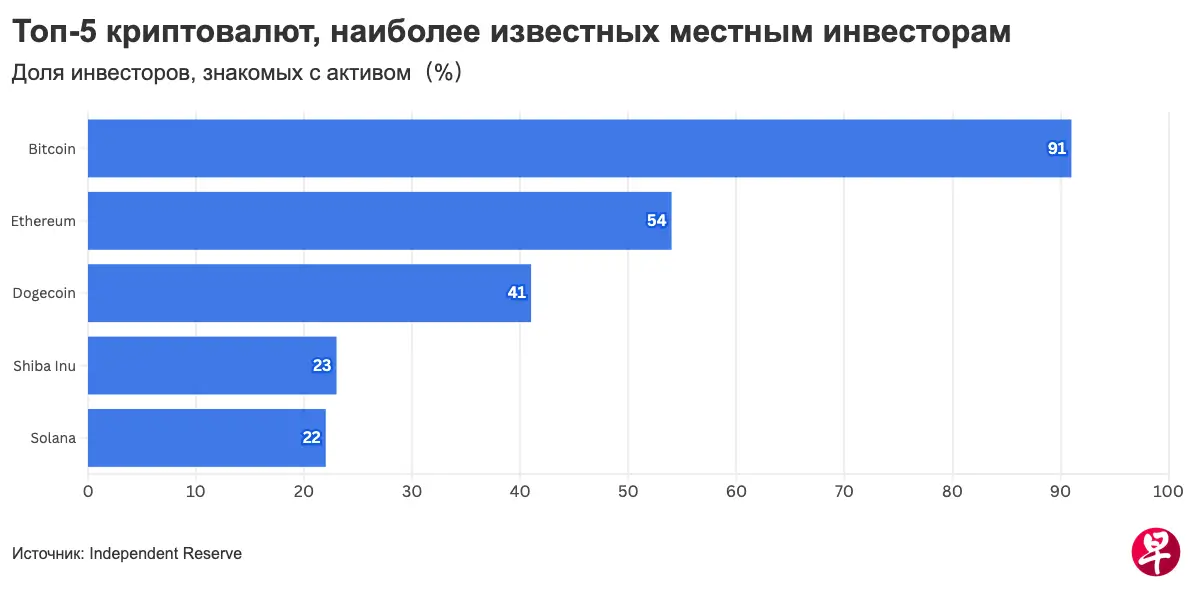

Биткоин — самая узнаваемая криптовалюта в Сингапуре. Источник: Independent Reserve.

Между тем, 46% инвесторов держат стейблкоины, в основном для торговли и деятельности DeFi, причем 83% из них привязаны к доллару США.

Мемкоины остаются спекулятивным сектором рынка, причем 28% респондентов держат по крайней мере одну мем-монету, причем Dogecoin (DOGE) является самой популярной.

Сингапур становится мировым криптоцентром

Сингапур закрепил свою роль в качестве мирового центра разработки блокчейнов и криптовалют, согласно отчету ApeX Protocol за декабрь 2024 года.

В исследовании говорится, что Сингапур лидирует в мире по числу патентов на блокчейны, 2433 рабочих мест, связанных с криптовалютами, и 81 активной криптовалютной бирже.

Гонконг занял второе место с 890 патентами на блокчейн, 1163 рабочими местами в секторе и 52 криптобиржами, что отражает продолжающееся продвижение города в секторе цифровых активов.

В 2024 году Сингапур удвоил свою регулирующую динамику. Денежно-кредитное управление Сингапура выдало 13 лицензий крупных платежных учреждений для криптобирж, что более чем в два раза превышает количество разрешений, выданных в 2023 году.

Leituras Relacionadas

Two Giants' Credit Expansion: Loan Balances of $9.9 Billion vs. $14.6 Billion, Brazil Emerges as the Main Battlefield

Title: Two Giants "Credit" Surge: Loan Balances of 99 Billion vs. 146 Billion USD, Brazil Emerges as Main Battlefield Summary: The article compares the rapid expansion of credit businesses by two major e-commerce and fintech players, Sea (via Monee) and Mercado Libre (via Mercado Pago), in overseas markets like Southeast Asia and Latin America, contrasting with a slowing domestic Chinese credit market. Using Q1 2026 financial data, it highlights their significant growth. Sea's Monee reached a loan balance of $99 billion, up 71% year-over-year (YoY), contributing 17.5% to Sea's total revenue. Mercado Pago's loan balance hit $146 billion, up 87% YoY, contributing 45% to its parent company's revenue. Both maintained stable risk metrics (e.g., Monee's 90+ day NPL at 1.1%) despite rapid scaling. Brazil is identified as a key and accelerating growth market for both. Sea's Brazilian operations saw loan volumes exceed $10 billion, growing 250% YoY, with SPayLater GMV penetration still low (~10%) indicating high potential. Sea also secured a key Brazilian financial credit license (SCFI). Mercado Libre's Brazil segment contributed over half (54%) of total group revenue, with its credit business there generating $11.24 billion in revenue, up 89% YoY and accounting for 12.7% of global revenue. Mercado Pago's credit portfolio, especially credit cards (46% of loans, +105% YoY), is a strategic focus, described as crucial as building logistics was a decade ago. Its net interest margin after loss (NIMAL) remains high at 17.8%. The article concludes that while Brazil presents immense opportunities, the success is largely driven by these integrated "e-commerce + fintech" giants with proprietary transaction data and ecosystems, making it challenging for standalone fintech players to compete effectively.

链捕手Há 22m

Two Giants' Credit Expansion: Loan Balances of $9.9 Billion vs. $14.6 Billion, Brazil Emerges as the Main Battlefield

链捕手Há 22m

Research Report Analysis: Is Intel Making a Comeback with Apple? Bernstein's Calculations Show the Right Direction, but the Price Is Already Overvalued

Bernstein analyst Stacy A. Rasgon published a report on June 18 regarding Intel, assessing the potential impact of recent political support for a US-based PC chip design and manufacturing collaboration between Apple and Intel. The report views this as a significant signal for the foundry landscape shift but concludes the initial financial contribution would be minimal. Key conclusions: 1) An Apple deal is seen as a small-scale "proof of concept." Even if Intel wins 40% of Apple's premium notebook chip orders (~5 million units/year), Bernstein estimates it would generate only about $500M in annual revenue and ~$0.03 EPS, negligible against Intel's ~$55B revenue. 2) Political encouragement is not equivalent to enforceable mandates. Winning orders ultimately depends on Intel demonstrating competitive technology (like its 18A node), cost, and reliable supply. 3) The path from validation to large-scale production involves significant challenges, capital investment, and time. Due to these uncertainties, Bernstein maintains a Market-Perform (Hold) rating with a $100 price target, implying potential downside from the ~$121.10 price at the report date. The analysis highlights the tension between near-term validation value—serving as a crucial trust signal for Intel's foundry ambitions and US supply chain resilience—and the long-term opportunity to attract larger cloud and AI chip customers. The investment thesis hinges on successful 18A execution and sustained policy support, not on immediate financial gains from Apple.

marsbitHá 46m

Research Report Analysis: Is Intel Making a Comeback with Apple? Bernstein's Calculations Show the Right Direction, but the Price Is Already Overvalued

marsbitHá 46m

27-Year Reign Ends: SK Hynix Market Cap Surpasses Samsung for First Time, an AI-Driven Reshuffle of Korean Chip Power

On June 22, 2026, SK Hynix made history by surpassing Samsung Electronics in market capitalization, ending Samsung's 27-year reign as South Korea's most valuable company. This dramatic reversal is powered by the AI boom and SK Hynix's dominant position in High Bandwidth Memory (HBM), a critical component for AI model training. Once a heavily indebted firm on the brink of bankruptcy, SK Hynix bet early on HBM, which has evolved from a niche product to essential AI infrastructure. It now commands a 59% share of the global HBM market. Its financial performance is staggering, with Q1 2026 net profit soaring nearly fourfold year-over-year to KRW 40.35 trillion, translating to over 2 billion RMB in daily net profit. HBM now drives roughly 40% of its revenue with exceptionally high margins. In contrast, Samsung, with its broad portfolio spanning memory chips, smartphones, and foundry services, has lagged in the HBM race while facing headwinds in other divisions. This shift signifies a deeper restructuring of South Korea's economy, moving from consumer electronics to AI-driven growth. However, the future remains competitive. With major capacity expansions planned industry-wide by 2028 and Samsung aiming to catch up in HBM technology, the new market leader cannot afford complacency. This event marks a pivotal moment in the global semiconductor industry's ongoing power realignment.

marsbitHá 57m

27-Year Reign Ends: SK Hynix Market Cap Surpasses Samsung for First Time, an AI-Driven Reshuffle of Korean Chip Power

marsbitHá 57m

Trading

Spot
Futuros
活动图片