Pi Network Price Soars 35% to $1.29 in Last 24 Hours

TheCryptoTimesPublicado em 2025-05-14Última atualização em 2025-05-14

Resumo

Whale moves 90M Pi coins spark a 278% volume spike, driving Pi Network’s price surge and retail interest to over $1 billion in trading.

The crypto market has been shocked by the dramatic 35% surge of Pi Network, which managed to recoup the $1 level and peak at $1.29. As a result of the rally, Pi’s total market value surpassed $8 billion, surpassing Litecoin (LTC) and Bitcoin Cash (BCH), according to CoinMarketCap.

Underlying this surge is a wave of large coin movements by whales. One whale moved 70 million Pi coins off exchanges, resulting in the first surge, and another 20 million Pi were moved from OKX shortly after.
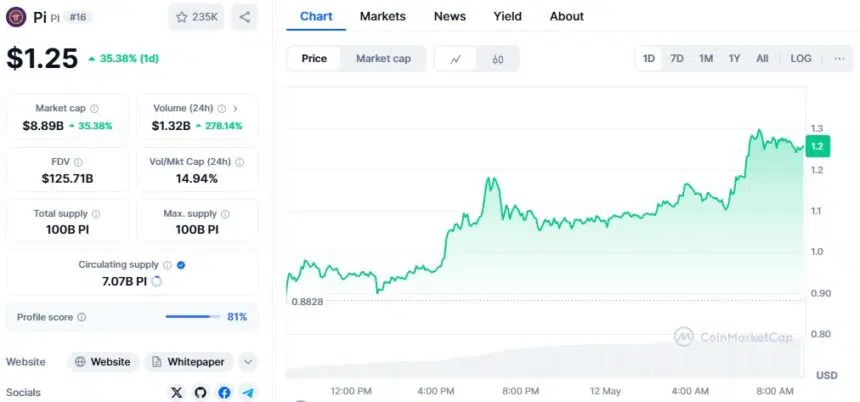
Due to these massive transfers, retail interest skyrocketed, sending trading volumes over $1 billion, a 278% increase in activity. Pi Coin, on the other hand, appreciated greatly, while Litecoin and Bitcoin Cash only increased moderately, highlighting Pi’s extraordinary growth. Pi has jumped to 14th rank following the surge, and if this momentum continues, it can even enter the top 10 ranking by CoinMarketCap.

Traders are focusing on the mid-May Consensus Summit because it could become a pivotal point for launching a long-term Pi rally.

In turn, the Pi Core Team is aggressively buying Pi from the exchanges to help stabilize the price following the latest token distribution. An expectation of a major announcement on May 14 is driving up investor excitement.

There are rumors flying around about a potential Binance listing, triggered by so-called test transactions. While fundamentals are strong and investor confidence increases, Pi Coin’s momentum continues unabated.


Leituras Relacionadas

The Final Piece of Franklin Templeton's Crypto Ambition

Franklin Templeton Completes Crypto Ambition with Acquisition of 250 Digital On June 22, Franklin Templeton announced the acquisition of 250 Digital and established Franklin Crypto, a new division focused on actively managed cryptocurrency strategies for institutional investors. The unit is led by Christopher Perkins and Seth Ginns. This acquisition marks a key piece in Franklin Templeton's multi-year crypto strategy, which began in 2018 with a digital assets team. The firm's crypto product suite now spans three layers: tokenized funds like the blockchain-based money market fund BENJI (~$831M AUM); a series of passive ETFs including Bitcoin (EZBC, ~$368M), Ethereum (EZET), XRP (XRPZ, ~$252M), Solana (SOEZ), and a multi-crypto index fund (EZPZ); and the newly added active management strategies from Franklin Crypto. The company has also expanded its crypto ecosystem through investments in projects like Ethena and Crossmint, and collaborations with blockchains such as Aptos and Sui. With approximately $18B in digital asset AUM and a total firm AUM of ~$1.78T, Franklin Templeton is positioning itself as a comprehensive crypto asset manager for pensions and sovereign wealth funds. In contrast, competitor Fidelity Investments has taken a different path, focusing early on building its own custody and trading infrastructure. Fidelity's Bitcoin ETF (FBTC) holds over $11B, significantly larger than Franklin Templeton's equivalent offering. Both giants' moves underscore the deepening trend of traditional finance entering the crypto space.

Foresight NewsHá 3m

The Final Piece of Franklin Templeton's Crypto Ambition

Foresight NewsHá 3m

Black Tuesday in Japanese and Korean Stock Markets: South Korea Triggers Circuit Breaker, Nikkei Plummets, AI Boom Undergoes Phased Adjustment

"Black Tuesday" for Asian Markets: Korean Stocks Halted by Circuit Breaker, Nikkei Plunges as AI Rally Undergoes Correction Asian stock markets experienced severe turbulence on Tuesday, with South Korea's benchmark KOSPI index plummeting nearly 10% after triggering a market-wide trading halt when its losses exceeded 8%. Japan's Nikkei 225 index also fell sharply by approximately 3.5%, ending an eight-day winning streak. The sell-off was heavily concentrated in the technology and semiconductor sectors, with giants like Samsung Electronics and SK Hynix leading the declines. The plunge reflected a rapid reversal from recent highs, with the KOSPI having retreated over 12% from its mid-June peak. Analysts attribute the sharp correction to multiple converging factors. The direct trigger was weakness in U.S. tech stocks, which fueled profit-taking in overbought Asian markets. Furthermore, stronger-than-expected U.S. jobs data has reinforced expectations that the Federal Reserve will maintain or even raise interest rates, putting pressure on rate-sensitive growth stocks. Structural vulnerabilities also played a role, particularly in South Korea, where the market is highly concentrated in a few semiconductor heavyweights, making it susceptible to shifts in global AI demand and foreign capital outflows. Despite the short-term volatility, the long-term narrative for AI and semiconductors remains intact. Industry forecasts still point to massive growth in global AI capital expenditure over the coming years. South Korean firms like SK Hynix maintain a dominant position in critical segments like High Bandwidth Memory (HBM), with long-term orders secured well into 2027. While near-term fluctuations are expected to continue, driven by U.S. monetary policy signals and upcoming corporate earnings, the current correction may present a buying opportunity for quality assets tied to the enduring AI infrastructure build-out.

marsbitHá 19m

Black Tuesday in Japanese and Korean Stock Markets: South Korea Triggers Circuit Breaker, Nikkei Plummets, AI Boom Undergoes Phased Adjustment

marsbitHá 19m

Trading

Spot
Futuros
活动图片