Биткоин слабо отреагировал на снижение инфляции в США до уровня 2021 года

RBK-cryptoPublicado em 2025-05-13Última atualização em 2025-05-13

Рост первой криптовалюты выше $100 тыс. в начале мая привлек на рынок новых покупателей, но опытные трейдеры проявляют осторожность, что может привести к дальнейшей коррекции, отмечают аналитики

Минтруд США опубликовал данные по инфляции за апрель, которые показали, что рост цен замедляется быстрее, чем ожидалось. Несмотря на это, биткоин несущественно изменился в цене в момент публикации отчета, в течение нескольких минут после новости он поднялся со $103,5 тыс. до $103,8 тыс.

Согласно опубликованной статистике, годовой индекс потребительских цен (CPI) обновил минимум с февраля 2021 года, он составил 2,3% против прогноза в 2,4%. Базовый CPI (без учета цен на энергию и продукты) остался в рамках прогноза, на уровне марта — 2,8%.

Крипторынок часто резко реагировал на инфляционные данные, поскольку они влияют на ожидания по ставке ФРС: замедление роста цен усиливает надежду на ее снижение, что обычно поддерживает спрос на рисковые активы, включая криптовалюты.

Как решения ФРС и макроданные США влияют на криптовалюты. Что учитывать

Хотя данные говорят о замедлении инфляции, они вряд ли повлияют на решение Федеральной резервной системы США (ФРС) о снижении ключевой ставки, пишет CoinDesk. На протяжении всей весны и на пресс-конференции после заседания ФРС на прошлой неделе председатель ФРС Джером Пауэлл указывал на то, что центральный банк не спешит предпринимать какие-либо действия в отношении процентных ставок.

Телеграм-канал «РБК-Крипто» — подпишитесь и будьте в курсе самых главных и актуальных новостей о криптовалюте.

Присоединяйтесь к форуму «РБК-Крипто» в Telegram для обсуждения новостей и тенденций криптомира.

Участники рынка также не рассчитывают на скорое смягчение политики ФРС. По данным CME FedWatch, вероятность снижения ставки в июне на 25 п.п. составляет всего 8,2%. По информации издания, месяц назад она составляла 80%. Вероятность того, что ФРС не будет повышать ставку и в июле — 61,4%, месяцем ранее — всего 7%.
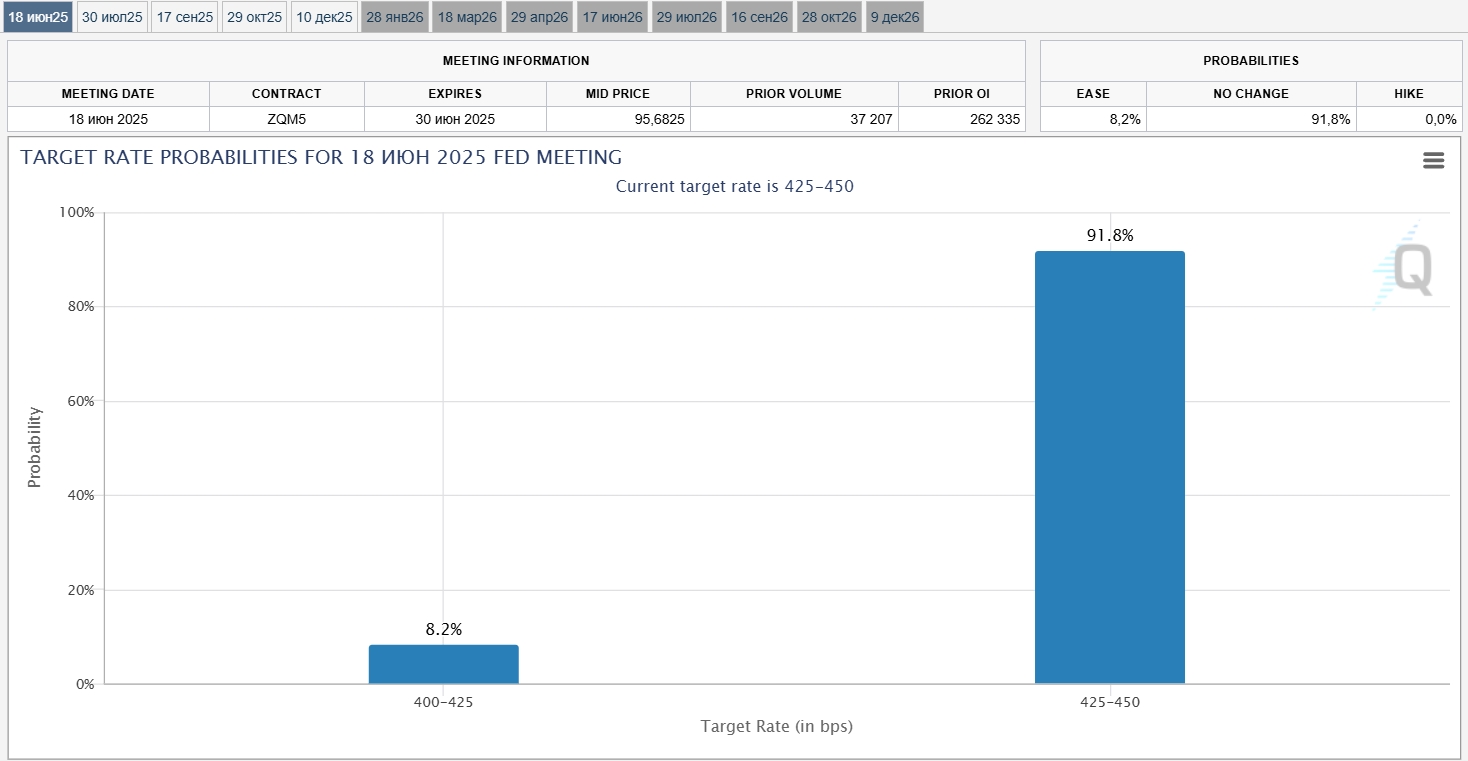
Оценка вероятности изменений ставки ФРС США. Источник: CME FedWatch

Ранее опрошенные «РБК-Крипто» аналитики отмечали, что сдержать дальнейший рост цен криптовалют может именно неготовность быстро снижать кредитные ставки со стороны ФРС. И сейчас произошел кратковременный рост, для продолжения которого нужны новые источники ликвидности.

В начале мая курс биткоина (BTC) обновил максимум за три месяца, поднявшись к $106 тыс. Рыночная капитализация монеты превысила $2 трлн. Этот рост привлек на рынок волну новых покупателей, в то время как опытные трейдеры проявляют осторожность, обратили внимание в Glassnode. Высокая активность новичков указывает на то, что на рынке сейчас эмоции преобладают над расчетом, отмечают журналисты.

Новые инвесторы в большом количестве обычно присоединяются к рынку в бычьих условиях, испытывая страх упустить выгоду — FOMO. Он возникает, когда инвесторы видят, что другие получают прибыль, или опасаются, что цены значительно вырастут без них. Это чувство заставляет пользователей совершать импульсивные покупки под напором эмоций, а не после тщательного расчета.

Однако активность других групп инвесторов не столь обнадеживающая, отмечают в Glassnode. По словам аналитиков, замедление притока капитала повышает вероятность консолидации или снижения цены биткоина.

«Рынок зависит от одного человека». Эксперты — о перспективах цены Ethereum

«Электрику» в Белоруссии дали 13 лет тюрьмы за вымогательство биткоинов

Акции криптовалютной биржи Coinbase войдут в состав индекса S&P 500

Leituras Relacionadas

The Entire Internet Hails Noam's Joining, But OpenAI's Loss Bill Just Got Thicker

While the AI community celebrates Noam Shazeer, co-author of the "Attention Is All You Need" paper, joining OpenAI as Head of Architectural Research, the company's audited financials reveal a starkly different reality. In 2025, OpenAI reported $13.07 billion in revenue but a massive $20.92 billion operating loss. Even excluding a one-time accounting charge, the cash burn is severe, with $3.7 billion consumed in Q1 2026 alone. This high-profile hiring occurs against a backdrop of significant internal research talent drain, with key founders and researchers departing as the company's focus shifts from exploratory research to product iteration. Meanwhile, OpenAI's fundamental business model faces a deep crisis. It paid Microsoft $10.59 billion for compute in 2025, while its vast user base of 9 billion weekly actives includes only 50 million paying customers, making growth a direct driver of escalating costs. The article argues Shazeer's recruitment is less about technical necessity and more about crafting a compelling narrative for OpenAI's upcoming IPO, aiming to justify a rumored $1 trillion valuation to future public market investors. It contrasts OpenAI's strategy with Anthropic's reported path to profitability, which relies on a strong enterprise customer base and cost control, rather than star-powered narratives. Ultimately, the piece concludes that while Shazeer's architectural work may take 1-2 years to materialize, OpenAI's financial clock is ticking much faster, with its massive losses undercutting the celebratory headlines.

marsbitHá 1m

The Entire Internet Hails Noam's Joining, But OpenAI's Loss Bill Just Got Thicker

marsbitHá 1m

Market Trend (June 19): US-Iran Deal Drives Out Geopolitical Premium; Chip Stocks Soar to New Highs; Energy Sector Leads Declines

U.S. Market Trends (June 19): U.S.-Iran Deal Eases Tensions, Chip Stocks Soar, Energy Sector Leads Declines. U.S. stocks rallied on Thursday as the signing of a temporary U.S.-Iran deal in Geneva de-escalated Middle East tensions, with Saudi oil tankers transiting the Strait of Hormuz. This geopolitical relief helped markets recover from recent Fed-driven volatility. The S&P 500 rose over 1%, the Nasdaq gained nearly 2%, and the Dow Jones Industrial Average closed at another record high. The Philadelphia Semiconductor Index surged over 6% to a historic peak. Chip stocks were the standout performers. Reports of an Apple-Intel design and foundry deal for certain products, alongside mentions of potential Nvidia and SpaceX collaborations with Intel, propelled the sector. Intel surged ~10.5%, while memory chip makers like Micron also saw significant gains, highlighting sustained confidence in long-term AI capital expenditure. In contrast, the energy sector was the day's sole loser, with the S&P 500 energy sub-index declining as WTI crude fell ~2% to around $74.29/barrel. The reopening of key shipping routes erased prior geopolitical risk premiums. SpaceX extended losses for a second day on news of a potential large bond offering. Market volatility (VIX) dropped sharply, indicating a swift reversal of post-Fed jitters. Treasury yields dipped slightly but remained elevated. The focus now shifts to upcoming economic data, including next week's PCE inflation report and Micron's earnings, which will serve as a key test for the AI trade's durability.

marsbitHá 24m

Market Trend (June 19): US-Iran Deal Drives Out Geopolitical Premium; Chip Stocks Soar to New Highs; Energy Sector Leads Declines

marsbitHá 24m

Will MicroStrategy Fall Into a Death Spiral? How Will the Macro Outlook Evolve in the Second Half of the Year?

**Summary:** The discussion centers on recent Bitcoin price declines and the evolving financial strategy of MicroStrategy (MSTR). The core argument is that the primary pressure is not from one-off Bitcoin sales by MSTR, but from the market's new expectation that MSTR may need to engage in *sustained, small-scale* Bitcoin sales to cover cash flow obligations for its growing portfolio of preferred shares and debt instruments (like STRC). This shift is driven by its stated goal of maintaining "bitcoins per share neutrality." The market is now testing whether it can absorb this potential ongoing selling pressure without entering a severe "death spiral" with Bitcoin's price. A resolution may involve MSTR softening its approach to avoid damaging both its stock and Bitcoin. The conversation then explores the parallel rise of AI-related stocks. The guest posits that AI is fundamentally restructuring labor, with "tokens" (representing access to AI models/compute) becoming a new form of capital and a substitute for human execution. This drives corporate efficiency and profits, benefiting upstream hardware providers (semiconductors, data centers), which explains the sustained rally. This represents the early stages of a "machine economy." Regarding crypto exchanges offering US stock trading, this is seen as a natural evolution. With few crypto-native assets generating lasting value, exchanges are pivoting to distribute valuable real-world assets (RWAs). This doesn't necessarily harm crypto's long-term prospects, as blockchain infrastructure may become crucial for future machine-to-machine economies. The analysis concludes that the era of rampant altcoin speculation is likely over, heavily damaged by the liquidity shock of the "1011" event (likely referring to a major market crash). Meme-driven capital has largely migrated to US equities. Looking ahead, macroeconomic uncertainty is rising due to potential large IPOs (e.g., SpaceX) and the US elections. While short-term market corrections are possible, the long-term trends of AI-driven productivity gains and the maturation of blockchain towards real-world utility and institutional adoption remain intact.

marsbitHá 28m

Will MicroStrategy Fall Into a Death Spiral? How Will the Macro Outlook Evolve in the Second Half of the Year?

marsbitHá 28m

Will MicroStrategy Fall into a Death Spiral? What Will the Macro Trend Be in the Second Half of the Year?

The podcast features investor Didier discussing the recent Bitcoin downturn and the evolving strategy of MicroStrategy (MSTR). He argues the core pressure is not macro factors or ETF outflows, but the market pricing in an expectation that MSTR will engage in continuous, small-scale Bitcoin sales to fund its increasing preferred stock and debt obligations under its "bitcoin-per-share neutrality" principle. This creates a structural headwind. However, he is cautiously optimistic a "death spiral" is avoidable without new major shocks, as market support is likely to emerge at a certain price point. Didier then posits that the AI-driven bull market in US stocks (semiconductors, data centers) is fundamentally driven by AI agents and tokens becoming the "new labor force," displacing human roles and boosting corporate margins. This shift toward a machine economy is still in its early stages. He comments on crypto exchanges adding US stock trading, viewing it as a natural move toward valuable real-world assets as truly valuable crypto-native assets remain scarce. For crypto-native traders, he suggests existing strategies (e.g., meme-chasing or value investing) can translate to similar assets in US markets. The discussion notes the severe liquidity damage from the "1011 event" (likely referring to a major market crash) has essentially ended the altcoin cycle, with speculative momentum shifting to the more liquid US stock market. Regarding the macroeconomic outlook for H2 2024, Didier expresses increased caution due to potential market pressure from upcoming mega-IPOs (e.g., SpaceX) and US midterm election risks. Long-term, he remains bullish on AI's productivity gains and its convergence with blockchain/Web3, which he sees maturing into a more institutional, real-asset-focused phase.

链捕手Há 30m

Will MicroStrategy Fall into a Death Spiral? What Will the Macro Trend Be in the Second Half of the Year?

链捕手Há 30m

Trading

Spot
Futuros
活动图片