Crypto's latest meltdown leaves punters bruised and bewildered

ReutersPublicado em 2022-06-21Última atualização em 2022-06-21

Resumo

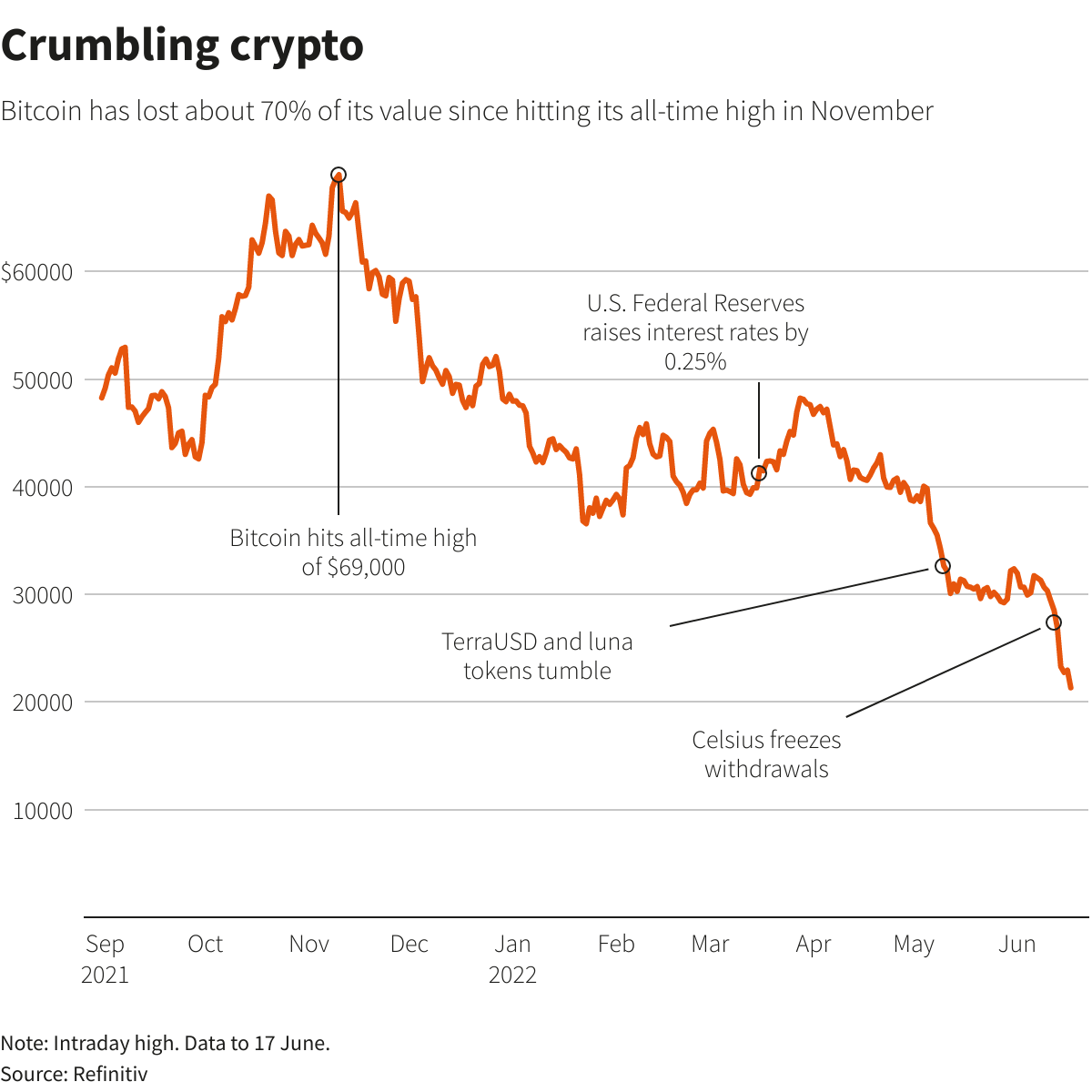
The Celsius blow-up followed the collapse of two other major tokens last month that shook a crypto sector already under pressure as soaring inflation and rising interest rates prompt a flight from stocks and other higher-risk assets.

For Jeremy Fong, U.S. crypto lender Celsius was an ideal place to stash his digital currency holdings - and earn some spending money from its double-digit interest rates along the way.

"I was probably earning $100 a week," at sites like Celsius, said Fong, a 29-year civil aerospace worker who lives in the central English city of Derby. "That covered my groceries."

Now, though, Fong's crypto - about a quarter of his portfolio - is stuck at Celsius.

The New Jersey-based crypto lender froze withdrawals for its 1.7 million customers last week, citing "extreme" market conditions, spurring a sell-off that wiped hundreds of billions of dollars from the paper value of the cryptocurrencies globally.

Fong's long-term crypto holdings are now down about 30%. "Definitely in a very uncomfortable position," he told Reuters. "My first instinct is just to withdraw everything," from Celsius, he said.

The Celsius blow-up followed the collapse of two other major tokens last month that shook a crypto sector already under pressure as soaring inflation and rising interest rates prompt a flight from stocks and other higher-risk assets.

Bitcoin fell below $20,000 on June 18 for the first time since December 2020. It has plummeted around 60% this year. The overall crypto market has slumped to around $900 billion, down from a record $3 trillion in November.

The tumble has left individual investors across the world bruised and bewildered. Many are angry at Celsius. Others swear never to invest in crypto again. Some, like Fong, want stronger oversight of the freewheeling sector.

Susannah Streeter, an analyst at Hargreaves Lansdown, compared the turmoil to dotcom stocks crash in the early 2000s - with technology and low-cost capital making it easy for individual investors to gain access to crypto.

"We've got this collision of smartphone technology, trading apps, cheap money and a highly speculative asset," she said. "That's why you've seen a meteoric rise and fall."
'PACING IN THE DARK AT 2 A.M.'

Crypto lenders, such as Celsius, offer high interest rates to investors - mostly individuals - who deposit their coins with these sites. These lenders, mostly unregulated, then invest deposits in the wholesale crypto market.

Celsius' troubles appear to be related to its wholesale crypto investments. As these investments turned sour the company was unable to meet client redemptions from investors amid the broader crypto market slump.

The redemption freeze at Celsius was akin to a small bank shutting its doors. But a traditional bank, overseen by regulators, would have some form of protection for depositors.

One of those impacted by the Celsius freeze was 38-year old Alisha Gee in Pennsylvania.

Gee invested "every last bit" of her paycheques in crypto since 2018, which have built up into a five-figure sum. She has $30,000 of deposits at Celsius - part of her overall crypto holdings - earning her interest of $40-$100 a week, which she hoped would help her to pay off her mortgage.

Just over a week ago, Gee got an email from Celsius saying she couldn't make withdrawals. "I just was pacing in the dark at 2 a.m., just back and forth," she said.

"I believed in the company," Gee said. "It doesn't feel good to lose $30,000, especially that I could've put towards my mortgage."

Gee said she would continue to use Celsius, saying she was "loyal" to the company and hadn't experienced problems before.

Celsius CEO Alex Mashinsky tweeted on June 15 the company was "working non-stop," but has given few details of how or when withdrawals would resume. Celsius said on Monday it was aiming to "stabilize our liquidity and operations."

GUARDRAILS

For some, enthusiasm for crypto is undimmed.

"I have seen multiple bear market cycles by now, so I am avoiding any knee-jerk reaction," said 23-year old Sumnesh Salodkar in Mumbai, whose crypto holdings are down but still in positive territory.

For others, warnings from regulators across the world about the risks of dabbling in crypto have become reality.

Halil Ibrahim Gocer, a 21-year old in the Turkish capital Ankara, said his father's crypto investments of $5,000 have tumbled to $600 since he introduced him to crypto.

"Knowledge can only take you so far in crypto," said Gocer. "Luck is what matters."

Another investor, a 32-year old IT worker in Mumbai, said he poured three-quarters of his savings - several hundred dollars - into crypto. Its value has plummeted by around 70%-80%.

"This will be my last investment in cryptocurrencies," he said, requesting anonymity.

Regulators in countries around the world have been working out how to build crypto guardrails that can protect investors and dampen risks to wider financial stability.

The crypto market turmoil sparked by Celsius highlights the "urgent need" for crypto rules, a U.S. Treasury official said last week.

Fong, the UK investor who has lost access to his crypto at Celsius, wants things to change.

"A bit of regulation would be good, essentially. But then I think it's a balance," he said. "If you do not want too much regulation, this is what you get" he said.


Leituras Relacionadas

Podcast Notes: Hyperliquid Has Become the Top Interest Point for Traditional Hedge Funds

Empire Podcast hosts Jason Yanowitz and Santiago Santos discuss the surging institutional interest in Hyperliquid, a decentralized perpetual exchange, marking the highest level of engagement from traditional hedge fund managers since Paul Tudor Jones endorsed Bitcoin in 2020. The primary driver is the demand for weekend trading of commodities like oil, especially during geopolitical tensions such as the Iran conflict, as Hyperliquid provides the only active price discovery venue when traditional markets are closed. Trade XYZ, a front-end on Hyperliquid, has seen significant growth, with weekend oil price predictions having a median error of only 50 basis points. Santos predicts commodity trading volume on Hyperliquid will surpass Bitcoin within the year and that its market cap could rise from $25 billion to $100 billion. Other key points include Kraken raising $200 million at a reduced valuation of $13.3 billion, and the SEC clarifying that self-custodied DeFi frontends like MetaMask are not subject to broker-dealer rules, resolving a major regulatory uncertainty. The hosts also note the strong correlation between crypto and macro markets, with the S&P 500 posting one of its best 10-day rallies since 1950. They highlight MicroStrategy's continued Bitcoin acquisitions and the potential of real-world asset (RWA) tokenization as a key trend. The discussion concludes with skepticism towards many L2 projects, predicting a wave of protocols truly going to zero as capital concentrates in proven assets like Bitcoin and Hyperliquid.

marsbitHá 59m

Podcast Notes: Hyperliquid Has Become the Top Interest Point for Traditional Hedge Funds

marsbitHá 59m

a16z: The Next Frontier of AI, The Triple Flywheel of Robotics, Autonomous Science, and Brain-Computer Interfaces

a16z presents a comprehensive investment thesis for the next frontier of AI: Physical AI, centered on a synergistic flywheel of robotics, autonomous science, and novel human-computer interfaces (HCIs) like brain-computers. While the current AI paradigm scales on language and code, the most disruptive future capabilities will emerge from three adjacent fields leveraging five core technical primitives: 1) learned representations of physical dynamics (via models like VLA, WAM, and native embodied models), 2) embodied action architectures (e.g., dual-system designs, diffusion-based motion generation, and RL fine-tuning like RECAP), 3) simulation and synthetic data as scaling infrastructure, 4) expanded sensory channels (touch, neural signals, silent speech, olfaction), and 5) closed-loop agent systems for long-horizon tasks. These primitives converge to power three key domains: * **Robotics:** The literal embodiment of AI, requiring all primitives for real-world physical interaction and manipulation. * **Autonomous Science:** Self-driving labs that conduct hypothesis-experiment-analysis loops, generating structured, causally-grounded data to improve physical AI models. * **Novel HCIs:** Devices (AR glasses, EMG wearables, BCIs) that expand human-AI bandwidth and act as massive data-collection networks for real-world human experience. These domains form a mutually reinforcing flywheel: Robotics enable autonomous labs, which in turn generate valuable data for robotics and materials science. New interfaces provide rich human-physical interaction data to train better robots and scientists. Together, they represent a new scaling axis for AI, moving beyond the digital realm to interact with and learn from physical reality, promising significant emergent capabilities and value.

marsbitHá 1h

a16z: The Next Frontier of AI, The Triple Flywheel of Robotics, Autonomous Science, and Brain-Computer Interfaces

marsbitHá 1h

Conversation with Bitwise Advisor: From K-Shaped Economy to AI Taking Jobs, How Can Bitcoin Save the Younger Generation?

Jeff Park, a macro strategist and advisor at Bitwise, argues that the traditional financial system is broken, particularly for young generations. He describes a "K-shaped economy" where asset inflation enriches the wealthy while leaving others behind, with unaffordable housing as a key symptom. Park explains that real estate is often a depreciating asset due to maintenance costs and taxes, yet it remains unattainable for many young people due to distorted demand from global capital flows. He proposes Bitcoin as a superior store of value—scarce, portable, and free from maintenance costs or excessive taxation. By diverting capital away from real estate, Bitcoin could help lower housing prices and increase accessibility. Park also discusses the decline of traditional "smart investing" (e.g., value stocks) and the rise of "ideological investing" in non-correlated assets like crypto, luxury goods, and collectibles. On AI, Park warns it could trigger extreme social inequality by eliminating jobs while boosting corporate profits. He believes this will push younger generations toward Bitcoin, not only as a hedge but also as a symbol of decentralization and data sovereignty—offering an alternative to centralized AI systems that use personal data without fair compensation. He advises a diversified portfolio with Bitcoin as a core holding to hedge against currency devaluation and systemic risk.

marsbitHá 2h

Conversation with Bitwise Advisor: From K-Shaped Economy to AI Taking Jobs, How Can Bitcoin Save the Younger Generation?

marsbitHá 2h

Trading

Spot
Futuros
活动图片