Кейтлин Лонг критикует ФРС США за политику в отношении стейблкоинов

cryptonews.ruPublicado em 2021-02-28Última atualização em 2025-04-29

Кейтлин Лонг, основатель и генеральный директор Custodia Bank, раскритиковала Федеральную резервную систему США за то, что она тихо сохраняет ключевую антикриптовалютную политику, благоприятствующую стейблкоинам, выпущенным крупными банками, несмотря на смягчение правил криптопартнерства для банков.

В ветке от 27 апреля на X Лонг объяснила, что, хотя ФРС недавно отменила четыре предыдущих правила в отношении криптовалют, она оставила нетронутым заявление от 27 января 2023 года, выпущенное совместно с администрацией Байдена.

По словам Лонг, это руководство блокирует банки от прямого взаимодействия с криптоактивами и запрещает им выпускать стейблкоины на общедоступных блокчейнах.

«ФРС СОХРАНИЛА РЕГУЛЯТИВНОЕ ПРЕДПОЧТЕНИЕ РАЗРЕШЕННЫМ СТЕЙБЛКОИНАМ (т.е. версиям крупных банков)», — заявила Лонг.

Она предупредила, что этот шаг дает традиционным финансовым учреждениям «фору» в запуске частных стейблкоинов, пока более широкий рынок ждет принятия Конгрессом законодательства о стейблкоинах.
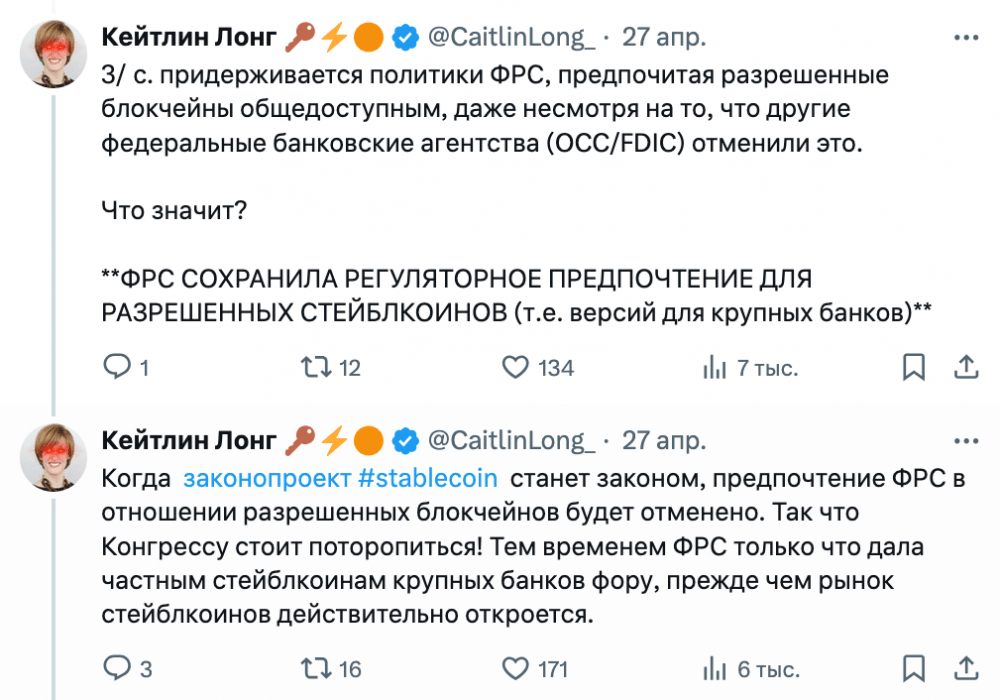

Кейтлин Лонг критикует предпочтение ФРС разрешенным стейблкоинам. Источник: Кейтлин Лонг

Лонг призывает Конгресс принять законопроект о стейблкоинах

Лонг отметила, что как только федеральный законопроект о стейблкоинах станет законом, он может перевесить позицию ФРС.

«Конгресс должен поторопиться», — призвала она.

Помимо стейблкоинов, Лонг указала на то, как политика ФРС мешает банкам участвовать в криптовалютных рынках в качестве принципалов, не давая им заниматься маркетмейкингом в таких активах, как биткоин (BTC), Ethereum (ETH) или Solana (SOL).

Она также отметила операционные проблемы для банков, желающих предложить услуги по хранению криптовалют, особенно в отношении покрытия сборов за газ для ончейн-транзакций — стандартной практики для хранителей криптовалют, но ограниченной действующими правилами ФРС.

Подводя итог своим опасениям, Лонг посетовала, что решение ФРС «ставит палки в колеса» банкам, входящим в хранение криптовалют, одновременно продвигая разрешенные стейблкоины, поддерживаемые крупными финансовыми учреждениями.

«ФРС определенно выиграла в пиар-ходе — в ее пресс-релизе был перечислен длинный список рекомендаций, которые она отменила, но не было НИКАКОГО упоминания о рекомендациях, которые она сохранила. Это, понятное дело, обмануло *многих* умных людей», — написала она.

Сенатор Ламмис называет действия ФРС «пустыми словами»

Сенатор Синтия Ламмис, ярая сторонница цифровых активов, также осудила действия ФРС как простые «пустые слова», что свидетельствует о возможном законодательном отпоре в ближайшем будущем.

Ламмис упомянула политическое заявление ФРС в разделе 9(13), которое не было отозвано. В нем говорится, что биткоин и цифровые активы считаются «небезопасными и ненадежными».
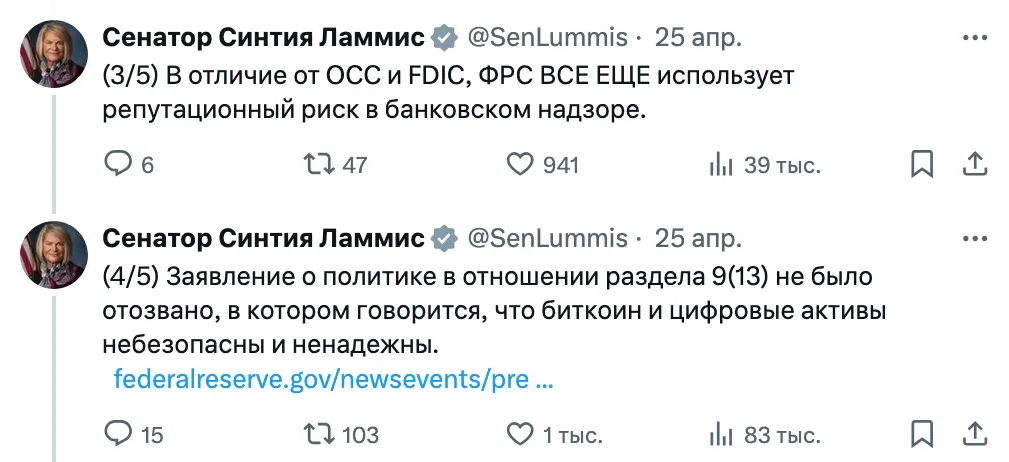

Сенатор Синтия Ламмис критикует ФРС. Источник: сенатор Синтия Ламмис

Однако другие руководители криптовалютных компаний высоко оценили заявление ФРС как позитивное событие для отрасли. Майкл Сэйлор из Strategy в посте X от 25 апреля сказал, что шаг ФРС означает, что «теперь банки могут свободно начать поддерживать биткоин».


Leituras Relacionadas

CPU Makes a Comeback to the Table, A $170 Billion "Power Seizure" Drama Begins

A new era is dawning for the server CPU (Central Processing Unit), driven by the shift from AI model training to large-scale reasoning and the rise of Agentic AI. This article explores how the CPU is reclaiming a central role in the AI data center. For years, the focus has been on the GPU (Graphics Processing Unit) for AI training. However, as AI moves to the inference and Agent phase—where tasks involve complex, multi-step reasoning, tool calls, and data management—the workload balance is flipping. Studies show CPUs now handle over 70% of the workload in Agentic AI, up from 10-30% in training. This is because Agent tasks generate massive intermediate data (KV Cache) that exceeds GPU memory, forcing it to be offloaded to the CPU's larger, more scalable memory pools. This increased importance is translating into market changes. Major players are taking note: NVIDIA launched its first standalone CPU line, Vera, based on ARM architecture and optimized for Agent performance. AMD doubled its server CPU market forecast to over $1200 billion by 2030. Analyst reports project the total server CPU market could reach $1700 billion by 2030, with AI-driven demand being a primary driver. Furthermore, the classic ratio of CPUs to GPUs in AI servers is rapidly changing, converging from 1:8 toward 1:1 for Agent deployments. This surge in demand has led to a rare industry-wide price increase of 10-15% for server CPUs from Intel and AMD, breaking a decade-long trend of "more performance for the same price." Demand is bifurcating into high-core-count CPUs for in-rack GPU support and moderate-core CPUs for standalone Agent task orchestration. In China, this global trend presents an opportunity for domestic CPU manufacturers like Hygon (海光信息) and Huawei Kunpeng, who are bolstered by both growing AI infrastructure needs and national policies promoting technological self-reliance ("xin chuang"). The maturity of their software ecosystems is also accelerating, evidenced by faster adaptation to new AI models. In conclusion, the narrative is shifting from a GPU-centric view to one where CPU-GPU synergy is critical. The CPU is no longer a peripheral component but a performance-defining bottleneck and a key growth driver in the AI hardware stack, opening a massive new market estimated in the hundreds of billions of dollars.

marsbitHá 9h

CPU Makes a Comeback to the Table, A $170 Billion "Power Seizure" Drama Begins

marsbitHá 9h

TechFlow Intelligence: AMD AI Director Publicly Criticizes Claude Code for "Becoming Dumber and Lazier", Trump Claims Full Ceasefire in Hormuz But Strait Still Has 80 Unexploded Mines

TechFlow Intelligence Report: This daily digest covers key developments in AI, crypto, hardware, and geopolitics. In AI, SK Telecom faces US export control scrutiny over its partnership with Anthropic, while a Gemini user reports being misled in a scam scenario, sparking safety debates. China's Z.AI launches the GLM-5.2 model, rivaling Claude Opus without NVIDIA chips. In crypto, Bithumb lists ReProtocol, and Upbit delists KernelDAO. On the hardware front, MIT researchers build a custom OS to study chips, ASML denies US claims its advanced lithography machines are in China, and Amazon considers selling its in-house AI chips. Apple's future A21 Pro chip may use TSMC's latest N2P process. Major tech issues include 10,000 GitHub repositories distributing malware and Apple patching a critical eavesdropping flaw in Beats earbuds. US stocks rise, led by semiconductors, with Intel surging 10.6%, while SpaceX falls 3.5%. Geopolitically, despite a US-Iran deal, the Strait of Hormuz remains risky with ~80 uncleared mines, stalling 80M barrels of oil on standby tankers. Iran postpones Switzerland talks, and Trump calls the agreement an "unconditional surrender." The report highlights a contrast: temporary geopolitical calm versus the ongoing, fundamental restructuring of tech supply chains and chip independence.

marsbitHá 9h

TechFlow Intelligence: AMD AI Director Publicly Criticizes Claude Code for "Becoming Dumber and Lazier", Trump Claims Full Ceasefire in Hormuz But Strait Still Has 80 Unexploded Mines

marsbitHá 9h

Trading

Spot
Futuros
活动图片