Руководитель CertiK: «Для выяснения причин краха Mantra OM потребуется следственная экспертиза»

cryptonews.ruPublicado em 2025-01-23Última atualização em 2025-04-23

Основатель и генеральный директор Mantra Джон Маллин начал сжигание токенов OM на сумму 80 миллионов долларов, чтобы вернуть доверие пользователей после сбоя токена в начале апреля. Однако, как сообщили исследователи блокчейна, вопрос о глубинных причинах сбоя остается без ответа.

Для расшифровки сбоя Mantra (OM) потребуется детальное экспертное исследование, а не просто базовый анализ блокчейна, сказала Натали Ньюсон, старший следователь блокчейна в компании по безопасности блокчейна CertiK.

«Полное экспертное исследование, похожее на то, что мы видели после FTX, потребуется для обоснования заявлений о преднамеренном эксплоите», — сказала Ньюсон, подчеркнув трудности отслеживания внебиржевых (OTC) транзакций.

Точка зрения Ньюсон на крах OM появилась через несколько дней после того, как Mantra опубликовала свое заявление после краха, в котором попросила партнеров по централизованной бирже сотрудничать для дальнейшего расследования инцидента.

Ончейн-активность против непрозрачных внебиржевых сделок

Рассматривая крах токенов OM, Ньюсон подчеркнула важность разграничения публичной ончейн-активности и «более непрозрачной природы внебиржевых сделок».

Генеральный директор Mantra Маллин сообщил в интервью Coffeezilla 15 апреля, что команда Mantra «провела небольшое количество внебиржевых сделок», до 30 миллионов долларов токенов OM.
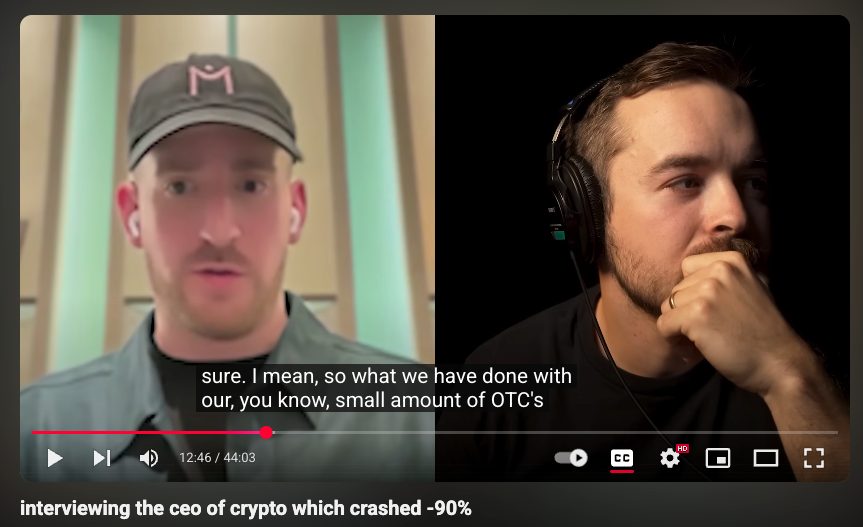

Основатель и генеральный директор Mantra Джон Маллин в интервью Coffeezilla. Источник: YouTube

В отличие от отслеживаемых транзакций на централизованных биржах, внебиржевые криптопереводы подразумевают метод покупки и продажи криптовалют за пределами бирж, призванный обеспечить высокую ликвидность и крупные сделки, одновременно смягчая волатильность цен.

«В этом случае накопление китом примерно 100 миллионов OM, по-видимому, стало результатом вторичных рыночных транзакций — не обязательно прямой активности инсайдеров Mantra», — сказала Ньюсон.

Анализ Arkham или Nansen недостаточен

Как упоминалось ранее, Маллин отверг обвинения в инсайдерском сбросе токенов OM, заявив, что платформа аналитики блокчейна Arkham «неправильно маркировала» некоторые кошельки.

Ньюсон сказала, что данных с Arkham и подобных платформ, таких как Nansen, будет недостаточно для подтверждения или опровержения участия инсайдеров.

«Чтобы подтвердить скоординированное поведение инсайдеров, вероятно, потребуется больше, чем просто базовое отслеживание кошельков на таких платформах, как Arkham или Nansen», — сказала Ньюсон.

«Инструменты анализа блокчейна могут предоставить направленные подсказки, но без доступа к офчейн-соглашениям и записям централизованных бирж делать окончательные выводы будет сложно», — добавила она.

Ньюсон не одинока в том, что подчеркивает непростую природу отслеживания транзакций в крахе токенов OM.

«Есть способы получить данные из узла, но, похоже, получить полную историю нелегко», — рассказал соучредитель Whale Alert Фрэнк Вирт.

Ранее Маллин говорил, что команда рассматривала возможность найма судебного аудитора после крушения OM, но по состоянию на 16 апреля решение не было принято.


Leituras Relacionadas

Grayscale: After Halving, BTC is Nearing the Bottom of This Cycle

Grayscale Research suggests Bitcoin's recent decline below $60,000, a >50% drop from its October peak, represents a cyclical correction within a long-term uptrend rather than a trend reversal. Key factors behind the pullback include a shift in market expectations toward Federal Reserve rate hikes under new Chair Kevin Warsh, uncertainty around the CLARITY Act's Senate passage, pressure on leveraged entities like Strategy, and concerns over quantum computing risks. The path out of the current bear market hinges on upcoming catalysts. An optimistic scenario, where the CLARITY Act passes, leverage is contained, and the Fed refrains from hiking, could mean Bitcoin is nearing its cycle bottom. A pessimistic scenario, featuring legislative failure, further deleveraging, and Fed rate hikes, could lead to additional moderate downside. Grayscale does not expect a historically deep ~80% drawdown due to a more measured prior bull run and stickier institutional demand. Despite short-term headwinds, Grayscale remains highly optimistic about crypto's long-term structural prospects, driven by institutional adoption of public blockchains, unsustainable government debt, declining trust in intermediaries, and AI's potential demand for alternative systems. The report concludes that while the exact cycle low depends on near-term catalysts, current valuations present an attractive entry point for long-term investors betting on the decade-ahead growth of digital assets.

marsbitHá 2m

Grayscale: After Halving, BTC is Nearing the Bottom of This Cycle

marsbitHá 2m

Web3 Bear Market Survival Guide: Ten Great Books to Help You Navigate the Cycles

"Web3 Bear Market Survival Guide: Ten Books to Help You Navigate the Cycle" This article presents a curated book list aimed at helping Web3 enthusiasts and professionals endure and grow during crypto market downturns. It argues that bear markets are not just periods of waiting but crucial times for deepening one's foundational understanding beyond technical whitepapers and price charts. The ten recommended books offer perspectives on technology, economics, philosophy, and strategy to build resilience and long-term vision. The list includes: 1. **"The Inevitable" by Kevin Kelly:** For using a long-term technological lens to combat uncertainty about the future, including the role of crypto and AI. 2. **"Human Action" by Ludwig von Mises:** To upgrade one's economic and philosophical framework, understanding action, speculation, and calculation in a bear market context. 3. **"The Nature of Technology" by W. Brian Arthur:** For viewing blockchain and crypto as combinatorial evolutions of existing technologies, understanding their modular and economic development. 4. **"The Distant Savior" (Chinese novel):** Explores the cultural attributes of self-reliance ("strong culture") versus dependency ("weak culture"), crucial for surviving industry cycles. 5. **"The Sovereign Individual" by James Dale Davidson & Lord William Rees-Mogg:** A prophetic 1997 work on how technology empowers individuals and challenges nation-states, foreshadowing Bitcoin's emergence. 6. **"Japanization: What the World Can Learn from Japan's Lost Decades" (Adapted title):** Uses Japan's economic history as a case study to identify structural opportunities that persist even during broader recessions. 7. **"Denationalisation of Money" by F.A. Hayek:** The ideological blueprint for Bitcoin, arguing for competitive currency issuance beyond state monopoly. 8. **"Duan Yongping Investment Q&A" (Chinese compilation):** Emphasizes the simple discipline of "doing the right things and doing things right," focusing on fundamentals and maintaining a "stop doing list." 9. **"The Network State: How To Start a New Country" by Balaji Srinivasan:** A visionary text from a crypto insider outlining bold predictions and concrete ideas for a blockchain-based future across media, governance, and identity. 10. **"Selected Works of Mao Zedong" (Vol. 1):** Analyzed as a strategic playbook for a weak force challenging a powerful establishment, offering lessons on strategy, alliance-building, and perseverance for the crypto movement. The conclusion states that bear markets filter out those with weak conviction, not weak skills. Survival depends on cognitive depth and mental fortitude, which these books aim to provide.

Foresight NewsHá 24m

Web3 Bear Market Survival Guide: Ten Great Books to Help You Navigate the Cycles

Foresight NewsHá 24m

Trump's 25-Year Financial Report: Family Earns Over $1 Billion Annually from Crypto, While Retail Investors Lose Money on $TRUMP

Former President Donald Trump's family earned approximately $1.2 billion from cryptocurrency ventures in 2025, according to a financial disclosure report. This revenue stream, outlined in a 927-page filing, now surpasses income from most of his long-established real estate holdings. The crypto earnings originated from two main sources: over $500 million from the sale of products like "governance tokens" by World Liberty Financial, a DeFi project co-owned by the Trump family, and roughly $635 million in royalties from the Trump-themed meme coin $TRUMP, issued by CIC Digital LLC. While Trump's entities profited, retail investors faced significant losses. The $TRUMP token, which peaked above $74 shortly after its January 2025 launch, has plummeted to around $1.68. World Liberty Financial's token has also fallen roughly 80% since its debut. Reports indicate that the majority of meme coin buyers have lost money, with Trump-linked entities still holding about 80% of $TRUMP's supply under vesting plans. The disclosure highlights a stark contrast: Trump's crypto and real estate businesses flourished—with new international property deals bringing in tens of millions—even as his administration shifted to crypto-friendly policies, relaxing the stringent regulatory stance of the previous Biden administration. The White House maintains that Trump acts only in the public interest, with his businesses placed in a trust managed by his sons, denying any conflict of interest. However, the report notes the difficulty of assessing such conflicts, particularly regarding foreign business dealings with countries that later received favorable U.S. policy decisions.

marsbitHá 44m

Trump's 25-Year Financial Report: Family Earns Over $1 Billion Annually from Crypto, While Retail Investors Lose Money on $TRUMP

marsbitHá 44m

From 'Address Clustering' to 'Evidence Standards': Why is Chainalysis Redefining Blockchain Tracing?

**Summary:** In June 2026, Chainalysis introduced the **Blockchain Tracing Ontology (BTO)**, a proposed data framework aiming to establish standardized, transparent, and verifiable models for blockchain analysis. This initiative addresses a core industry issue: despite public blockchain data, different firms often produce inconsistent results (e.g., differing entity labels for the same address) due to non-uniform methodologies, particularly in **address clustering**. This lack of standardization poses challenges for judicial investigations, AML, and enforcement. The BTO is not a new clustering algorithm but a **common "language" or conceptual framework**. It moves beyond the simplistic "cluster" model by introducing a hierarchical structure: **Entity → Wallet → Wallet Segment → Address**, which better reflects complex organizational wallet management. A key shift is from presenting mere results to ensuring **process trust and explainability**. The framework emphasizes documenting the **Evidence** and **Confidence** behind each analytical claim—specifying the on-chain/off-chain data, rules applied, and certainty levels—enabling third-party verification. This focus is partly informed by legal precedents like the **Bitcoin Fog** case, where Chainalysis's methods underwent rigorous judicial scrutiny (Daubert hearing), highlighting the need for reproducible, scientifically sound analysis. The proposal clarifies that on-chain analysis identifies address relationships and flow patterns, not real-world identities, which still require off-chain evidence (e.g., KYC data). Ultimately, Chainalysis envisions steering the industry from an "experience-driven" to a **"standards-driven"** future, where competition centers on **data quality, analytical transparency, and judicial admissibility** rather than just label coverage. Widespread adoption could facilitate cross-agency collaboration, reduce disputes, and provide a more reliable foundation for global compliance and enforcement.

marsbitHá 1h

From 'Address Clustering' to 'Evidence Standards': Why is Chainalysis Redefining Blockchain Tracing?

marsbitHá 1h

Trading

Spot
活动图片