Broader Than SEC’s Case: Oregon AG Lawsuit Against Coinbase Calls 31 Cryptocurrencies ‘Unregistered Securities’

bitcoinistPublicado em 2025-04-23Última atualização em 2025-04-23

Resumo

Oregon’s Attorney General (AG) has listed XRP and 30 other cryptocurrencies as alleged “unregistered securities” in its state-level complaint against...

Trusted Editorial content, reviewed by leading industry experts and seasoned editors. Ad Disclosure

Oregon’s Attorney General (AG) has listed XRP and 30 other cryptocurrencies as alleged “unregistered securities” in its state-level complaint against Coinbase. The lawsuit follows the Securities and Exchange Commission (SEC)’s decision to drop its case against the crypto exchange, which has led industry figures and investors to call the move an unlawful and “politically motivated” action.

XRP, SOL, And ADA Called ‘Unregistered Securities’

Oregon Attorney General Dan Rayfield filed a complaint against Coinbase on April 18, alleging the US-based crypto exchange had violated the Oregon securities law by facilitating the sale of unregistered cryptocurrencies to the state’s residents.

The court document, filed in in Multnomah County Circuit Court, states that the crypto exchange “has continuously and repeatedly violated the Oregon Securities Law, which ascribes liability to persons ´who [s]ell[] or successfully solicit[] the sale of a security … in violation of the Oregon Securities Law’ (ORS 59.115(1)(a)), as well as to persons who ‘participate[] or materially aid[] in the sale’ (ORS 59.115(3)).”

On Monday, Paradigm’s Vice President of Regulatory Affairs, Justin Slaughter, highlighted that the Oregon AG’s complaint is a “true kitchen sink lawsuit,” covering significantly more tokens than the Securities and Exchange Commission (SEC)’s case.

The lawsuit claims that the crypto exchange offered and sold 31 cryptocurrencies as investment contracts. The list of alleged “unregistered securities” includes AAVE, ADA, ALGO, AMP, APE, ATOM, AVAX, AXS, CHZ, COMP, DASH, DDX, EOS, FIL, FLOW, ICP, LCX, LINK, MATIC, MIR, MKR, NEAR, POWR, RLY, SAND, SOL, UNI, VGX, WLUNA, XRP, and XYO.

coinbase

Excerpt from Oregon AG's complaint agaisnt Coinbase. Source: Justin Slaughter on X

Journalist and Podcast host Eleanor Terret noted that Rayfield’s complaint names 18 more cryptocurrencies than the SEC originally named in its case, which listed 13 tokens: SOL, ADA, MATIC, FIL, SAND, AXS, CHZ, FLOW, ICP, NEAR, VGX, DASH, and NEXO.

For context, the SEC sued Coinbase in June 2023, claiming the platform was an unregistered securities exchange. The regulatory agency argued that the exchange operated as an unregistered broker-dealer and illegally sold unregistered securities through its staking program. Nonetheless, the lawsuit was dismissed in February 2025.

Coinbase Slams Oregon AG’s Lawsuit

Coinbase’s Chief Legal Officer (CLO), Paul Grewal, stated that “no matter your asset or project,” the Oregon Attorney General has “accused you of violating securities laws and fleecing your token holders.”

In his Monday post, He added that the exchange had notified around 560,000 of its users in Oregon “about the unlawful action taken in their name.” Last week, Grewal called the lawsuit an “embarrassing waste of Oregon taxpayer dollars.”

coinbase

Coinbase's CLO responds to Oregon AG's list of alleged unregistered securities. Source: Paul Grewal on X

Rayfield argues that Coinbase sold high-risk investments without being properly vetted to protect consumers, causing significant losses for Oregonians. Nonetheless, Grewal has criticized the legal action, suggesting the lawsuit is politically motivated after the complaint omitted key details.

Look no further than section 9, where it 1) omits Judge Failla’s order granting interlocutory appeal of the @SECGov case; 2) omits any mention of Judge Torres’ decision in XRP; and 3) bears the stamp of the two private law firms brought on to profit from this suit; 4) labels the Chairman of the SEC as a “crypto lobbyist” and 5) decries the reassignment of Gensler’s lead lawyer to the IT department. Not exactly subtle.

Coinbase’s CLO has also stated that the Attorney General’s office had “made it clear” that they were “literally picking up where the Gary Gensler SEC left off.” Grewal considers that Oregon AG’s “copycat case” is attempting to “resurrect” the Commission’s long-criticized regulatory approach, which was recently dropped.

Notably, the SEC has pivoted from its “regulation by enforcement” strategy to oversee the sector under the crypto-friendly Trump administration. As part of its shift, the regulatory agency has scaled back on its special crypto enforcement unit, closed or paused most of its major litigations, and created the Crypto Task Force to oversee the establishment of a comprehensive regulatory framework.
coinbase, TOTAL

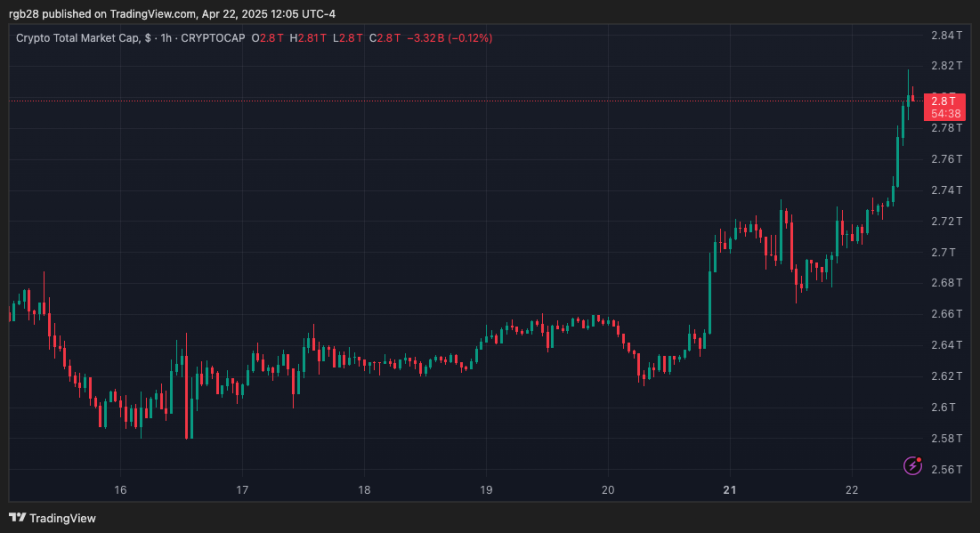
Total crypto market capitalization is at $2.8 trillion in the one-week chart. Source: TOTAL on TradingView
Featured Image from Unsplash.com, Chart from TradingView.com
Editorial Process for bitcoinist is centered on delivering thoroughly researched, accurate, and unbiased content. We uphold strict sourcing standards, and each page undergoes diligent review by our team of top technology experts and seasoned editors. This process ensures the integrity, relevance, and value of our content for our readers.

Rubmar is a crypto enthusiast who likes learning and improving constantly. She enjoys reporting on the latest news and developments in the crypto industry. Rubmar also enjoys scrapbooking, crafting, simulation games, and watching football.

Leituras Relacionadas

Token FOLD Auction Imminent, What is The Interfold, Supported by Vitalik?

**Title:** FOLD Token Auction Approaches: What is The Interfold, Supported by Vitalik? **Summary:** The Interfold, a "confidential coordination infrastructure" previously known as Enclave, is launching its functional token FOLD via a Uniswap Continuous Clearing Auction (CCA) starting July 8th. Endorsed by Ethereum co-founder Vitalik Buterin in May, the protocol tackles the core problem of governance bribery in decentralized voting (e.g., on platforms like Votium) by enabling multiple parties to compute a verifiable result without exposing their private input data. Its core technology, the Encrypted Execution Environment (E3), uses a distributed network of "Ciphernodes" that perform computations on fully encrypted data using Fully Homomorphic Encryption (FHE), with process integrity verified by Zero-Knowledge (ZK) proofs and decryption keys managed via Decentralized Threshold Cryptography (DTC) to eliminate a single point of trust. The primary application is CRISP (Coercion-Resistant Impartial Selection Protocol) for DAO governance, which ensures encrypted voting, "receipt-free" votes to prevent bribery, and verifiable tallying. The Interfold, developed by the Gnosis Guild team (creators of the Zodiac DAO tooling), positions itself as a focused solution to make on-chain voting truly un-buyable, realizing the vision of Vitalik's earlier MACI (Minimal Anti-Collusion Infrastructure) framework without its reliance on a single trusted coordinator. FOLD tokens will be used for Ciphernode staking, paying for computation requests, and protocol governance. Following the 48-hour auction, there is a 40-day cooling period where tokens can only be staked, with the official Token Generation Event (TGE) expected around August 19th.

Foresight NewsHá 16m

Token FOLD Auction Imminent, What is The Interfold, Supported by Vitalik?

Foresight NewsHá 16m

Bridging Traditional Funds and DeFi: Who Will Capture the Next Decade's RWA Dividends?

Bridging Traditional Funds and DeFi: Who Will Capture the RWA Decade's Value? Tokenization of real-world assets (RWA) is merging the 24/7, permissionless world of DeFi with the time-bound, regulated world of traditional finance. While the complexity is immense, the infrastructure layer enabling this fusion holds significant value. The total value of on-chain tokenized real-world assets now exceeds $33 billion. While tokenized U.S. Treasuries dominate, their share has fallen from 55% to under 45% in a year as other assets like institutional and private credit grow. The key differentiator for on-chain assets is *composability*, allowing capital to be recycled across multiple yield-generating strategies simultaneously. However, tokenized funds remain regulated products with daily NAV updates, KYC requirements, and redemption windows. Bridging these to DeFi requires solving core conflicts: pricing assets between NAV updates, enforcing compliance without stifling DeFi activity, and maintaining accurate accounting during cross-chain transfers. Solutions like the Centrifuge V3 architecture, in collaboration with LayerZero, propose a hub-and-spoke model. A single authoritative hub chain manages NAV, compliance, and accounting, while LayerZero's messaging layer syncs this data to spokechains where tokens can be freely composed in DeFi. This creates a high-barrier, essential middleware layer. The major incentive for institutions is the potential for recursive yield strategies—for example, depositing into a tokenized Treasury fund, borrowing stablecoins against it, and redeploying those funds into another yield-bearing asset, amplifying returns. Yet, risks remain: mismatches between on-chain instant redemptions and off-chain fund limits (as seen in recent private credit fund runs), pricing arbitrage due to NAV lags, and cross-chain settlement failures. Infrastructure must solve these while maintaining regulatory compliance. Just as SWIFT and Visa captured immense value as financial plumbing, the entities that build the robust middleware connecting traditional finance and DeFi are positioned to capture the next decade's value in the RWA space.

Foresight NewsHá 41m

Bridging Traditional Funds and DeFi: Who Will Capture the Next Decade's RWA Dividends?

Foresight NewsHá 41m

Trading

Spot
活动图片