ABCDE 停止投资推 Vernal,加密 VC 转型求生路

链捕手Publicado em 2025-04-22Última atualização em 2025-04-22

作者:Patti,ChainCatcher

编辑:TB,ChainCatcher


上周末,ABCDE 联创杜均正式发文宣布“ABCDE Capital 已停止新项目投资并中止二期基金募资计划“,并对 ABCDE 一期基金投资简单总结道:投资近 4000 万美元,支持项目超 30 个,领投项目超 50% 。

杜均推文一出,引起了X上一片哗然。

悲观与无奈交织

部分人士认为,这反映出加密市场一级投资环境已恶化至极,投资机构即便全力投入也难以扭转颓势;也有人分析,这或许是投资方为及时止损而作出的无奈之举。

在投资博主Kay Capital看来,杜均宣布停止投资大概率是因为本轮Crypto VC投资回报率过低。他指出:“上一轮Crypto VC及格水平是5 - 10倍回报,优秀水平是20 - 50倍回报,顶级水平是百倍以上回报“,但是本轮Crypto VC及格水平只达到亏50%的结果,优秀水平则勉强不亏或小挣几成,而顶级水平则是上仓位投了譬如Sui这样在牛市中解锁的项目,或许才有机会全仓翻倍。

Kay Capital进一步分析了当前Crypto VC面临的高风险和高波动性,以及VC亏损的全过程。他提到:“假设一个4年的投资周期,需要在2年内部署掉大多数资金”,而现阶段正处于2022年熊市之后的第三年,部分VC都陷入了无钱可投的阶段。

同时,并不是所有投资的项目都会发布,很多项目存在无法发布的风险,这就意味着VC的投资无法回流创造利益。而在那可以发布的项目中,TGE解锁也成为了VC投资难以回收的原因之一,Kay Capital表示:“很多项目需要等待1年才能真正流动,而这时项目和做市商(MM)早已将项目‘拱手让人’了。”

此外,加密博主DeFi Teddy在社交媒体上发布帖子指出,目前Crypto VC模式面临多个问题,包括缺乏创新、同质化严重;通过空投刷数据,制作繁荣假象;高估值、低流通,散户成接盘侠等。

那么,事实果真的如此呢?Crypto VC处境真的如此悲观了吗?

ABCDE转型推出Vernal

实际上,在ABCDE宣布停止新项目投资和二期募资期间,旗下新的孵化器产品Vernal已经开始酝酿。正如杜均说的那样:“想换一个姿势,重新思考如何参与行业的发展”。并表示:“这不是资金或能力的问题,而是方向的选择”,而新产品Vernal或许成为了杜均的新方向。

随后,杜均在新的推文中对“Vernal”规划做了简要分享:推出新的孵化器品牌Vernal;以继续投身一级市场投资;研究二级交易,并邀请加密有志之士加入其团队当中。

融资环境仍存活力

事实上,在看似消极的市场情绪下,Crypto VC仍然保持着积极的融资环境。

据RootData数据显示,截至目前,本月加密领域种子轮融资达13起,包括a16z、Dragonfly在内的加密原生基金仍就活跃在加密投资领域。

其中,Dragonfly Capital 主导的稳定币区块链初创公司 Codex 1580 万美元的种子轮融资是金额最大的一笔,Coinbase 和 Circle、Cumberland、Wintermute 和 Selini Capital 等均有参投,而Dragonfly 更是在本轮融资中豪掷约 1400 万美元。

同样地,仅在4月,a16z就参与了6次加密项目融资,涵盖AI、社交等领域,并据市场消息披露,a16z 正寻求为其最大规模基金募集 200 亿美元。

而面对市场对加密行业的唱衰声音,Dragonfly 管理合伙人 Haseeb Qureshi 也回应,自己作为加密行业的风险投资人已近 8 年,期间多次听到类似“没有人会买这些代币”“行业真相已揭晓”“不会再有回报”等言论。
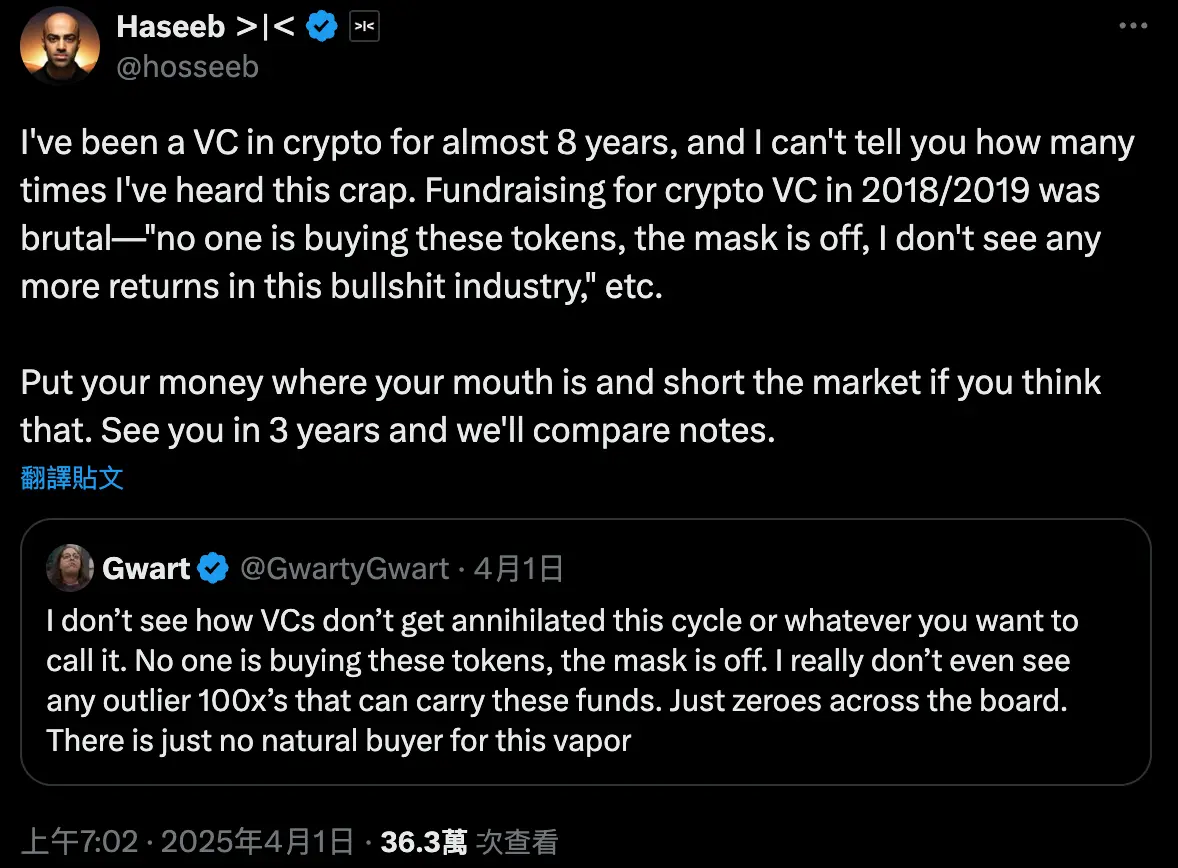
他表示,2018/2019 年加密 VC 募资极为艰难,但现实已经证明周期会重启。他强调:“如果你真的不看好加密,那就拿出真金白银去做空市场。三年后我们再来对比结果。”

流动性枯竭下生存之道

实际上,随着大量热钱从VC币流向Meme,本就几近枯竭的流动性变得岌岌可危,加密市场陷入“山寨项目崩盘潮”。

据加密KOL @Anymose 96统计,ABCDE投资已发币项目中,币价最高下跌幅度高达95.5%,而这或许也成为了ABCDE转型的因素之一。
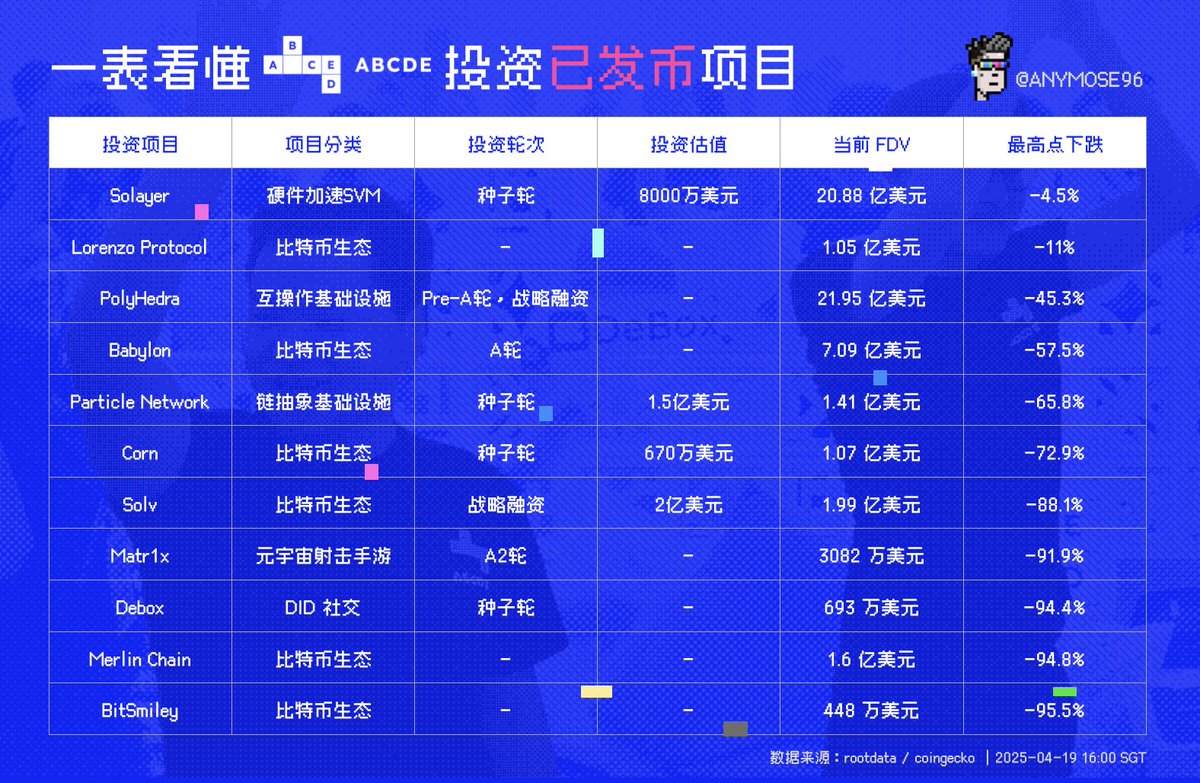
圖片

而这也是当先众处于生态上游的资本机构所面临的困境,一场破局转型迫在眉睫。

以 ABCDE 为代表的资本机构正在转型,在维持一级投资业务的同时,积极向二级市场投资与交易领域拓展,力求实现更出色的市场表现与资金回报。

而以a16z 、Dragonfly Capital为代表的老牌原生加密资本,则将目光投向 AI、稳定币等热门领域,借助更广泛的关注度、资金规模以及应用产品,寻求更多的发展机遇。

Haseeb 曾于今年3月 Denver 发表了关于 AI Agents 的演讲,并讲述了 AI 对 Crypto 的影响以及对AI 与 Crypto 的未来期待,末尾曾表示“未来加密货币和 AI 的交集将非常丰富,但这在很大程度上取决于 AI 的发展和与加密的融合”,而这也表明”AI +Crypto“将成为Dragonfly未来的重要投资标的。

结语

如何在流动性枯竭的当下维持生存,成为了众多Crypto VC思考的问题。

显而易见,承接着人类未来的AI赛道成为连接web2与crypto流动性的天然纽带,而”AI +Crypto“也逐渐成为VC获取流动性的重要叙事。

如果将加密视为一个圈,那么ABCDE的转型似乎是在向圈内创造流动性,而a16z 、Dragonfly Capital则是在向圈外索取更多流动性。

未来,加密资本市场的格局将如何演变,资本机构能否在转型中找到新的生存之道,这一切都还是未知数。

但可以确定的是,加密资本市场正经历着前所未有的变革与挑战,资本机构需要不断调整策略,适应市场变化,才能在激烈的竞争中生存下来并实现可持续发展。
Leituras Relacionadas

The Largest Upgrade Since The Merge? How Glamsterdam Will Affect Ethereum?

Ethereum's next major upgrade, Glamsterdam (combining consensus layer "Gloas" and execution layer "Amsterdam"), is scheduled for late 2026 and considered the most significant overhaul since The Merge. It aims to fundamentally enhance L1 performance and architecture to prepare for substantial capacity increases. The upgrade centers on three core changes: 1. **Enshrined PBS (ePBS - EIP-7732):** Integrates the Proposer-Builder Separation directly into the protocol, eliminating reliance on external relays. This extends the window for processing execution payloads, allowing nodes more time to handle larger blocks and more data, paving the way for a higher Gas Limit. 2. **Block-Level Access Lists (BALs - EIP-7928):** Provides a pre-declared "map" in the block header of all state data (accounts, storage) that transactions will access and modify. This enables potential parallel transaction processing and faster state synchronization for nodes. 3. **Gas Repricing (EIP-8037):** Overhauls the gas model to more accurately reflect the real resource costs for nodes. It separates computation costs from state storage costs, making operations that create permanent state data (like new accounts) more expensive, while computation-heavy operations become relatively cheaper. These changes work together to solve the trilemma of scaling: giving nodes more time to process larger blocks (ePBS), reducing execution bottlenecks (BALs), and controlling unsustainable state growth (Gas Repricing). The goal is a credible path to a higher Gas Limit (e.g., 200M gas) without compromising decentralization by overburdening node hardware. For users: * Transaction fees for simple transfers may decrease and become more stable due to increased block space, but state-intensive operations (contract deployment) may cost more. * Gas estimation by wallets will improve in accuracy. * L2 data posting costs could become more stable long-term due to increased Blob capacity. * EIP-7708 will standardize logs for ETH transfers, improving tracking for wallets and exchanges. Node operators must upgrade clients, but ETH holders need take no action. In essence, Glamsterdam doesn't just raise the block size limit; it re-engineers Ethereum's core block production, execution, and economic models to enable sustainable, decentralized scaling.

marsbitHá 18m

The Largest Upgrade Since The Merge? How Glamsterdam Will Affect Ethereum?

marsbitHá 18m

Robinhood Chain Mainnet Goes Live: Can Stocks Finally Be Moved Into Wallets?

Robinhood has officially launched its public mainnet, Robinhood Chain, along with stock-like tokens, the USDG yield product, and a DeFi lending portal. This marks a significant shift where a major online broker is integrating its user interface, regulatory compliance, self-custody wallet, and on-chain protocols into a single, streamlined experience. The goal is to simplify access to stock exposure, stablecoin yields, collateralized lending, and AMM trading for mainstream users. Eligible non-U.S. users can hold these "Stock Tokens"—structured as tokenized debt securities—in the Robinhood Wallet for 24/7 exposure to assets like U.S. stocks or ETFs. U.S. users can access an estimated ~7% APY on dollar-backed USDG through the Robinhood Earn program via self-custody wallets, with lending infrastructure powered by Morpho protocol. Built as a Layer 2 on Arbitrum, Robinhood Chain leverages existing DeFi protocols like Uniswap. The core strategy is not to reinvent DeFi but to channel Robinhood's large traditional finance user base (27.4 million funded customers as of Q1 2026) into on-chain finance, lowering the technical barriers. However, key limitations exist. The stock tokens are not direct equity ownership and are unavailable in the U.S. and some jurisdictions due to regulatory constraints. The ~7% yield is variable and carries inherent DeFi risks, not guaranteed principal protection. Furthermore, while AMMs enable trading, price discovery for major stocks will likely remain anchored in traditional markets like NASDAQ for the foreseeable future. Ultimately, Robinhood Chain is an early experiment in "on-chain brokerage." Its success will depend on real-world metrics like trading volume, sustained user migration to self-custody, stable yield performance, and regulatory feedback, rather than its launch narrative.

marsbitHá 1h

Robinhood Chain Mainnet Goes Live: Can Stocks Finally Be Moved Into Wallets?

marsbitHá 1h

Circle CEO Responds to OUSD Challenge: Stablecoin Market Is 'Winner-Takes-All', Consortium Model Doomed to Fail

Circle CEO Jeremy Allaire addresses market concerns following the announcement of the Open USD (OUSD) stablecoin project backed by 140 global companies. Allaire argues the stablecoin market exhibits "winner-takes-all" dynamics due to powerful network effects. He cites USDC's near-decade lead in three key areas: 1) **Application Integration & Protocol Development**: Thousands of integrated services and protocols (like CCTP) create utility and lock-in for developers and users. 2) **Liquidity Network Effects**: A deeply embedded, globally distributed liquidity infrastructure across primary and secondary markets, built over years. 3) **Regulatory Integration**: Extensive licensing and compliance groundwork ensuring USDC's acceptance in major markets like Europe and Japan. Allaire challenges OUSD's proposed advantages. He contends that promises of free redemption, while appealing, face market realities where such models can become exit routes for other stablecoins. He also questions the feasibility of fully distributing all revenue to an alliance, stating it would "starve" the critical infrastructure investments needed for scale and utility. Furthermore, he expresses skepticism about large alliance governance models, noting they often lead to slow decision-making and misaligned incentives. While welcoming OUSD to the ecosystem, Allaire reaffirms confidence in USDC's dominant position, backed by its long-term infrastructure investments and strong partnerships, including its ongoing collaboration with Coinbase.

marsbitHá 1h

Circle CEO Responds to OUSD Challenge: Stablecoin Market Is 'Winner-Takes-All', Consortium Model Doomed to Fail

marsbitHá 1h

Trading

Spot
活动图片