Next Crypto to Explode as $TRUMP Token Faces $320M Unlock Pressure

bitcoinistPublicado em 2025-04-14Última atualização em 2025-04-14

Resumo

On April 18, a hefty 40M of $TRUMP (worth $320M) will be unlocked, triggering sell-offs but also potentially revealing the...

Trusted Editorial content, reviewed by leading industry experts and seasoned editors. Ad Disclosure

On April 18, a hefty 40M of $TRUMP (worth $320M) will be unlocked, triggering sell-offs but also potentially revealing the next crypto to explode.

As a series of $TRUMP token unlocks hits the market, an extra 493K worth $4M will be released every day.

The $TRUMP Token Unlocks Might Trigger Sell-Offs

Industry observers anticipate increased selling pressure owing to the fact that the first batch of unlocked tokens will be given to team members at no cost. They’ll likely want to sell their tokens to realize a profit when the unlock occurs.

This wave of sell-offs could intensify downward pressure and create volatile short-term moves.

But the outlook isn’t all doom and gloom. When a significant token like $TRUMP faces enhanced selling pressure, investors often rotate their capital into other meme coins with stronger prospects.

Consequently, some of the best meme coins on presale could be the next crypto to explode during this volatile period. Let’s look at $BTCBULL, $SOLX, and $LCAI; some of the hottest contenders right now.

1. BTC Bull Token ($BTCBULL) – Stabilizes Its Supply With $BTC Airdrops & Ongoing Token Burns

$BTCBULL’s name says it all. It’s possibly one of the most bullish Bitcoin-based projects because it dishes out free $BTC every time the blueprint token breaks a new record – $100K, $150K, and $200K.

To top it off, you can anticipate free $BTCBULL airdrops when $BTC eventually hits its $250K milestone. For airdrop eligibility, there’s a slight catch. You must purchase $BTCBULL on the Best Wallet app.

As the world’s first crypto wallet to feature presale tokens, you can buy coins at their lowest prices before they attract mainstream attention. In fact, it has much to offer, as pinpointed in our Best Wallet review.

In stark contrast to $TRUMP, $BTCBULL burns or removes a percentage of its token supply instead of adding new tokens to the market. Fewer tokens in circulation makes them scarcer, which can lead to higher prices if demand stays the same or increases.

$BTC acts as a burn trigger. causing $BTCBULL to be removed when the OG coin hits $125K, $175K, and $225K.

Besides profiting from token airdrops and possibly deflationary price action, you can also stake $BTCBULL at an 89% APY. That means you can earn passive income simply by holding onto the token. Plus, you’ll help stabilize the Bitcoin Bull ecosystem.
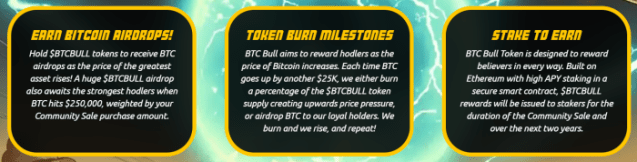
BTC Bull Token airdrops, burns, and staking
Source: BTC Bull Token

Get behind BTC’s rise to $250k and beyond. Find out how to buy $BTCBULL on presale for just $0.00246. Our $BTCBULL price predictions see it reaching $0.00835 by this year’s end (a 239%+ uplift compared to its current price), so it’s prime buying time.

Solaxy ($SOLX) – Behind the First Ever Solana L2; Presale Just Hit $30M

Looking like the next crypto to explode is $SOLX. It’s accelerating rapidly, having just hit over $30M on presale!

Solaxy has raised $30M on presale
Source: Solaxy

Attracting the eyes of investors is its being the entry point to Solaxy, the world’s first Solana L2 network currently in development.

Despite Solana’s reputation for speed (50K tps), low cost, and scalability, its recent performance has faltered – especially during periods of high demand.

For example, when $TRUMP launched in January, the overwhelming 24-hour demand resulted in a $21.9B trading volume and triggered transaction failures across the network.

This is where Solaxy steps into the scene. Addressing Solana’s pain points, it aims to enhance the blockchain’s scalability and overall efficiency by bundling transactions onto a side chain.

Moreover, enabling cross-chain transfers between Solana and Ethereum will unlock greater liquidity and dApp opportunities. This includes DeFi platforms, NFT marketplaces, Web3 games, and easy access to the best crypto to buy now.

To keep you engaged before the L2 networks initiation, you can also stake $SOLX at a 135% APY.

Now’s an opportune time to buy $SOLX on presale for just $0.001694. This is especially true when considering the SOLX price is predicted to reach $0.032 before 2026 kicks off (a 3,100% increase compared to its initial $0.0010 valuation!).

You wouldn’t be the only one betting on the coin’s success. Less than 24 hours ago, two major whale buyers funneled $31K+ and $29K+ into the project, helping $SOLX to achieve its $30M+ raise.

3. Lightchain AI ($LCAI) – The Backbone of Fully Decentralized & Scalable AI Applications

$LCAI is the backbone of Lightchain AI, a decentralized ecosystem to support and accelerate AI development and applications.

Interestingly, it uses a novel consensus mechanism – Proof of Intelligence (PoI) – that rewards participants (nodes) for performing valuable AI computations. Such tasks include model training, interference, and optimization.

Lightchain AI Proof of Intelligence (PoI)
Source: Lightchain AI

At the platform’s core is the Artificial Intelligence Virtual Machine (AIVM), a cutting-edge computational layer designed to facilitate hassle-free AI-specific tasks on the blockchain.

By purchasing $LCAI, you can access AI model training, the interface, and other machine-learning services held on the AIVM.

Moreover, you can partake in the PoI to earn rewards and contribute to the network’s security and overall efficiency.

You’ll also get governance rights to influence protocol updates and ecosystem development.

$LCAI is currently in its presale phase. Although the coin is yet to launch on exchanges, it’s already raised over $19M. One coin costs as little as $0.007125 and can be bought in exchange for $USDT or $ETH.

Suppose you’re conscious of blockchain technology’s environmental impact. In that case, you’ll be relieved to hear that Lightchain AI’s operations should be more sustainable by October 2025, when its energy-efficient system optimizations are planned.

$BTCBULL Token Burns Over $TRUMP Supply Surge

The meme coin market is bracing for turbulence as the $TRUMP token unlocks loom.

However, with volatility comes opportunity. $BTCBULL, $SOLX, and $LCAI could be the next crypto to explode as traders look for new options.

$BTCBULL, in particular, flips $TRUMP’s script. Instead of flooding the market with new tokens, it reduces its supply to capitalize on scarcity.

Still, this isn’t investment advice. You must always DYOR and beware that all crypto investments can be volatile and pose significant risks.

Editorial Process for bitcoinist is centered on delivering thoroughly researched, accurate, and unbiased content. We uphold strict sourcing standards, and each page undergoes diligent review by our team of top technology experts and seasoned editors. This process ensures the integrity, relevance, and value of our content for our readers.

Bitcoinist is the ultimate news and review site for the crypto currency community!

Leituras Relacionadas

A 10,000-Word Interpretation of the "Optical Interconnect" Industry Chain: The AI Infrastructure Bottleneck Obscured by GPU Glare

**Summary: The Rise of Optical Interconnect in AI Infrastructure** This analysis explores the critical, yet often overlooked, role of optical interconnects in large-scale AI data centers. While GPUs provide raw computational power, the efficiency of AI clusters depends heavily on high-speed data transfer between thousands of cooperating GPUs during both training and inference tasks. Copper-based electrical connections are hitting physical limits in bandwidth, distance, and power consumption. Fiber optics, using light signals, offer a superior solution with exponentially higher bandwidth and lower energy use over longer distances. This shift is driving rapid growth in the optical interconnect market. The core translation device is the pluggable optical transceiver (or module), which converts electrical signals from GPUs into optical signals for fiber transmission and vice versa. Its manufacturing involves two distinct semiconductor domains: indium phosphide (InP) for optical chips (lasers, modulators, detectors) and silicon for digital signal processing (DSP) chips. A transformative next-generation technology is Co-Packaged Optics (CPO). CPO moves the optical engine (a silicon photonic integrated circuit, or PIC) much closer to the GPU or switch inside the same chip package, drastically reducing power loss and latency. CPO necessitates an external laser source and relies on silicon photonics (using Silicon-on-Insulator/SOI wafers) for integration with silicon chips. The optical interconnect ecosystem is highly fragmented, unlike the concentrated GPU market. Key bottlenecks and players span the entire supply chain: InP substrates (e.g., AXT), epitaxial wafers (e.g., IQE), laser chips (e.g., Sivers, Lumentum, Coherent), silicon photonics foundries (e.g., Tower Semiconductor), SOI wafers (e.g., Soitec), DSP/switch chips (e.g., Broadcom, Marvell), and underlying fiber (e.g., Corning). The article posits that AI infrastructure competition is extending from "who has more GPUs" to "who can secure the scarce optical interconnect supply chain." CPO represents the largest potential growth variable, with projections suggesting it could become a market worth tens of billions of dollars by 2028. Investment opportunities vary from conservative (large, diversified players) to aggressive (small, high-beta companies focused on specific bottleneck technologies), but the sector carries significant volatility and execution risks.

marsbitHá 1m

A 10,000-Word Interpretation of the "Optical Interconnect" Industry Chain: The AI Infrastructure Bottleneck Obscured by GPU Glare

marsbitHá 1m

a16z: RWA Has Passed the Proof of Concept, but the Real Challenges Are Just Beginning

a16z highlights that the tokenized real-world asset (RWA) market, excluding stablecoins, has grown tenfold in under two years to roughly $340 billion. This surge is primarily driven by US Treasury bonds and gold, offering investors yield on idle stablecoins and providing institutions with more efficient settlement and collateral flows. However, the core insight is that most tokenized assets today are simply digital certificates for off-chain holdings—used for ownership and transfer but not deeply integrated into DeFi as composable financial building blocks. For instance, only about 5% of tokenized bonds ($8B) are actively used in DeFi protocols. Smaller categories like reinsurance tokens show much higher DeFi utilization (84%), indicating they were designed for on-chain composability from the start. The market remains concentrated, with US Treasuries and commodities comprising two-thirds of the total. Gold dominates the commodities segment. While Ethereum holds over half the market, activity is spreading across multiple chains like BNB Chain and Solana. Predictions for the market's future size vary widely (from $2 trillion to over $30 trillion by 2030/2034), reflecting different definitions of what constitutes tokenization. All agree on significant growth. The current market is minuscule compared to traditional finance (e.g., tokenized bonds are 0.01% of the global bond market). The key takeaway is that the initial "proof-of-concept" phase for moving familiar assets on-chain is proving successful. The next, harder challenge is moving more complex financial instruments onto blockchains and enabling true on-chain composability, where these assets become programmable components within a native digital financial system, rather than just digitized records.

marsbitHá 38m

a16z: RWA Has Passed the Proof of Concept, but the Real Challenges Are Just Beginning

marsbitHá 38m

The Wind of 'Proactive' AI Blows into Silicon Valley: Hark Secures $700 Million in Funding

Hark, an AI startup founded in late 2025, has raised $700 million in Series A funding at a $6 billion valuation. Led by Parkway Venture Capital with participation from NVIDIA, AMD Ventures, Intel Capital, Qualcomm Ventures, and Salesforce Ventures, the company aims to develop next-generation human-computer interfaces using a combination of proprietary foundational models and custom-built AI-native hardware. Founded by serial entrepreneur Brett Adcock, Hark envisions a system of multimodal devices equipped with agentic capabilities, end-to-end voice models, and personalized memory. This "active" AI approach seeks to move beyond passive chatbots, creating collaborative companions that anticipate needs and interact naturally within the real world. Adcock's experience with Figure, a humanoid robotics company, informs this hardware-focused venture. The article argues that while current AI is powerful, it remains confined to screens and traditional interfaces like chat. The next paradigm shift requires dedicated hardware that is always-on, possesses persistent memory, and enables intuitive interaction, potentially rivaling the impact of the iPhone. Hark is assembling a team with talent from Apple, Meta, Google, and Tesla to tackle this complex engineering challenge across models, hardware, and interaction design. Finally, the piece suggests Chinese startups may have an advantage in this "active" AI hardware space due to strong manufacturing ecosystems, a vast domestic market, and supportive government policies, framing the competition as one that requires integrated progress in models, operating systems, and devices.

marsbitHá 43m

The Wind of 'Proactive' AI Blows into Silicon Valley: Hark Secures $700 Million in Funding

marsbitHá 43m

Competitors Going Public, Kimi Can't Sit Still

Competitors Go Public, Kimi Feels the Pressure Yue Zhi An Mian (Moonshot AI), the company behind the AI assistant Kimi, has begun dismantling its VIE and red-chip structure, clearing a key obstacle for a potential Hong Kong IPO. This marks a significant shift from six months ago when founder Yang Zhilin stated the company was in "no hurry" to list. The move comes as rivals like Zhipu AI and MiniMax have successfully listed on the Hong Kong Stock Exchange in early 2026, experiencing massive surges in market value. This has reset valuation logic for AI companies, turning "going public" from an end goal into a competitive necessity. Analysts suggest Kimi is both seizing a favorable market window and responding to competitive pressure. Kimi's valuation has skyrocketed from around $3 billion at its 2023 founding to over $20 billion by May 2026. Capital is betting on its potential as a future AI platform and gateway, though some caution this "emotional valuation" depends on sustained technological leadership and successful commercialization. Traditionally focused on core model R&D over user growth, Kimi has recently pivoted strategy. While its monthly active users declined through 2025, it shifted focus to Agent development and reducing marketing spend. The release of its K2.5 model in early 2026 reportedly generated substantial revenue, with annual recurring revenue reaching $200 million by April, driven by subscriptions and API services. A $2 billion D-round financing in May signaled investor approval of this commercial shift. However, listing will bring new pressures. Experts predict a listed Kimi would face stricter scrutiny on financial controls, compliance, and R&D efficiency. The narrative must evolve from pure technological breakthroughs to demonstrating clear commercialization paths, sustainable income, and a defensible valuation, balancing model superiority with business performance.

marsbitHá 1h

Competitors Going Public, Kimi Can't Sit Still

marsbitHá 1h

Trading

Spot
Futuros
活动图片