China Highlights Digital Yuan Growth Amid Rising U.S. Tariffs

TheCryptoTimesPublicado em 2025-04-11Última atualização em 2025-04-11

After U.S. President Donald Trump slapped a jaw-dropping 145% tariff on Chinese goods, the yuan took a sharp dive, hitting its lowest level in 17 years at 7.3498 per dollar. 

In response, China’s central bank is pushing the success story of its digital currency, aiming to show that the economy still has a few strong cards to play.

Before March 11, data from China’s central bank showed a big jump in the use of its digital currency, the e-CNY. In just nine months, the number of personal wallets grew from 180 million to 800 million, and total transactions went up by 45%, reaching 10.2 trillion yuan. 

Chinese state media has been sharing these numbers everywhere — likely to boost public confidence and show strength as the economy comes under pressure.

At the same time, the U.S. has lowered tariffs for many other countries but kept high ones in place for China. That’s led Beijing to hit back with its own set of tariffs on American imports.

At the same time, the PBOC has reportedly asked banks to cut back on buying U.S. dollars. Still, the forex markets aren’t too convinced — the yuan continues to slide.

Not everyone’s convinced by China’s glowing numbers. Some economists think it’s all just PR, especially when tensions are high — the kind of moment when stats usually get dressed up.

And let’s be honest, the e-CNY isn’t without issues. Since it’s tied to people’s digital IDs, there’s growing unease that it could be used to keep tabs on how folks spend their money.

That said, China isn’t slowing down on upgrading the e-CNY. New tools like offline payments and better QR code functionality have rolled out, and more cities are allowing it for public transport. 

Whether all of this is enough to offset the damage from the tariff war is still up in the air, but one thing’s for sure: China is betting big on its digital currency to steady the ship.

Also Read: Amid Trump Tariff War, China And Russia Turn To Bitcoin


Leituras Relacionadas

Hash Global Founder: Why I Also Choose to Liquidate All My ETH Holdings?

Hash Global founder explains his decision to sell all ETH holdings, despite recognizing the potential regulatory clarity from the US CLARITY Act as a positive development. He argues against the narrative that such clarity would automatically grant ETH a "monetary premium" comparable to Bitcoin or gold. The core of his critique is that market valuation for ETH remains tied to fundamental network metrics—like mainnet revenue, DeFi activity, staking yield, and competition—rather than a pure store-of-value narrative. He contends that legal classification solves compliance issues for institutions but does not inherently create the deep, historical consensus required for monetary status. Furthermore, Ethereum's complexity and role as a multi-functional infrastructure asset (gas, collateral, settlement layer) work against the simple narrative needed for such a premium. Looking forward, he suggests that the rise of DeFi and tokenized real-world assets (RWA) will mean ETH is not the only yield-bearing asset; tokenized gold, treasuries, and others will also offer programmable yield. Thus, ETH's "yielding" advantage diminishes. He believes monetary premium will likely remain with Bitcoin, physical gold, and potentially tokenized gold, while ETH's value is more accurately framed as a crucial infrastructure asset. Ultimately, he views CLARITY's benefit as reducing a "regulatory discount" on ETH, not unlocking trillions in monetary re-rating. ETH's long-term value is significant but stems from its network effects, developer ecosystem, and role in on-chain finance—not from being a direct substitute for gold.

marsbitHá 3m

Hash Global Founder: Why I Also Choose to Liquidate All My ETH Holdings?

marsbitHá 3m

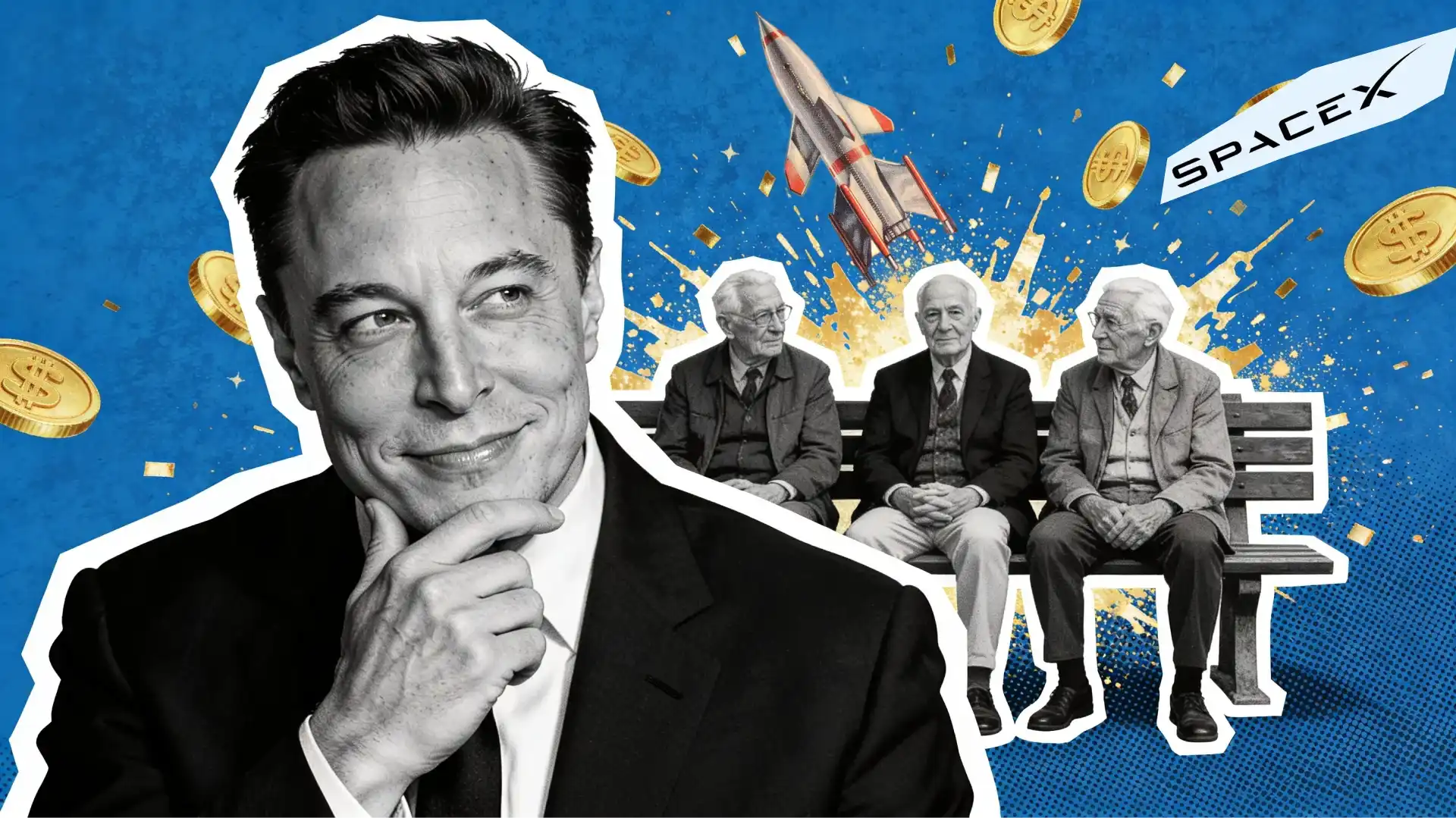
Elon Musk's 'Granny Drain'

Title: Musk "Milking the Old Folks" Author: Nancy, PANews As the memory sector surges with Micron and SK Hynix each surpassing a trillion-dollar market cap, Elon Musk is accelerating his own myth of becoming the world's first trillionaire. SpaceX, with its astronomical valuation, is speeding toward the capital markets. This potentially wealth-history-rewriting super IPO is pushing Musk toward that unprecedented personal fortune and delivering hundredfold or even thousandfold returns to early backers like Google, Valor Equity Partners, Founders Fund, and others. However, to sustain this most expensive space narrative in human history, new buyers are ultimately needed. As massive pension funds are set to be "forced to buy," the retirement savings of Americans are becoming the fuel for Musk's space dreams. Wall Street has begun paving a fast track for such super IPOs. Major indices like Nasdaq and S&P have recently eased rules, allowing mega-companies like SpaceX to be incorporated into key benchmarks like the Nasdaq 100 much faster post-listing. This matters because a vast portion of the U.S. retirement system—trillions in 401(k)s and pension funds—relies on passive index investing. Once a company enters a major index, all funds tracking it are compelled to buy its shares automatically, regardless of valuation, profitability, or risk. This has sparked significant backlash. Teacher unions and major public pension funds (collectively managing trillions) have warned the SEC and written to Musk, opposing SpaceX's extreme governance structure where Musk holds 85% voting control. They argue workers' lifelong savings could be tied to a company resembling a Musk family office more than a transparent public entity. In essence, after early investors reap immense rewards, the potential "bag-holding" cost is being transferred onto passive investors—the ordinary American retirees—through the mechanism of index inclusion.

marsbitHá 7m

Elon Musk's 'Granny Drain'

marsbitHá 7m

This Xiaohongshu Graphic Layout AI Skill Has Found a Route to Bypass AI Labeling for Graphic Generation

A new open-source tool called "guizang-social-card-skill" has emerged, offering a unique workaround for AI content labeling rules on platforms like Xiaohongshu. Instead of using AI models to generate images, it employs AI to make layout decisions, then uses HTML/CSS to render the final graphic. Photographic assets are sourced from libraries like Unsplash. The output is a rasterized browser screenshot, not an "AI-generated image." This approach is a direct response to platform policies. In early 2026, Xiaohongshu mandated labeling for AI-generated synthetic content and deployed audio-visual recognition models to detect AI-generated pixels based on statistical patterns. This tool bypasses those pixel-level detectors by not using diffusion or GAN models for image generation. The tool provides 28 predefined layout templates across two visual styles. Users input a topic, and the AI selects a template, positions text, and integrates elements like maps (using OpenStreetMap). The system prioritizes user-uploaded photos before falling back to stock image searches. The article outlines three divergent technical paths for social media graphic tools: 1) AI models directly generating pixels (highest detection risk), 2) API template engines (risk of anti-spam rules for homogeneity), and 3) this HTML-rendering method. The longevity of this workaround depends on whether platforms broaden their definition of "AI-generated content" to include programmatically rendered, AI-designed graphics. While effective for structured content like travel itineraries, the tool's 28 templates may be too restrictive for creative fields like fashion or beauty. Its future hinges on an ongoing cat-and-mouse game between platform detection models and tool developers, highlighting the tension between "AI-assisted" creativity and "AI-replaced" mass production.

marsbitHá 13m

This Xiaohongshu Graphic Layout AI Skill Has Found a Route to Bypass AI Labeling for Graphic Generation

marsbitHá 13m

Hash Global Founder: Why I Also Chose to Liquidate All My ETH?

Title: Hash Global Founder Explains Why He Sold All His ETH The author (Hash Global founder) has liquidated his entire ETH holdings, despite acknowledging that the potential U.S. CLARITY Act (clarifying ETH as a decentralized digital commodity) is a significant regulatory positive. His core argument is that this regulatory clarity should not be conflated with granting ETH a "monetary premium" akin to Bitcoin (BTC) or gold. He disputes the thesis that ETH's valuation framework should shift from network revenue to a monetary/store-of-value logic. The market continues to value ETH based on concrete metrics like network fees, DeFi activity, staking yield, and ecosystem competition—essentially as a productive infrastructure/platform asset. BTC's narrative as "digital gold" is simpler and more suited for monetary premium. The author identifies several key reservations: 1) Legal classification solves compliance for institutions but doesn't automatically create long-term store-of-value demand. 2) ETH's "yield-bearing" advantage over BTC/gold may diminish as DeFi and Real-World Assets (RWA) tokenize traditional assets like gold and treasuries, which can also generate yield on-chain. 3) Future monetary premium will likely remain with BTC, physical gold, and potentially tokenized gold, while ETH serves as the core settlement infrastructure for these assets. 4) Ethereum's value-capture mechanism remains unresolved, especially with Layer-2 scaling; ecosystem growth does not guarantee proportional value accrual to ETH. 5) Institutions using Ethereum for applications (e.g., stablecoins, RWA) does not necessitate them holding ETH as a core asset. In conclusion, CLARITY is a positive that reduces ETH's "regulatory discount," but it does not transform ETH into a monetary asset like gold. ETH is a critically important financial infrastructure asset whose valuation should be based on network fundamentals, usage, and value flow, not an assumed monetary premium.

链捕手Há 20m

Hash Global Founder: Why I Also Chose to Liquidate All My ETH?

链捕手Há 20m

Trading

Spot
Futuros
活动图片