65% Of All Shiba Inu Holders Now Underwater As Profitability Drops To 2024 Levels

bitcoinistPublicado em 2025-04-09Última atualização em 2025-04-09

Resumo

Shiba Inu investors continue to endure major losses as the SHIB price remains 87% below its all-time high price reached...

Trusted Editorial content, reviewed by leading industry experts and seasoned editors. Ad Disclosure

Shiba Inu investors continue to endure major losses as the SHIB price remains 87% below its all-time high price reached back in 2021. Multiple price crashes over the last few have left the majority of investors in the red with profitability dropping to early 2024 levels once again.

65% Of Shiba Inu Investors Suffer Losses

In the last year alone, the Shiba Inu price has declined by more than 60% to eliminate most of the recovery from 2023-2024. As a result, investors have been nursing losses, with over 65% of investors seeing losses already. In contrast, 32% are seeing some profit, while 3% are struggling at breakeven prices.

IntoTheBlock’s data shows that at the current price, only 98.2 trillion SHIB, worth $1.12 billion bought by investors is seeing any profit. This is in comparison to the 878.5 trillion SHIB, worth $9.99 billion, that are current nursing losses. Lastly, the amount of SHIB sitting at breakeven is only 8.14 trillion SHIB, worth $92.59 million.

Historically, the profitability has fluctuated wildly as bull and bear markets have come and gone. After the 2021 bear market which saw the highest levels of profitability in October, SHIB holders have had a hard time keeping up profitability. Throughout 2022 and 2023, profitability remained low, well into 2024 before a turn in the market.
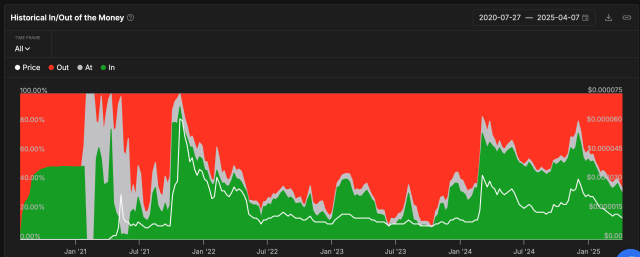
Shiba Inu profitability
Source: IntoTheBlock

By December 2024, profitability reached over 72% again as the Shiba Inu price looked like it was surging toward new all-time highs. However, 2025 has come with a different narrative with profitability tanking once again. Currently, in April 2025, profitability is now sitting at levels not seen since February 2024.

When it comes to the bullish versus bearish narrative, the bulls continue to dominate despite the sell-offs. Expectations remain that the Shiba Inu price would bottom soon and that a rally would follow shortly after.

Why A SHIB Price Recovery Could Happen

Large Shiba Inu transactions have seen a spike in the last few days amid the market downturn. According to IntoTheBlock, large transaction volumes rose over 100% between Sunday and Monday, and have continued to rise.
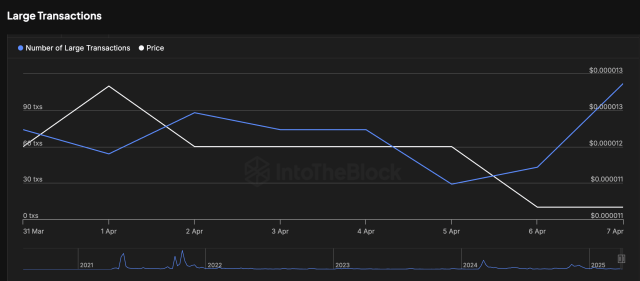
Shiba Inu whales
Source: IntoTheBlock

On the one hand, this could suggest that whales were part of the selling spree that contributed to the SHIB price crash. However, it could also mean that interest is returning for the meme coin, and if this participation turns into buying pressure, then it could lead to a recovery for SHIB.

Shiba Inu price chart from TradingView.com
Bears maintain control of price | Source: SHIBUSDT on TradingView.com

Featured image from Dall-E, Chart from TradingView.com

Editorial Process for bitcoinist is centered on delivering thoroughly researched, accurate, and unbiased content. We uphold strict sourcing standards, and each page undergoes diligent review by our team of top technology experts and seasoned editors. This process ensures the integrity, relevance, and value of our content for our readers.

Scott Matherson is a leading crypto writer at Bitcoinist, who possesses a sharp analytical mind and a deep understanding of the digital currency landscape. Scott has earned a reputation for delivering thought-provoking and well-researched articles that resonate with both newcomers and seasoned crypto enthusiasts. Outside of his writing, Scott is passionate about promoting crypto literacy and often works to educate the public on the potential of blockchain.

Leituras Relacionadas

Large Language Models Ace All Exams, Yet Move Farther from AGI: What Does This Paper Reveal?

The article discusses the ongoing challenge of defining and achieving Artificial General Intelligence (AGI). It notes that industry leaders have set vague, often profit- or time-based benchmarks for AGI, while the concept itself lacks a consensus definition—a situation the article compares to a "Rorschach test." It highlights a recent 2025 paper by researcher Michael Timothy Bennett, who proposes a new, measurable definition. Bennett frames AGI not as mimicking human performance on tests, which current large language models (LLMs) have already mastered, but as an "artificial scientist." A true AGI, according to this view, should be able to widely and efficiently adapt to new environments and tasks within real-world constraints (like computational and energy limits), focusing on the *discovery of new knowledge* rather than the replication of existing data. The author contrasts this with the current dominant approach of "scale-maxing"—massively scaling up data, parameters, and compute. While powerful, this method leads to models that fail on out-of-distribution problems and lack core intelligent abilities: they are passive learners, cannot reason causally, and cannot actively experiment or balance exploration with exploitation. The article argues that Bennett's framework offers a crucial shift. It makes AGI a quantifiable engineering problem and proposes new evaluation "adaptation benchmarks" that test an AI's ability to actively learn in novel scenarios. The conclusion is that achieving AGI will require a fundamental reset—a fusion of multiple methodologies beyond simple scaling, moving AI from mimicking patterns to embodying the scientific spirit of inquiry and discovery.

marsbitHá 1h

Large Language Models Ace All Exams, Yet Move Farther from AGI: What Does This Paper Reveal?

marsbitHá 1h

Pope Issues First AI Encyclical: 40,000 Words, 10 Key Points, Clarifying AI Anxiety

Pope Leo XIV's historic encyclical "Magnifica Humanitas," released in May 2026, marks the Catholic Church's first major document addressing artificial intelligence. The 40,000-word text moves beyond theological abstraction to confront practical AI anxieties affecting society. It argues that AI is no longer a mere tool but an embedded environment influencing daily decisions in areas like employment, healthcare, justice, and information, often without users' awareness. The encyclical presents ten core concerns. It highlights that the central issue isn't just regulation, but who holds the underlying *power*—control over data, compute, and platforms—often concentrated in private entities. It warns that even developers cannot fully explain AI systems, creating accountability gaps. While AI can simulate human interaction and creativity, it cautions against treating it as a moral agent capable of bearing true responsibility or forming genuine relationships. Key risks identified include AI's role in opaque decision-making for jobs or welfare, the amplification of persuasive disinformation, and the potential for education to focus on tool use over critical thinking. The document stresses that work has value beyond efficiency, and AI should enhance human capabilities, not merely replace roles. It firmly states that irreversible decisions, especially involving life and death, must remain under human judgment. Ultimately, the encyclical frames AI's challenge as anthropological, not just technological. As AI simulates uniquely human capacities like judgment and creation, it forces a re-examination of what makes human action meaningful: our capacity for responsibility, vulnerability, and bearing real consequences. The Pope concludes that technology is never neutral; its development and deployment are shaped by human values and choices, making an inclusive, ethically grounded dialogue essential for its future.

marsbitHá 1h

Pope Issues First AI Encyclical: 40,000 Words, 10 Key Points, Clarifying AI Anxiety

marsbitHá 1h

Trading

Spot
Futuros
活动图片