JPMorgan sees yield-bearing stablecoins growing from 6% to 50% of market share

THE BLOCKPublicado em 2025-03-28Última atualização em 2025-03-28

Resumo

JPMorgan analysts forecast that yield-bearing stablecoins could rise from the current 6% to as much as 50% of the stablecoin market cap in the future.

JPMorgan analysts forecast that yield-bearing stablecoins could rise from the current 6% to as much as 50% of the stablecoin market cap in the future.

Yield-bearing stablecoins are attracting investors similarly to traditional money market funds, particularly in today’s high-interest-rate environment, the analysts said.

Yield-bearing stablecoins, including tokenized Treasurys, which offer interest returns similar to traditional financial products, could experience massive growth ahead, according to JPMorgan analysts.

Yield-bearing stablecoins currently make up just 6% of the total stablecoin market cap but could expand significantly, potentially capturing up to 50% of the market unless regulatory changes intervene, JPMorgan analysts led by managing director Nikolaos Panigirtzoglou wrote in a report released Wednesday.

The top five yield-bearing stablecoins — Ethena's USDe, Sky Dollar's USDS, BlackRock's BUIDL, Usual Protocol's USD0 and Ondo Finance's USDY— have seen rapid growth since the U.S. election in November, rising from around $4 billion to over $13 billion in combined market cap, Panigirtzoglou told The Block.

According to analysts, this growth is expected to continue. They added that the U.S. Securities and Exchange Commission's recent approval of Figure Markets' application for a yield-bearing stablecoin, YLDS, which is registered as a security, provides further momentum to this segment.
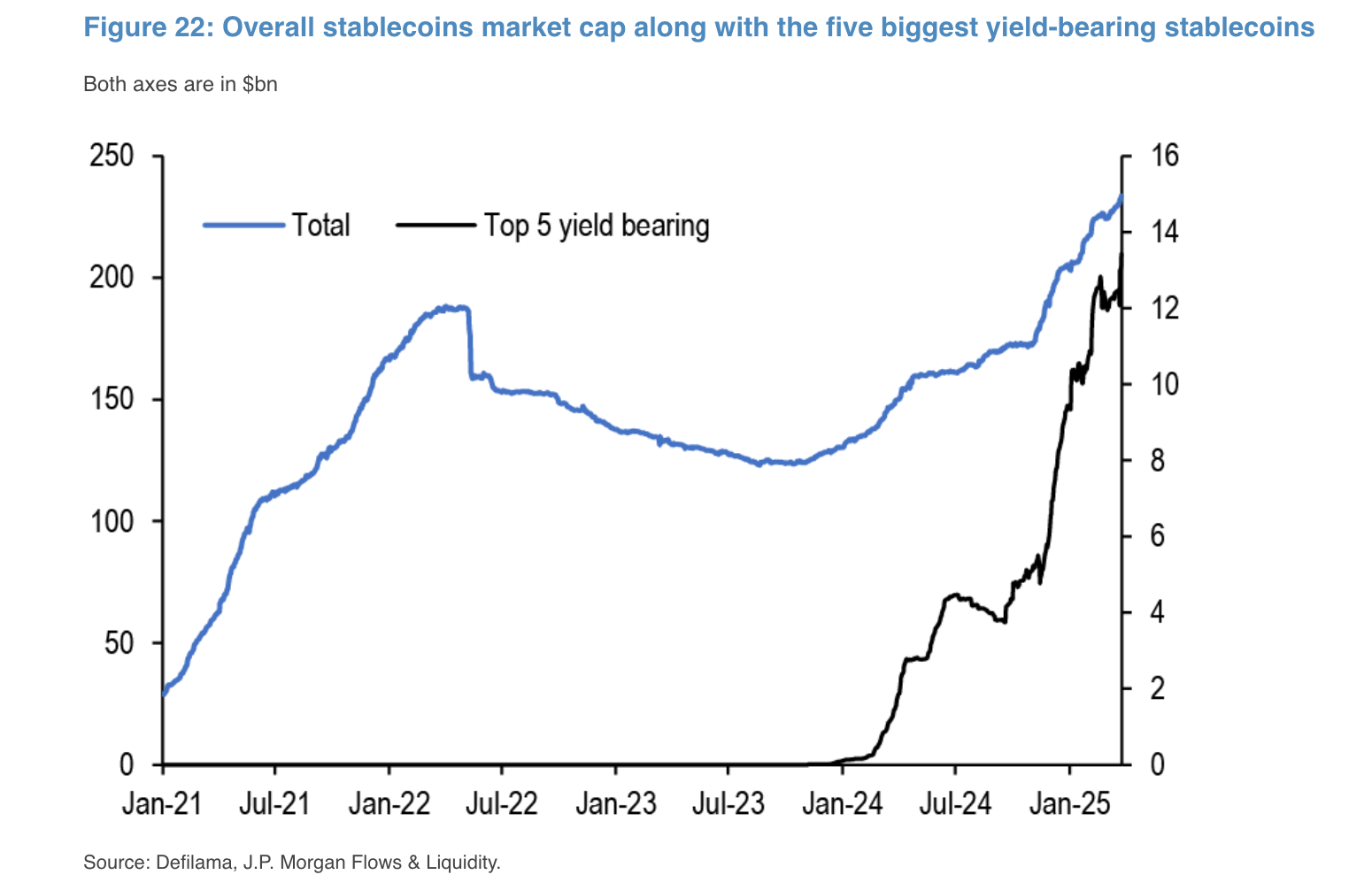
Traditional stablecoins, such as Tether's USDT and Circle's USDC, do not share reserve yields with their users because doing so would classify these assets as securities, according to the analysts. Such a classification would also impose additional compliance requirements, hindering their current seamless use as collateral within the crypto ecosystem, they said.

Why yield-bearing stablecoins are on the rise

The JPMorgan analysts identified several factors driving the rapid growth of yield-bearing stablecoins.

First, investors prefer these assets because they offer interest without requiring holders to engage in risky trading or lending activities or give up custody of their assets.

Second, major crypto trading platforms such as Deribit and FalconX now accept tokenized Treasurys as collateral, enabling traders to earn yield on posted collateral.

Additionally, crypto investors are increasingly turning to tokenized Treasurys in decentralized finance (DeFi) to obtain higher yields, as typical DeFi yields have significantly decreased from their peak levels of 2022. Projects like Frax Finance are also adopting tokenized Treasurys as underlying assets, further fueling this growth.

Despite this positive outlook, the JPMorgan analysts noted barriers. Yield-bearing stablecoins are classified as securities, subjecting them to regulatory restrictions that limit their adoption, especially among retail investors. Moreover, traditional non-yield-bearing stablecoins continue to hold a notable liquidity advantage.

With a combined market cap of around $220 billion across multiple blockchains and centralized exchanges, traditional stablecoins offer efficient, fast and low-cost transactions, even at large volumes. In contrast, yield-bearing stablecoins are newer, smaller and comparatively less liquid.

However, "This liquidity disadvantage could potentially be lessened over time as yield-bearing stablecoins gain further traction in the future in crypto derivative trading as source of collateral, in DAO treasuries, liquidity pools, and idle cash with crypto venture funds," according to the analysts.

As a result, over time, yield-bearing stablecoins could attract much of the idle cash currently sitting in traditional stablecoins, the analysts said. While the exact amount of this idle cash is difficult to estimate, it's unlikely to represent the majority of the stablecoin market, according to the analysts.


Leituras Relacionadas

Trillion-Dollar Euphoria for Memory Sellers, Halved Profits for Memory Buyers

Title: The Trillion-Dollar Memory Seller's Carnival vs. The Buyer's Halved Profits On May 26, a stark contrast unfolded. While memory chipmaker Micron's market cap surged past $1 trillion, smartphone maker Xiaomi reported plummeting profits. Xiaomi's Q1 2026 profits fell 43% year-on-year. Executive Lu Weibing cited memory prices quadrupling from last year, adding roughly $210 to a phone's cost. To survive, Xiaomi is cutting entry-level models, sacrificing volume. Micron's stock, however, skyrocketed over 19% in a day, capping an 8x gain in a year. Major banks like UBS and JPMorgan issued bullish reports, raising price targets drastically. Their core thesis: Long-Term Agreements (LTAs) with AI cloud giants (Microsoft, Google, etc.) are eliminating the memory industry's notorious boom-bust cycle. By locking in fixed-price, multi-year contracts for AI-grade memory (HBM, server DDR5), these deals promise stable, utility-like earnings, justifying a higher valuation (20-30x P/E vs. the historical 8-15x). The article reveals a three-tiered memory market in 2026: 1) **AI Storage (HBM/DDR5/Enterprise SSD)**: Extreme shortage, soaring prices, LTAs. This is Micron's story. 2) **Mobile/Embedded Memory**: Also facing sharp price hikes as AI production crowds out capacity, severely pressuring phone makers like Xiaomi. 3) **PC Retail**: Some spot prices are falling due to channel inventory liquidation, creating a divergence from contract markets. The author questions if LTAs truly end the cycle. It hinges on sustained, hyper-growth AI demand. Micron's current profits are at a cycle peak, driven mostly by price hikes, not volume. If AI capital expenditure growth slows, the massive industry capacity expansion (e.g., Micron's $250B+ CapEx plan) could lead to a glut. Historically, using peak-cycle earnings for valuation is a classic trap. While the AI-driven structural shift might be real, the unanimous Wall Street euphoria warrants caution, echoing past bubbles like Cisco's in 2000. The memory seller's trillion-dollar狂欢 (carnival) continues, but the cycle's shadow remains.

链捕手Há 3m

Trillion-Dollar Euphoria for Memory Sellers, Halved Profits for Memory Buyers

链捕手Há 3m

Agentized OS: It's Not About AI, It's About the Foundation

The Agentic OS: Beyond AI, It's About the Foundational Stack In 2026, major operating systems like Android, iOS, HarmonyOS, and Windows are entering the "Agentic" era, integrating proactive AI assistants deeply into the system layer. However, the real competition lies not in the flashy AI features showcased at events, but in the three-layer foundational stack that enables them: the system-level AI Runtime, proprietary/controllable chips, and the on-device/cloud model matrix. The AI Runtime acts as the central scheduler, managing model inference, resource allocation, and exposing capabilities to apps. Controllable chips (e.g., Apple Silicon, Google Tensor, Huawei Kirin) are crucial for deep hardware-software co-optimization, determining the efficiency and experience limits of on-device Agents. The on-device/cloud model matrix provides the "intelligence," with proprietary, chip-optimized small models (like Gemini Nano, Apple's ~3B model) handling daily tasks locally for low latency, privacy, and reliability, while cloud models tackle complex requests. Deep synergy between these three layers enables key Agent differentiators: ultra-low latency and power efficiency, genuine "on-device first" privacy, access to system-level personal context across apps, and reliable performance as a system service even offline. OS vendors with strong integration across this stack (like Apple, Google, and Huawei) build a deeper moat. Beyond this core stack, long-term competitiveness depends on variables like structured App integration (e.g., App Intents/AppFunctions) for reliable multi-step workflows, and robust privacy frameworks that build user trust. This shift towards Agentic OS extends beyond phones and PCs to IoT, cars, and XR glasses via existing multi-device ecosystems. The race is won not in a keynote, but through generations of meticulously co-developed chips, models, and system software.

marsbitHá 1h

Agentized OS: It's Not About AI, It's About the Foundation

marsbitHá 1h

Why Sam Altman's 'Water and Electricity Theory' Sparks Copyright Controversy

OpenAI CEO Sam Altman's recent statement that "intelligence will become a utility like electricity or water" has sparked significant controversy, primarily around copyright issues and the nature of AI development. While positioning AI as a utility serves as a compelling narrative for infrastructure investors, critics argue the analogy is flawed in three key areas. First, there's a fundamental "property gap." Traditional utilities like water and power create new, physical infrastructure from scratch. In contrast, major AI models are trained by reorganizing vast amounts of existing human-created content—books, articles, code, etc.—often scraped from the web without explicit permission or compensation to creators. This "free acquisition, paid resale" model is seen by many as ethically problematic. Second, there's a "pricing gap." True public utilities are typically regulated to ensure universal service with non-discriminatory, cost-plus pricing. AI's token-based pricing, however, involves significant price discrimination (e.g., output tokens costing much more than input tokens) and is designed for revenue maximization, not equitable access. Third, a "governance gap" exists. Utilities operate under public oversight, while AI pricing and development are currently controlled by a few private companies. Furthermore, the industry's own shift toward buying licensed training data (e.g., deals with Reddit or news publishers) undermines its previous legal reliance on "fair use" for freely scraped data. In conclusion, while AI is indeed becoming a foundational technology, calling it a public utility remains contentious. The title requires not just scale and a pay-per-use model, but also credible solutions for data provenance, equitable pricing, and public governance.

marsbitHá 1h

Why Sam Altman's 'Water and Electricity Theory' Sparks Copyright Controversy

marsbitHá 1h

Trading

Spot
Futuros

Artigos em Destaque

Como comprar ONDO

Bem-vindo à HTX.com!Tornámos a compra de OndoFinance (ONDO) simples e conveniente.Segue o nosso guia passo a passo para iniciar a tua jornada no mundo das criptos.Passo 1: cria a tua conta HTXUtiliza o teu e-mail ou número de telefone para te inscreveres numa conta gratuita na HTX.Desfruta de um processo de inscrição sem complicações e desbloqueia todas as funcionalidades.Obter a minha contaPasso 2: vai para Comprar Cripto e escolhe o teu método de pagamentoCartão de crédito/débito: usa o teu visa ou mastercard para comprar OndoFinance (ONDO) instantaneamente.Saldo: usa os fundos da tua conta HTX para transacionar sem problemas.Terceiros: adicionamos métodos de pagamento populares, como Google Pay e Apple Pay, para aumentar a conveniência.P2P: transaciona diretamente com outros utilizadores na HTX.Mercado de balcão (OTC): oferecemos serviços personalizados e taxas de câmbio competitivas para os traders.Passo 3: armazena teu OndoFinance (ONDO)Depois de comprar o teu OndoFinance (ONDO), armazena-o na tua conta HTX.Alternativamente, podes enviá-lo para outro lugar através de transferência blockchain ou usá-lo para transacionar outras criptomoedas.Passo 4: transaciona OndoFinance (ONDO)Transaciona facilmente OndoFinance (ONDO) no mercado à vista da HTX.Acede simplesmente à tua conta, seleciona o teu par de trading, executa as tuas transações e monitoriza em tempo real.Oferecemos uma experiência de fácil utilização tanto para principiantes como para traders experientes.

414 Visualizações TotaisPublicado em {updateTime}Atualizado em 2025.03.21

Como comprar ONDO

Discussões

Bem-vindo à Comunidade HTX. Aqui, pode manter-se informado sobre os mais recentes desenvolvimentos da plataforma e obter acesso a análises profissionais de mercado. As opiniões dos utilizadores sobre o preço de ONDO (ONDO) são apresentadas abaixo.

活动图片