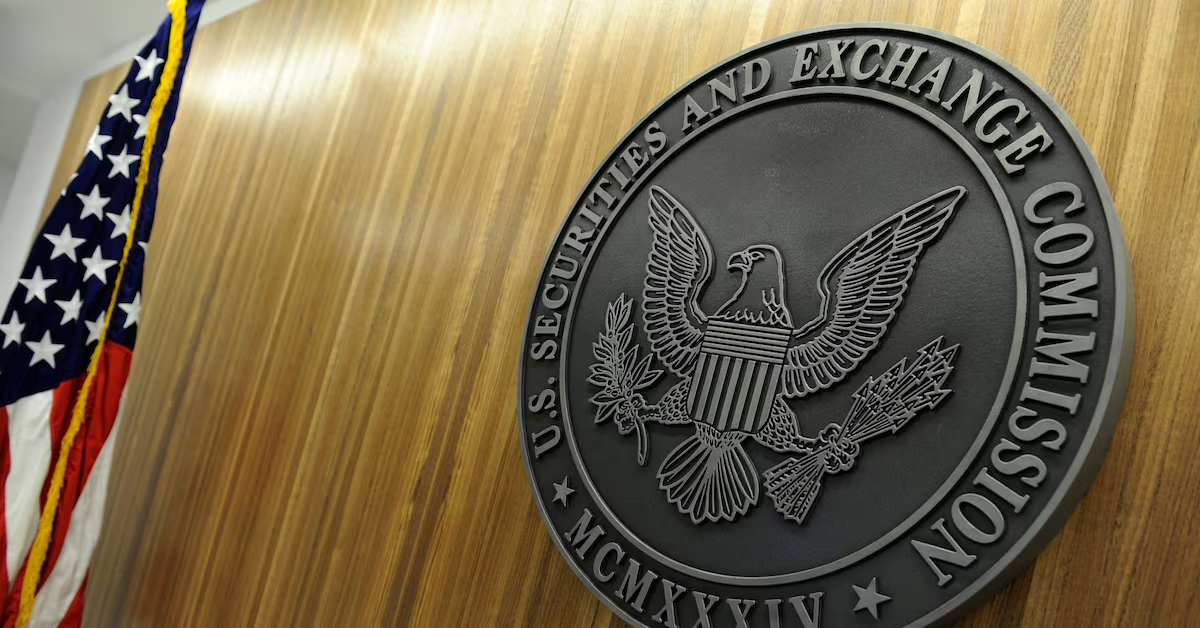
IRS Defi Rule Repeal Great For Best Wallet Token And New Cryptos

bitcoinistPublicado em 2025-03-27Última atualização em 2025-03-27

Resumo

The IRS’ DeFi rule (which proposed stricter tax reporting for DeFI transactions) is set to be repealed, following a 70-28...

Trusted Editorial content, reviewed by leading industry experts and seasoned editors. Ad Disclosure

The IRS’ DeFi rule (which proposed stricter tax reporting for DeFI transactions) is set to be repealed, following a 70-28 motion vote by the US Senate.

Now on the desk of President Donald Trump, the resolution is widely expected to be signed. And it’s a move welcomed by cryptos, like the Best Wallet Token, and DeFi protocols in particular.

When the US Internal Revenue Service (IRS) published its rule on the Gross Proceeds Reporting by Brokers That Regularly Provide Services Effectuating Digital Asset Sales (or, more simply, the IRS DeFi Rule), the crypto community was less than pleased.

That’s because the definition of ‘digital asset brokers’ was updated to include digital asset exchanges and kiosks, crypto payment processors; custodial wallet providers; and front-end DeFi service providers.

And this meant DeFi platforms would need to implement KYC policies and share taxpayers’ details with the IRS.

Not nice. Not nice at all…

IRS Defi Rule Has The Market Up In Arms

Opponents claimed the rule was inherently impractical. After all, DeFi platforms function through self-executing code on blockchains. So they don’ track users’ identities.

‘This rule, issued as a midnight regulation in the final days of the previous [Biden] administration,’ according to a March 4 statement issued by the US Office of Management and Budget.

Whitehouse AI and crypto czar David Sacks also voiced the US administration’s support of repealing the DeFi Rule on his personal X account. Now that the Senate has since voted in favor of this, it’s highly likely that Trump – a major advocate of cryptocurrency – will sign it.David Sacks, on X, supports repealing the DeFi Rule

In another pro-crypto move, Trump told summit delegates that he has ‘also called on Congress to pass landmark legislation creating simple, common sense rules for stablecoins and market structure.

‘And with dollar-backed stablecoins, you’ll help expand the dominance of the US dollar and many, many years to come,’ he said.

Trump’s remarks about stablecoins appear well-timed. His World Liberty Financial (WLFI) firm announced on March 25 that the company is about to launch its own dollar-pegged stablecoin – $USD1.

Trump's WFLI announced it is introducing a stablecoin

Speaking of, Wyoming Prepares for First State-Issued Stablecoin

Yesterday, Governor Mark Gordon announced that Wyoming is preparing to launch the first state-issued stablecoin.

The Wyoming Stable Token ($WYST) will be backed by cash and US Treasury securities, and it’s expected to launch in mid-2025.

Stablecoins aren’t anything new, with the likes of Tether and $USDC leading the charge by market cap. But lately they’ve been gaining traction, with more companies and institutions introducing their own stablecoins.

The leaders of the stablecoin sector by market cap
Source: CoinGecko

Ripple, for instance, introduced its own native stablecoin – $RLUSD – in December last year. ‘The stablecoin market is valued at $160B and projected to grow to $3T by 2028,’ according to Ripple president Monica Long.

‘To meet this growing demand, there’s a need for stablecoins that will prioritize regulatory compliance, increase diversification, and drive utility.’ Long says the Ripple stablecoin was launched to continue to bridge the gap between traditional finance and blockchain.

‘Brokers’ Definition A Concern For Custodial Wallets like Best Wallet

With Trump set to approve the motion to repeal the IRS DeFi rule, the market has breathed a collective sigh of relief. But it’s also a stark reminder of the importance of using a non-custodial wallet, like the Best Wallet app.

After all, the rule not only applied to DeFi protocols – the IRS considered custodial wallet providers as digital asset brokers too.

The Best Wallet app remains one of the best anonymous crypto wallets on the market. For one, it is the only wallet that lets you buy the best presale tokens. Better yet, there’s no KYC involved, and it is a multi-chain and multi-currency wallet.

Most importantly, though, it’s a fully non-custodial wallet. That means you have complete control of your Best Wallet’s private keys. No one can access your digital assets – not even the IRS.

But know what’s even better?

The Best Wallet Token Powers the Best Self-Custody Wallet

The team behind this crypto wallet has also introduced its own native coin – the Best Wallet Token ($BEST). Currently in presale, $BEST is set to help Best Wallet dominate 40% of the very lucrative crypto wallet market, while giving $BEST holders a range of benefits.

Among those benefits are lower transaction fees, exclusive access to the best presale tokens, rewards that you can claim through $BEST airdrops.
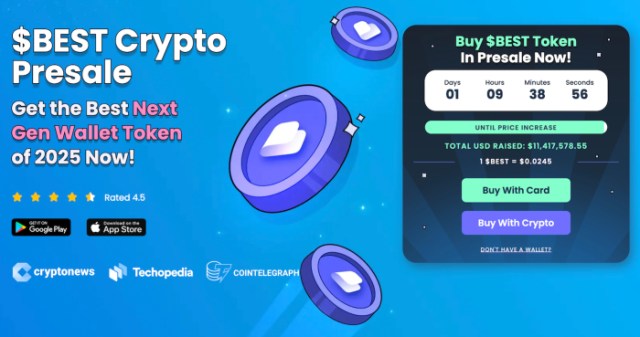
The Best Wallet Token will give $BEST holders additional benefits

The Best Wallet Token presale has seen impressive investor interest, with $11.4M already raised. And considering Best Wallet has a consistent 50% monthly user growth rate, $BEST has the potential to be one of this year’s top presales.

Currently, 1 $BEST costs $0.0245, and staking your $BEST could see you earn 137% APY. Being a presale, though, the price increases in stages. Our guide to buying $BEST explains how to invest before the next increase.

Remember, though, as with any investment – be it $BEST or the soon-to-be-launched $WYST, or the top trending new crypto – don’t forget to DYOR. We’re not financial advisers, so you need to do your own homework before investing in any crypto.

Editorial Process for bitcoinist is centered on delivering thoroughly researched, accurate, and unbiased content. We uphold strict sourcing standards, and each page undergoes diligent review by our team of top technology experts and seasoned editors. This process ensures the integrity, relevance, and value of our content for our readers.

Bitcoinist is the ultimate news and review site for the crypto currency community!

Leituras Relacionadas

Agentized OS: It's Not About AI, It's About the Foundation

The Agentic OS: Beyond AI, It's About the Foundational Stack In 2026, major operating systems like Android, iOS, HarmonyOS, and Windows are entering the "Agentic" era, integrating proactive AI assistants deeply into the system layer. However, the real competition lies not in the flashy AI features showcased at events, but in the three-layer foundational stack that enables them: the system-level AI Runtime, proprietary/controllable chips, and the on-device/cloud model matrix. The AI Runtime acts as the central scheduler, managing model inference, resource allocation, and exposing capabilities to apps. Controllable chips (e.g., Apple Silicon, Google Tensor, Huawei Kirin) are crucial for deep hardware-software co-optimization, determining the efficiency and experience limits of on-device Agents. The on-device/cloud model matrix provides the "intelligence," with proprietary, chip-optimized small models (like Gemini Nano, Apple's ~3B model) handling daily tasks locally for low latency, privacy, and reliability, while cloud models tackle complex requests. Deep synergy between these three layers enables key Agent differentiators: ultra-low latency and power efficiency, genuine "on-device first" privacy, access to system-level personal context across apps, and reliable performance as a system service even offline. OS vendors with strong integration across this stack (like Apple, Google, and Huawei) build a deeper moat. Beyond this core stack, long-term competitiveness depends on variables like structured App integration (e.g., App Intents/AppFunctions) for reliable multi-step workflows, and robust privacy frameworks that build user trust. This shift towards Agentic OS extends beyond phones and PCs to IoT, cars, and XR glasses via existing multi-device ecosystems. The race is won not in a keynote, but through generations of meticulously co-developed chips, models, and system software.

marsbitHá 1h

Agentized OS: It's Not About AI, It's About the Foundation

marsbitHá 1h

Why Sam Altman's 'Water and Electricity Theory' Sparks Copyright Controversy

OpenAI CEO Sam Altman's recent statement that "intelligence will become a utility like electricity or water" has sparked significant controversy, primarily around copyright issues and the nature of AI development. While positioning AI as a utility serves as a compelling narrative for infrastructure investors, critics argue the analogy is flawed in three key areas. First, there's a fundamental "property gap." Traditional utilities like water and power create new, physical infrastructure from scratch. In contrast, major AI models are trained by reorganizing vast amounts of existing human-created content—books, articles, code, etc.—often scraped from the web without explicit permission or compensation to creators. This "free acquisition, paid resale" model is seen by many as ethically problematic. Second, there's a "pricing gap." True public utilities are typically regulated to ensure universal service with non-discriminatory, cost-plus pricing. AI's token-based pricing, however, involves significant price discrimination (e.g., output tokens costing much more than input tokens) and is designed for revenue maximization, not equitable access. Third, a "governance gap" exists. Utilities operate under public oversight, while AI pricing and development are currently controlled by a few private companies. Furthermore, the industry's own shift toward buying licensed training data (e.g., deals with Reddit or news publishers) undermines its previous legal reliance on "fair use" for freely scraped data. In conclusion, while AI is indeed becoming a foundational technology, calling it a public utility remains contentious. The title requires not just scale and a pay-per-use model, but also credible solutions for data provenance, equitable pricing, and public governance.

marsbitHá 1h

Why Sam Altman's 'Water and Electricity Theory' Sparks Copyright Controversy

marsbitHá 1h

Trading

Spot
Futuros
活动图片