DoubleZero’s alternative to public internet targets mainnet rollout in H2

CointelegraphPublicado em 2025-03-05Última atualização em 2025-03-06

Resumo

A network hoping to become a parallel internet for blockchains is planning for a public mainnet launch in the second half of 2025 after recently completing a $28 million funding round and testnet beta launch.

A network hoping to become a parallel internet for blockchains is planning for a public mainnet launch in the second half of 2025 after recently completing a $28 million funding round and testnet beta launch.


The DoubleZero Network hopes to be an alternative to the public internet that allows network operators to contribute underutilized bandwidth to a dedicated network built for systems like blockchains, according to a March 5 statement from the DoubleZero Foundation.


Austin Federa, co-founder of DoubleZero, said in a March 5 post to X that the project is an attempt to bring private networking technology to blockchains and distributed systems on a network owned by its operators and that it is open for anyone with fiber to participate.
“Faster is better, but faster alone is not enough. Faster must include the ability for everyone on the (physical fiber) network to have the same access to data (state) as everyone else. This is fairness — this is multicast — this is the future,” he said. 

Source: Austin Federa

Federa was the Solana Foundation Strategy Lead until last December when he departed after four years to found DoubleZero with crypto entrepreneurs Andrew McConnell and Mateo Ward. 


The DoubleZero Foundation is building the network to become the legacy technology powering the next half-century of distributed systems, according to Federa.


“We’ve reached a point where the bottleneck for blockchain is actually on the network and data transport layer, not the compute,” he said. 


“The current ambition for crypto is still too small. We see a near future that’s fully underpinned by distributed systems, and our vision is to provide a new fiber infrastructure network that can securely power that at mass scale.” 


The protocol recently completed a $28 million token round co-led by venture capital firms Multicoin Capital and Dragonfly Capital to hire more staff for the mainnet rollout later this year. 

In conjunction with the funding round, the foundation also launched a testnet beta for Solana validators and Remote Procedure Calls across seven cities: Singapore, Tokyo, Los Angeles, New York, London, Amsterdam and Frankfurt, with additional cities coming to mainnet later in the year.


The current phase of the testnet aims to improve the system’s efficiency and scalability of the network. 


At the moment, Jump Crypto, Distributed Global, RockawayX and bare metal infrastructure providers Teraswitch and Latitude.sh are operating as fiber contributors.

Leituras Relacionadas

On-chain Analyst: Why Are Most Zcash Transactions Still Traceable?

Title: Why Most Zcash Transactions Remain Traceable Zcash, a privacy-focused cryptocurrency launched in 2016, was designed to offer anonymity by hiding transaction details like sender, receiver, and amount using zero-knowledge proof technology (zk-SNARKs). However, in practice, a significant portion of ZEC transactions are still traceable on-chain. The key reason is Zcash's dual-address system. It features transparent addresses (t-addresses), which work like standard Bitcoin addresses with all data public, and shielded addresses (z-addresses) that encrypt transaction details. There are four transaction types with varying privacy levels: fully transparent (t→t), partially shielded (t→z and z→t), and fully private (z→z). Despite its privacy capabilities, most real-world Zcash activity involves transparent addresses, primarily because major exchanges and institutions use them for regulatory compliance. As a result, blockchain analytics platforms like Arkham can track and attribute a substantial volume of Zcash transactions. Arkham reports it has identified entities behind over $420 billion in ZEC transaction volume. Case studies highlight this traceability: the U.S. government holds seized Zcash from a dark web case, visible via its transparent wallet, and individual traders' profitable moves are trackable from purchase to exchange deposit. In conclusion, Zcash's privacy is not inherent but user-dependent. While purely shielded (z→z) transactions remain cryptographically private, the prevalence of transparent address usage makes much of the network's activity traceable. The actual privacy protection offered depends entirely on how users choose to transact.

marsbitHá 19m

On-chain Analyst: Why Are Most Zcash Transactions Still Traceable?

marsbitHá 19m

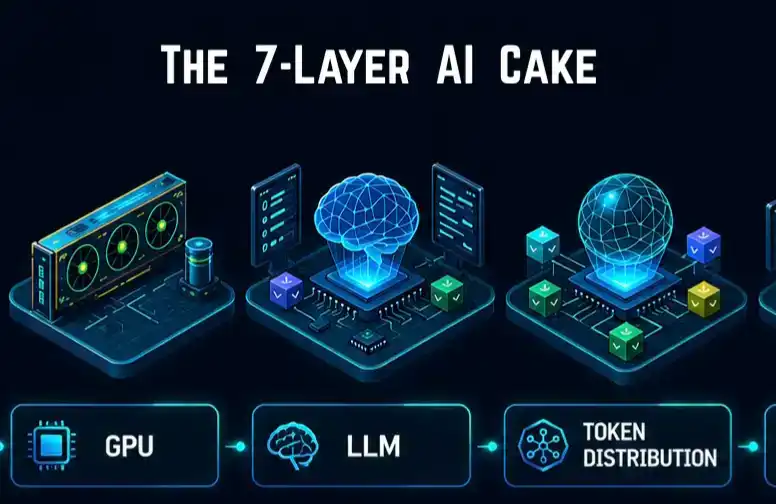
From Power Infrastructure to Token Economy: The 'Seven-Layer Cake' of the AI Industry Chain

From Power Grid to Token Economy: The AI Industry's "Seven-Layer Cake" The AI industry is shifting from a "model-centric" paradigm focused on massive training to a "token-centric" industrial era driven by inference demand. This new phase revolves around the production, distribution, scheduling, and consumption of tokens—the units of computation used by AI agents for every interaction and task. The article proposes a "seven-layer cake" framework for the AI economy: 1. **Power**: The foundational energy source, with competition shifting to securing stable, low-cost electricity. 2. **AIDC (AI Data Centers)**: Large-scale "Token factories." A trend toward smaller, modular, and regionally deployed AI Factories is emerging for efficiency and proximity to users. 3. **GPU**: The core production hardware for tokens. While NVIDIA dominates, competition exists from AMD, ASIC makers, and Chinese chipmakers, with a growing focus on inference efficiency. 4. **LLMs**: The "engines" that generate tokens. The competition is evolving beyond model size to prioritize factors like token cost, inference efficiency, and operational synergy with infrastructure. 5. **Token Distribution**: The "grid" that allocates and rents out compute resources, led by cloud giants and specialized AI-native platforms. 6. **Token Optimization & Intelligent Scheduling**: The critical "brain" layer that intelligently routes tasks (e.g., to local, cloud, or edge models) for optimal cost, latency, and privacy—maximizing the value of each token. 7. **AI Agents & Models**: The end consumers of tokens. The vision involves billions of AI agents working and interacting concurrently, consuming vast amounts of tokens. Currently, the industry faces fragmentation and inefficiencies between these layers. The true "mass adoption era" of AI will begin only when this seven-layer infrastructure is fully integrated and operates as a cohesive, intelligent network—transforming AI from a software tool into a global industrial system spanning energy, hardware, and compute logistics.

marsbitHá 40m

From Power Infrastructure to Token Economy: The 'Seven-Layer Cake' of the AI Industry Chain

marsbitHá 40m

Trading

Spot
Futuros
活动图片