Cardano’s 18% slump and falling whale activity raises concerns – What next?

AmbcryptoPublicado em 2025-03-03Última atualização em 2025-03-03

Resumo

Assessing recovery odds of ADA amid ETF speculation and BTC dominance dip.

ADA dropped by 18% over the past week, raising questions about its future.

A significant reduction in whale addresses signals weakening market confidence.

Cardano [ADA] has faced a notable downturn, with its price dropping by 18% in the past week.

This decline comes hand in hand with a sharp reduction in whale activity, as the number of whale addresses plummeted to its lowest level since the 9th of January.

This combination of falling price and diminishing whale interest raises questions about the future trajectory of Cardano, especially as market sentiment and network dynamics shift.

Cardano hits pivotal level

At the time of writing, Cardano was down 50% from its December peak of $1.3, marking a multi-month downtrend channel (white). The current price action retested the channel’s range low, which also doubled as a bullish order block (likely support, cyan) at $0.69.

However, technical indicators show mixed signals. The daily RSI is below a neutral level, indicating muted demand. But the Chaikin Money Flow (CMF) flipped positive, suggesting improved inflows.

Simply put, ADA bulls could attempt to defend the range-low, if BTC recovers. On the contrary, a sustained sell-off could drag ADA to $0.56, the first cool-off zone after the post-US election upswing.

ADA’s speculative interest drops
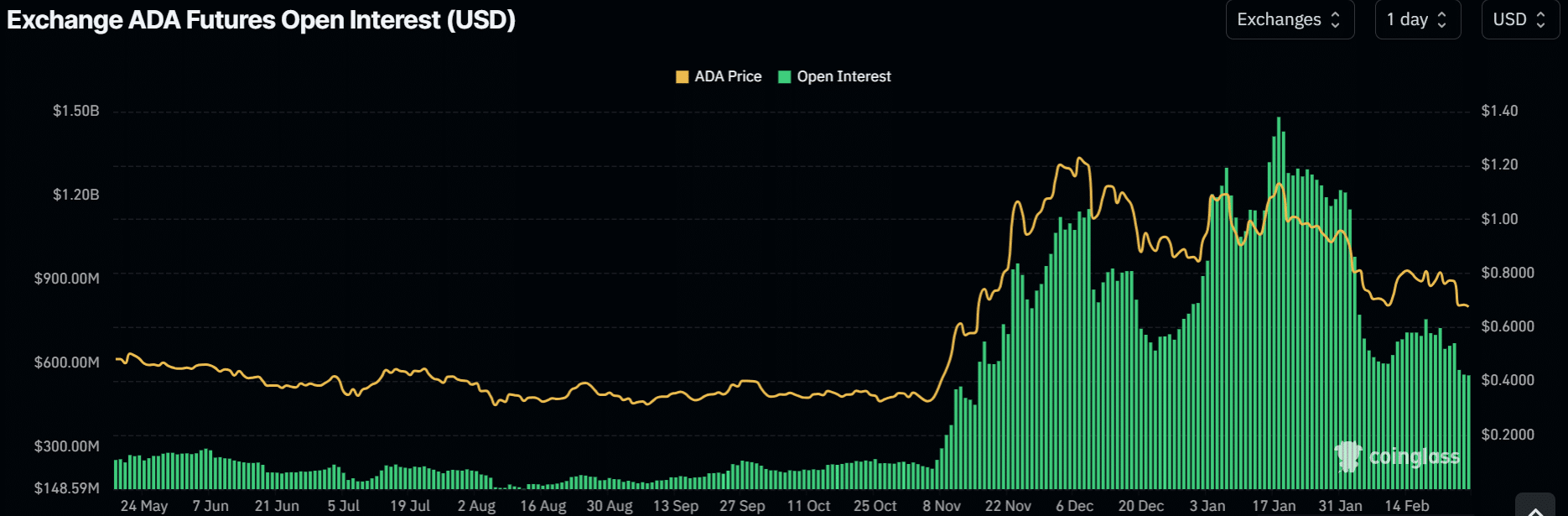
ADA’s weak demand was also evident in the Futures market. The altcoin’s speculative interest dropped over 60% from $1.48B in January to $555M, at press time. This meant investors withdrew money from the derivatives market, a bearish signal.

From a liquidity perspective, there were four key pockets of liquidity (bright yellow) worth tracking. The levels were $0.78, $0.75, $0.7 and $0.62.
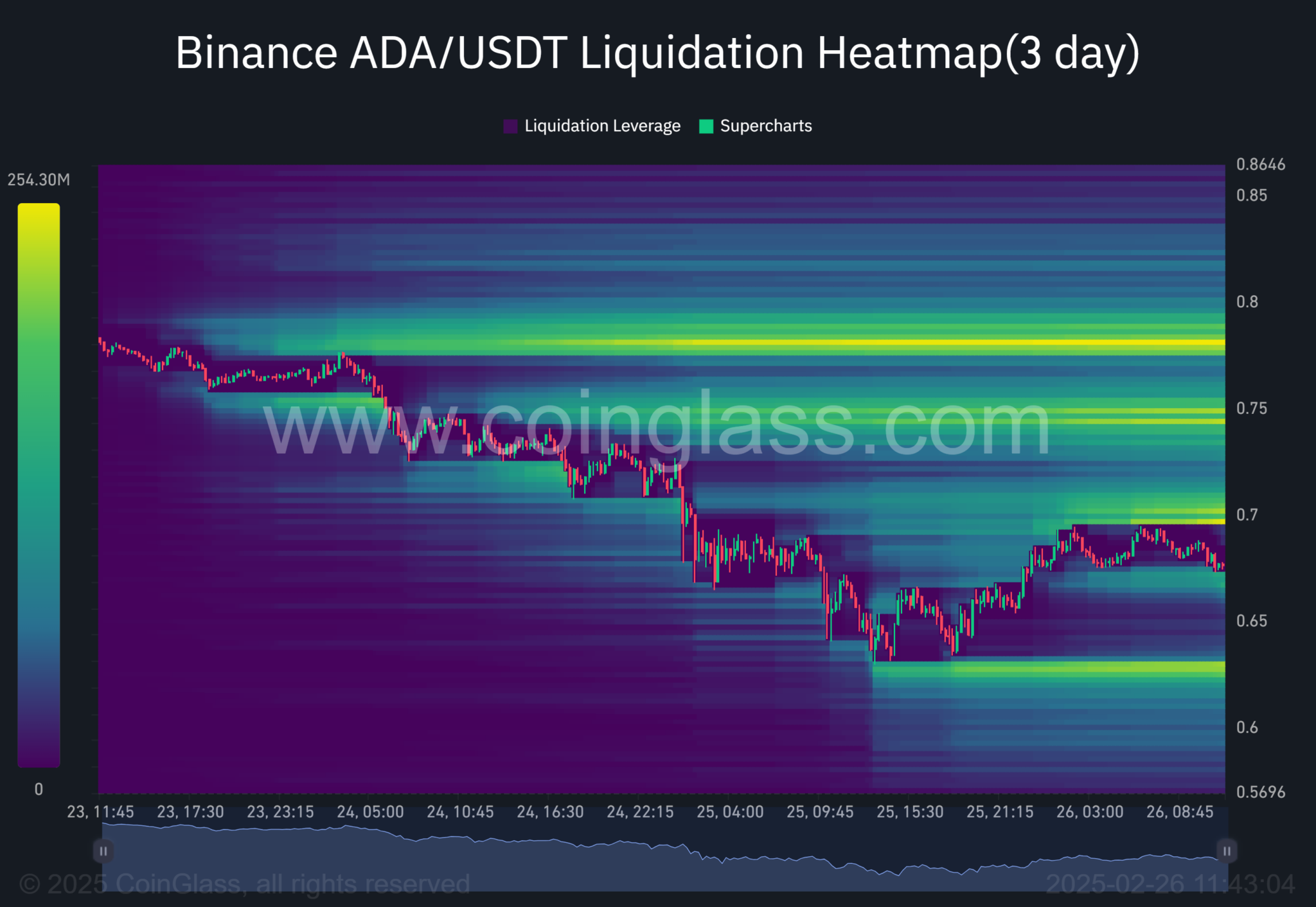
The $0.78 aligned with the channel’s mid-range level, while $0.62 coincided with the range lows. In case of a liquidity sweep, the altcoin could fluctuate between these key levels, especially if BTC fails to set a decisive direction.

Leituras Relacionadas

DeFi Has Reached Its Most Dangerous Moment: The Real Vulnerabilities Are Not in the Code

DeFi in Peril: The Real Vulnerability Isn't in the Code April 2026 marked a paradigm shift in DeFi security, with over $625 million lost across 30 incidents—the worst month in crypto history by event count. Crucially, none of the major exploits (Drift Protocol: $285M, KelpDAO: $292M, Wasabi Protocol: $4.5M) resulted from smart contract vulnerabilities. Instead, failures occurred in the operational "plumbing": social engineering to compromise multi-signature councils, a single-point-of-failure 1-of-1 bridge validator, and stolen admin private keys. These events expose a fundamental misalignment: the industry's security model has long focused on code audits, while the actual attack surface has shifted to privileged access points and off-chain infrastructure. The article introduces the term "OpenFi" to describe this reality: permissionless, on-chain, yet operationally dependent on trusted third parties (admins, validators, oracles) at key junctures. The KelpDAO exploit vividly demonstrated asymmetric "contagion risk." A configuration error in a smaller protocol triggered a panic, causing approximately $13.2 billion in outflows from larger, unaffected protocols like Aave within 48 hours, as users fled uncertain collateral. The core dilemma is the double-edged sword of centralization. Operational levers like emergency councils (e.g., Arbitrum freezing stolen funds post-KelpDAO) enable crisis response but also create catastrophic attack surfaces if compromised (e.g., Drift). The path forward demands radical honesty: protocols must clearly disclose their trust assumptions, operational levers, and failure modes. The industry must treat operational security (key management, configurations, incident response) with the same rigor as code security. Survival depends on building systems whose risks can be understood, priced, and insured, moving beyond the outdated "code is law" mantra to a mature model of disclosed and managed trust.

链捕手Há 9h

DeFi Has Reached Its Most Dangerous Moment: The Real Vulnerabilities Are Not in the Code

链捕手Há 9h

Vitalik's Article Emphasizes Ethereum Must Be 'Amazing', But Foundation Is Not the Center

Vitalik Buterin has published a lengthy response to recent community criticism directed at the Ethereum Foundation (EF). Acknowledging a sense of "unease," he addresses concerns about the EF's strategic direction, its perceived disconnect from ETH's price performance, and calls for its reduced central role. Vitalik rejects the notion that the EF should be the central governing body of Ethereum, framing it instead as one "node with a clear mandate" among many within the ecosystem. He highlights the EF's limited ETH holdings (≈0.16% of supply) compared to other blockchain foundations and states it will no longer sell significant amounts of ETH. Its future focus will be on long-term, critical projects that align with Ethereum's core values of censorship-resistance and decentralization, which might not otherwise happen. A core argument is that Ethereum must be "amazing," but not by merely chasing higher transaction speeds at the cost of decentralization. He proposes focusing on the "CROPS" dimensions: creating a Cryptographically provable, Reliable, Open, Private, and Secure network. This includes pursuing goals like a formally verifiable, bug-free Ethereum client and minimizing protocol-level reliance on intermediaries. The article concludes by noting that while Vitalik clarifies the EF's refocused role, he does not directly address community suggestions for creating a new organization explicitly aligned with ETH's economic interests. This "alignment gap" is presented as a key challenge for Ethereum's future.

链捕手Há 9h

Vitalik's Article Emphasizes Ethereum Must Be 'Amazing', But Foundation Is Not the Center

链捕手Há 9h

Trading

Spot
Futuros

Artigos em Destaque

Como comprar ADA

Bem-vindo à HTX.com!Tornámos a compra de Cardano (ADA) simples e conveniente.Segue o nosso guia passo a passo para iniciar a tua jornada no mundo das criptos.Passo 1: cria a tua conta HTXUtiliza o teu e-mail ou número de telefone para te inscreveres numa conta gratuita na HTX.Desfruta de um processo de inscrição sem complicações e desbloqueia todas as funcionalidades.Obter a minha contaPasso 2: vai para Comprar Cripto e escolhe o teu método de pagamentoCartão de crédito/débito: usa o teu visa ou mastercard para comprar Cardano (ADA) instantaneamente.Saldo: usa os fundos da tua conta HTX para transacionar sem problemas.Terceiros: adicionamos métodos de pagamento populares, como Google Pay e Apple Pay, para aumentar a conveniência.P2P: transaciona diretamente com outros utilizadores na HTX.Mercado de balcão (OTC): oferecemos serviços personalizados e taxas de câmbio competitivas para os traders.Passo 3: armazena teu Cardano (ADA)Depois de comprar o teu Cardano (ADA), armazena-o na tua conta HTX.Alternativamente, podes enviá-lo para outro lugar através de transferência blockchain ou usá-lo para transacionar outras criptomoedas.Passo 4: transaciona Cardano (ADA)Transaciona facilmente Cardano (ADA) no mercado à vista da HTX.Acede simplesmente à tua conta, seleciona o teu par de trading, executa as tuas transações e monitoriza em tempo real.Oferecemos uma experiência de fácil utilização tanto para principiantes como para traders experientes.

1.2k Visualizações TotaisPublicado em {updateTime}Atualizado em 2025.03.21

Como comprar ADA

Discussões

Bem-vindo à Comunidade HTX. Aqui, pode manter-se informado sobre os mais recentes desenvolvimentos da plataforma e obter acesso a análises profissionais de mercado. As opiniões dos utilizadores sobre o preço de ADA (ADA) são apresentadas abaixo.

活动图片