Story [IP] joins top 10 AI tokens, but is a 15% drop ahead?

mediumPublicado em 2025-02-21Última atualização em 2025-02-21

Resumo

IP’s four-hour chart indicates that the asset might experience a short-term price correction.

IP’s Average Directional Index (ADX) stood at 59, at press time, indicating strong momentum.

On-chain metrics revealed that exchanges have witnessed an outflow of $2.15 million worth of IP tokens.

The recently launched crypto AI project, Story [IP], is making waves in the cryptocurrency market with its impressive upside momentum.

With the massive 32% surge, traders and investors are strongly betting on the asset and accumulating it, as reported by the on-chain analytics firm Coinglass.

IP’s current price momentum

Not only that, but it has also secured a spot among the top ten crypto AI tokens by surpassing Virtuals Protocol [VIRTUAL]. At the time of writing, IP was trading near $3.42 and has witnessed a 97% surge in trading volume.

Since the project’s launch, exchanges have seen a consistent outflow of IP tokens, suggesting that investors and long-term holders are accumulating the asset.

Data from the spot inflow/outflow reveals that, in the past 24 hours, exchanges have recorded an outflow of IP tokens worth $2.15 million.
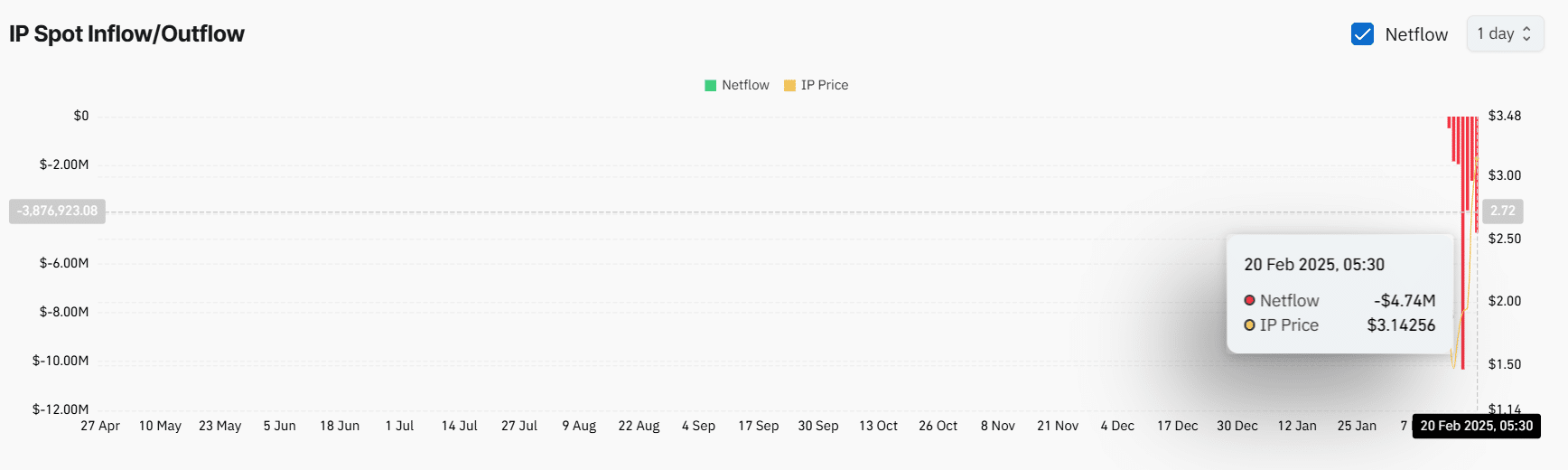
This significant outflow from exchanges could create buying pressure and drive further upside momentum. This might explain today’s substantial rally.

Following this accumulation and price surge, intraday traders entered the market heavily. This resulted in a 70% increase in IP’s Open Interest (OI).

The rise in OI indicates that traders have increased their positions on both the long and short sides.

Major liquidation areas

Data from Coinglass revealed that traders betting on the long side are currently dominating the asset and are over-leveraged at the $3.134 level, holding $3.28 million worth of long positions.

On the other hand, short sellers appear to be exhausted, as they are over-leveraged at the $3.276 level, with $1.54 million worth of short positions.
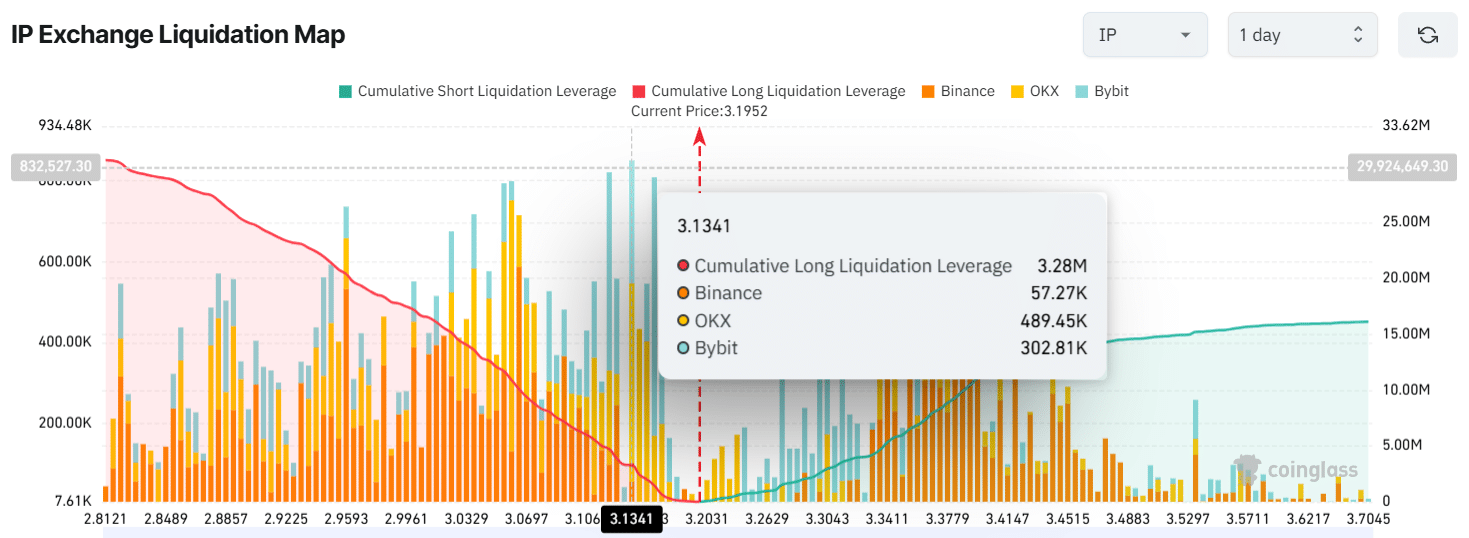
These on-chain metrics indicate that bulls are strongly supporting the asset, which could help sustain its upside momentum.

IP’s technical analysis and key levels

According to AMBCrypto’s technical analysis, IP appears bullish as the Average Directional Index (ADX) currently stands at 59, indicating strong momentum.

The upward-sloping ADX line suggests that IP’s momentum is accelerating.
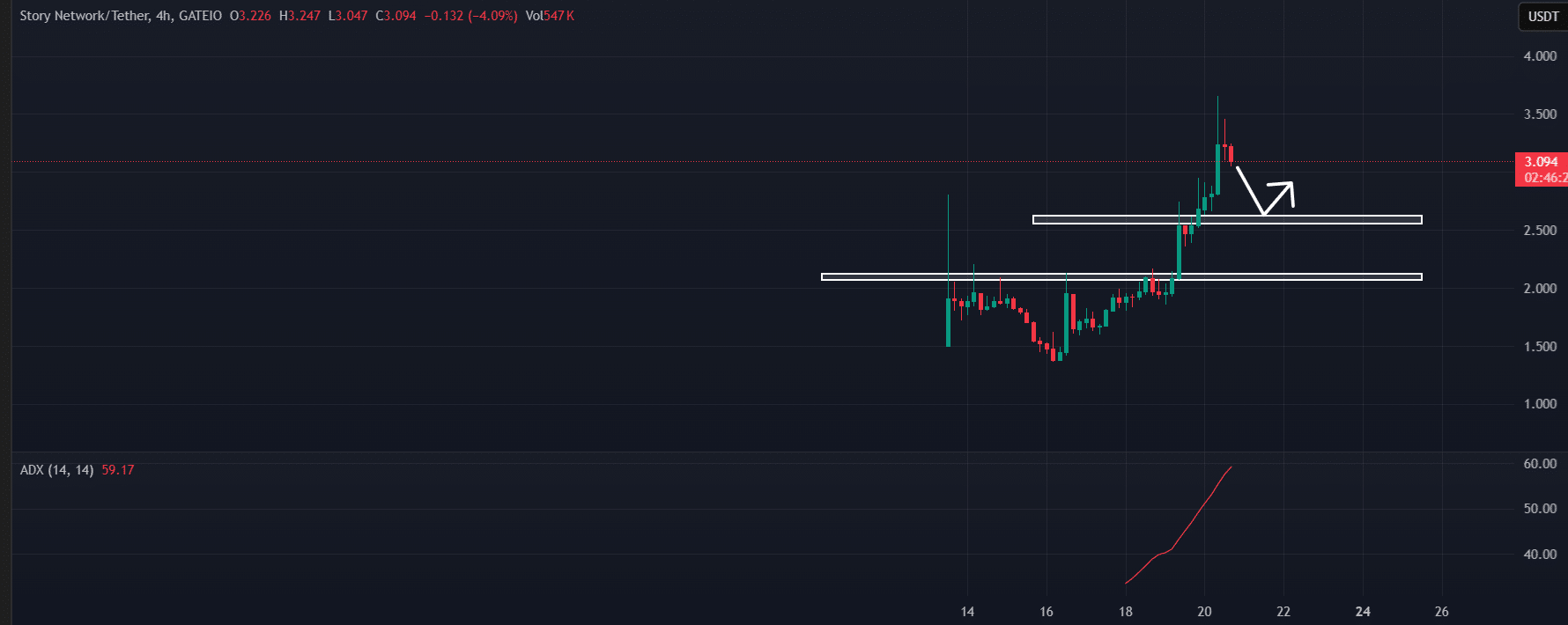
However, despite ADX’s bullish trend, the four-hour chart indicates that the asset might experience a short-term price correction.

Based on recent momentum, IP could see a 15% price drop, potentially reaching the $2.61 level in the coming days.


Leituras Relacionadas

Google Cracks Down on 'AI Poisoning'

Google has taken a strong stance against "AI poisoning," a new form of manipulation where advertisers subtly feed information to influence AI-generated answers like those in Google's AI Overview. Unlike traditional SEO, which aims for higher website rankings, Generative Engine Optimization (GEO) seeks to have a brand or product recommended within the AI's response itself. This is particularly valuable as AI summaries, often perceived as neutral and comprehensive, can shorten the consumer decision path and directly influence purchases. The article illustrates the issue with a "hot dog experiment," where fabricated content was quickly picked up and presented as fact by AI. GEO exploitation is potent because AI models aggregate information from various sources—reviews, articles, forums—and can mistake coordinated marketing campaigns for genuine consensus. This threatens the core credibility of search engines. While Google's updated spam policy now explicitly covers attempts to manipulate AI-generated content, enforcement faces challenges. Google can leverage its long experience fighting SEO spam, using penalties like ranking demotion. However, sophisticated "gray area" tactics, such as sponsored third-party reviews or industry reports, are harder to distinguish from legitimate promotion. Other AI players, like Microsoft, have taken a more open approach to GEO, viewing it as a new channel for brands. Ultimately, as AI becomes a primary information source, maintaining the trustworthiness of its answers is a critical challenge for all platforms.

marsbitHá 18m

Google Cracks Down on 'AI Poisoning'

marsbitHá 18m

When Futu Turns into a Matchmaking Corner: Overseas Identity Becomes the Hard Currency for the Middle Class

When Futu Becomes a Matchmaking Corner: Overseas Status as the New Hard Currency for China's Middle Class Following a severe penalty announcement from Chinese regulators on May 22nd targeting offshore brokerages like Futu, its app community unexpectedly transformed into an impromptu matchmaking platform. Users posted相亲 (matchmaking) requests, explicitly seeking partners with overseas residency or citizenship, revealing a stark new reality: for China's middle class, an overseas identity has become a crucial asset. The regulatory crackdown, which restricts mainland Chinese residents from opening new accounts to buy overseas securities like US stocks, has sharply escalated the value of a foreign passport or permanent residency. This status now acts as a gateway to global asset allocation—including US equities, offshore property, and foreign currency deposits—effectively becoming a new form of "hard currency." Its scarcity, non-transferability (except through marriage, inheritance, etc.), and role as a hedge against domestic uncertainty have driven its premium. The article traces the evolution of how China's middle class views overseas resources: from an investment for opportunity (2000s), to risk diversification (2010s), and now to a mandatory "insurance policy" for financial access. With the regulatory window closing for many, the demand is shifting towards securing such status for the next generation through international education. The surreal scene of high-performing investors posting dating resumes underscores a 2026 where financial talent can be secondary to the right passport.

marsbitHá 1h

When Futu Turns into a Matchmaking Corner: Overseas Identity Becomes the Hard Currency for the Middle Class

marsbitHá 1h

Understanding Bound in One Article: The "Multi-signature + Timelock" Escape Mechanism and the Off-Chain Matching Black Box

**Title**: Understanding Bound: The Escape Mechanism of "Multi-Sig + Time Lock" and the Off-Chain Matching Black Box **Summary**: Bound Exchange, evolved from the earlier radFi platform, introduces a novel approach to Bitcoin trading by combining self-custody security with exchange-like speed. Its core mechanism relies on a 2-of-2 multi-signature (multi-sig) address for user deposits. One private key is held by the user via a passkey, and the other is held by Bound. This setup requires both keys to sign any transaction, preventing Bound from unilaterally accessing user funds (non-custodial). To address the risk of Bound becoming unavailable, a 3-month timelock is integrated into the Bitcoin script. After this period, users can withdraw their assets with just their single signature, ensuring an escape hatch. For trading, Bound operates a concentrated liquidity AMM. However, as Bitcoin L1 lacks smart contracts, the AMM curve, liquidity management, and trade price calculations occur off-chain in Bound's backend database. On-chain Bitcoin transactions serve only as final settlement receipts for pre-determined amounts. This creates a centralization point: the critical sequence of trade execution—which determines the exact price along the curve for each order—is managed off-chain by Bound in a non-transparent "black box." While the 2-of-2 setup protects user本金 (principal), the pricing and ordering of trades introduce potential operational MEV risks, as the order processing is invisible and unverifiable on-chain. In practice, users can also connect external wallets (like Unisat) for fully self-custodied trading, but this requires manually signing every transaction. The platform currently supports deposits of BTC and Runes only.

marsbitHá 1h

Understanding Bound in One Article: The "Multi-signature + Timelock" Escape Mechanism and the Off-Chain Matching Black Box

marsbitHá 1h

Technology Has No Barriers, 24/7 Trading is the Key to Hyperliquid's Success

The article argues that Hyperliquid's competitive edge lies not in technological superiority but in its 24/7 trading model, which fundamentally challenges traditional finance's fixed market hours. Based in Singapore with an 11-person team, Hyperliquid has generated significant revenue and trading volume. Its core advantage is the ability to facilitate trading continuously, including during weekends when major exchanges like the CME are closed. This was demonstrated when Hyperliquid listed a SpaceX pre-IPO perpetual contract on a Sunday, allowing the market to price the company hours before traditional institutions opened. This disruption has drawn regulatory scrutiny from traditional giants like CME and ICE, who cite risks like lack of KYC and market manipulation. However, the article suggests their concern stems from Hyperliquid eroding the "time monopoly" of established markets. The piece contrasts Hyperliquid's synthetic derivatives—pure price-betting contracts with no underlying asset or centralized issuer—with other models like PreStocks (dependent on real股权) and Ondo (licensed but targetable). Hyperliquid's code-based, decentralized structure makes it resilient to takedowns, even if founders face legal action. Ultimately, the author concludes that while it raises legitimate regulatory questions, Hyperliquid's "unforgeable" competitive barrier is the time advantage of non-stop trading, a feature legacy systems cannot replicate.

marsbitHá 1h

Technology Has No Barriers, 24/7 Trading is the Key to Hyperliquid's Success

marsbitHá 1h

Trading

Spot
Futuros
活动图片