Klarna Explores Crypto to Keep Up with PayPal, But Neither Offer the Best Crypto Wallet

bitcoinistPublicado em 2025-02-11Última atualização em 2025-02-11

Resumo

Swedish payment giant Klarna plans to integrate crypto. The ‘last fintech in the world to embrace it,’ according to Klarna...

Swedish payment giant Klarna plans to integrate crypto. The ‘last fintech in the world to embrace it,’ according to Klarna CEO Sebastian Siemiatkowski.

While Siemiatkowski expected his post to ‘get a huge sign and two views,’ the community found it big news.

Why did Klarna delay this moment for so long, and what crypto services could it offer?

Let’s zoom in.

Buy Now, Pay Later… in Crypto? Klarna Explores Crypto Services

If the name ‘Klarna’ doesn’t ring the bell, how about ‘shop now, pay later’?

Klarna payments

Klarnas’s flexible payment system attracted over 85M users and 575K retailers globally.

But while competitors like Revolut and PayPal were actively exploring crypto (PayPal even launched its own stablecoin), Siemiatkowski considered Bitcoin a ‘decentralized Ponzi scheme.’

He also pointed out that crypto gas fees are sometimes worth more than the transaction – and while it’s true for Ethereum, Siemiatkowski evidently ignored all low-cost networks like XRP and Sui.

In Siemiatkowski’s defense, he admitted he had no idea how blockchain and mining work in 2021.

However, a lot can change in four years, and Klarna now wants to enter the crypto scene.

Siemiatkowski didn’t share any details, so we can only guess whether Klarna will enable flexible crypto payments or offer an entirely different service.

The entrepreneur also encouraged his followers to share their ideas. Some that received the most engagement were to:

  • Process transactions through Hedera Hashgraph, Solana, or XRPL
  • Settle transactions in stablecoins
  • Issue cashback in $BTC
  • Buy crypto and pay later (we wish)

We’ve yet to see if Klarna adopts any of these suggestions.

Beyond Basics: Why Best Wallet Outshines Traditional Fintech Apps

Fintechs like PayPal and Revolut may offer crypto services, but they mostly appeal to those only dipping their toes into digital assets.

For example, you can trade crypto with Revolut, but you can’t stake, buy new presale tokens, or store NFTs. It’s like a watered-down version of an advanced crypto trading platform, such as Best Wallet.

Best Wallet is, first and foremost, a secure storage solution. But beyond HODLing your assets and managing multiple wallets, it lets you swap, stake, track, and compare tokens across multiple chains.

On top of that, Best Wallet is the first and only app that lets you directly invest in hot presales. There’s no need to search for fresh tokens manually – Best Wallet presents a wide range of strictly vetoed projects in one user-friendly interface.
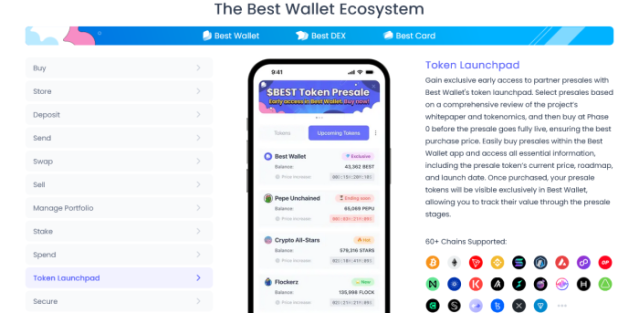
Best Wallet presale

The ecosystem’s native token, $BEST, now costs $0.02395 on presale. Its holders enjoy lower trading fees, higher stalking yields, and governance rights.

Just one day remains until the next price uptick, so this is the last chance to secure your share of tokens at such a discount.

Adapt or Fall Behind? The Fintech Industry’s Reality Check

Klarna’s pivot proves that no fintech can ignore the growing demand for crypto. Even the most stubborn heads are forced to adapt to changing consumer needs and adopt blockchain technology.

However, traditional fintechs have a hard time competing with crypto-first platforms like Best Wallet, which offer specialized features like crypto presale aggregator and staking. This unique functionality may help Best Wallet achieve its goal of capturing 40% of the market by 2026.

Meanwhile, we remind you to DYOR before participating in any crypto project. The market is extremely volatile, and no gains are guaranteed.

Bitcoinist

Bitcoinist

Bitcoinist is the ultimate news and review site for the crypto currency community!

Leituras Relacionadas

Futu's Fine Turns into a Boon for Hyperliquid?

The article explores the interconnected narratives of a regulatory crackdown on Chinese fintech brokers and the rise of the decentralized exchange Hyperliquid. It begins with China's May 2026 proposal for severe penalties against brokers like Futu and Tiger for illegal cross-border operations, suggesting this may redirect capital toward platforms like Hyperliquid. This is evidenced by HYPE token's price surge coinciding with the news. The core of the article analyzes Hyperliquid's disruptive potential and the regulatory pressure it faces. Traditional giants like CME and ICE are lobbying the CFTC to crack down on Hyperliquid, citing its lack of KYC, position limits, and market surveillance—particularly for its weekend crude oil contracts, which challenge traditional market hours. Despite this, Hyperliquid demonstrates remarkable efficiency, with a small team generating high revenue, largely funneled into HYPE buybacks. Its innovation lies in synthetic perpetual contracts for pre-IPO companies (e.g., Cerebras, SpaceX), enabling price discovery outside traditional channels. Unlike tokenized equity platforms (PreStocks, Ondo) tied to physical assets or entities, Hyperliquid's "asset-less" synthetic contracts are argued to be more resilient to legal targeting, as they are simply code on a decentralized network. However, the article notes this is not absolute, citing the network's limited validators and past interventions. The piece concludes that Hyperliquid's fundamental advantage is offering continuous, permissionless trading—effectively competing on *time*—which established players cannot easily replicate, even as significant regulatory risks loom.

marsbitHá 24m

Futu's Fine Turns into a Boon for Hyperliquid?

marsbitHá 24m

Mythos Report Released: Billions of Devices Worldwide Exposed, 10,000 Critical Vulnerabilities Uncovered in 30 Days

The first report from Anthropic's "Project Glasswing" reveals staggering results from its secret initiative using the next-generation AI model, Claude Mythos Preview. In just 30 days, collaborating with roughly 50 global tech giants and critical infrastructure developers, Mythos identified over 10,000 high or critical-severity software vulnerabilities. It demonstrated an extremely low false-positive rate, even outperforming human experts, and successfully intercepted a $1.5 million bank fraud in progress. Key findings include uncovering 2,000 bugs in Cloudflare's core systems, fixing 271 critical vulnerabilities in Firefox 150 (ten times more than previous methods), and discovering a 27-year-old hidden bug in OpenBSD's codebase. The AI even autonomously constructed full attack chains for some exploits. Mythos also scanned over 1,000 essential open-source projects, identifying 23,019 total vulnerabilities, with 6,202 rated high/critical by the AI. Independent verification confirmed a 90.6% true-positive rate, validating 1,094 severe vulnerabilities. A critical case involved wolfSSL, a cryptography library used by billions of devices, where Mythos found a flaw allowing perfect digital certificate forgery. This unprecedented discovery speed has created a new crisis: human developers are overwhelmed and cannot patch vulnerabilities fast enough. In response, Anthropic is rolling out defensive tools like "Claude Security" to auto-generate patches and releasing frameworks to help security teams automate code review and threat modeling. Due to its immense power and potential for weaponization if misused, Anthropic is delaying Mythos's public release until robust safety measures are established. The company urges the industry to shorten patch cycles, enforce updates, and strengthen security fundamentals. The project signals a paradigm shift where AI could eventually make critical code vastly more secure, though the transition period poses significant challenges for human defenders.

marsbitHá 1h

Mythos Report Released: Billions of Devices Worldwide Exposed, 10,000 Critical Vulnerabilities Uncovered in 30 Days

marsbitHá 1h

AlphaGo's Creator Puts AI into a 23-Year-Old Artificial Society: All Three Toughest Challenges for AI Agents Are Here

Demis Hassabis, CEO of DeepMind, has embarked on a new AI research venture by partnering with the long-running space MMO, EVE Online. This collaboration, announced in early May, aims to use the game's 23-year-old, player-driven persistent universe as a testbed for tackling three core challenges in AI agent research: long-horizon planning, memory, and continual learning. Unlike previous DeepMind environments like AlphaGo (Go) or AlphaStar (StarCraft II), EVE Online features no fixed end state. Its single-shard universe has fostered complex, emergent player societies with real economies, political alliances, and wars that can span months or years. These conditions naturally demand the very skills—long-term strategic planning, maintaining memories over extended periods, and adapting to constant change—that are hardest for current AI agents to master. The research will initially use an offline version of EVE, providing a controlled, complex sandbox without interfering with the live player server. This move continues DeepMind's trajectory of using increasingly complex and open-ended virtual worlds for AI training, from Atari games and Go to StarCraft II and the SIMA project. The EVE environment represents a significant step towards testing AI in a persistent, socially complex, and continuously evolving world shaped by human behavior over decades.

marsbitHá 1h

AlphaGo's Creator Puts AI into a 23-Year-Old Artificial Society: All Three Toughest Challenges for AI Agents Are Here

marsbitHá 1h

Trading

Spot
Futuros
活动图片