Институциональный спрос поддерживает курс биткоина выше уровня $96 000

cryptonews.ruPublicado em 2024-07-07Última atualização em 2025-02-07

Стоимость биткоина удерживается выше отметки в $96 000, в то время как трейдеры указывают на множество бычьих сигналов. По данным торговых площадок, BTC/USD торгуется в узком диапазоне с низкой волатильностью, пока участники рынка заняли выжидательную позицию.
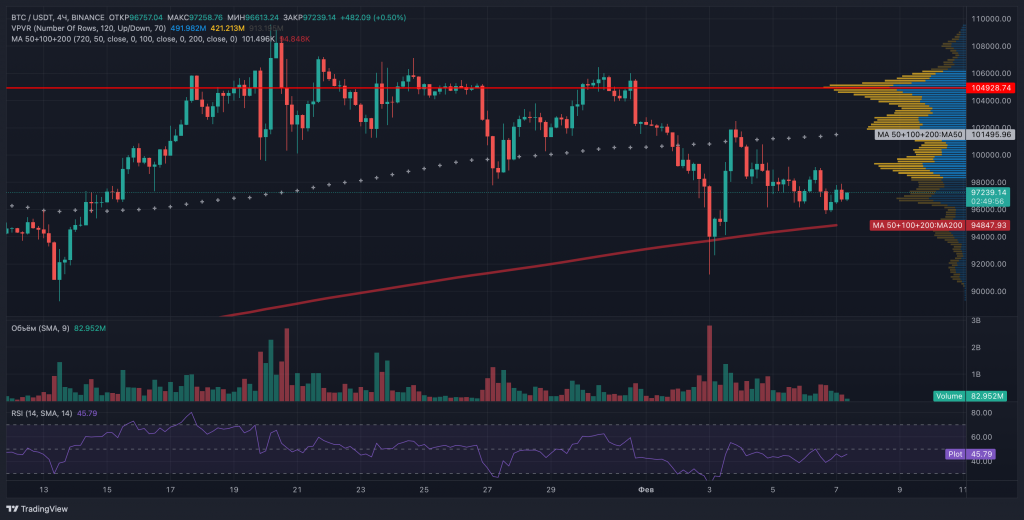
4-часовой график BTC/USDT. Источник: скринер криптовалют Cryptovizor

Технический анализ и прогнозы

Известный трейдер Jelle отмечает формирование более высокого минимума на графике. «Цель остается прежней — преодоление отметки в $100 000. По совпадению, это также середина торгового диапазона. После ее пробития следующей целью станет уровень $110 000», — пояснил он.
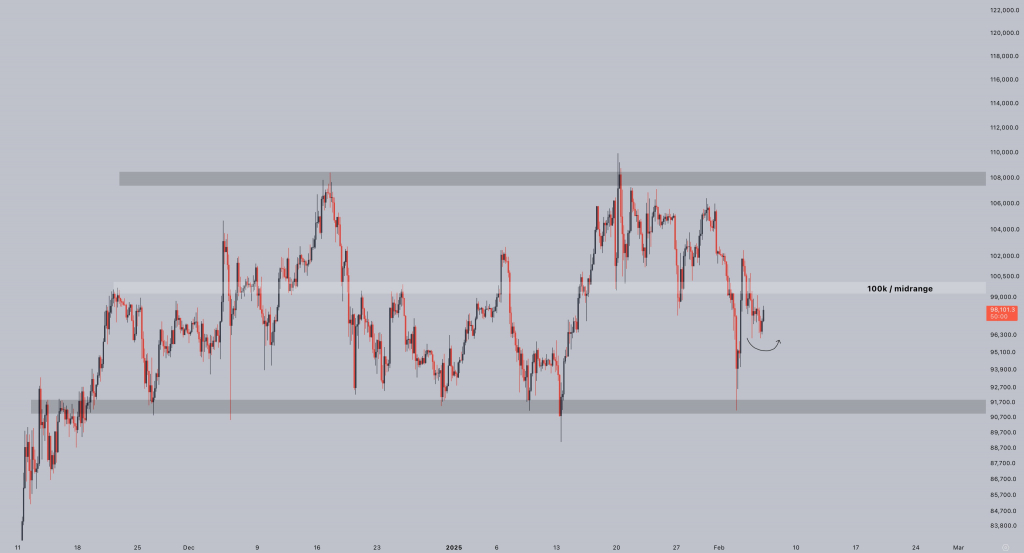
График BTC/USDT. Аналитика: Jelle

Трейдер Daan Crypto Trades обращает внимание на высокий спрос на спотовом рынке. По его словам, премия на спотовом рынке указывает на значительный интерес покупателей, что позволило биткоину сохранить устойчивость во время недавней турбулентности.
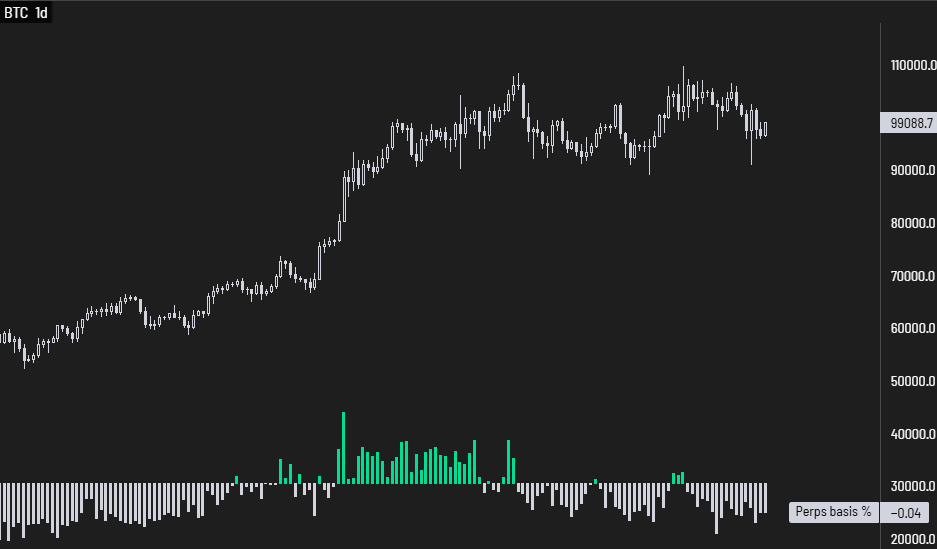
1-дневный график BTC/USDT. Аналитика: Daan Crypto Trades

«С появлением спотовых ETF и активным накоплением монет институциональными инвесторами, такими как MicroStrategy, происходит постоянная смена владельцев. Это должно привести к истощению предложения в текущем ценовом диапазоне и последующему росту», — добавил аналитик.

Трейдер и аналитик Rekt Capital отмечает формирование сужающегося канала на индикаторе относительной силы (RSI) на дневном графике. По его мнению, RSI удерживает поддержку у нижней границы канала, готовясь к росту к верхней границе канала.
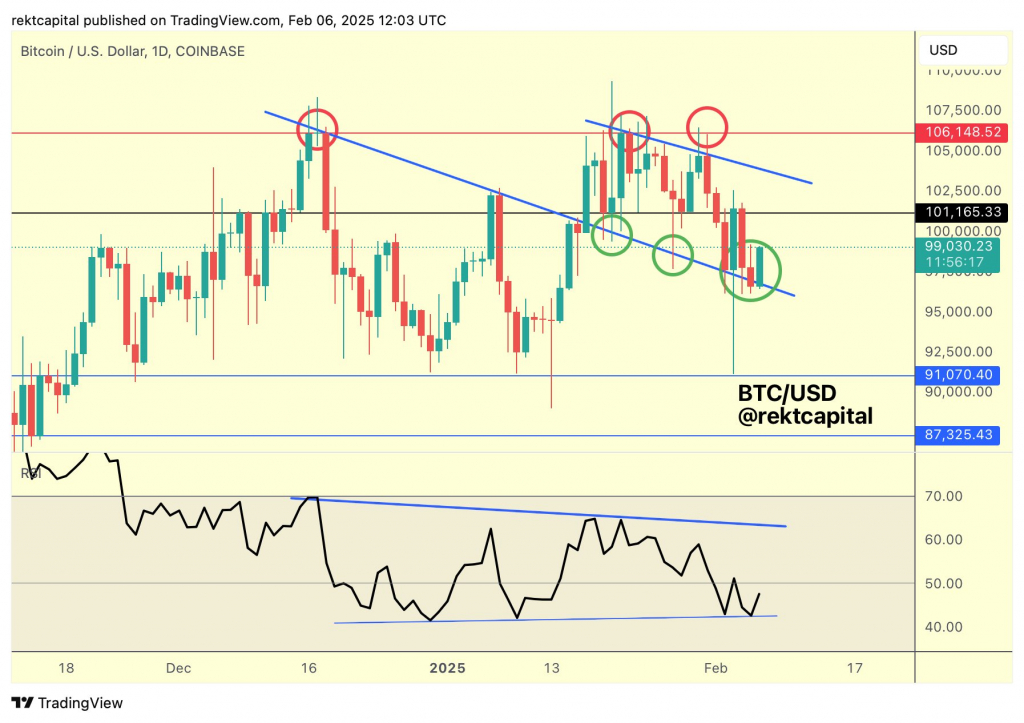
1-дневный график BTC/USDT. Аналитика: Rekt Capital

Факторы риска

Торговая компания QCP Capital придерживается более осторожной позиции. Аналитики предупреждают, что биткоин не застрахован от внешних шоков волатильности, особенно связанных с геополитическими событиями. «Устойчивость BTC выше $90 000 впечатляет, но мы сохраняем осторожность в отношении негативных геополитических шоков из-за напряженности между США и Китаем, особенно на фоне неопределенности на глобальных рынках», — отмечают эксперты QCP.

Текущая ситуация характеризуется отсутствием значимых краткосрочных катализаторов роста в криптосекторе, что делает рынок уязвимым к негативным ценовым шокам.

Leituras Relacionadas

Examining the Open USD Partner Lineup: Follow Who's Joining to See Where the Money Flows

**Title: Deciphering the Open USD Partner Roster: Following the Money** The launch of Open USD is notable less for the stablecoin itself and more for its expansive list of over 140 founding partners, which reads like a "who's who" of global finance and tech. This coalition, including asset managers like BlackRock, card networks Visa and Mastercard, banks (BNY Mellon, Standard Chartered, etc.), tech giants (Google, IBM), merchants (Shopify), and crypto firms (Coinbase, Ripple, Aave, MetaMask), signals a strategic shift. The diverse membership reveals that stablecoins are increasingly viewed not as products to compete over, but as shared infrastructure too critical to be left to any single entity. Each partner category has distinct motives. Asset managers like BlackRock seek to manage the large, sticky cash reserves, a lucrative fee-generating opportunity. Merchants like Shopify aim for lower-cost settlement and potential yield on balances. Banks join defensively to retain custody and settlement roles, fearing deposit outflows to stablecoins. Tech companies bet on programmable money for future machine-to-machine commerce. Crypto firms gain mainstream legitimacy and distribution channels. Remarkably, the consortium includes direct competitors (Visa vs. Mastercard, Coinbase vs. Ripple), indicating that the fear of exclusion from this emerging financial layer outweighs competitive rivalries. However, this shared governance could also lead to slow decision-making. The roster's composition is the real message: it represents a collective bet that a widely accepted, consortium-owned stablecoin is preferable to proprietary versions or having none at all. For incumbents like Circle and Tether, this alliance poses a significant threat, as potential clients have collectively chosen to build their own alternative. The absence of major U.S. retail banks (busy with their own tokenized deposit networks) is equally telling. In essence, the partner list maps where the industry believes value and risk will flow in a tokenized dollar future, marking stablecoin's evolution from a product to a utility.

Foresight NewsHá 10m

Examining the Open USD Partner Lineup: Follow Who's Joining to See Where the Money Flows

Foresight NewsHá 10m

IOSG: Q-Day Countdown, Will Quantum Computing End Cryptocurrency?

IOSG: The Q-Day Countdown – Will Quantum Computing End Cryptocurrency? This analysis explores the looming threat quantum computing poses to blockchain technology. Quantum computers, leveraging Shor's algorithm, could theoretically break the elliptic curve cryptography (ECC) underpinning cryptocurrencies like Bitcoin and Ethereum. The article outlines a hypothetical "Q-Day" scenario where exposed public keys from dormant assets are compromised, leading to fund theft and a deep governance crisis. The core risk is not the complete erasure of blockchains but a systemic reset of public-key cryptography. Bitcoin faces significant challenges due to its "code-is-law" ethos and the immense social consensus required for migration. Its primary vulnerability lies in legacy UTXOs with publicly exposed keys. Ethereum's path involves a more complex, full-stack cryptographic agility upgrade across execution, consensus, and data layers. The industry has a limited "engineering comfort window" of 5-8 years to coordinate a migration to post-quantum cryptography (PQC), such as lattice-based or hash-based signatures. While the existential threat is often overstated, the real bottleneck is the immense coordination required across protocol developers, node operators, wallet providers, exchanges, and custodians. Market repricing of crypto assets may occur well before an actual Q-Day if quantum hardware roadmaps accelerate or regulatory pressure mounts. The article concludes that quantum computing is not a doomsday weapon but a severe stress test for blockchain's foundational security model and governance structures.

marsbitHá 39m

IOSG: Q-Day Countdown, Will Quantum Computing End Cryptocurrency?

marsbitHá 39m

Why 2026 could redefine Ethereum, Solana, Base and Avalanche

Blockchain infrastructure is undergoing a major coordinated transformation, driven by institutional demand for reliability, compliance, and predictable settlement. Over $30 billion in Real-World Assets (RWA) on-chain has exposed network weaknesses. Major blockchains are responding with foundational upgrades, moving beyond incremental speed improvements. Ethereum's "Glamsterdam" upgrade, planned for H1 2026, will significantly increase gas limits and introduce features like PBS (pre-blocked state) for enhanced settlement and parallel execution. Solana's "Alpenglow," targeting a mainnet launch in H2 2026, focuses on reducing finality time dramatically and freeing network resources to improve reliability. Beyond speed, compliance is critical. Base's "Beryl" upgrade in Q3 2026 will introduce a standardized, regulatory-compliant token framework (B20). Avalanche's "Octane" upgrade aims to boost transaction processing and reduce costs for enterprise applications. Even Bitcoin is evolving with the potential activation of OP_CAT by late 2026/early 2027. The competition is shifting. While technical upgrades are widespread, institutions will ultimately allocate capital based on proven execution, operational resilience, and regulatory compatibility during market stress. Ethereum currently leads in tokenized assets, while networks like Base and Solana are strengthening their institutional offerings. The blockchain that best delivers reliable, compliant, and uninterrupted service is poised to attract the greatest share of future institutional capital.

ambcryptoHá 1h

Why 2026 could redefine Ethereum, Solana, Base and Avalanche

ambcryptoHá 1h

Trading

Spot
活动图片