Какие альткоины в тренде сегодня — 9 января

cryptonews.ruPublicado em 2021-07-09Última atualização em 2025-01-09

Альткоины, связанные с ИИ, такие как AI16Z, LLM и VIRTUAL, находятся сегодня в центре внимания крипторынка

AI16Z пережил резкое падение — на 20% за последние сутки и на 36% за неделю.Между тем LLM, новый токен, вырос на 138%, достигнув рыночной капитализации $120 млн. VIRTUAL остается лидером в сегменте ИИ. Монета тоже пережила значительное падение, но все еще держится в топ-50 самых капитализированных альткоинов. Все эти альткоины идут разными путями, но рынок одинаково внимательно следит за их перспективами.

Анализ цены ai16z (AI16Z)

AI16Z — известная монета, связанная с сектором ИИ, привлекла много внимания благодаря интересу к ИИ-криптоагентам. В начале 2025 года ее рыночная капитализация достигла $2,7 млрд, когда цена поднялась до $2,5. Однако сейчас токен упал почти на 20% за последние сутки и на 36% за неделю.

Прогнозы показывают, что коррекция может продолжиться, и на графике вскоре может появиться новый «крест смерти». Этот сигнал может привести к дальнейшему снижению, делая уровень поддержки $1,40 очень важным. Если AI16Z опустится ниже этого уровня, она может упасть еще больше, возможно, до $0,75.
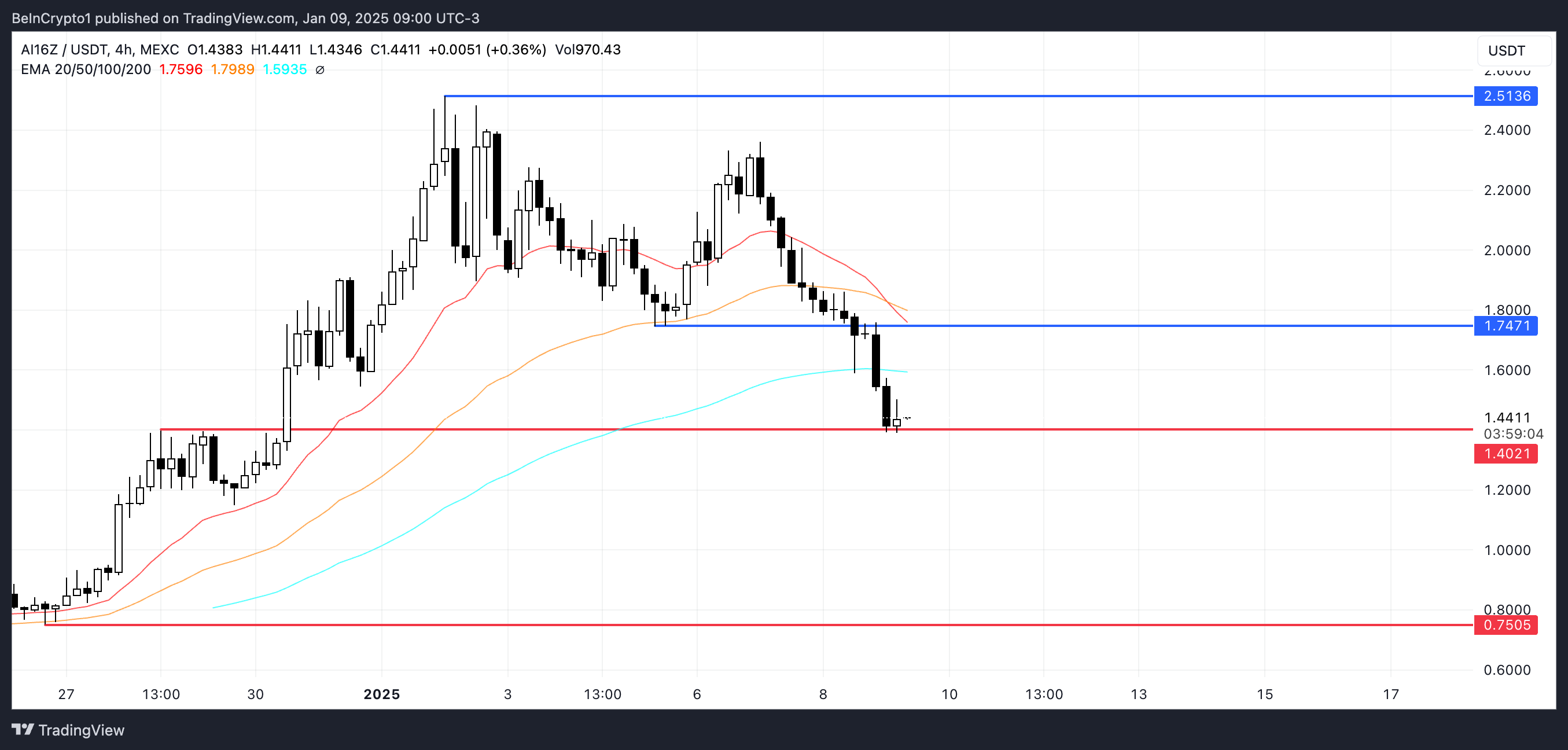
Анализ цены AI16Z. Источник: TradingView.

С другой стороны, разворот тренда может возобновить бычий импульс. Если AI16Z защитит поддержку и протестирует сопротивление на $1,74, прорыв этого уровня может сигнализировать о сильном восстановлении. Такое движение может вернуть AI16Z к $2,5 и, возможно, к новым историческим максимумам.

Large Language Model (LLM)

Запущенный всего полтора дня назад на Pumpfun и быстро перешедший на Raydium, LLM стал одним из самых популярных альткоинов за последние 24 часа. Этот коин искусственного интеллекта вырос на впечатляющие 138% за это время. Его рыночная капитализация увеличилась примерно до $120 млн.

Недавно один адрес купил 23 млн LLM во время фазы Pumpfun всего за $269. По данным аккаунта OnchainLens, пользователь продал монеты спустя всего четыре часа за $507 000. В итоге он получил невероятную прибыль в 1 887Х.
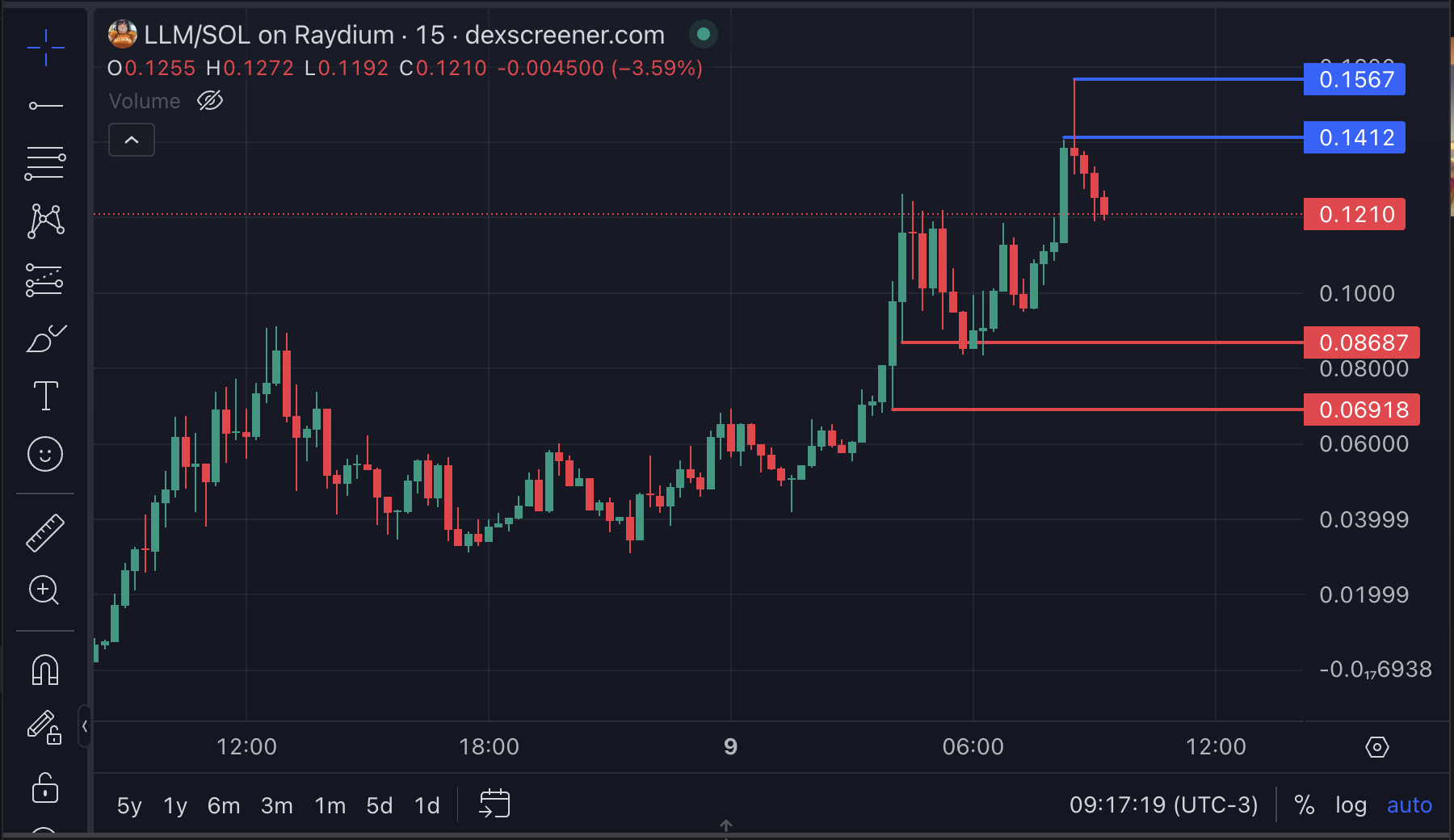
Анализ цены LLM. Источник: Dexscreener.

С технической точки зрения, важный уровень поддержки проходит на $0,086. Возможно дальнейшее снижение до $0,069, если медвежий импульс сохранится. Напротив, возобновление бычьего импульса может привести к тому, что LLM бросит вызов сопротивлениям на $0,141 и $0,156. Потенциально возможно установление новых максимумов.

Virtuals Protocol (VIRTUAL)

VIRTUAL — лидер в сегменте ИИ-монет. Он стабильно занимает первые три строчки в рейтинге рыночной капитализации в этой категории. После достижения почти $5 млрд в начале 2025 года, монета вошла в фазу сильной коррекции, но продолжает удерживать место в топ-50 альткоинов.

За последние 24 часа токен упал на 5,4%, увеличив потери за неделю почти до 30%. Последние сутки были неудачными для цены VIRTUAL, несмотря на новости о его партнерстве с криптоигрой Illuvium.
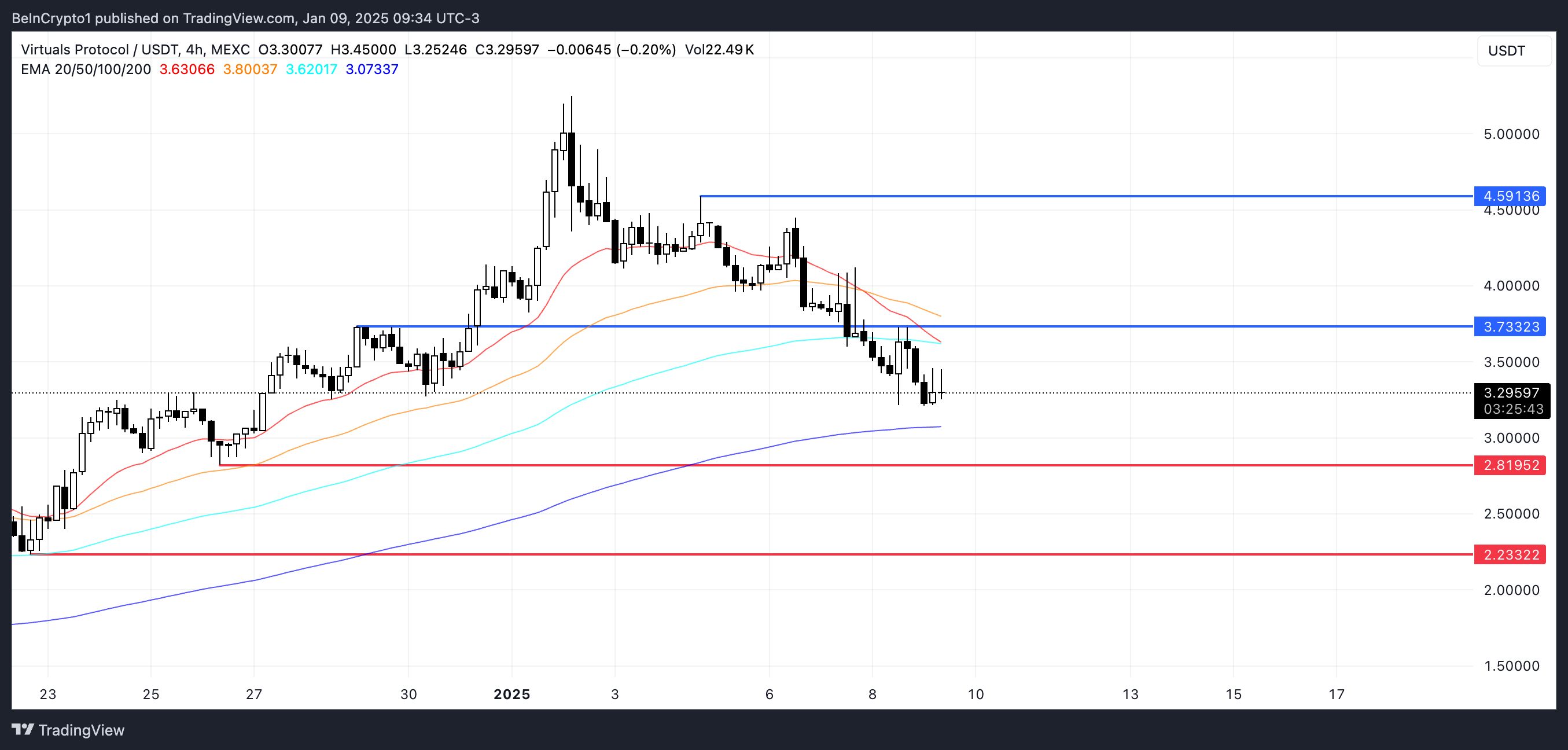
Анализ VIRTUAL. Источник: TradingView.

Анализ цены показывает, что коррекция может углубиться, так как краткосрочные линии EMA приближаются к возможному формированию «креста смерти» с долгосрочными EMA. Этот медвежий сигнал может подтолкнуть VIRTUAL к тестированию ключевого уровня поддержки на $2,81, с дальнейшим снижением до $2,23, если поддержка не выстоит. Однако интерес к ИИ-монетам дает альткоину шанс на разворот.

Если интерес к ИИ-проектам сохранится, VIRTUAL может восстановить бычий импульс и бросить вызов сопротивлению на $3,73. Прорыв этого уровня может открыть путь к дальнейшему росту, с целью на $4,59. Это обозначит потенциальное восстановление до предыдущих максимумов.


Criptomoedas em alta

Leituras Relacionadas

U.S. Stock Market Trend (August 11): Oil Prices Surge, Treasury Yields Rise, Tech Stocks Under Pressure, Optical Communication Plummets

U.S. Stock Market Trends (August 11): Oil Surge and Rising Bond Yields Pressure Tech; Optical Communication Stocks Plunge. U.S. stock indices closed slightly lower on Monday, with the S&P 500 and Dow Jones retreating from recent record highs. The primary market pressures were a significant oil price jump of over 5% amid unresolved negotiations to reopen the Strait of Hormuz and a consequent rise in U.S. Treasury yields, which weighed on growth stock valuations. The technology sector faced pressure, with Nvidia falling nearly 3% despite news of its pursuit of a $500 billion AI infrastructure financing consortium with major Wall Street firms. The optical communication sector saw a sharp sell-off, with Coherent dropping over 14%. In contrast, Chinese stocks listed in the U.S. were a notable bright spot, as the Nasdaq Golden Dragon China Index rose nearly 2%. Gold prices advanced for a second consecutive session on inflation hedging demand, while Bitcoin fell below $64,000. Key market movers included surging oil prices (WTI and Brent up ~5%) due to stalled Strait of Hormuz talks and heightened supply concerns, pushing the 10-year Treasury yield near 4.71%. Major tech stocks were mixed. Beyond Nvidia's decline, Intel fell over 4% on a new share offering plan. The Philadelphia Semiconductor Index dropped approximately 1.2%. Market attention remains on oil price dynamics, the impact of rising yields, and the forthcoming U.S. CPI data.

marsbitHá 8m

U.S. Stock Market Trend (August 11): Oil Prices Surge, Treasury Yields Rise, Tech Stocks Under Pressure, Optical Communication Plummets

marsbitHá 8m

JP Morgan Research Report Analysis: SK Hynix Fell 15% Last Week, Concerns Over HBM Pricing Overblown and Shareholder Returns to Land Ahead of Schedule

JPMorgan Research Report Interpretation: Addressing Concerns on SK Hynix's Recent Share Price Decline SK Hynix's stock fell 15% last week, underperforming the KOSPI (-5%) and Samsung (-9%). Key investor concerns centered on HBM pricing uncertainty, unclear shareholder return timelines, and a recently disclosed ₩54 trillion capital expenditure plan. JPMorgan's August 9 report addresses each point. Regarding HBM, JPMorgan refutes inaccurate media reports suggesting potential 50% price discounts for HBM4 in 2027. The firm's conservative model assumes <40% average HBM price growth by 2027, based on factors including memory suppliers prioritizing high-margin DDR5/LPDDR5/NAND in LTA allocations and the long-term partnership with key customer NVIDIA. The most significant near-term catalyst is shareholder returns. SK Hynix has committed to announcing additional shareholder return measures before the end of Q3 (September), earlier than its prior "year-end" guidance. JPMorgan anticipates a progressive policy, supported by an estimated cumulative free cash flow exceeding ₩800 trillion over three years and proceeds from the Kioxia stake sale. The substantial ₩54 trillion capex plan is for two new memory fabs to support its 2030 roadmap, not short-term aggressive expansion. The Yongin Y2 DRAM fab (₩35.2tn) and Cheongju M17 NAND fab (₩19.1tn) have construction starts scheduled for 2027, with clean room completion and investments stretching to 2028-2031. JPMorgan sees limited strategic value in a potential IPO for subsidiary Solidigm, noting SK Hynix's strong internal cash flow can fund capex without dilution, and an IPO might trigger dual-listing rule constraints in Korea. The report concludes last week's sell-off was an overreaction. JPMorgan maintains its Overweight rating and ₩2.75 million price target (~7x avg. 2026-2027 EPS), asserting the memory super-cycle thesis and SK Hynix's fundamentals remain intact.

marsbitHá 11m

JP Morgan Research Report Analysis: SK Hynix Fell 15% Last Week, Concerns Over HBM Pricing Overblown and Shareholder Returns to Land Ahead of Schedule

marsbitHá 11m

The Post-Crypto Era Outlook: Asset Valuation Returns to Fundamentals, What to Watch for the Next Decade?

Cryptoeconomy at a Turning Point: Valuations Reset, Focus Shifts to Real Value The cryptoeconomy is undergoing its most significant transformation yet, moving from speculative excess to a focus on sustainable, value-generating applications. After the 2021 hype cycle, which saw unsustainable valuations, the market has experienced a prolonged "reversion to the mean." Structural issues like cyclical revenues, regulatory uncertainty, and misaligned incentives between equity and token holders led to widespread fatigue. However, these problems are now widely recognized and are being addressed. A key shift is the emergence of applications demonstrating real, compounding growth independent of token prices. These include peer-to-peer internet platforms, global digital dollars, permissionless exchanges, novel derivatives, global collateral markets, and open financing platforms. Leading blockchains like Ethereum and Solana are solidifying their positions as foundational monetary and financial layers for the internet. Simultaneously, traditional financial and tech institutions are accelerating their blockchain integration with production-grade products, moving beyond mere experiments. Clearer regulations are enabling a shift from compliance concerns to exploring new business models. While the broader cryptoeconomy's emergence appears inevitable—driven by declining institutional trust, monetary devaluation, and a desire for fairer systems—intense competition means only a few native projects will become the dominant winners. The current phase offers a unique opportunity for investors, as leading projects are potentially undervalued after years of consolidation. The task is no longer to debate the technology's viability but to identify and capitalize on the real value being built for the next decade.

marsbitHá 12m

The Post-Crypto Era Outlook: Asset Valuation Returns to Fundamentals, What to Watch for the Next Decade?

marsbitHá 12m

Outlook for the Post-Encryption Era: Asset Valuation Returns, What to Watch in the Next Decade?

The crypto economy is undergoing its most significant transformation in eight years, characterized by a shift from speculative frenzy to fundamental-driven growth. After the extreme overvaluation and unrealistic expectations of 2021, asset prices, including Bitcoin relative to gold, have corrected significantly. This reset has exposed structural industry weaknesses such as cyclical revenues, regulatory uncertainty, misaligned incentives between equity and token holders, poor disclosure, and a lack of common valuation frameworks, leading to widespread investor fatigue. However, this correction is healthy and has set the stage for a more mature phase. Numerous real-world use cases have emerged and are exhibiting compound growth, independent of token prices. These include peer-to-peer internet platforms, global digital dollars, permissionless exchanges, novel derivatives, global collateral markets, democratized asset creation, open fundraising platforms, and decentralized physical infrastructure networks. Key issues like dual-token models are being resolved, disclosure is improving, and a consensus is forming that most assets must generate cash flow. The leading blockchains (e.g., Ethereum, Solana) are becoming the monetary and financial base layer of the internet, with entrenched network effects. Established Wall Street and Silicon Valley institutions are now launching production-grade products on public chains, a shift accelerated by clearer regulations. While valuations have reset and growth models remain conservative, the potential for exponential growth remains. The broader macro environment—declining institutional trust, unsustainable sovereign debt, currency debasement, deglobalization, and a generational wealth transfer—is uniquely favorable for crypto's adoption. The market is not uniformly maturing; it consists of various products at different adoption stages where speculation will persist in cycles. The core opportunity lies in identifying the few native projects that will become foundational winners as the world rebuilds its economic systems. The current period of disillusionment conceals a generational opportunity for those betting on the new paradigm rather than mourning the old one.

Odaily星球日报Há 46m

Outlook for the Post-Encryption Era: Asset Valuation Returns, What to Watch in the Next Decade?

Odaily星球日报Há 46m

Trading

Spot

Artigos em Destaque

Como comprar VIRTUAL

Bem-vindo à HTX.com!Tornámos a compra de Virtuals Protocol (VIRTUAL) simples e conveniente.Segue o nosso guia passo a passo para iniciar a tua jornada no mundo das criptos.Passo 1: cria a tua conta HTXUtiliza o teu e-mail ou número de telefone para te inscreveres numa conta gratuita na HTX.Desfruta de um processo de inscrição sem complicações e desbloqueia todas as funcionalidades.Obter a minha contaPasso 2: vai para Comprar Cripto e escolhe o teu método de pagamentoCartão de crédito/débito: usa o teu visa ou mastercard para comprar Virtuals Protocol (VIRTUAL) instantaneamente.Saldo: usa os fundos da tua conta HTX para transacionar sem problemas.Terceiros: adicionamos métodos de pagamento populares, como Google Pay e Apple Pay, para aumentar a conveniência.P2P: transaciona diretamente com outros utilizadores na HTX.Mercado de balcão (OTC): oferecemos serviços personalizados e taxas de câmbio competitivas para os traders.Passo 3: armazena teu Virtuals Protocol (VIRTUAL)Depois de comprar o teu Virtuals Protocol (VIRTUAL), armazena-o na tua conta HTX.Alternativamente, podes enviá-lo para outro lugar através de transferência blockchain ou usá-lo para transacionar outras criptomoedas.Passo 4: transaciona Virtuals Protocol (VIRTUAL)Transaciona facilmente Virtuals Protocol (VIRTUAL) no mercado à vista da HTX.Acede simplesmente à tua conta, seleciona o teu par de trading, executa as tuas transações e monitoriza em tempo real.Oferecemos uma experiência de fácil utilização tanto para principiantes como para traders experientes.

520 Visualizações TotaisPublicado em {updateTime}Atualizado em 2026.08.06

Como comprar VIRTUAL

Discussões

Bem-vindo à Comunidade HTX. Aqui, pode manter-se informado sobre os mais recentes desenvolvimentos da plataforma e obter acesso a análises profissionais de mercado. As opiniões dos utilizadores sobre o preço de VIRTUAL (VIRTUAL) são apresentadas abaixo.

活动图片