Ripple Leadership Dines With Donald Trump: What Was It About?

bitcoinistPublicado em 2025-01-08Última atualização em 2025-01-08

Resumo

Ripple CEO Brad Garlinghouse and Chief Legal Officer Stuart Alderoty were spotted dining with President-elect Donald Trump at Mar-a-Lago on...

Ripple CEO Brad Garlinghouse and Chief Legal Officer Stuart Alderoty were spotted dining with President-elect Donald Trump at Mar-a-Lago on January 7, 2025. The news broke via both Garlinghouse and Alderoty’s posts on X, featuring a photograph with Trump that quickly went viral.

What Did Ripple’s Execs Discuss With Trump?

Garlinghouse stated, “Great dinner last night with Donald Trump & Stuart Alderoty. Strong start to 2025!” while Alderoty, adding a personal flair, wrote, “…and to top it off, the beef bourguignon was really good.” Neither executive elaborated on specific topics covered during the dinner, leaving the crypto community to speculate on whether regulatory matters—or the still-unresolved legal battle with the US Securities and Exchange Commission—were on the agenda.

Trump, set to be inaugurated later this month, chose Paul Atkins in December to lead the SEC. In light of the ongoing Ripple-SEC case, many analysts are waiting to see whether Atkins and Trump’s administration might alter the agency’s appellate strategy. As reported by Bitcoinist yesterday, the SEC’s grounds for appeal are due by January 15, just days before Inauguration Day. While some in the XRP community believe a withdrawal of appeals could be in the cards under new leadership, no official statements have been released.

Despite the lack of concrete information about the discussion, crypto proponents have largely welcomed the meeting. Charles Hoskinson, founder of Cardano, congratulated Garlinghouse directly, posting, “Nicely done Brad.” The sentiment was echoed by other influencers.

Moon Lambo (@MoonLamboio) wrote via X “If anyone thought Trump wasn’t serious about making crypto great again, you can put those fears TO BED!!! $XRP.” Pro-XRP lawyer bill Morgan commented “Love that” and Joey Swoll (@TheJoeySwoll) added: “Make crypto great again! LOCK IN! #XRPARMY”

However, not everyone responded uncritically. ĐΛRKHØRSΞ™ (@DarkhorseDNME4) questioned the meeting’s cost, writing, “So for the record… you know ‘have met’ with Donald Trump where as before Stuart said you had and you hadn’t.. how much did that cost? I heard dinners with Trump are upwards of $100k per seat.”

Still, the overall mood among XRP holders appears bullish. Commentators are optimistic that the dinner signals friendlier policy measures under the forthcoming Trump administration.

Others point to a tweet Garlinghouse shared on January 5—just days before the Mar-a-Lago meeting—highlighting what he described as the “Trump bull market.” In that tweet, Garlinghouse wrote, “2025 is here and the Trump bull market is real. For Ripple, this is even more personal after Gensler’s SEC effectively froze our business opportunities here at home for years. The optimism is obvious and very deserved.”

Garlinghouse also disclosed tangible signs of momentum. “75% of Ripple’s open roles are now US-based, while over the last 4 years, the vast majority of hires were outside the US,” he revealed. Furthermore, he disclosed that Ripple has “signed more US deals in the last six weeks of 2024 (since the election) than the previous six MONTHS.”

He credited these developments to the “Trump effect,” contending that the President-elect, along with allies such as Scott Bessent, David Sacks, and Paul Atkins, has already been “jumpstarting innovation and job growth” before even taking office.

At press time, XRP traded at $2.28.
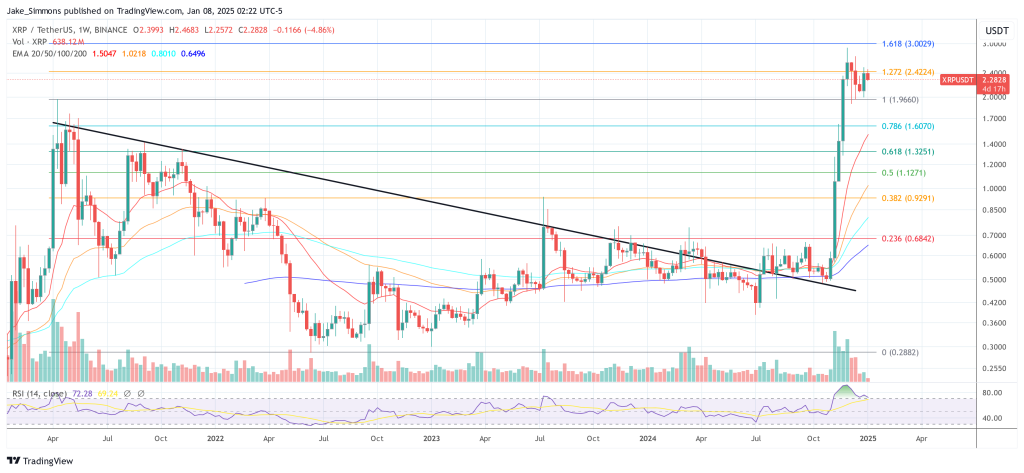
XRP price
XRP price, 1-week chart | Source: XRPUSDT on TradingView.com
Featured image from X, chart from TradingView.com
Jake Simmons

Jake Simmons

Jake Simmons has been a Bitcoin enthusiast since 2016. Ever since he heard about Bitcoin, he has been studying the topic every day and trying to share his knowledge with others. His goal is to contribute to Bitcoin's financial revolution, which will replace the fiat money system. Besides BTC and crypto, Jake studied Business Informatics at a university. After graduation in 2017, he has been working in the blockchain and crypto sector. You can follow Jake on Twitter at @realJakeSimmons.

Leituras Relacionadas

Anthropic Major Release: "The Founder's Playbook" - All 4 Stages of Entrepreneurship, Completely Reimagined with AI

**Anthropic Releases "The Founder's Playbook," Reimagining the Four Stages of Startups with AI** The logic of entrepreneurship is being fundamentally reshaped by AI. Anthropic's new handbook, "The Founder's Playbook: Building an AI-Native Startup," defines the AI-native startup as a new species: not a traditional company with AI tools, but a venture driven by AI from day one. The founder's role is transforming from a hands-on builder to a conductor or architect, orchestrating AI agents for execution while focusing on high-level judgment and strategy. Anthropic outlines a product matrix of Claude tools for different tasks: Claude Chat for interactive research, Claude Code for generating production-ready code, and Claude Cowork for automating knowledge-intensive workflows. The handbook structures the startup lifecycle into four stages, detailing core goals, pitfalls, and AI applications for each: 1. **Idea Stage**: Focuses on validating a real problem. The core challenge is avoiding confirmation bias. AI practices include using Claude as a "structured devil's advocate" to challenge assumptions and for automated market/competitor research. 2. **MVP Stage**: Aims to gather early signals of Product-Market Fit (PMF). Key risks are technical debt and scope creep due to rapid AI-assisted development. Recommended AI uses include maintaining project memory documents (e.g., CLAUDE.md), using Claude Code for structured coding, and automating user feedback analysis. 3. **Launch Stage**: Centers on establishing scalable growth, operations, and compliance. Challenges include accelerating technical debt and founders becoming bottlenecks. AI should be used to build an "operating system" for launch—automating routine tasks (scheduling, reporting, content) and code audits—freeing founders for critical decisions. 4. **Scale Stage**: Focuses on achieving sustainable business operations. The main challenge is delegating operational control. AI should be leveraged for differentiated marketing, operational optimization, and building competitive moats through data network effects. The handbook concludes that in the AI era, "Can we build it?" is no longer the primary constraint. The advantage shifts back to foundational strengths: **insight, judgment, and a deep understanding of a specific problem and audience.**

marsbitHá 5h

Anthropic Major Release: "The Founder's Playbook" - All 4 Stages of Entrepreneurship, Completely Reimagined with AI

marsbitHá 5h

Eight Departments Launch Severe Crackdown on Cross-Border Securities Firms, How to Interpret This?

China's top financial regulators, including the CSRC and seven other ministries, have launched a sweeping crackdown on unlicensed cross-border securities operations. The core action involves a joint enforcement plan and the issuance of administrative penalties against major offshore internet brokers like Futu and Tiger Brokers for conducting unauthorized securities business in mainland China without a domestic license. The primary legal basis is China's requirement for securities businesses to operate with proper, locally issued licenses. The crackdown aims to eliminate a major regulatory gray area, plugging channels that allowed massive, unmonitored capital outflows which posed risks to financial stability, currency controls, and foreign exchange reserves. It also seeks to protect mainland investors who previously lacked legal recourse when dealing with offshore platforms and to secure sensitive financial data. The immediate impact is severe for the targeted brokers, including a complete ban on new mainland business, forced liquidation of existing mainland client positions over two years, and the confiscation of illegal profits estimated in the billions. Their U.S.-listed shares plummeted in response. Market analysts warn that the forced sell-off of an estimated 250-280 billion RMB in assets, concentrated in U.S. tech stocks, Chinese ADRs, and Hong Kong equities, could create sustained selling pressure on these markets over the next two years, potentially lowering valuations. For mainland investors, legal cross-border investment channels will become extremely constrained. The high asset threshold for the Stock Connect program and the severe shortage of QDII fund quotas—leading to chronic high premiums on popular U.S.-focused ETFs—mean retail access to overseas markets like the U.S. will be sharply limited. Conversely, some of the returning capital may flow into domestic A-share sectors like AI, semiconductors, and advanced manufacturing. However, this could further inflate valuations in these already elevated sectors. In conclusion, regulators frame this move not as closing off cross-border investment, but as a necessary step to enforce compliance, manage systemic risk, and steer investors toward regulated, protected channels like QDII and Stock Connect for the long-term health of the financial system.

链捕手Há 5h

Eight Departments Launch Severe Crackdown on Cross-Border Securities Firms, How to Interpret This?

链捕手Há 5h

Trading

Spot
Futuros
活动图片