生态赋能与行业创新,GT为何成为投资者的下一个“必选项”

Odaily星球日报Publicado em 2025-01-08Última atualização em 2025-01-08

Resumo

本文将以GT为核心,通过对比分析和多维度解读,探讨其在全球加密行业中的价值逻辑与未来可能。

生态赋能与行业创新,GT为何成为投资者的下一个“必选项”

加密货币行业的发展催生了众多变革,其中交易所平台币的崛起是不可忽视的重要一环。作为链接交易所、用户与生态的核心资产,平台币集生态治理、资产赋能和价值分配于一体,为交易所业务扩展和用户参与提供了坚实支撑。从最初简单的手续费折扣工具,到如今涵盖多场景的复杂生态角色,平台币已然成为行业发展的风向标。

在这一场平台币的竞逐中,GT(Gate Token)凭借其独特的战略定位、严格的销毁机制及高度契合市场需求的应用场景,正快速崛起。与市值已达千亿美元的 BNB 不同,GT 在市值和价格层面仍处于被低估状态,其稀缺性与生态扩展能力预示着极大的增长潜力。

特别是在 2024 年,这一年被视为 Gate.io 增长最快的年份,平台用户突破 2000 万,用户增长实现 234% 增长,交易量实现 120% 增长,这一系列的里程碑式数据为 GT 的价值释放提供了强而有力的支持。

本文将以 GT 为核心,通过对比分析和多维度解读,探讨其在全球加密行业中的价值逻辑与未来可能。

对比分析:GT在平台币生态中的独特竞争力

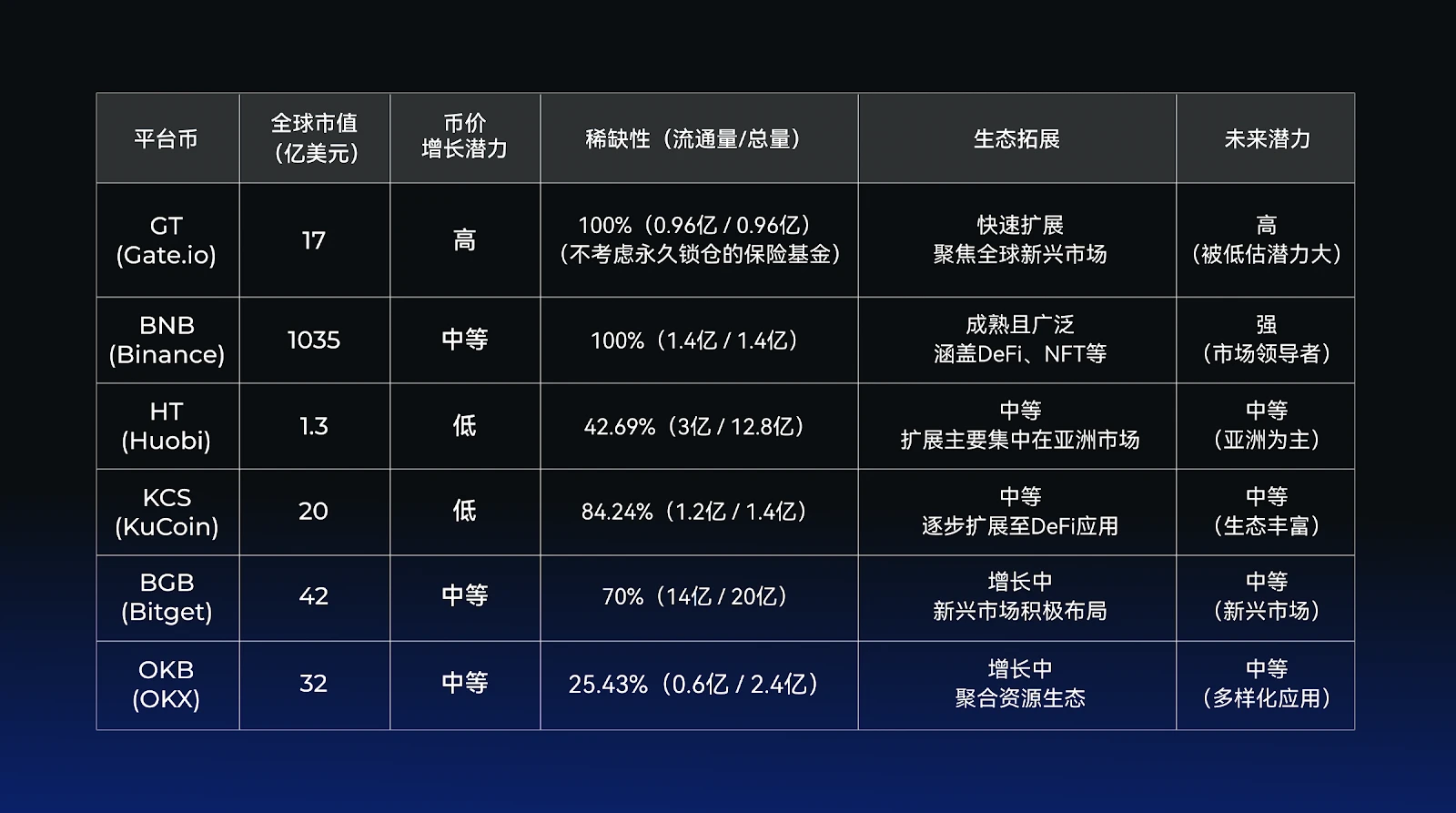
通过与主流平台币的多维对比,可以清晰看到 GT 的优势和潜力:

GT 的显著优势在于销毁比例和稀缺性:其流通量完全释放,且通过持续的季度销毁实现了流通量仅为 1.03 亿的稀缺状态。这种特性直接增强了代币的价格稳定性和增长空间。此外,GT 的市值远低于同类平台币,但其应用场景和生态深度扩展的能力远高于其他平台币,呈现出巨大的潜在爆发力。

平台币的崛起与 GT 的独特市场定位

平台币的多元角色与战略重要性

平台币不仅是交易所内部的流通工具,更已成为生态体系的价值核心。在日益复杂的加密生态中,平台币正在推动多个维度的创新:

  • 赋能用户:通过新币认购、空投奖励等激励机制,让用户获得更多价值;

  • 支持治理:作为平台治理的基础工具,平台币确保了社区和用户的深度参与;

  • 强化生态:通过绑定核心业务场景,平台币帮助交易所扩展服务边界,同时实现生态闭环。

GT 在上述维度中表现尤为突出,其设计逻辑基于用户需求的深刻洞察,且与平台生态高度融合。无论是从流通机制的透明度,还是销毁策略的实施力度,GT 都以清晰、科学的增长模型确立了其市场地位。

差异化竞争力

相较于 BNB 的成熟和 HT 的区域化特征,GT 在多个方面展现了独特的竞争力。其完全释放的流通量确保了代币供需关系的平衡,而持续的销毁机制进一步强化了稀缺性。此外,Gate.io 的国际化战略为 GT 打开了新兴市场的大门,为其未来的全球化布局奠定了良好的基础。

综合多维因素,使得 GT 成为一个既具现实价值,又充满未来潜力的资产。通过与其他主流平台币的对比,GT 的差异化特征愈加鲜明,而这些特征的背后,是 Gate.io 对长期增长逻辑的精准把握。

适配多个应用场景,兼备“一鱼多吃”的价值潜力

作为平台币,GT 的核心价值不仅体现在生态绑定的深度上,还通过多种收益场景为用户提供了“一鱼多吃”的投资体验。持有 GT,用户可以同时从价格上涨、Startup 认购、质押挖矿、VIP 权益提升与手续费折扣等维度获取收益。

基于多场景的有序叠加,GT 构建了完整的收益闭环,从资本增值到权益扩展,再到被动收入,全面覆盖用户的多样化需求。对投资者而言,GT 是一个值得长期持有的资产,更是一个可以充分发挥其价值潜力的多功能工具。

生态赋能下的多维展开

从核心功能到战略布局的系统性支持

GT 的功能远不止于平台币的传统角色,它已融入 Gate.io 交易所的关键业务流程,成为连接用户与生态的桥梁。

例如在新币认购中,Startup 为 GT 用户提供独家且低门槛的参与机会,还通过优质资产配置吸引大量投资者。Startup 的成功依赖于平台本身的影响力,自然也离不开 GT 在其中扮演的核心角色。

Startup 是全球最大的加密货币项目首发平台,目前累计空投高达 1.2 亿美元。在 Startup、新币挖矿及任务广场,全球超百万用户每天在此免费领取各类潜力空投。

2024 年全年,Startup 共送出 3, 000 万美元的空投奖励,为用户创造了丰厚回报,同时进一步强化了 GT 在用户资产配置中的核心地位。

另一方面,GT 作为 GateChain 的原生代币,在链上支付、Gas Fee 消耗和跨链资产操作等方面展现了其技术价值。这种底层功能的稳定性和灵活性,使 GT 超越了单一的交易所代币角色,成为整个生态的重要支撑。

驱动生态多场景协同发展

Gate.io 在深耕交易所服务的同时,还积极拓展Web3生态。从 DeFi 到 NFT,从链上资产管理到跨链操作,GT 贯穿于每一个核心领域,被广泛应用于包括币币交易、OTC 场外交易、杠杆交易、期货合约以及各类衍生产品场景。

与此同时,GT 质押挖矿业务以高达 10.89% 的预期年化收益吸引大批用户长期持币。通过 Startup 空投机制,GT 可进一步增强持币用户的权益黏性。

数据显示,余币宝理财服务在 2024 年为用户创造了超过 1 亿美元的利息收益。这一业务进一步拓展了 Gate.io 的理财功能,为 GT 的使用与持有创造了更多实际需求。这种“多场景协同发展”的模式,为 GT 的长期稳定增长提供了坚实的内在驱动力。

价格与销毁机制的协同效应

通缩模型的价值逻辑

GT 的销毁策略可以被视为其价值增长的“压舱石”。自 2019 年上线以来,GT 通过季度销毁将总量从 3 亿枚削减至不到 1 亿枚,销毁比例高达 58% 。这一通缩模型有助于减少代币供给压力,且通过链上透明操作持续增强投资者信心。

值得注意的是,GT 的销毁量与平台收入挂钩,这种动态调整机制可确保销毁策略的可持续性,同时有效平衡市场流通与稀缺性。

价格修复的潜在空间

2025 年 1 月,GT 价格攀升至历史新高,触达 18.474 美元。尽管 GT 的价格在过去一年内实现了接近 300% 的增长,但与其实际价值相比仍有较大上升空间。

当前市值仅为 18 亿美元的 GT,在生态扩展和全球化布局的持续推动下,价格有望进一步突破。与 BNB 或 OKB 等平台币的成熟态势相比,GT 更像是“价值洼地中的潜力股”,其成长轨迹令人期待。

多维收益结构与长期价值体现

资本增值与被动收益的双轮驱动

GT 的投资逻辑是多层次的。在资本增值层面,GT 的价格上升动力来自于市场需求的扩展、生态的深化以及销毁机制的支撑。而在被动收益方面,GT 通过质押挖矿和 Startup 空投等多种途径,为用户提供了稳定且可观的回报。

这种“双轮驱动”的收益模式,丰富了用户的投资选择,也增强了 GT 作为长期持有资产的吸引力。

丰富的权益回报与实际场景覆盖

通过提升 VIP 等级、获取交易费率折扣和优先参与新币认购等权益,GT 为用户带来了超出价格本身的多重价值。

假如一位用户在 2024 年初长期持有 1000 枚 GT,包括币价增值、挖矿回报和空投奖励等多个维度在内,至 204 年底其年度持有 GT 总收益将超过 11, 000 美元,整体回报率显著高于其他同类平台币。

助力行业发展与未来蓝图

赋能加密行业的深远影响

GT 是 Gate.io 交易所的核心资产,更在推动行业创新和技术普及方面发挥着重要作用。通过支持新兴项目、增强链上流动性和降低用户参与门槛,GT 正在为整个加密行业注入新的活力。

Gate.io 是全球领先的加密货币交易所,其国际化战略为 GT 提供了强大的市场支持。通过优化本地服务、布局新兴市场,为 GT 创造了广泛的流通需求。

此外,随着Web3生态的崛起,GT 在链上支付、跨链支持和智能合约领域的应用也逐步深化,成为连接传统金融与区块链技术的桥梁。

促进垂直赛道与新兴领域的发展

作为一个具备强大生态支撑的代币,GT 有潜力在 NFT、DeFi 和跨链支付等领域进一步扩展应用场景。跟随Web3生态兴起的步伐,GT 将成为推动这些新兴赛道发展的重要工具,同时为用户创造更多的价值增长机会。

技术层面,GateChain 的多次升级显著提高了交易效率并降低了用户成本。作为 GateChain 的核心代币,GT 的功能性将进一步扩展,为用户提供更高效的区块链服务。

从价值洼地到生态引领者

GT 通过稀缺性、生态赋能和全球扩展战略的多重优势,构建了清晰的价值增长逻辑。在加密行业持续发展的背景下,GT 的潜力已逐步显现。作为下一代平台币的代表性资产,GT 还将为用户提供多样化的收益路径。

随着加密行业的持续发展,平台币的竞争将更注重技术落地和生态深度。GT 以其独特的价值逻辑、强劲的市场表现和多元化的应用场景,有望成为加密货币行业下一个标志性平台币。

Leituras Relacionadas

OpenAI's Hyperliquid Pre-IPO Pricing Venture: Why Did It Last Only Half a Year?

The article discusses the rise and fall of Pre-IPO pricing markets on the Hyperliquid blockchain. Trade.xyz, an anonymous team, successfully built the largest pre-market for SpaceX (SPCX) by launching a contract with a clear anchor: the eventual Nasdaq listing price. This provided inherent price stability and validation. In contrast, Ventuals, a team backed by Paradigm, failed despite holding exclusive contracts for highly sought-after companies like OpenAI and Anthropic. Its key mistake was its pricing mechanism. For companies with no near-term IPO date, Ventuals' oracle relied partly on opaque private market transactions and, critically, partly on its own contract's moving average price. This created a self-referential feedback loop where prices were artificially propped up and detached from genuine supply and demand, leading to illiquid markets. Ventuals shut down after nine months, settling positions at final prices of $1,341.80 for OpenAI and $1,618.90 for Anthropic. Ironically, some employees and late-stage investors of these very companies reportedly used these flawed Ventuals prices for valuation reference, highlighting the acute demand for any price signal in illiquid private markets. The article concludes that while demand for pre-IPO trading is real and growing, with players like Coinbase now entering the space, the fundamental challenge remains: without a public listing to provide a definitive price anchor, these markets struggle to establish truly accurate and liquid pricing. The need for a transparent, self-correcting market is the critical lesson from Ventuals' failure.

marsbitHá 15m

OpenAI's Hyperliquid Pre-IPO Pricing Venture: Why Did It Last Only Half a Year?

marsbitHá 15m

With Daily Active Users Reaching 3-4 Times That of the Industry's Second Place, Which Crack in the Office Agent Market Has Tencent's WorkBuddy Torn Open?

Tencent's AI office assistant, WorkBuddy, has achieved daily active users (DAU) 3-4 times that of the industry's second-place product, primarily driven by non-technical users like HR, operations, and administrative staff. Its rapid growth, starting with a public beta in March 2026, highlights a key strategic divergence from competitors like OpenAI's Codex and Anthropic's Claude Code. Unlike those tools, which originated as developer-focused assistants (in command lines or IDEs) and are now expanding towards office scenarios, WorkBuddy was built from the ground up for non-technical office workers. Its development was user-driven, initiated after腾讯云's team observed non-technical employees using their CodeBuddy coding tool for general tasks. WorkBuddy's design is defined by three core decisions aimed at lowering barriers: 1) Using natural language instead of technical concepts, so users describe their goal without needing to understand prompts or agents. 2) Providing pre-packaged "Skill" templates for common office tasks like data processing, content creation, and research. 3) Natively integrating into existing腾讯 ecosystems like腾讯 Docs and WeChat, making the agent a seamless part of the user's workflow rather than a separate tool. This "scenario encapsulation" approach, prioritizing the shortest path for users to get work done, contrasts with the "underlying capability" focus of Codex and Claude, which offer more flexibility but require more technical setup. Analysts confirm WorkBuddy's leading market position in China by mid-2026, with massive user and request growth following its launch. Recognizing the same trend of surging non-technical adoption, OpenAI and Anthropic are now pivoting their products with features like role-based plugins (Codex) and a simplified desktop interface (Claude Cowork). However, adapting tools built for developers requires significant changes to interaction models and integrations. WorkBuddy currently holds an estimated six-month lead in delivering a complete solution for non-technical office users. Its recently launched enterprise version aims to solidify this advantage. The competition underscores two valid paths: embedding agent capabilities directly into familiar work environments versus building powerful, general-purpose agents that users must learn to access. WorkBuddy's early success demonstrates the effectiveness of the former strategy for mainstream office adoption.

marsbitHá 24m

With Daily Active Users Reaching 3-4 Times That of the Industry's Second Place, Which Crack in the Office Agent Market Has Tencent's WorkBuddy Torn Open?

marsbitHá 24m

Dalio's Latest Warning: Don't Get Carried Away by AI, Real Returns on US Stocks in the Next 5-10 Years Could Be -5% to -10%

Ray Dalio, founder of Bridgewater Associates, warns investors against excessive concentration in AI stocks. He argues the current market, dominated by a few AI giants, mirrors historical patterns where revolutionary new technologies lead to high risk, volatility, and uncertainty. While acknowledging AI's transformative potential, Dalio emphasizes that most investors fail at this stage of the cycle by over-concentrating in a handful of leading companies. He cites inherent risks: companies cannot accurately forecast investment needs or external shocks (e.g., monetary policy, geopolitics, taxes), face potential disruption from future technologies and international competition (notably from China), and experience significant price swings. Dalio's core advice is diversification, calling it his "Holy Grail of Investing." He presents a mathematical case that a well-diversified portfolio of 15-20 uncorrelated, good bets offers a superior risk-adjusted return compared to a concentrated position. Dalio also offers a cautious outlook, suggesting U.S. stocks may deliver real returns of -5% to -10% over the next 5-10 years based on valuation and bubble indicators. He concludes that in the face of high uncertainty, the prudent strategy is not to avoid betting entirely, but to avoid large, concentrated bets where one lacks sufficient informational edge. Instead, investors should build a strategically balanced, diversified portfolio.

marsbitHá 1h

Dalio's Latest Warning: Don't Get Carried Away by AI, Real Returns on US Stocks in the Next 5-10 Years Could Be -5% to -10%

marsbitHá 1h

Trading

Spot
Futuros

Artigos em Destaque

Como comprar GT

Bem-vindo à HTX.com!Tornámos a compra de Gatechain (GT) simples e conveniente.Segue o nosso guia passo a passo para iniciar a tua jornada no mundo das criptos.Passo 1: cria a tua conta HTXUtiliza o teu e-mail ou número de telefone para te inscreveres numa conta gratuita na HTX.Desfruta de um processo de inscrição sem complicações e desbloqueia todas as funcionalidades.Obter a minha contaPasso 2: vai para Comprar Cripto e escolhe o teu método de pagamentoCartão de crédito/débito: usa o teu visa ou mastercard para comprar Gatechain (GT) instantaneamente.Saldo: usa os fundos da tua conta HTX para transacionar sem problemas.Terceiros: adicionamos métodos de pagamento populares, como Google Pay e Apple Pay, para aumentar a conveniência.P2P: transaciona diretamente com outros utilizadores na HTX.Mercado de balcão (OTC): oferecemos serviços personalizados e taxas de câmbio competitivas para os traders.Passo 3: armazena teu Gatechain (GT)Depois de comprar o teu Gatechain (GT), armazena-o na tua conta HTX.Alternativamente, podes enviá-lo para outro lugar através de transferência blockchain ou usá-lo para transacionar outras criptomoedas.Passo 4: transaciona Gatechain (GT)Transaciona facilmente Gatechain (GT) no mercado à vista da HTX.Acede simplesmente à tua conta, seleciona o teu par de trading, executa as tuas transações e monitoriza em tempo real.Oferecemos uma experiência de fácil utilização tanto para principiantes como para traders experientes.

103 Visualizações TotaisPublicado em {updateTime}Atualizado em 2026.06.02

Como comprar GT

Discussões

Bem-vindo à Comunidade HTX. Aqui, pode manter-se informado sobre os mais recentes desenvolvimentos da plataforma e obter acesso a análises profissionais de mercado. As opiniões dos utilizadores sobre o preço de GT (GT) são apresentadas abaixo.

活动图片













