死亡交叉显现, KAS 血崩! 将去向何方?

金色财经Publicado em 2025-01-07Última atualização em 2025-01-07

过去 30 天对Kaspa [KAS]来说是灾难性的,因为它的价值大幅缩水。这可能引发了投资者的恐慌。
v2-e932bc6e1a12495bd6683c2da07a988a_720w.webp?source=d16d100b

然而,一些链上指标和技术指标暗示趋势逆转,那么多头能否接管市场?

卡斯帕链上技术指标

KAS 投资者的日子不好过,因为该代币的价格在过去 30 天内下跌了 25% 以上。事实上,仅在过去七天里,该代币的价值就暴跌了 12% 以上。在撰写本文时,Kaspa 的交易价格为 0.1047 美元,市值超过 26 亿美元。

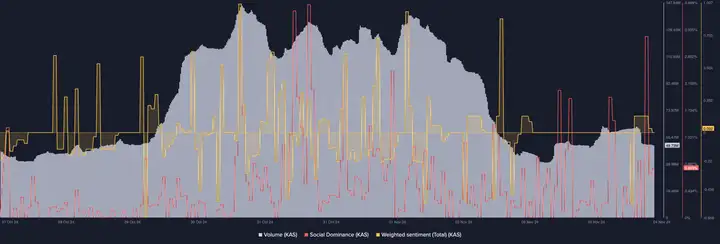
然而,在这次大幅下跌之后,一些链上指标暗示了看涨趋势的逆转。目前,KAS 的社交主导地位有所提高,反映了其在加密领域的受欢迎程度。

在急剧下跌之后,KAS 的加权情绪滑落至正值区域——这表明围绕该代币的看涨情绪一直在增强。
v2-b8681389e34dacfcf68d295b89426a23_720w.webp?source=d16d100b

在急剧上涨之后,Kaspa 的交易量开始下降。指标的下降通常意味着趋势逆转。

与此同时,KAS 的未平仓合约下降。每当该指标下降时,就意味着现行价格发生变化的可能性很高。
v2-af41f00d53abac119f47018b2eb8ecf0_720w.webp?source=d16d100b

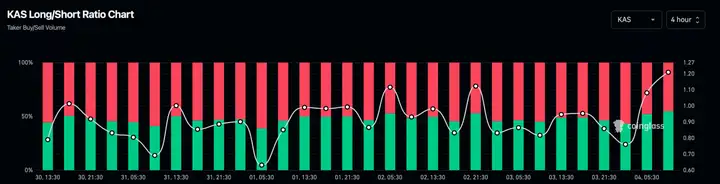
除此之外,KAS 的多头/空头比率也开始上升。这表明市场上的多头仓位多于空头仓位——这是一个看涨信号。

Kaspa 的死亡交叉显现

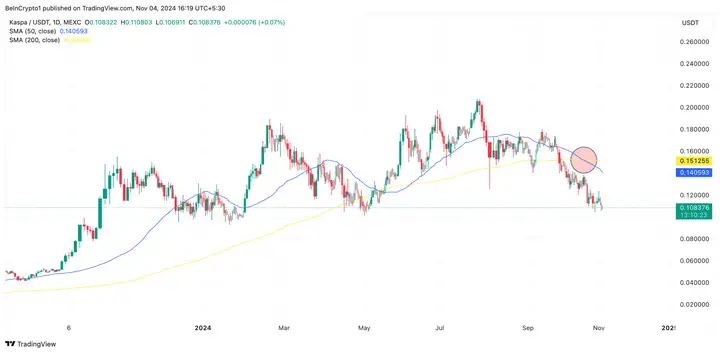
BeInCrypto 对KAS/USD 单日图的评估显示,10 月 22 日形成了死亡交叉。当资产的短期移动平均线(通常是 50 天移动平均线)跌破其长期移动平均线(通常是 200 天移动平均线)时,就会形成这种模式。

这种交叉是一个看跌信号,表明趋势正在减弱,近期价格下跌超过长期价格上涨。
v2-e881c186b059e3a94938938275ea29d3_720w.webp?source=d16d100b

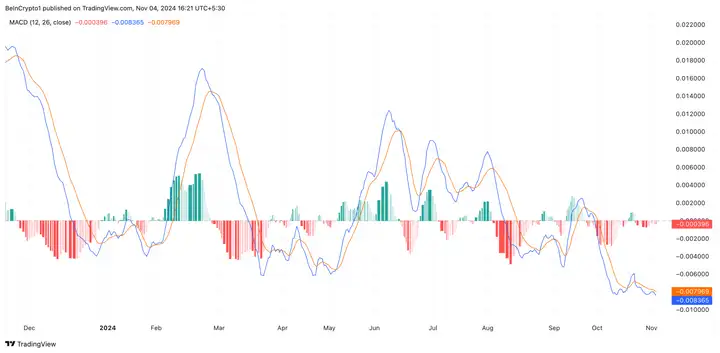
KAS 的死亡交叉预示着进一步的下跌,尤其是考虑到其他指标的看跌读数,例如其移动平均收敛/发散 (MACD) 指标——该指标跟踪其趋势方向、变化和潜在的价格反转点。截至本文撰写时,KAS 的 MACD 线(蓝色)位于其信号线(橙色)和零线下方。

MACD 线位于信号线下方被视为看跌信号,表明短期动能弱于长期趋势。这表明该资产的近期表现与其长期趋势相比有所放缓,可能导致进一步的抛售压力。
v2-0432b7beb55eaafa2d0a21d0cad91c33_720w.webp?source=d16d100b

当 MACD 和信号线均低于零线时,如 KAS 的情况,表明下行势头占主导地位。零线代表趋势转变的基线;低于零线则进一步表明市场可能看跌。

KAS 价格预测:KAS 的去向何方?

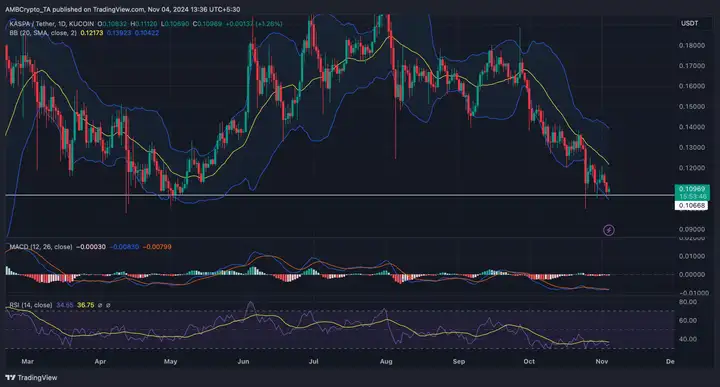
值得一提的是,通过检查 KAS 的日线图可以发现 Kaspa 的价格触及了布林带的下限。事实上,在撰写本文时,该代币正在测试关键支撑位。此类事件通常会导致价格上涨。
v2-e1c2fe816fa3b4563432a8bf9ab025e4_720w.webp?source=d16d100b

经过下跌后,该代币的相对强弱指数 (RSI) 略有上升。此外,技术指标 MACD 预测看涨交叉的可能性。

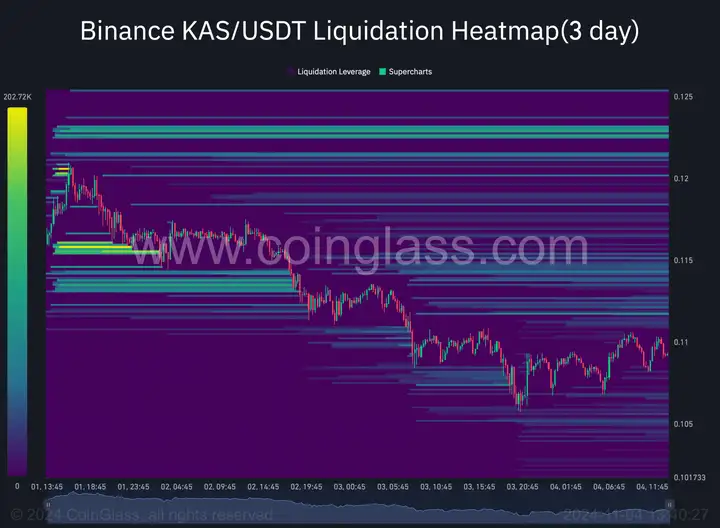
如果出现看涨趋势逆转,KAS 的第一个目标将是 0.122 美元,这并不令人意外。情况似乎确实如此,因为 Kaspa 的清算将在该水平大幅上升。
v2-d6eead6b49de5b6c17b02d82cee0dafb_720w.webp?source=d16d100b

通常,清算量增加会导致短期价格调整。突破该阻力位可能会推动 KAS 升至 8 月高点。

总而言之,KAS 交易价格为 0.1047 美元,正在测试关键支撑位 0.104 美元。随着抛售压力的增强,该代币的多头可能难以捍卫这一关键价格水平。跌破 0.104 美元将引发暴跌至 0.076 美元,这是 2023 年 11 月以来的最低点。

然而,如果市场对KAS 的情绪从看跌转为看涨,这种看跌前景可能会失效。如果发生这种情况,0.104 美元的支撑位可能会保持,并有可能推动该代币升至 0.16 美元。

简而言之,Kaspa 的股价在过去 30 天内下跌了两位数,多项指标暗示趋势将逆转至 0.12 美元。

Leituras Relacionadas

Tiger Research: Zuckerberg Begins Betting on Prediction Markets, While Asian Nations Still View Them as Gambling

This article examines the rise of prediction markets, contrasting their growing institutional acceptance in the West with their restrictive regulation in Asia. It details how prediction markets, which originated from informal political betting and academic experiments like the Iowa Electronic Market, aggregate crowd wisdom into probabilistic prices through binary contracts. Their growth accelerated around 2020, reaching over $14 billion in monthly volume. A key driver is the "skin in the game" principle, where users risk their own capital, leading to high accuracy in predicting events like Fed rate decisions and elections, as demonstrated by platforms like Polymarket. Meta's entry, with Mark Zuckerberg reportedly leading the development of the Arena app, signals the market's maturation. In the U.S., court rulings have distinguished prediction markets from gambling, facilitating entry by traditional financial institutions. However, most Asian jurisdictions still classify them as gambling, focusing on social control rather than financial innovation. The article argues this stance creates three problems for Asia: 1) regulatory arbitrage pushes users to riskier offshore platforms, 2) loss of sovereign information infrastructure as valuable social sentiment data accumulates abroad, and 3) abandonment of user protection. It concludes that Asia needs a policy shift from prohibition to constructive regulation, integrating these markets into the formal system to harness their data as a national asset, as initiatives like Limitless Research are beginning to do.

marsbitHá 41m

Tiger Research: Zuckerberg Begins Betting on Prediction Markets, While Asian Nations Still View Them as Gambling

marsbitHá 41m

Ethereum's Next Decade in the Eyes of Vitalik

"Lean Ethereum" Long-Term Roadmap Unveiled by Vitalik Buterin On July 5, 2026, Vitalik Buterin published the "Lean Ethereum" roadmap, positioning it as Ethereum's third major evolution following the Merge. This multi-year, multi-phase upgrade aims to fundamentally transform Ethereum's core protocol through staged network upgrades extending to 2029. Key goals include achieving 1 gigagas per second L1 throughput (a massive increase from the current ~32 TPS), near-instant finality, and quantum-resistant cryptography. The plan involves transitioning Ethereum's security model from full transaction re-execution by all nodes to native verification via recursive STARK proofs. A major proposed change is replacing the EVM with a proof-friendly architecture like RISC-V or leanISA, though this remains a point of contention, especially with L2s like Arbitrum favoring alternatives like WASM. Other planned upgrades include a restructured state model with a large, cheap "warehouse" storage layer to drastically reduce fees for migrated applications, multi-dimensional gas pricing, and a new focus on making privacy a first-class, native protocol feature. While the roadmap significantly raises Ethereum's long-term technical ceiling, analysts note it does not directly address ETH's mid-term token economics or value capture. The plan's multi-year timeline means near-term price impact will likely depend on observable progress milestones, such as the successful deployment of the upcoming Glamsterdam gas limit increase, growth in L2 activity and blob usage, and trends in L1 fee revenue and ETH burn.

链捕手Há 2h

Ethereum's Next Decade in the Eyes of Vitalik

链捕手Há 2h

In Just 11 Days, Claude Rewrote Millions of Lines of Code, an Epic AI Engineering Feat Sparks Fury

In just 11 days, Bun's founder Jarred Sumner used Anthropic's Claude AI models to rewrite its million lines of code from Zig to Rust. This move sparked significant controversy, particularly from Zig's creator, Andrew Kelley, who publicly criticized Sumner's engineering practices and the decision to use AI for such a massive rewrite. Bun, a high-performance JavaScript/TypeScript runtime and rival to Node.js, was originally written in Zig. After Anthropic acquired Bun, the team encountered persistent stability and memory safety bugs in the Zig codebase. These issues, combined with Zig's strict policy against LLM-generated code, led to the decision to rewrite in Rust. The rewrite was executed using Claude AI tools at an estimated API cost of $165,000, dramatically reducing the expected time and financial cost. Andrew Kelley's response was scathing. He blamed the original bugs on poor engineering habits, calling Bun's Zig code a collection of "hacks on top of hacks." He expressed relief that Bun was no longer associated with Zig, fearing it would misrepresent the language and attract low-quality, AI-generated contributions. The tech community is divided; some view Kelley's critique as unprofessional, while others see it as a defense of engineering integrity. A major concern about the AI-driven rewrite is the resulting code quality. The translation from Zig left approximately 27,000 lines of unsafe Rust code, raising fears about long-term maintainability and technical debt. The debate centers on whether this project is a milestone in AI-assisted development or a future maintenance nightmare.

marsbitHá 3h

In Just 11 Days, Claude Rewrote Millions of Lines of Code, an Epic AI Engineering Feat Sparks Fury

marsbitHá 3h

From Auto Finance to Bitcoin to AI Engines: An Analysis of Cango's 'What Not to Do' Strategy

From Auto Finance to Bitcoin and Now AI: Cango's "What Not to Do" Strategy Cango, a Chinese auto finance platform that went public on the NYSE in 2018, is undergoing its third major transformation. After selling its entire auto business in 2024, it pivoted to become a large-scale Bitcoin miner, acquiring 50 exahash of mining rigs from Bitmain. However, its true goal was never Bitcoin, but owning and controlling energy infrastructure. Now, Cango is pivoting again. While most listed Bitcoin miners are leasing power to giant hyperscalers for AI training clusters, Cango is taking the opposite path. It has launched an AI inference subsidiary called EcoHash, focusing not on training but on distributed inference. The company's strategy hinges on the insight that over 70% of mining industry power is controlled by small, independent sites (10-50 MW), which are too small for hyperscalers but ideal for low-latency AI inference. Cango aims to partner with these small operators, providing the AI technology, customers, and financing through its EcoLink software layer, which can distribute workloads across sites for reliability. Cango maintains a hybrid model, running roughly 31.7 EH/s of Bitcoin mining for cash flow while aggressively cleaning its balance sheet—slashing long-term debt by 94.5% to $30.6 million and raising $75 million for its AI venture. Its first AI deployment will be at a 50 MW site in Georgia. The strategy faces skepticism, given the high costs of converting mining sites and the potential for an AI bubble. However, Cango's leadership believes discipline around "what not to do"—avoiding direct competition with hyperscalers in training—positions it to capture the long-tail demand for distributed AI inference power.

Foresight NewsHá 3h

From Auto Finance to Bitcoin to AI Engines: An Analysis of Cango's 'What Not to Do' Strategy

Foresight NewsHá 3h

Trading

Spot
活动图片