Coinbase проведет делистинг USDT, PYUSD и DAI для пользователей в Европе

cryptonews.ruPublicado em 2020-05-12Última atualização em 2024-12-12

Что произошло? 13 декабря ведущая американская централизованная криптобиржа (CEX) Coinbase проведет делистинг нескольких стейблкоинов с привязкой к фиату для европейских пользователей. Торговля будет прекращена активами USDT, PAX, PYUSD, GUSD, GYEN и DAI, поскольку они не соответствуют Закону о рынках криптоактивов (MiCA), который постепенно вводится в действие на территории блока.
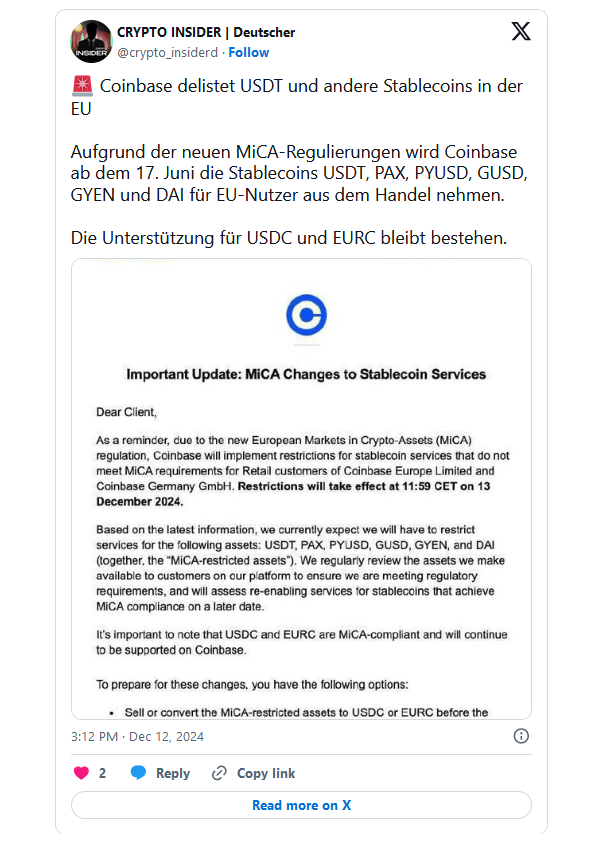
Источник: X.com

Что еще известно? Изменения не затронут стабильные монеты от эмитента Circle с привязкой к доллару и евро: USDC и EURC. В разработке USDC Coinbase принимала непосредственное участие, а сейчас активно использует эту монету в своих операциях.

В письме европейским клиентам биржа пояснила, что изменения касаются розничных клиентов платформ, операторами которых выступают Coinbase Europe Limited и Coinbase Germany GmbH. Компания рекомендовала до вышеуказанной даты конвертировать все подлежащие делистингу стейблкоины в USDC и EURC, либо перевести их с платформы на собственный некастодиальный кошелек.

При этом 1 декабря Coinbase также свернула программу выплаты вознаграждений держателям USDC в Европейской экономической зоне (ЕЭЗ), сославшись на MiCA.

В связи с изменениями в НКО Algorand Foundation, которая занимается поддержкой блокчейна Algorand с нативным токеном ALGO, выступили с заявлением. Команда подчеркнула, что USDC на Algorand останется доступен в ЕЭЗ, а также обратила внимание на компанию Quantoz, которая обладает лицензией на выпуск электронных денег в Европе и выступает эмитентом стейблкоина EURD на базе Algorand.
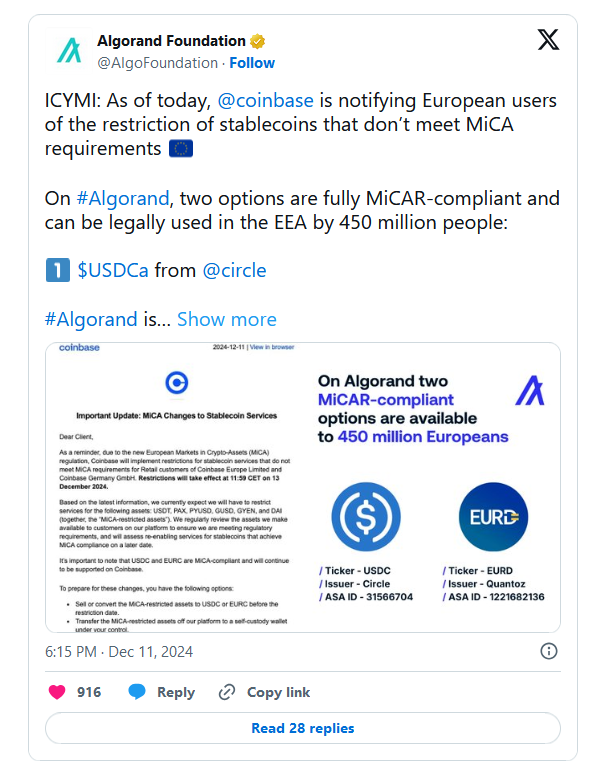
Источник: X.com

Coinbase анонсировала прекращение торговли не соответствующими требованиям MiCA стейблкоинами еще в начале октября. MiCA представляет собой всеобъемлющую нормативно-правовую базу для регулирования различных аспектов криптоотрасли и приведения правил в странах-участницах блока к единому стандарту.

Он требует в том числе регистрации криптофирм как минимум в одном государстве ЕС, что позволяет работать на всей территории блока.

Криптобиржа Bitstamp еще 30 июня прекратила торговлю EURT в Евросоюзе, а 1 июля платформа Uphold предприняла аналогичные действия в отношении USDT, DAI, FRAX, GUSD, USDP и TUSD.

Глава Tether, выпускающей USDT и EURT, заявлял, что MiCA может усложнить работу эмитентов стейблкоинов, а также повысить риски использования подобных активов с лицензией.

USDT является крупнейшим стейблкоином на крипторынке, по капитализации он уступает лишь биткоину и Ethereum с показателем 139,8 млрд долларов.


Criptomoedas em alta

Leituras Relacionadas

A Guide to Grayscale’s ‘Bottom Fishing’: Using Cash Flow to Assess Cryptocurrency Value

**Title:** Grayscale's Guide to Bottom-Fishing: Valuing Cryptoassets Using Cash Flows **Summary:** This report by Grayscale Research presents a fundamental valuation framework for cryptocurrency assets, moving beyond pure speculation to analyze those with underlying cash flows. It distinguishes between "commodity-like" assets (e.g., Bitcoin) and "cash-flow" assets, primarily within DeFi. Using the leading decentralized lending protocol Aave as a case study, the analysis applies traditional financial methodologies like Discounted Cash Flow (DCF) and Price-to-Earnings (P/E) multiples. Key findings indicate that AAVE tokens are currently undervalued. Despite recent challenges, the protocol's strong revenue growth, ~50% net profit margin, and diversified treasury support a fundamental valuation range of $80-$100 per token (compared to a ~$75 market price at the time of writing). In a base-case scenario driven by stablecoin adoption and regulatory clarity, the fair value could rise to around $175 within a year. The report emphasizes that protocol success does not automatically translate to token value. It critically examines the "value capture" mechanisms—such as buybacks, burns, and staking rewards—that channel protocol profits to token holders. Furthermore, it addresses the legal and governance complexities of Decentralized Autonomous Organizations (DAOs), noting their difference from traditional corporate equity but highlighting how robust, transparent governance can align protocol economics with holder interests. The conclusion is that the crypto market is maturing, with capital increasingly flowing towards projects with demonstrable fundamentals, real adoption, and disciplined capital allocation, creating opportunities for value-based investors.

marsbitHá 1m

A Guide to Grayscale’s ‘Bottom Fishing’: Using Cash Flow to Assess Cryptocurrency Value

marsbitHá 1m

After semiconductors lead the gains, are funds buying into AI orders or a macroeconomic rebound?

After US-Iran talks led to a temporary ceasefire and framework for reopening the strategic Strait of Hormuz, U.S. stocks rose on June 18, with the Nasdaq gaining 1.9%. The semiconductor and AI hardware sectors outperformed. This rally stemmed primarily from reduced geopolitical risk, which lowered oil prices and inflation expectations, easing discount rate pressure on high-valuation growth stocks like tech. The key question is not whether tech rebounded, but the nature of the rebound. The market appears to be selectively repricing AI infrastructure plays rather than broadly chasing AI narratives. Gains were concentrated in chips, optical interconnects, memory, and domestic manufacturing—segments tied to tangible data center build-outs and capital expenditure. Intel's ~10% surge, fueled by a Trump statement about potential Apple collaboration, exemplifies this mixed dynamic. It reflects policy catalysts and domestic manufacturing sentiment more than confirmed fundamentals. Meanwhile, strong earnings from companies like Astera Labs (revenue up 93% YoY) provided concrete evidence of AI-driven demand in hardware. In essence, the rally represents a risk-premium recalibration. Lower Middle East tensions opened a valuation repair window, and capital flowed first into AI infrastructure segments with visible near-term revenue streams. The sustainability of this move hinges on upcoming Q2 earnings, specifically continued strength in cloud provider capex, AI server orders, and hardware company guidance. Policy hopes alone are insufficient; the cycle needs validation from orders and financials.

marsbitHá 6m

After semiconductors lead the gains, are funds buying into AI orders or a macroeconomic rebound?

marsbitHá 6m

The Entire Internet Hails Noam's Joining, But OpenAI's Loss Bill Just Got Thicker

While the AI community celebrates Noam Shazeer, co-author of the "Attention Is All You Need" paper, joining OpenAI as Head of Architectural Research, the company's audited financials reveal a starkly different reality. In 2025, OpenAI reported $13.07 billion in revenue but a massive $20.92 billion operating loss. Even excluding a one-time accounting charge, the cash burn is severe, with $3.7 billion consumed in Q1 2026 alone. This high-profile hiring occurs against a backdrop of significant internal research talent drain, with key founders and researchers departing as the company's focus shifts from exploratory research to product iteration. Meanwhile, OpenAI's fundamental business model faces a deep crisis. It paid Microsoft $10.59 billion for compute in 2025, while its vast user base of 9 billion weekly actives includes only 50 million paying customers, making growth a direct driver of escalating costs. The article argues Shazeer's recruitment is less about technical necessity and more about crafting a compelling narrative for OpenAI's upcoming IPO, aiming to justify a rumored $1 trillion valuation to future public market investors. It contrasts OpenAI's strategy with Anthropic's reported path to profitability, which relies on a strong enterprise customer base and cost control, rather than star-powered narratives. Ultimately, the piece concludes that while Shazeer's architectural work may take 1-2 years to materialize, OpenAI's financial clock is ticking much faster, with its massive losses undercutting the celebratory headlines.

marsbitHá 1h

The Entire Internet Hails Noam's Joining, But OpenAI's Loss Bill Just Got Thicker

marsbitHá 1h

Trading

Spot
Futuros

Artigos em Destaque

Como comprar PYUSD

Bem-vindo à HTX.com!Tornámos a compra de Paypal USD (PYUSD) simples e conveniente.Segue o nosso guia passo a passo para iniciar a tua jornada no mundo das criptos.Passo 1: cria a tua conta HTXUtiliza o teu e-mail ou número de telefone para te inscreveres numa conta gratuita na HTX.Desfruta de um processo de inscrição sem complicações e desbloqueia todas as funcionalidades.Obter a minha contaPasso 2: vai para Comprar Cripto e escolhe o teu método de pagamentoCartão de crédito/débito: usa o teu visa ou mastercard para comprar Paypal USD (PYUSD) instantaneamente.Saldo: usa os fundos da tua conta HTX para transacionar sem problemas.Terceiros: adicionamos métodos de pagamento populares, como Google Pay e Apple Pay, para aumentar a conveniência.P2P: transaciona diretamente com outros utilizadores na HTX.Mercado de balcão (OTC): oferecemos serviços personalizados e taxas de câmbio competitivas para os traders.Passo 3: armazena teu Paypal USD (PYUSD)Depois de comprar o teu Paypal USD (PYUSD), armazena-o na tua conta HTX.Alternativamente, podes enviá-lo para outro lugar através de transferência blockchain ou usá-lo para transacionar outras criptomoedas.Passo 4: transaciona Paypal USD (PYUSD)Transaciona facilmente Paypal USD (PYUSD) no mercado à vista da HTX.Acede simplesmente à tua conta, seleciona o teu par de trading, executa as tuas transações e monitoriza em tempo real.Oferecemos uma experiência de fácil utilização tanto para principiantes como para traders experientes.

205 Visualizações TotaisPublicado em {updateTime}Atualizado em 2026.06.02

Como comprar PYUSD

Discussões

Bem-vindo à Comunidade HTX. Aqui, pode manter-se informado sobre os mais recentes desenvolvimentos da plataforma e obter acesso a análises profissionais de mercado. As opiniões dos utilizadores sobre o preço de PYUSD (PYUSD) são apresentadas abaixo.

活动图片