Bitcoin Miner Incomes Under Stress

GlassnodePublicado em 2022-06-13Última atualização em 2022-06-13

Resumo

With the market trading near the price lows of the 2021-22 cycle, a great majority of investors are now holding unrealized losses.

With the market trading near the price lows of the 2021-22 cycle, a great majority of investors are now holding unrealized losses. Furthermore, miners appear to experiencing some income stress, with revenues falling, whilst production costs climb.

CryptoVizArt

Glassnode

CryptoVizArt, Glassnode

Jun 6, 2022 • 10 min read

Miner Incomes Under Stress

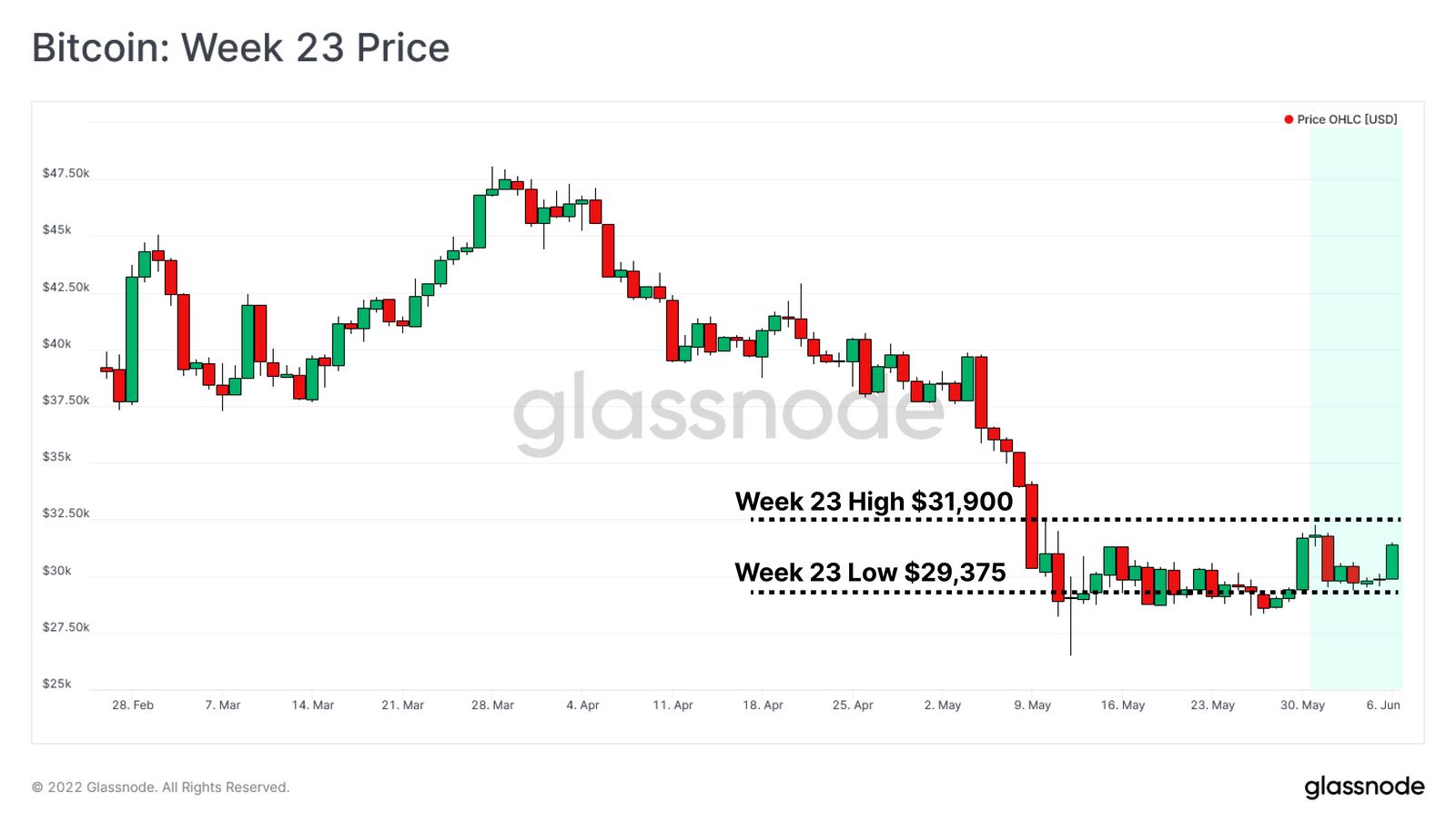
Coming out of a bloody nine consecutive red weeks, the market closed its first weekly candle in the green, albeit with a relatively uninspiring weekly gain of 1.57%. The market traded between a weekly high of $31,900 and a low of $29,375.

With prices trading at the lower end of the 2021-22 cycle range, the vast majority of buyers from the last 17-months are now holding unrealized losses. The intensity of this uncertainty and stress in the market is observable in on-chain data, with a continual reliance on Long-Term Holders to shoulder the load.

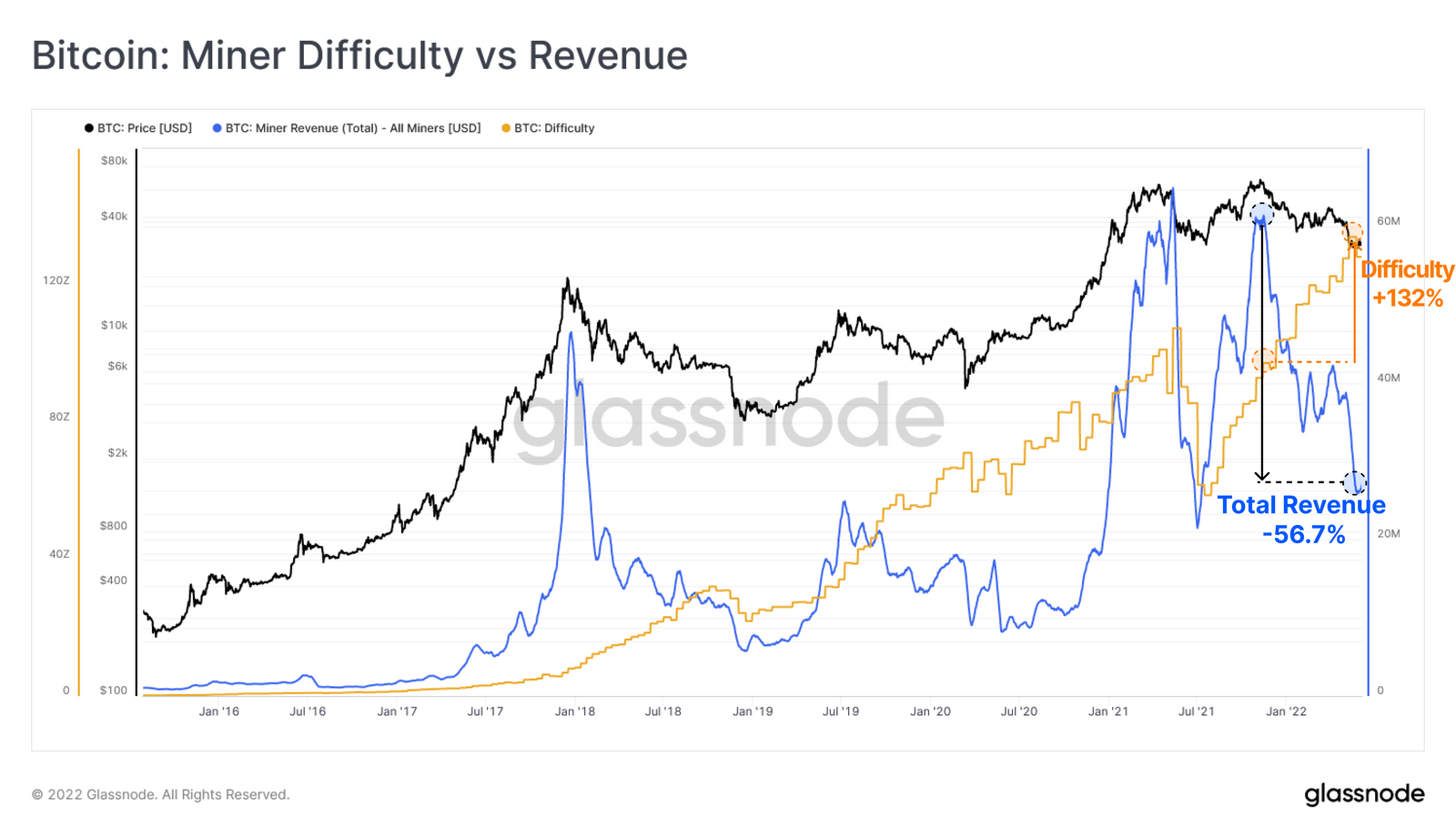
We are also seeing miner revenues decline substantially, despite the climbing difficulty. This suggests that miner operations have expanded, capital has been spent, and production costs have increased as revenues are falling off. As profit multiples compress across the board and financial stress increases, the highest probability is that the market is within the second and historically final capitulation phase of a Bitcoin bear market.
Translations

This Week On-chain is now being translated into Spanish, Italian, Chinese, Japanese, Turkish, French, Portuguese, Farsi, Polish, Hebrew and Greek.

The Week Onchain Dashboard

The Week Onchain Newsletter has a live dashboard with all featured charts available here. This dashboard and all covered metrics are explored further on our Video Report which is released on Tuesdays each week. Visit and subscribe to our Youtube Channel, and visit our Video Portal for more video content and metric tutorials.

Historical Macro Lows

Among all models mapping the value zones in Bitcoin market, two simple but powerful indicators have been utilized widely by analysts alike; the Mayer Multiple and Realized Price.

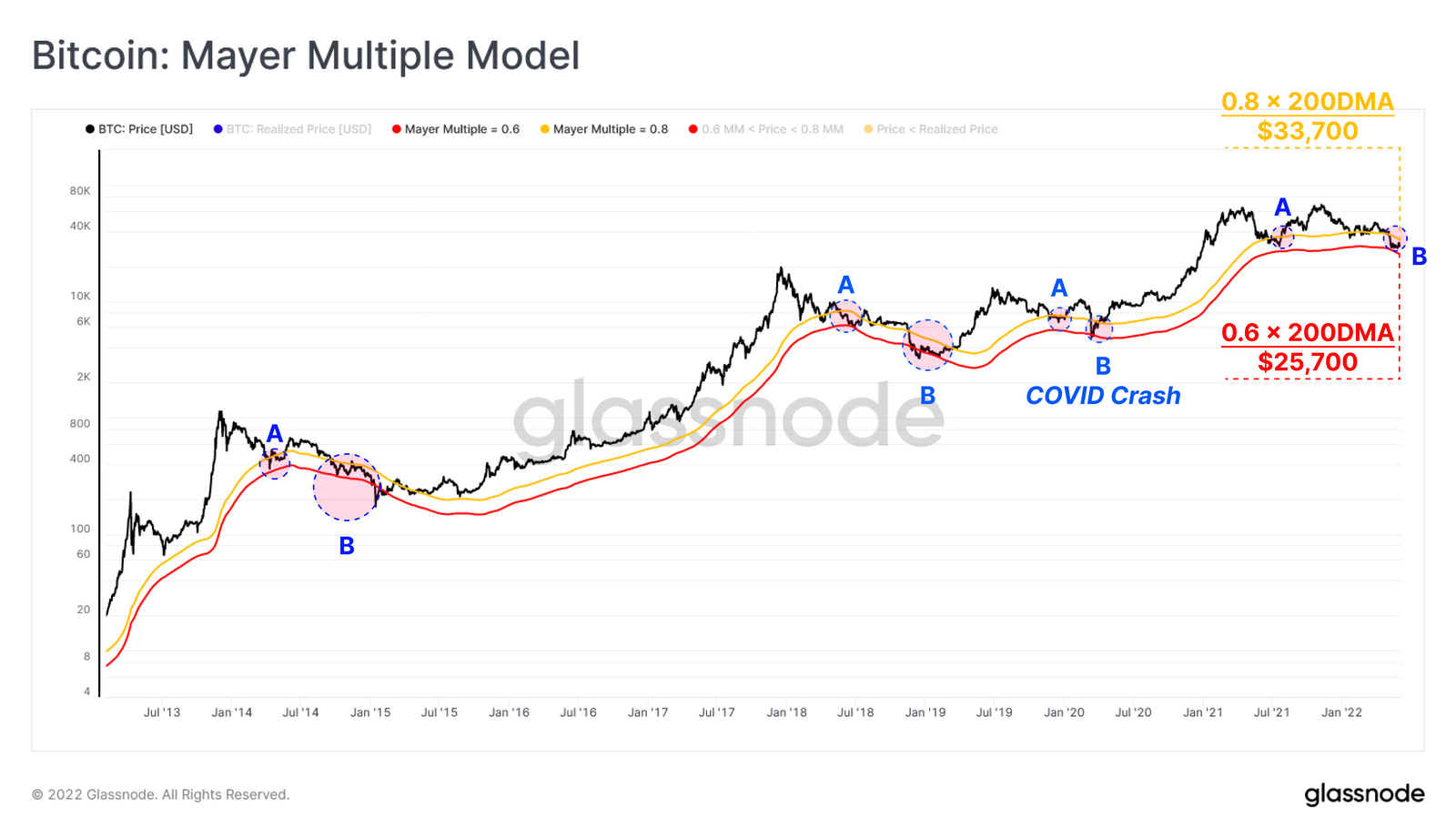
The Mayer Multiple is an oscillator defined as the ratio between price and the 200-day moving average. Therefore the Mayer Multiple represents the deviation from this long-term average price as a tool to gauge overbought and oversold conditions incorporating data points encompassing Bitcoin’s lifespan.

Following the original analysis, oversold or undervalued conditions have coincided with the Mayer Multiple falling in the range of 0.6-0.8. These multiples are applied to the 200DMA in the following chart to demonstrate the undervalued zones according to Mayer Multiple; 0.6 MM < Price < 0.8 MM.

Throughout the past four bear markets, market prices have entered this value range in two distinguishable phases:

Phase A- Early in the bear market, as the initial post-ATH sell-off causes investors to panic

Phase B Late-stage bear market as the market enters the bottom formation and capitulation

In the current market, prices have been hovering inside this value zone ($25,200 to $33,700) since 5-May, more closely resembling Phase B of the previous bear cycles. From a probabilistic view, Bitcoin prices have only closed below a Mayer Multiple of 0.8 for 7.9% of trading days.
Live Workbench

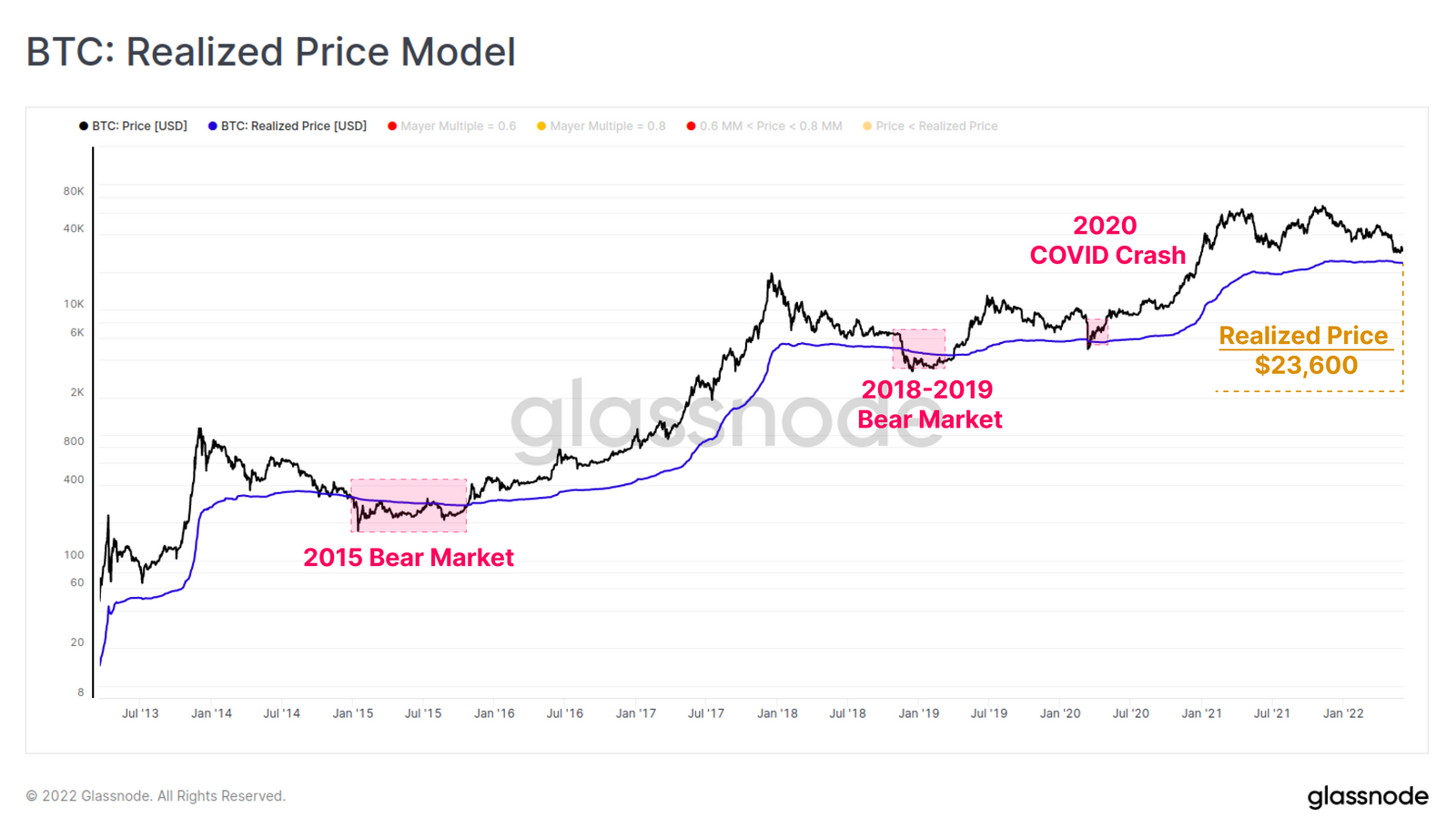
The Realized Price Model is the former macro indicator to map the cycle bottoms. The Realized Price is currently trading at $23,600 and represents the estimated average cost basis of all coins in the Bitcoin supply, based on the price when they last moved on-chain. In previous bear market cycles, when spot prices traded below the Realized Price, it signalled elevated probabilities of a macro low being established.

Historically, the overall market cost basis or realized price has been a very sound cycle support level, with 84.9% of Bitcoin trading days closing above this level. In other words, only 15.1% of trading days have closed below the Realized Price, providing a similar confluence with the Mayer Multiple of 0.8.
Live Workbench

A Prolonged Bear Market & Profitability

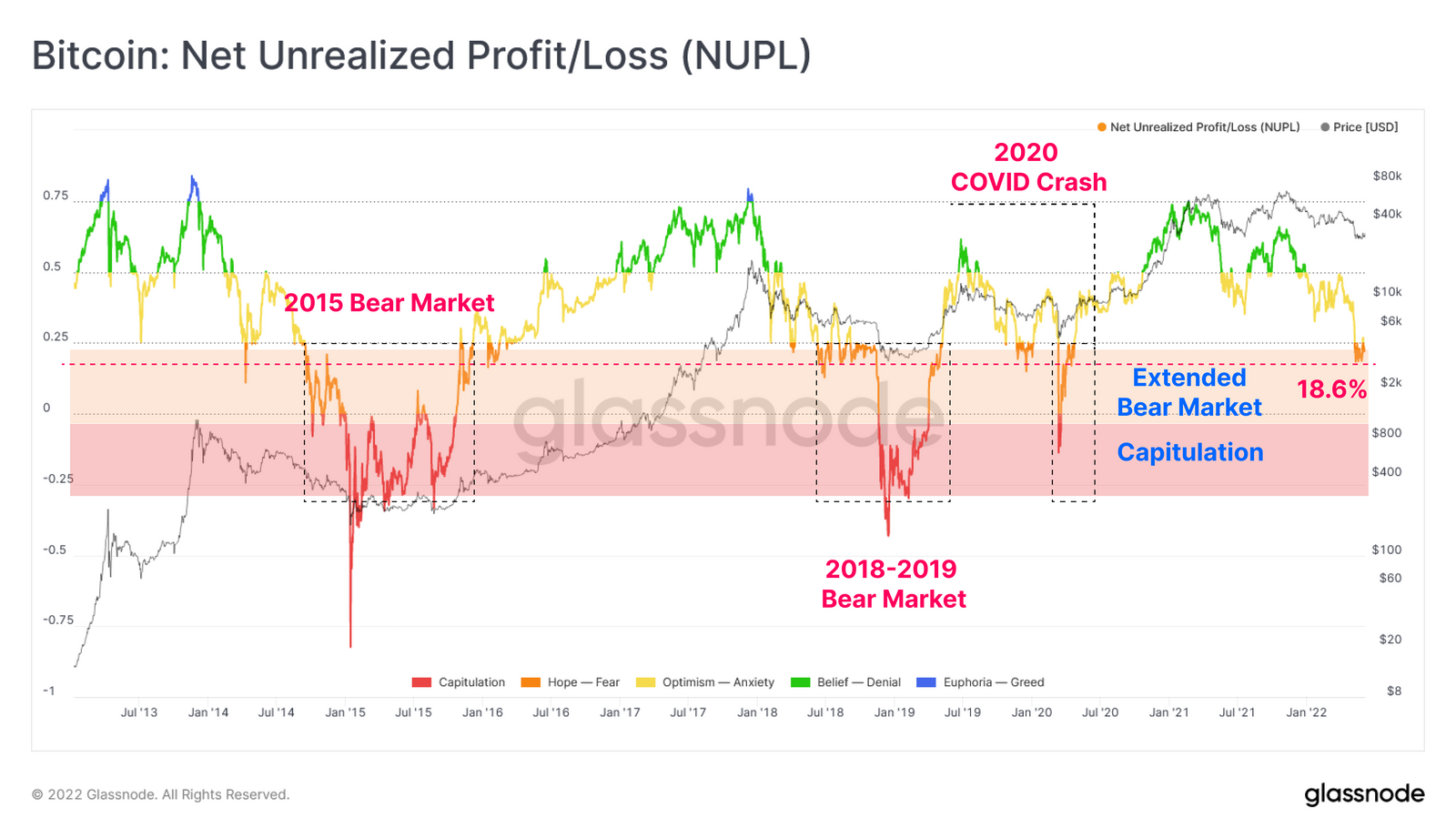
Having now assessed past bear market structure to model a potential cycle bottom zone, the confidence of this claim can be queried by quantifying the degree of ‘Bear Market pain’ felt across the network. The Net Unrealized Profit/Loss (NUPL) metric maps out the overall unrealized profit and loss of the network as a proportion of the market cap. Thus NUPL can be used as a compass to assess this market pain threshold.

Since early May, the NUPL has fluctuated in a compressed range of 18.6% to 25.0%, indicating less than 25% of the market cap is held in profit. This resembles a market structure equivalent to pre-capitulation phases in previous bear markets. In the event of a capitulation, the NUPL has usually traded down to an unrealized loss of up to -25% times the Market Cap. Given the current realized price of $23,600, the matching price range of $23,600 to $20,560 is where NUPL would imply a full-scale capitulation scenario.

It is worth noting that NUPL cycle lows have been gradually climbing as a result of both lost and long HODLed coins. This impact may well be further intensified by the introduction of derivatives, which enable the hedging of risk without selling spot exposure.
Live Chart

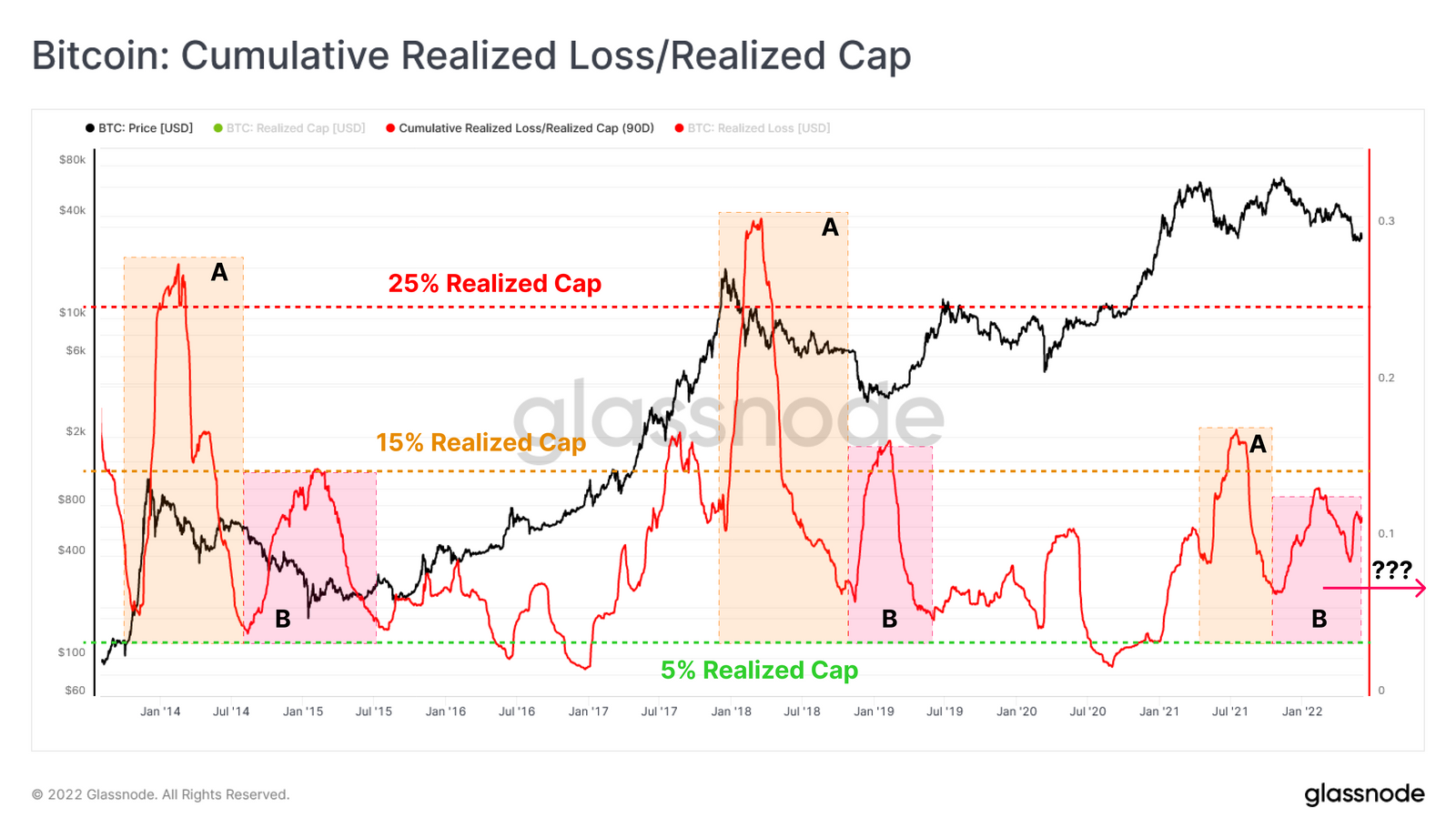
Since NUPL tracks the unrealized profit and loss in the market, we can supplement with an investigation of the Realized Losses to gauge the actual investor response. Here, the Cumulative Realized Loss (90D) is presented as a ratio with the Realized Cap to normalize for market size. Consistent with the highlighted two-phase bear market pattern in the Mayer Multiple models, the cumulative realized loss chart also is denoting two stages in a bear market.

The early wave of losses of the current cycle has already been realized via the post ATH crash in May-July 2021 (phase A). At the moment, the market is experiencing phase B where the probability of a capitulation event taking place is elevated, and sustained losses are being realized on-chain.
Live Workbench

Long-Term Holders Shoulder Losses

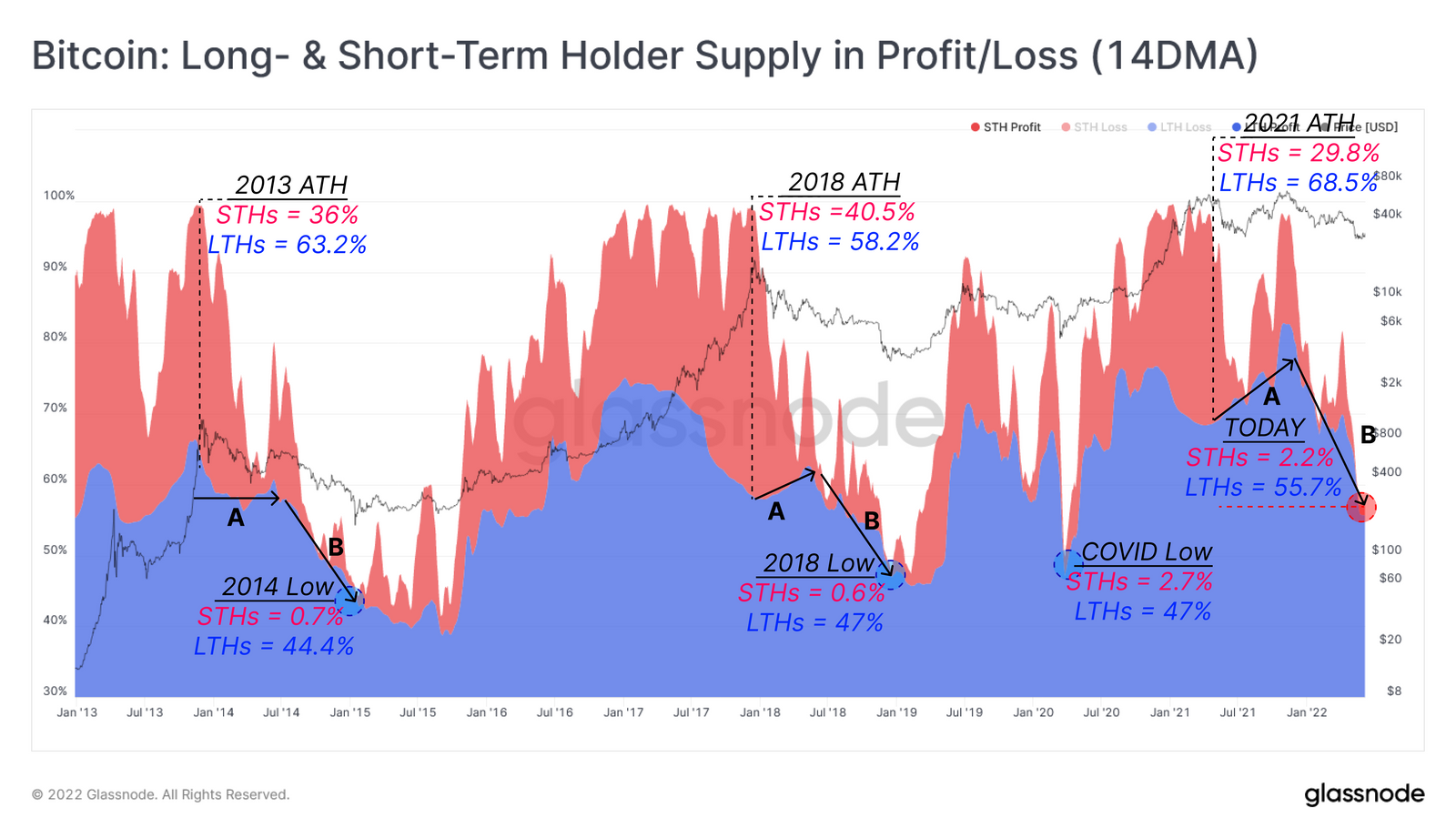
One of the outstanding trends of a bear market is the diminishing share of short-term holders (STHs), as speculators are flushed from the market. As a result, STHs end up holding fewer coins, and Long-Term Holders accumulate and dominate the circulating supply. This trend is the result of two parallel events occurring during a bear market:

Phase A: Short-term holders who purchased near the top are immediately plunged into a loss, reducing their overall Supply in Profit.

Phase B: Long-Term Holder accumulation persists during the bear, despite prices pushing their newly acquired coins into an unrealized loss.

At the moment, almost 58% of the circulating supply is in profit while in the last three market capitulations this metric fell down to <50% levels. STH-Supply in profit is just 2.2% meaning the short-term holders are almost entirely at a loss. Meanwhile, LTHs have seen their share of profitable supply drop from 68.5% in April to 55.7% today, indicating they are currently shouldering much of the market's unrealized losses.
Live Chart

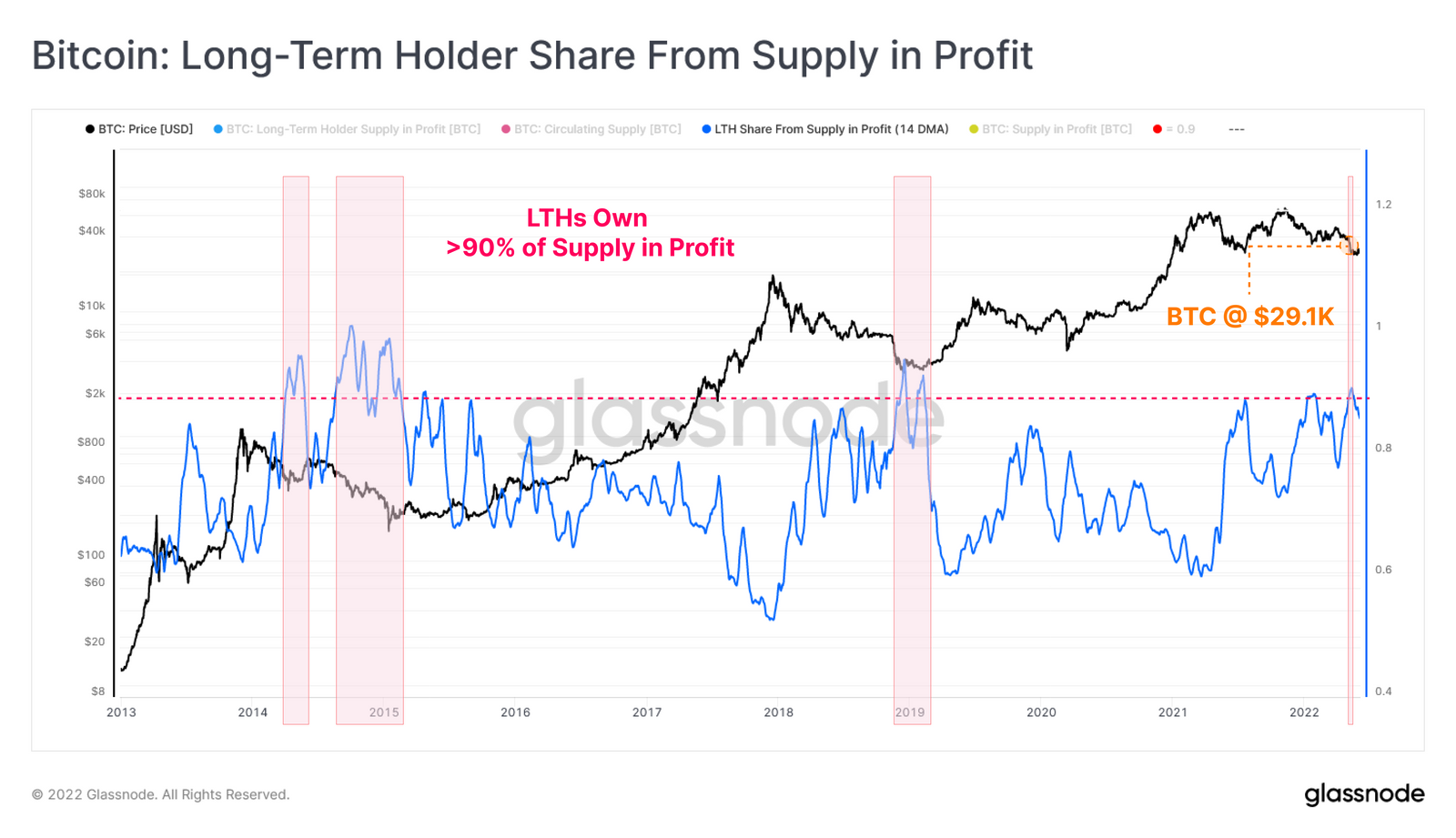
To add a new dimension to this observation, we can look into the share of Supply in Profit Held By Long-Term Holders. Here, the growing dominance of long-term holders (or diminishing share of short-term holders) through the late stages of a bear market are noticeable.

In the last two extended bear markets, the 14 DMA of this metric broke above the 90% threshold line. This means under the psychological pressure of bearish price action, short-term holders were holding < 10% of the profit in the market. With the recent leg down to sub $30K range, this metric crossed over the 90% threshold. Above this level, STHs have essentially reached a near-peak pain threshold, with almost no unrealized profits held while LTHs dominating the remaining profitable supply.
Live Workbench

Moreover, the examination of the unrealized loss distribution among LTHs and STHs suggests the following findings of the current cycle:

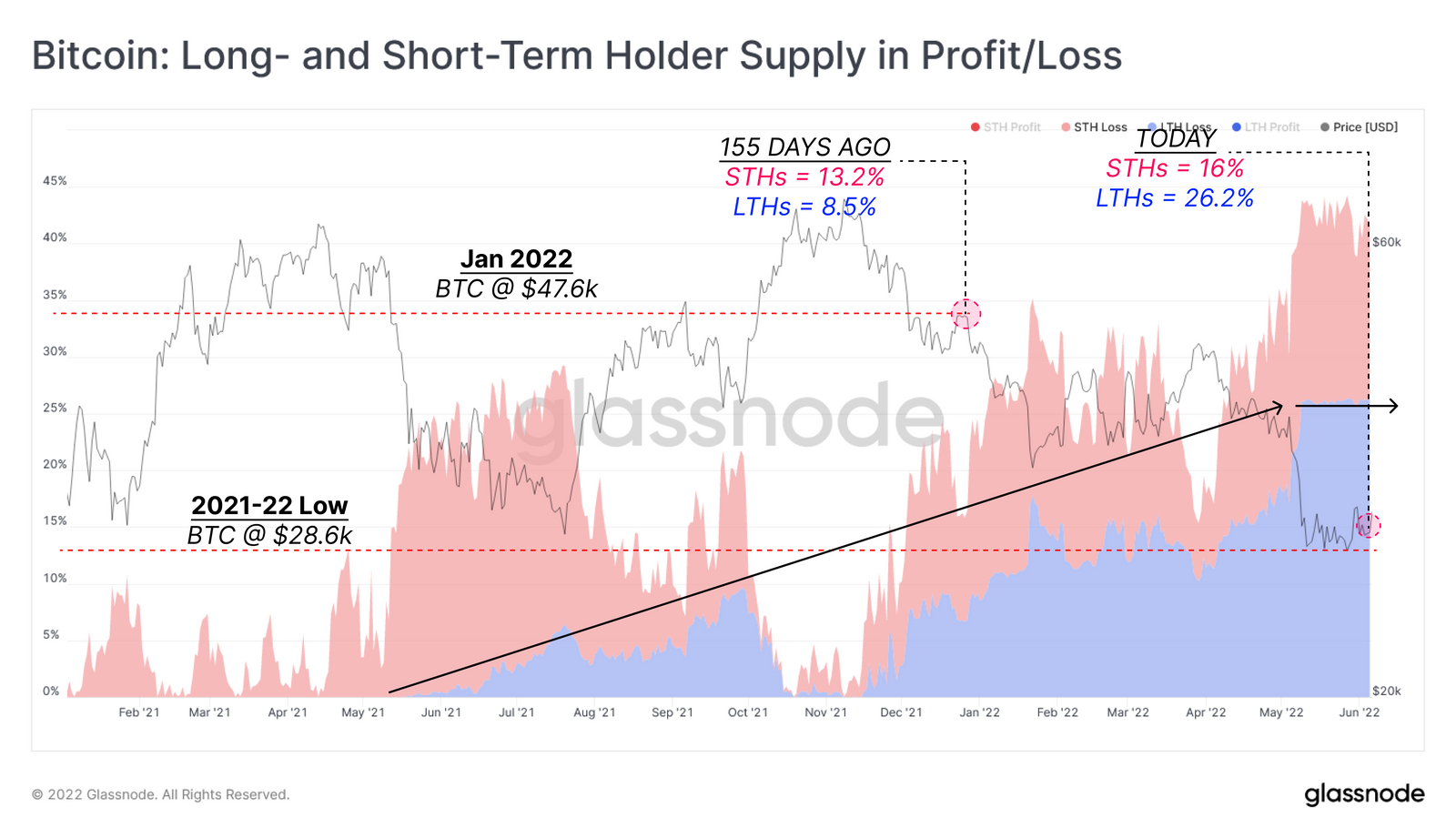
Price currently is trading at the lows of the 2021-2022 cycle, which means almost all buyers since Jan-2021 are now holding unrealized losses.

The LTH supply in loss has been increasing since May 2021 but has since plateaued at 26% of supply (vs. STHs with 16%). This indicates that LTHs are shouldering more of the unrealized losses (a constructive reshuffling of coin ownership), and currently holds around 62% of the 2021-22 cycle supply in loss (26% / (26%+16%)).

STH Supply in loss is also approximately stable, oscillating around 16% to 18% of supply. Note that 155-days ago (1-Jan-2022) the price was $47k. Thus the majority of STHs accumulated throughout the previous consolidation range in Q1 2022.
Live Chart

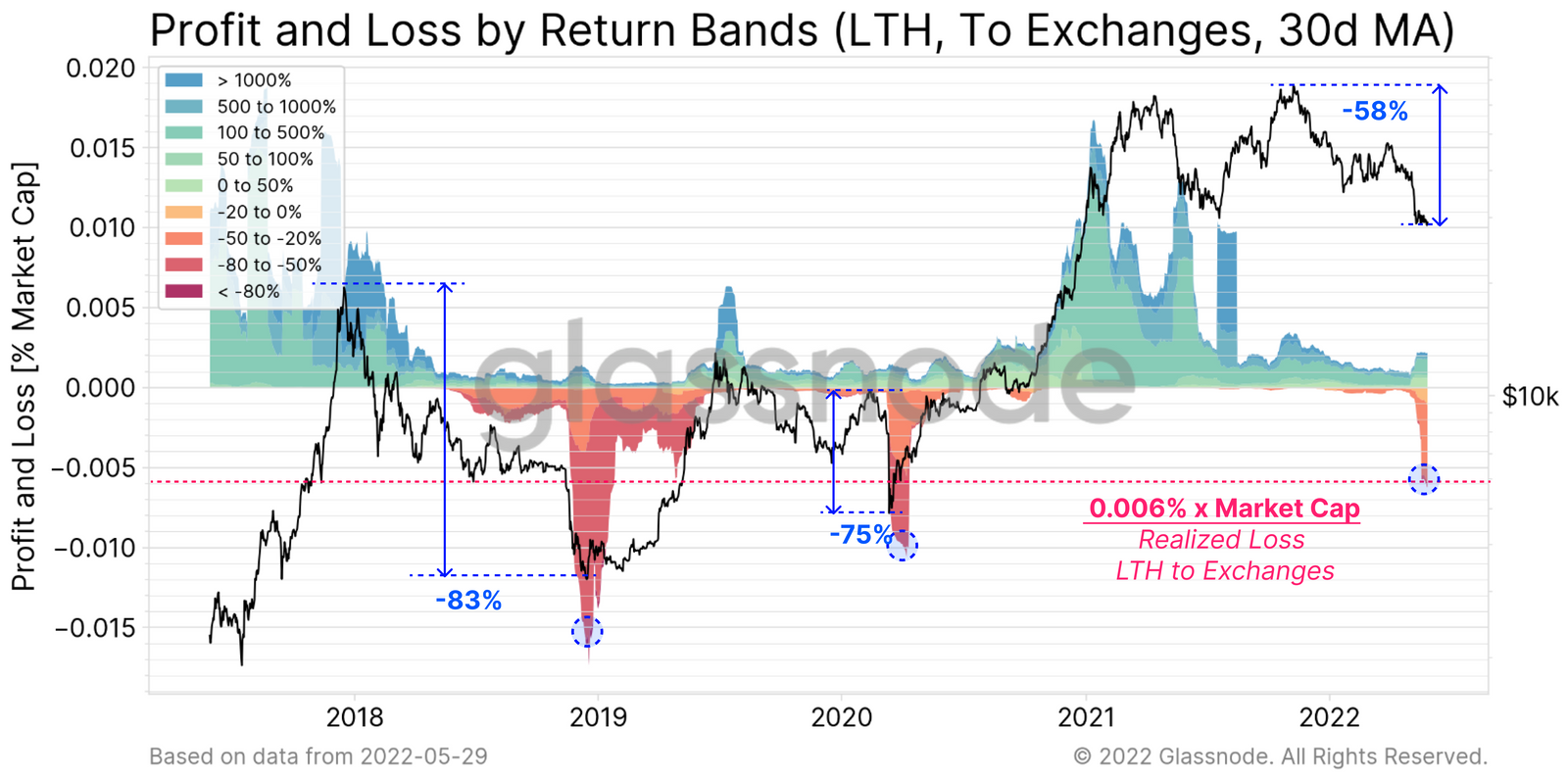
The behavioural analysis of the LTHs under pressure would not be concluded without examining their reaction to intense price corrections. Here we will inspect the Return Bands of Long-Term Holders’ Realized Profit & Loss metric, specifically for coins deposited into exchanges. In the 2018-19 bear market and the March 2020 Covid crash, the aggregated realized loss exceeded 0.006% of the market cap. This pattern has now reoccurred during the plunge below $30K in early May. To lay a foundation for this investigation, we should emphasize that:

The LTH losses on coins deposited to exchanges have now reached a magnitude comparable to previous bear markets. However, we do not yet have the duration component, and also the drawdown magnitude is 58% relative to previous >75% drawdowns.
Miner Earnings Under Stress

After determining the severity of the current bear market and exploring the long-term holders’ corresponding behaviour, we will now assess the reaction of miners to declining incomes.

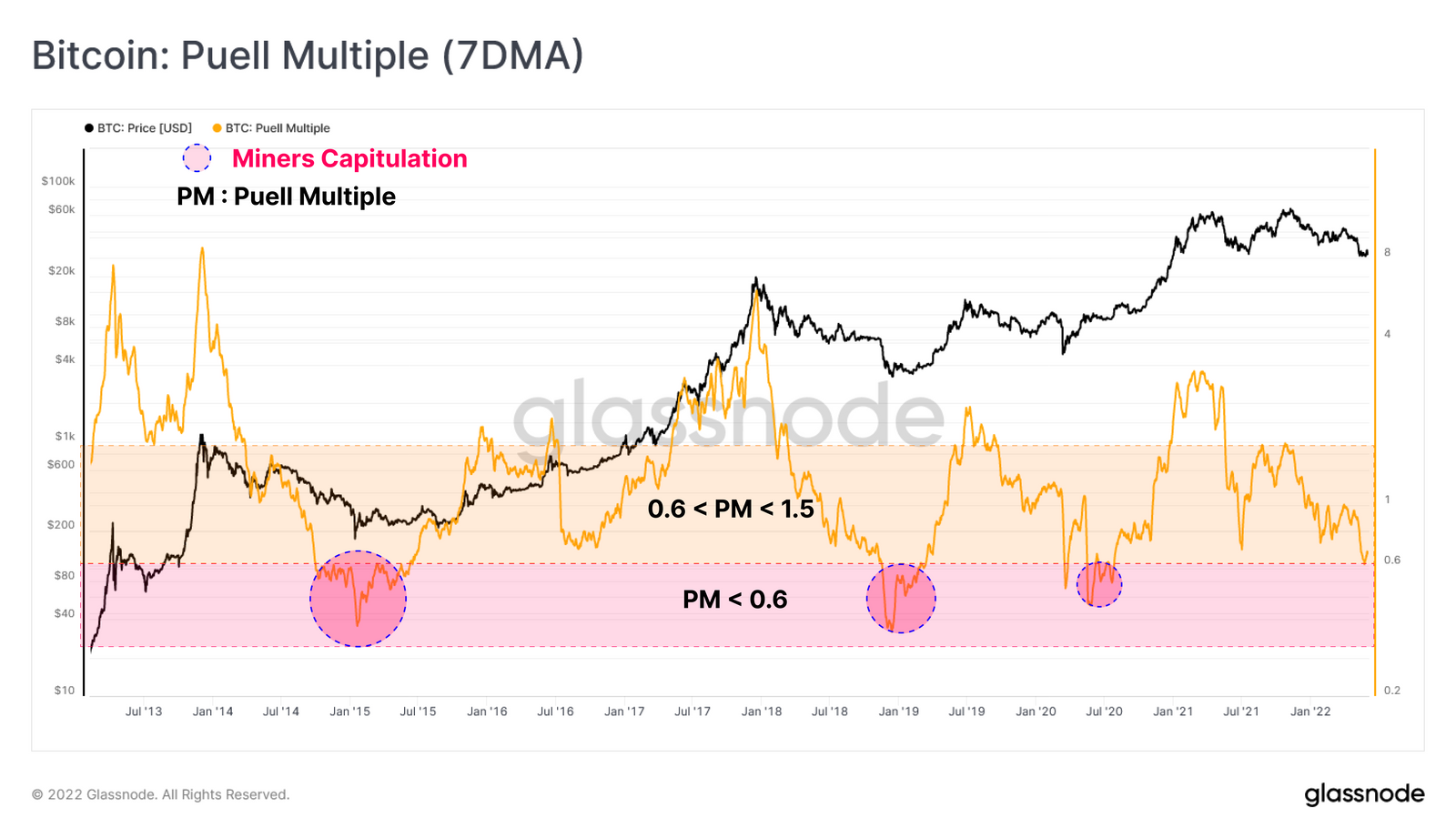
To lay a foundation for this analysis we first have to quantify the profitability of the market from the miners’ perspective. The Puell Multiple is the ratio of the daily issuance value of bitcoin (in USD) to the 365-day moving average of this value.

Assessing the entire history of Puell Multiple, the two-phase-bear market narrative outlined above is also evident here. At the early stages of the bear market, the Puell Multiple typically falls into the range of 0.6 to 1.0, indicating current incomes are up to 40% lower than the last year on average. Subsequently, in the later stages of a prolonged bear market where the capitulation events tend to take place, the Puell Multiple plunges to the sub-0.5 zone.

This metric is currently sitting at 0.66, on the edge of entering the capitulation range. Taking the high correlation between this indicator and price into account, a price decline of -10% or more would indicate widespread stress on miner income streams.
Live Chart

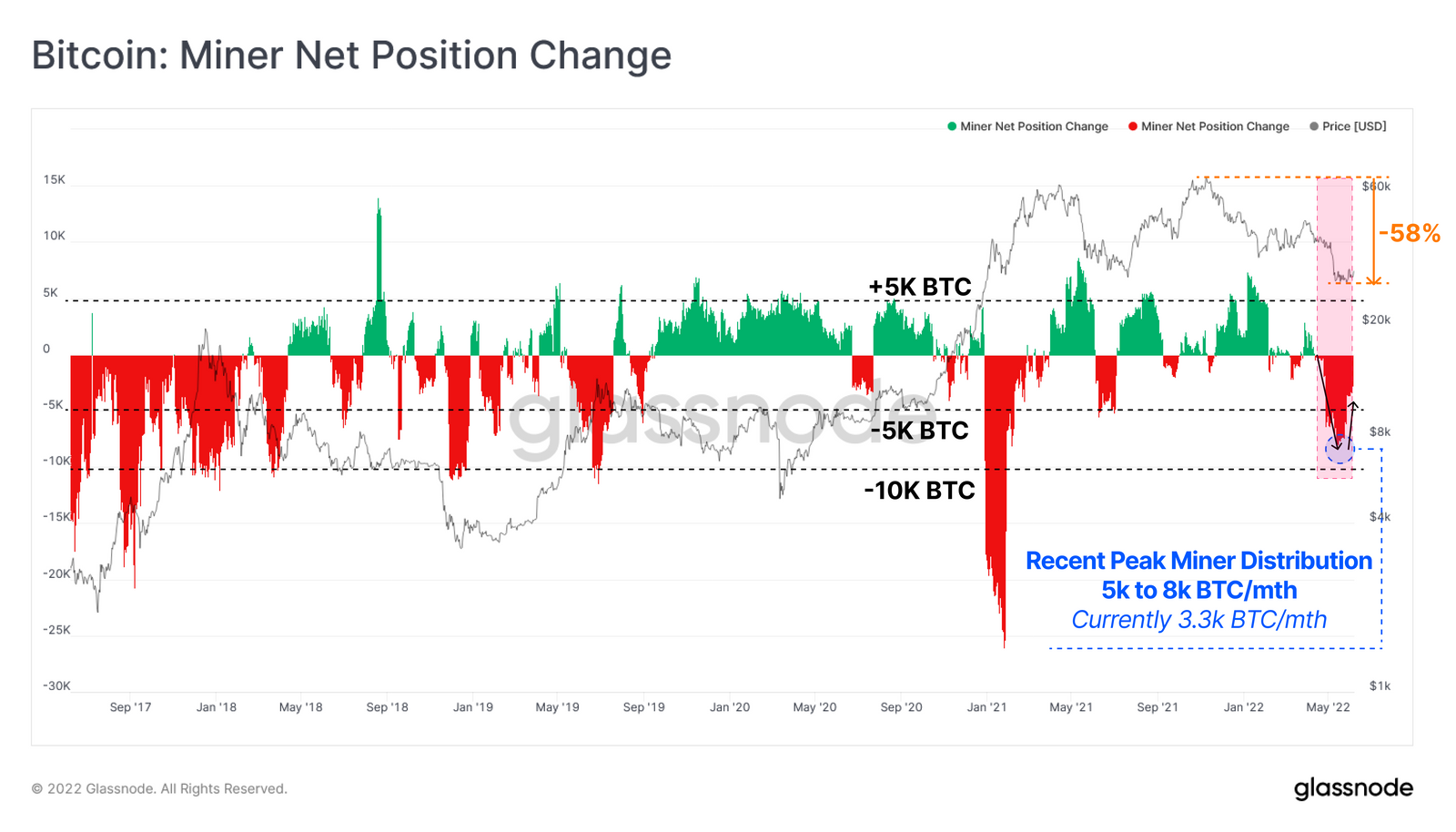
In reaction to the prevailing decline in USD incomes since November 2021, we can observe miner balances declining and additional spending taking place. The Miner Net Position Change metric is currently indicating an aggregate miner balance reduction of between 5k and 8k BTC per month.
Live Chart

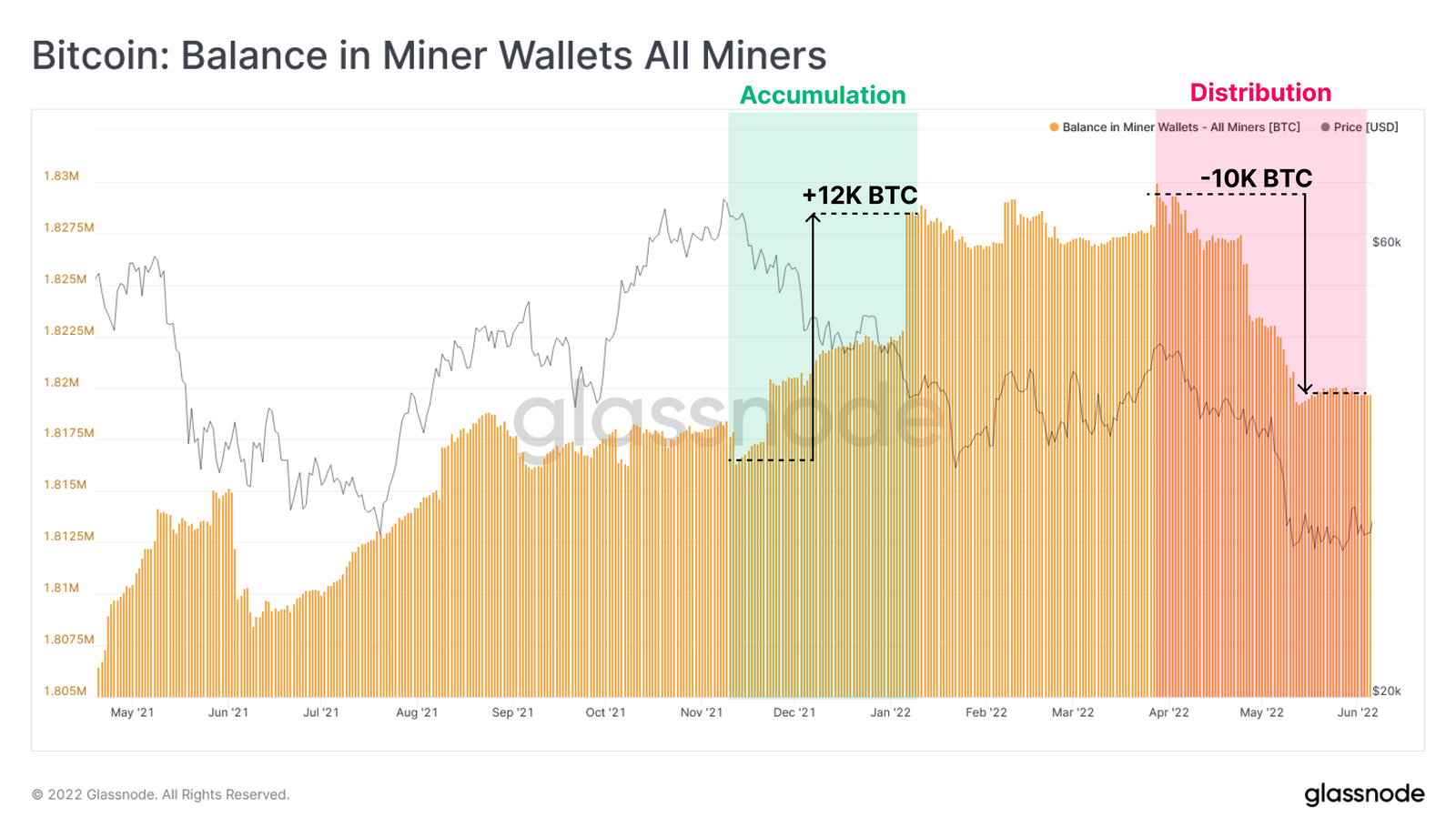
This signals a distinct change in miner behaviour, as their balance had seen a net accumulation of around 12k BTC during the first drawdown from ATH. In response to the market crash due to LUNA Foundation selling over 80k BTC in an attempt to maintain the UST peg, miners have since distributed 10k BTC adding to the selling pressure in the market.
Live Chart

A Chronological Divergence

An intriguing divergence to discuss is the continued climbing of network difficulty, which has risen by 132% since the ATH, despite the financial incentive of total miner revenue dropping by 56.7%. This substantial jump in difficulty suggests that existing miners have expanded their operations, and new miners have joined the network despite a massive income reduction. As such it is likely that recent capital expenses on mining hardware and facilities could add continued pressure to miners’ balance sheets.
Live Workbench

Summary and Conclusion

Based on the Mayer Multiple, and the Realized Price, the market has now pushed Bitcoin prices down to levels that have been seen for less than 15% of Bitcoins trading days.

Network unrealized losses are hovering in the twilight zone of late-stage bear markets, however, are not yet signalling complete capitulation. With prices at the lower bound of the 2021-22 cycle, all buyers since 1-Jan-2021 are now underwater.

Long-Term Holders are currently shouldering the majority (62%) of unrealized losses, signifying that a gradual but constructive change of ownership has taken place throughout this bear market.

Miners appear to be increasingly under stress, with signs of both balance sheet reduction alongside recent operation expansion expressed through rising difficulty. This means that each coin is now more expensive to mine, whilst the USD denominated reward continues to decline and may portend a potential miner capitulation cycle ahead.


Leituras Relacionadas

$9.4 Billion: The Largest Robotics Funding This Year Has Emerged

Munich-based humanoid robotics company Neura has completed a $1.4 billion (approximately RMB 94.9 billion) Series C funding round, valuing the company at around $7 billion and positioning it among the global leaders in the sector. The investment round is notable not just for its size—reportedly the largest in robotics this year—but also for its strategic backers, which include tech giants like NVIDIA and Amazon, alongside established industrial players such as German engineering firms Bosch and Schaeffler. This mix of investors signals a significant shift in the industry's focus from technological demonstrations and general-purpose narratives toward practical, industrial deployment and commercialization. Neura's approach centers on developing humanoid robots for defined, high-value industrial tasks rather than pursuing a general-purpose model. Its early validation comes from a partnership with BMW, where its robots are being tested on actual production lines. The involvement of Bosch and Schaeffler, companies deeply embedded in global manufacturing, underscores a growing belief that humanoid robots are transitioning from labs to viable factory-floor solutions. The article highlights two converging trends driving investment: advancements in AI and large language models, which enhance robots' perception and decision-making in unstructured environments, and mounting pressure from labor shortages and rising costs in major manufacturing regions. The funding landscape is now bifurcating between companies like Figure AI, focusing on versatile general-purpose robots, and firms like Neura, targeting specific vertical industrial applications with clearer, shorter paths to ROI. While technical hurdles remain, the core challenges for widespread adoption are increasingly seen as engineering and commercial in nature: managing the high integration and customization costs for different factory environments and establishing robust, localized maintenance and service networks. The record investment in Neura, particularly from industrial capital, indicates the industry's growing confidence in moving from proving feasibility to solving the practical problems of scalability, reliability, and building sustainable business models around humanoid robots in real-world settings like automotive manufacturing and hazardous labor environments.

marsbitHá 3h

$9.4 Billion: The Largest Robotics Funding This Year Has Emerged

marsbitHá 3h

"119 to 176 Dollars": Behind SpaceX's Listing, MSX Once Again Successfully Executes the Pre-IPO Closed Loop

Following May's 300% gain on Cerebras, MSX delivered another outstanding performance during SpaceX's listing night. On June 12, SpaceX (SPCX) launched on Nasdaq, reaching a high of $176. This marked the successful culmination of MSX's Pre-IPO project launched in March, where users subscribed at $119, achieving gains of approximately 40-48%. This event validated MSX's complete Pre-IPO mechanism, a crucial advantage in a market where access to top-tier private company equity is typically limited to institutions. MSX's model provides a full cycle for users: subscription (at $119 for SpaceX), real-time on-chain portfolio tracking, optional early redemption, seamless conversion to tradable spot assets (SPCX.M) upon IPO, and final settlement in stablecoins. This end-to-end process distinguishes MSX from platforms that faced settlement issues during the SpaceX IPO, highlighting that the core challenge of Pre-IPO is not just access, but a clear exit and conversion path post-listing. This success with SpaceX is MSX's second major Pre-IPO verification, following the Cerebras listing in May, which yielded ~300% returns for early participants. These back-to-back achievements demonstrate MSX's capability to source, structure, and deliver real assets through a replicable on-chain model. The true barrier for Pre-IPO products lies not in providing an entry point, but in ensuring reliable fulfillment from subscription through to post-IPO liquidity. MSX's proven闭环 (closed-loop) process addresses this, offering Web3 users a structured way to access high-growth, pre-public companies in sectors like AI and frontier tech. MSX plans to continue expanding its Pre-IPO portfolio with this focus on authenticity, transparency, and post-listing execution.

Odaily星球日报Há 16h

"119 to 176 Dollars": Behind SpaceX's Listing, MSX Once Again Successfully Executes the Pre-IPO Closed Loop

Odaily星球日报Há 16h

Trading

Spot
Futuros

Artigos em Destaque

O que é BITCOIN

Compreender o HarryPotterObamaSonic10Inu (ERC-20) e a Sua Posição no Espaço Cripto Nos últimos anos, o mercado de criptomoedas assistiu a um aumento na popularidade das moedas meme, cativando não apenas os traders, mas também aqueles que procuram envolvimento comunitário e valor de entretenimento. Entre estes tokens únicos está o HarryPotterObamaSonic10Inu (ERC-20), um projeto intrigante que mistura referências culturais no tecido das criptomoedas. Este artigo explora os principais aspetos do HarryPotterObamaSonic10Inu, examinando os seus mecanismos, a sua ética orientada pela comunidade e o seu envolvimento com o vasto panorama cripto. O que é o HarryPotterObamaSonic10Inu (ERC-20)? Como o nome sugere, o HarryPotterObamaSonic10Inu é uma moeda meme construída na blockchain Ethereum, classificada sob o padrão ERC-20. Ao contrário das criptomoedas tradicionais, que podem enfatizar a utilidade prática ou o potencial de investimento, este token prospera no valor de entretenimento e na força da sua comunidade. O projeto visa promover um ambiente onde utilizadores envolvidos possam reunir-se, partilhar ideias e participar em atividades inspiradas por diversos fenómenos culturais. Uma característica notável do HarryPotterObamaSonic10Inu é a zero taxa sobre transações. Este elemento atraente visa encorajar a negociação e o envolvimento da comunidade, isento de encargos adicionais que podem desencorajar os traders de pequena escala. A oferta total da moeda está fixada em mil milhões de tokens, uma cifra que marca a sua intenção de manter uma circulação substancial dentro da comunidade. Criador do HarryPotterObamaSonic10Inu (ERC-20) As origens do HarryPotterObamaSonic10Inu estão um pouco envoltas em mistério; os detalhes sobre o criador permanecem desconhecidos. O desenvolvimento deste token carece de uma equipa identificável ou de um plano explícito, o que não é raro no setor das moedas meme. Em vez disso, o projeto surgiu de forma orgânica, com o seu progresso a depender fortemente do entusiasmo e da participação da sua comunidade. Investidores do HarryPotterObamaSonic10Inu (ERC-20) No que diz respeito a investimentos externos e apoios, o HarryPotterObamaSonic10Inu também permanece ambíguo. O token não lista quaisquer fundações de investimento conhecidas ou apoio organizacional significativo. Em vez disso, o “sangue vital” do projeto é a sua comunidade de base, que informa o seu crescimento e sustentabilidade através da ação coletiva e do envolvimento no espaço cripto. Como Funciona o HarryPotterObamaSonic10Inu (ERC-20)? Como uma moeda meme, o HarryPotterObamaSonic10Inu opera principalmente fora dos quadros tradicionais que muitas vezes governam o valor dos ativos. Existem vários aspetos distintivos que definem como o projeto funciona: Transações Sem Taxas: Sem taxas sobre transações, os utilizadores podem comprar e vender o token livremente, sem a preocupação de custos ocultos. Envolvimento da Comunidade: O projeto prospera na interação da comunidade, aproveitando plataformas de redes sociais para criar entusiasmo e facilitar a participação. Discussões, partilha de conteúdo e envolvimento são elementos cruciais que ajudam a expandir o seu alcance e a fomentar a lealdade entre os apoiantes. Sem Utilidade Prática: Deve ser notado que o HarryPotterObamaSonic10Inu não oferece utilidade concreta dentro do ecossistema financeiro. Em vez disso, é classificado como um token principalmente para entretenimento e atividades comunitárias. Referência Cultural: O token incorpora de forma inteligente elementos da cultura popular para atrair interesse, conectando-se tanto com entusiastas de memes como com seguidores de criptomoedas. HarryPotterObamaSonic10Inu exemplifica como as moedas meme operam de forma diferente de projetos de criptomoedas mais tradicionais, entrando no mercado como construções sociais inovadoras em vez de ativos utilitários. Linha do Tempo do HarryPotterObamaSonic10Inu (ERC-20) A história do HarryPotterObamaSonic10Inu é marcada por vários marcos notáveis: Criação: O token surgiu de um meme viral, capturando a imaginação de muitos entusiastas de criptomoedas. Datas específicas de criação não estão disponíveis, sublinhando a sua ascensão orgânica. Listagem em Exchanges: O HarryPotterObamaSonic10Inu conseguiu entrar em várias exchanges, permitindo um acesso e negociação mais fáceis pela comunidade. Iniciativas de Envolvimento da Comunidade: Atividades contínuas direcionadas a melhorar a interação comunitária, incluindo concursos, campanhas em redes sociais e geração de conteúdo por fãs e defensores. Planos de Expansão Futura: O roteiro do projeto inclui o lançamento de uma coleção de NFTs, mercadorias e um site de eCommerce relacionado aos seus temas culturais, envolvendo ainda mais a comunidade e tentando adicionar mais dimensões ao seu ecossistema. Pontos-Chave sobre o HarryPotterObamaSonic10Inu (ERC-20) Natureza Orientada pela Comunidade: O projeto prioriza a contribuição coletiva e a criatividade, assegurando que o envolvimento dos utilizadores está na vanguarda do seu desenvolvimento. Classificação como Moeda Meme: Representa o epítome da criptomoeda baseada em entretenimento, destacando-se dos veículos de investimento tradicionais. Sem Afiliação Direta com o Bitcoin: Apesar da semelhança no nome do ticker, o HarryPotterObamaSonic10Inu é distinto e não tem qualquer relação com o Bitcoin ou outras criptomoedas estabelecidas. Foco na Colaboração: O HarryPotterObamaSonic10Inu é projetado para criar um espaço de colaboração e partilha de histórias entre os seus detentores, proporcionando uma via para a criatividade e o fortalecimento da comunidade. Perspectivas Futuras: A ambição de expandir além da sua premissa inicial para NFTs e mercadorias delineia um caminho para o projeto potencialmente entrar em avenidas mais mainstream dentro da cultura digital. À medida que as moedas meme continuam a capturar a imaginação da comunidade cripto, HarryPotterObamaSonic10Inu (ERC-20) destaca-se devido aos seus laços culturais e abordagem centrada na comunidade. Embora possa não se encaixar no molde típico de um token orientado para utilidade, a sua essência reside na alegria e camaradagem fomentadas entre os seus apoiantes, destacando a natureza em evolução das criptomoedas em uma era cada vez mais digital. À medida que o projeto continua a desenvolver-se, será importante observar como as dinâmicas comunitárias influenciam a sua trajetória no panorama em constante mudança da tecnologia blockchain.

1.7k Visualizações TotaisPublicado em {updateTime}Atualizado em 2024.12.03

O que é BITCOIN

Como comprar BTC

Bem-vindo à HTX.com!Tornámos a compra de Bitcoin (BTC) simples e conveniente.Segue o nosso guia passo a passo para iniciar a tua jornada no mundo das criptos.Passo 1: cria a tua conta HTXUtiliza o teu e-mail ou número de telefone para te inscreveres numa conta gratuita na HTX.Desfruta de um processo de inscrição sem complicações e desbloqueia todas as funcionalidades.Obter a minha contaPasso 2: vai para Comprar Cripto e escolhe o teu método de pagamentoCartão de crédito/débito: usa o teu visa ou mastercard para comprar Bitcoin (BTC) instantaneamente.Saldo: usa os fundos da tua conta HTX para transacionar sem problemas.Terceiros: adicionamos métodos de pagamento populares, como Google Pay e Apple Pay, para aumentar a conveniência.P2P: transaciona diretamente com outros utilizadores na HTX.Mercado de balcão (OTC): oferecemos serviços personalizados e taxas de câmbio competitivas para os traders.Passo 3: armazena teu Bitcoin (BTC)Depois de comprar o teu Bitcoin (BTC), armazena-o na tua conta HTX.Alternativamente, podes enviá-lo para outro lugar através de transferência blockchain ou usá-lo para transacionar outras criptomoedas.Passo 4: transaciona Bitcoin (BTC)Transaciona facilmente Bitcoin (BTC) no mercado à vista da HTX.Acede simplesmente à tua conta, seleciona o teu par de trading, executa as tuas transações e monitoriza em tempo real.Oferecemos uma experiência de fácil utilização tanto para principiantes como para traders experientes.

4.2k Visualizações TotaisPublicado em {updateTime}Atualizado em 2026.06.02

Como comprar BTC

O que é $BITCOIN

OURO DIGITAL ($BITCOIN): Uma Análise Abrangente Introdução ao OURO DIGITAL ($BITCOIN) OURO DIGITAL ($BITCOIN) é um projeto baseado em blockchain que opera na rede Solana, com o objetivo de combinar as características dos metais preciosos tradicionais com a inovação das tecnologias descentralizadas. Embora partilhe um nome com o Bitcoin, frequentemente referido como “ouro digital” devido à sua percepção como uma reserva de valor, o OURO DIGITAL é um token separado projetado para criar um ecossistema único dentro da paisagem Web3. O seu objetivo é posicionar-se como um ativo digital alternativo viável, embora os detalhes sobre as suas aplicações e funcionalidades ainda estejam em desenvolvimento. O que é o OURO DIGITAL ($BITCOIN)? OURO DIGITAL ($BITCOIN) é um token de criptomoeda explicitamente projetado para uso na blockchain Solana. Em contraste com o Bitcoin, que fornece um papel amplamente reconhecido como armazenamento de valor, este token parece focar em aplicações e características mais amplas. Aspectos notáveis incluem: Infraestrutura Blockchain: O token é construído na blockchain Solana, conhecida pela sua capacidade de lidar com transações de alta velocidade e baixo custo. Dinâmicas de Oferta: O OURO DIGITAL tem um fornecimento máximo limitado a 100 quatrilhões de tokens (100P $BITCOIN), embora os detalhes sobre o seu fornecimento circulante ainda não tenham sido divulgados. Utilidade: Embora as funcionalidades precisas não estejam explicitamente delineadas, existem indicações de que o token poderia ser utilizado para várias aplicações, potencialmente envolvendo aplicações descentralizadas (dApps) ou estratégias de tokenização de ativos. Quem é o Criador do OURO DIGITAL ($BITCOIN)? Neste momento, a identidade dos criadores e da equipa de desenvolvimento por trás do OURO DIGITAL ($BITCOIN) permanece desconhecida. Esta situação é típica entre muitos projetos inovadores no espaço da blockchain, particularmente aqueles alinhados com finanças descentralizadas e fenómenos de moedas meme. Embora tal anonimato possa fomentar uma cultura orientada pela comunidade, intensifica as preocupações sobre governança e responsabilidade. Quem são os Investidores do OURO DIGITAL ($BITCOIN)? As informações disponíveis indicam que o OURO DIGITAL ($BITCOIN) não tem apoiantes institucionais conhecidos ou investimentos proeminentes de capital de risco. O projeto parece operar num modelo peer-to-peer focado no apoio e adoção da comunidade, em vez de rotas de financiamento tradicionais. A sua atividade e liquidez estão principalmente situadas em exchanges descentralizadas (DEXs), como a PumpSwap, em vez de plataformas de negociação centralizadas estabelecidas, destacando ainda mais a sua abordagem de base. Como Funciona o OURO DIGITAL ($BITCOIN) A mecânica operacional do OURO DIGITAL ($BITCOIN) pode ser elaborada com base no seu design de blockchain e nas características da rede: Mecanismo de Consenso: Ao aproveitar o exclusivo proof-of-history (PoH) da Solana combinado com um modelo de proof-of-stake (PoS), o projeto assegura uma validação eficiente das transações, contribuindo para o alto desempenho da rede. Tokenomics: Embora mecanismos deflacionários específicos não tenham sido extensivamente detalhados, o vasto fornecimento máximo de tokens implica que pode atender a microtransações ou casos de uso de nicho que ainda estão por definir. Interoperabilidade: Existe o potencial para integração com o ecossistema mais amplo da Solana, incluindo várias plataformas de finanças descentralizadas (DeFi). No entanto, os detalhes sobre integrações específicas permanecem não especificados. Cronologia de Eventos Chave Aqui está uma cronologia que destaca marcos significativos relacionados ao OURO DIGITAL ($BITCOIN): 2023: O lançamento inicial do token ocorre na blockchain Solana, marcado pelo seu endereço de contrato. 2024: O OURO DIGITAL ganha visibilidade ao tornar-se disponível para negociação em exchanges descentralizadas como a PumpSwap, permitindo que os utilizadores o negociem contra SOL. 2025: O projeto testemunha atividade de negociação esporádica e potencial interesse em envolvimentos liderados pela comunidade, embora não tenham sido documentadas parcerias ou avanços técnicos notáveis até ao momento. Análise Crítica Forças Escalabilidade: A infraestrutura subjacente da Solana suporta altos volumes de transações, o que pode aumentar a utilidade do $BITCOIN em vários cenários de transação. Acessibilidade: O potencial preço de negociação baixo por token pode atrair investidores de retalho, facilitando uma participação mais ampla devido a oportunidades de propriedade fracionada. Riscos Falta de Transparência: A ausência de apoiantes, desenvolvedores ou um processo de auditoria publicamente conhecidos pode gerar ceticismo em relação à sustentabilidade e confiabilidade do projeto. Volatilidade do Mercado: A atividade de negociação depende fortemente do comportamento especulativo, o que pode resultar em volatilidade significativa dos preços e incerteza para os investidores. Conclusão O OURO DIGITAL ($BITCOIN) surge como um projeto intrigante, mas ambíguo, dentro do ecossistema em rápida evolução da Solana. Embora tente aproveitar a narrativa do “ouro digital”, a sua divergência do papel estabelecido do Bitcoin como reserva de valor sublinha a necessidade de uma diferenciação mais clara da sua utilidade pretendida e estrutura de governança. A aceitação e adoção futuras dependerão provavelmente da abordagem da atual opacidade e da definição mais explícita das suas estratégias operacionais e económicas. Nota: Este relatório abrange informações sintetizadas disponíveis até outubro de 2023, e desenvolvimentos podem ter ocorrido além do período de pesquisa.

92 Visualizações TotaisPublicado em {updateTime}Atualizado em 2025.05.13

O que é $BITCOIN

Discussões

Bem-vindo à Comunidade HTX. Aqui, pode manter-se informado sobre os mais recentes desenvolvimentos da plataforma e obter acesso a análises profissionais de mercado. As opiniões dos utilizadores sobre o preço de BTC (BTC) são apresentadas abaixo.

活动图片